The narrow, paddle-like structures that fall from ash trees are commonly called ash seeds, but the whole airborne unit is more accurately a samara: a dry, winged fruit that carries the seed. In Fraxinus, the thin wing and the heavier seed-bearing portion form one dispersal unit. The wing changes how that unit interacts with air, prolonging its descent and giving moving air more time to carry it away from the parent tree.
This is the botanical sense of alate—winged or bearing a wing-like expansion. It has no reproductive-caste meaning here. The ash samara is an alate fruit whose shape, mass distribution and rotational behavior influence how it falls and disperses. Royal Botanic Gardens, Kew describes samaras among the fruit forms of Oleaceae and records Fraxinus as a genus with winged fruit.[a]
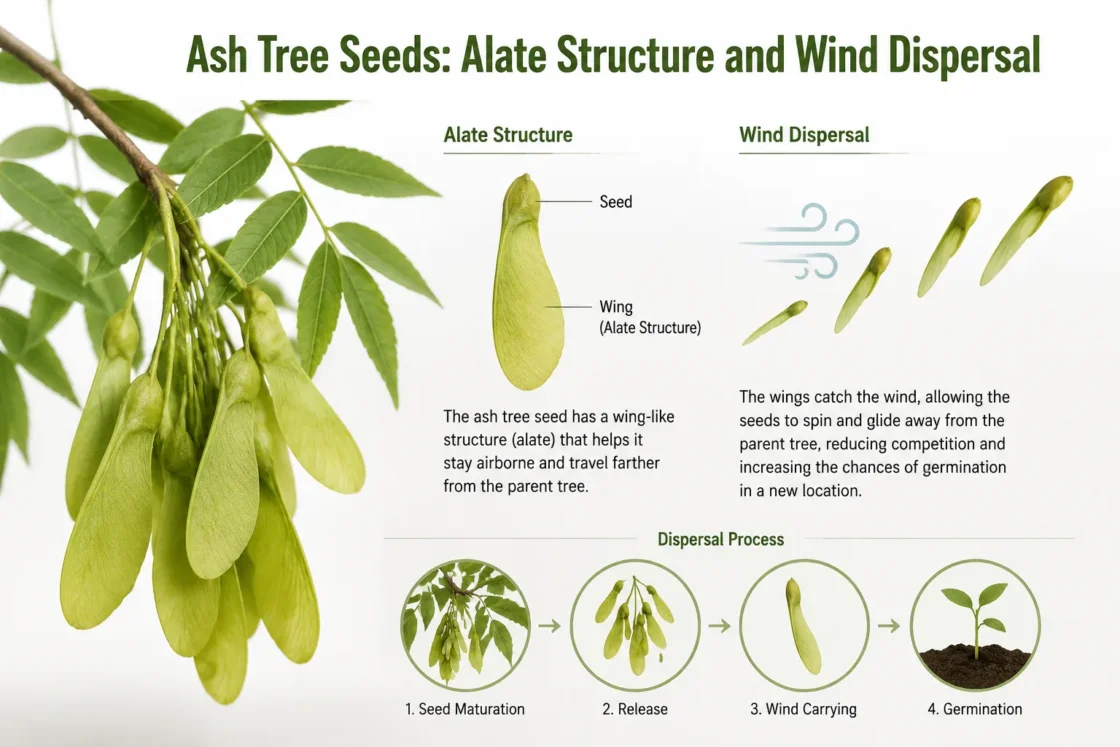
The “Seed” Has Two Aerodynamically Different Parts
An ash samara is strongly asymmetric. Most of its useful aerodynamic area is a thin, flattened wing, while much of its mass is concentrated toward the seed-bearing end. These regions perform different jobs during dispersal.
- Seed-bearing body: contains the embryo and associated tissues and contributes much of the concentrated mass at one end of the fruit.
- Wing: adds broad surface area with relatively little material, increasing interaction with the surrounding air.
- Attachment end: connects the developing fruit to the tree until abscission releases it.
- Whole samara: acts as the dispersal unit. The fruit does not need to release a bare seed before wind transport begins.
USDA Forest Service descriptions of green ash, Fraxinus pennsylvanica, call the fruits elongated, winged, single-seeded samaras borne in clusters.[b] White ash, Fraxinus americana, follows the same general fruit plan. The exact outline and the distance that the wing extends along the seed-bearing body vary among ash species.
Seed or samara?
“Ash seed” is useful everyday language, especially when describing what is falling from a tree. Botanically, however, the visible winged object is the fruit containing the seed. Calling the whole structure a samara becomes useful when discussing its aerodynamics because both the wing and seed-bearing body affect the fall.
The Wing Converts Falling Time Into Dispersal Opportunity
Gravity pulls a released samara downward. Air resists that motion and also acts on the wing as the fruit changes orientation. The result is a descent that can be much slower and more structured than the fall of a compact object with the same mass.
The connection with wind dispersal is straightforward: the longer a samara remains airborne, the longer horizontal air movement can displace it. Release height, descent velocity and the air moving through and above the canopy therefore interact. A taller release point can provide more flight time, while a lower descent velocity can extend that time further.
A useful physical relationship
In a deliberately simplified case, time aloft can be approximated as release height ÷ average descent velocity. If horizontal airflow were steady, horizontal displacement would scale with air speed × time aloft. A real tree canopy does not provide steady airflow, so this relationship explains the mechanism rather than predicting an exact landing distance.
Wing loading helps explain why shape and mass both matter
Wing loading describes mass relative to aerodynamic area. In broad terms, adding effective wing area without adding the same proportion of mass can favor slower descent. A heavier samara with comparatively little effective area tends to face a different aerodynamic regime.
That does not mean that the ash samara with the largest visible wing must travel farthest. Three-dimensional shape, thickness, curvature, mass distribution, release orientation and the surrounding airflow all influence the trajectory. The wing cannot be evaluated as a flat outline alone.
Terminal descent is useful, but it is not the whole flight
As a falling object accelerates, aerodynamic forces increase until the descent approaches a more stable speed regime. Samara research often uses descent velocity or terminal-velocity measurements because slower downward movement generally means more time available for wind transport.
An ash samara still has to transition from release into its stable falling motion. How it leaves the branch matters. A samara released edge-first, broadside or already rotating does not necessarily establish its final motion at the same moment.
Ash Samaras Can Roll While Their Descent Path Precesses
Ash fruits are often grouped casually with the familiar “helicopter seeds” of maples. The comparison is useful only to a point. Maple samaras are classic examples of autorotation, but experimental work on ash shows a different and more complex form of motion.
A 2025 study in the Journal of the Royal Society Interface examined naturally dispersed samaras of Fraxinus americana, Fraxinus excelsior and tulip tree, Liriodendron tulipifera, using synchronized high-speed cameras and three-dimensional tracking. The ash samaras displayed a dual-axis descent: they rolled about their spanwise axis while simultaneously tracing a helical precessional path downward.[c]
In the experiments, rolling began before the broader precession developed. The direction in which a samara began to roll determined the direction of its precession. Across the three species studied, the fruits averaged roughly seven rolling cycles for each precession cycle. The seed-bearing end, being more massive than the wing, also affected where the center of aerodynamic rotation occurred.
Ash samaras therefore should not be pictured as miniature propellers rotating in one fixed plane. Their descent can combine rapid rolling, slower precession and a smooth helical downward trajectory.
Measured ash samaras did not all descend alike
The same 2025 experiment measured different morphology and descent velocities in American white ash and European ash. These values describe the sampled fruits under the experimental conditions; they should not be treated as fixed constants for every samara produced by either species.
| Measured trait | Fraxinus americana | Fraxinus excelsior |
|---|---|---|
| Samaras sampled | 10 | 10 |
| Mean mass | 39.0 ± 3.0 mg | 60.0 ± 10.0 mg |
| Mean wing thickness | 0.50 ± 0.02 mm | 0.41 ± 0.02 mm |
| Mean planform area | 1.867 ± 0.142 cm² | 1.784 ± 0.115 cm² |
| Mean descent velocity | 131 ± 9 cm/s | 191 ± 21 cm/s |
Each specimen was flown in three replicate trials. Within the full three-species dataset, wing thickness was the morphological measurement that best predicted descent velocity. That result is specific to the sampled rolling samaras and should not be converted into a universal rule that thickness alone determines dispersal in every winged fruit.[c]
Why an Ash Samara Does Not Have One Predictable Flight Distance
A statement such as “an ash seed flies 50 meters” leaves out most of the physics. Wind dispersal produces a range of landing distances, not one distance programmed into the fruit. Even samaras released from the same tree can encounter different air movements within seconds of each other.
- Release height: a fruit leaving the upper crown begins with more vertical distance available for airborne movement than one released from a low branch.
- Descent velocity: slower descent generally increases exposure time to horizontal airflow.
- Instantaneous wind: the air acting on the samara at release matters more than a daily weather-station average measured elsewhere.
- Canopy turbulence: branches, leaves, trunks and neighboring vegetation create gusts, eddies, wind shear and short-lived vertical air movements.
- Initial orientation: the 2025 rolling-samara experiments found that release orientation affected how rapidly stable autorotation developed.
- Fruit morphology: mass, wing area, thickness, curvature and the distribution of material along the samara influence descent.
These variables also explain why a simple ash-seed distance calculator would be misleading without detailed local measurements. A ground-level wind speed and a guessed tree height are not enough to reconstruct the three-dimensional airflow inside a crown.
Falling slowly and traveling far are related, but they are not identical
A slow-descending fruit has greater potential to move horizontally because it remains exposed to moving air for longer. It still needs useful horizontal or upward-moving air during that interval. A slowly falling samara in weak air may land close to its parent, while a fruit caught by a strong gust at canopy height can be displaced farther.
The same distinction applies to wing size. A broad wing can alter descent, but visible area alone does not specify the resulting trajectory. The recent ash experiments show why measurements such as thickness and mass distribution deserve attention alongside planform area.
Most Dispersal Is Better Understood as a Distance Distribution
When many samaras leave a tree, they do not form an even ring at a fixed radius. Many land comparatively near the source, fewer reach progressively farther locations, and occasional fruits may experience conditions favorable to longer movement. Ecologists describe this pattern with a dispersal kernel: a distribution showing how the probability or density of deposited propagules changes with distance from the source.
Species-specific forestry observations illustrate why a single genus-wide number is inappropriate. The USDA Forest Service reports that white ash (Fraxinus americana) seed can be wind-dispersed up to about 140 m (460 ft) from the parent tree. The same source reports that nearly 99% of examined white ash fruits contained one seed.[d]
Green ash is described differently: Forest Service material states that most green ash seeds are dispersed by wind within short distances of the parent tree. Those statements are not contradictory. They concern different species and different descriptions of dispersal. A documented maximum or upper distance for one species does not represent the distance traveled by the average ash samara, and it cannot be applied automatically to every member of Fraxinus.
How to interpret distance claims
A reported maximum dispersal distance, a typical deposition distance and the distance traveled by most fruits are different measurements. They should not be combined into one universal “ash seed flight distance.”
Ash Species Do Not Share One Samara Shape
The basic plan—seed-bearing body plus wing—is recognizable across ash trees, but the proportions vary enough to help with identification. One useful trait is how far the wing runs down the body of the samara.
The North Carolina State University herbarium key describes the wing of white ash (F. americana) as extending down only the upper third or less of the samara body. In green ash (F. pennsylvanica), the wing extends onto half or more of the body. Water ash, F. caroliniana, has a flattened body winged along its full length, while pumpkin ash, F. profunda, has a different pattern again.[e]
These differences matter for two reasons. They can help identify ash fruits found beneath a tree, and they show that “an ash samara” is not one fixed aerodynamic design. Changing where the wing begins, how wide it becomes, how the fruit curves and where its mass is concentrated changes the geometry presented to the airflow.
The 2025 flight experiments offer a clear example. F. americana was described as having a more planar, symmetrically tapering wing, while F. excelsior showed subtle helical wing curvature. Both exhibited rolling autorotation, yet their measured descent velocities differed. The shared dispersal strategy therefore allows morphological variation within the genus.
From Branch Release to Landing
Wind dispersal is easier to understand as a sequence of physical events rather than as a single act of the wind “blowing the seed away.”
- The samara matures while attached to the tree. The fruit reaches its mature form before dispersal; seed development can continue after the samara has reached much of its external size.
- Abscission releases the fruit. Gravity begins the downward motion. Wind does not need to pull the samara from the tree for wind dispersal to occur.
- The samara accelerates through the surrounding air. Its asymmetric shape and concentrated seed mass produce aerodynamic forces and moments as orientation changes.
- Rolling and precession can develop. In the experimentally studied ash species, rolling appeared first and developed into a stable dual-axis descent.
- Moving air shifts the trajectory. Horizontal airflow, gusts and canopy turbulence can move the falling fruit laterally while it loses height.
- The samara reaches a surface. This first landing point marks the end of primary aerial dispersal, but it is not always the final location of the fruit.
First landing can be followed by secondary movement
Ash is primarily discussed as a wind-dispersed genus, but local habitat can add another transport route after or during seed fall. Forest Service accounts note possible water dispersal in green ash, and pumpkin ash has been reported to disperse by both wind and water. A samara reaching a stream, flooded bottomland or moving surface water may therefore continue beyond its first terrestrial landing point.
That secondary movement should remain separate from the aerodynamic question. The alate structure controls the airborne phase; water transport, surface movement and later germination involve different processes.
The Wing Changes Dispersal, Not the Basic Requirements for Germination
The samara wing should not be interpreted as a germination device. Its direct mechanical role is in dispersal before establishment. After landing, successful regeneration depends on the seed being viable and encountering environmental conditions that permit dormancy to be broken, germination to occur and the seedling to establish.
Those stages can be separated as fruit production → release → dispersal → deposition → germination → establishment. The wing acts most clearly in the release-to-deposition portion of that sequence. A fruit can perform well aerodynamically and still land where germination fails; another can travel only a short distance and reach a suitable microsite.
Why the Alate Form Works Without Active Flight
An ash samara produces no thrust and contains no powered flight mechanism. Its motion is passive but aerodynamically organized. Gravity supplies the downward motion; the fruit’s geometry determines how that motion interacts with air; ambient wind supplies much of the horizontal transport.
The functional chain is therefore compact: a lightweight wing increases aerodynamic interaction, asymmetric mass helps organize rotation, rotational descent changes the rate and path of the fall, and additional airborne time creates more opportunity for displacement by wind. Recent measurements of rolling ash samaras add another layer to that picture by showing that the motion can involve rapid spanwise rolling superimposed on slower helical precession.
That combination is what makes an ash samara a useful example of an alate plant structure. The visible wing is part of a complete dispersal system in which fruit shape, mass distribution, release conditions and atmospheric motion determine where the seed-bearing fruit eventually reaches the ground.
Sources and Verification
- Royal Botanic Gardens, Kew — Oleaceae, Plants of the World Online — Used for Oleaceae fruit morphology, samara terminology and the winged-fruit context of Fraxinus. [a]
- USDA Forest Service — Green Ash (Fraxinus pennsylvanica), Silvics of North America — Used for the elongated, winged, single-seeded samara description, fruit development and wind-dispersal context. [b]
- Schaeffer & Dickerson — Precession dynamics and morphology of rolling samaras, Journal of the Royal Society Interface (2025) — Used for dual-axis rolling and precessional descent, high-speed flight measurements, release-orientation effects and the reported relationships between morphology and descent velocity. [c]
- USDA Forest Service — White Ash (Fraxinus americana), Silvics of North America — Used for white ash fruit seed number and the species-specific report of wind dispersal up to about 140 m (460 ft). [d]
- North Carolina State University Herbarium — Fraxinus identification key — Used for differences in how the samara wing extends along the fruit body in white, green, water and pumpkin ash. [e]