To get rid of winged aphids in a garden, find and reduce the colony on the plant instead of trying to catch individual aphids in flight. Check young shoots, flower buds, stems and leaf undersides, then use a firm stream of water, remove heavily infested growth and protect aphid predators. Apply a labeled insecticidal soap or horticultural oil only when colonies continue to distort or weaken the plant. A few winged aphids do not automatically mean that treatment is needed.
Treat the Colony, Not the Aphids in Flight
A winged aphid is an alate, or a dispersal form capable of moving to another host plant. Many aphid species produce winged adults when a colony becomes crowded, the food source declines or seasonal conditions trigger movement. The flying adults may be the first insects noticed, but most reproduction and feeding usually occurs among the wingless aphids and nymphs clustered on plant tissue.
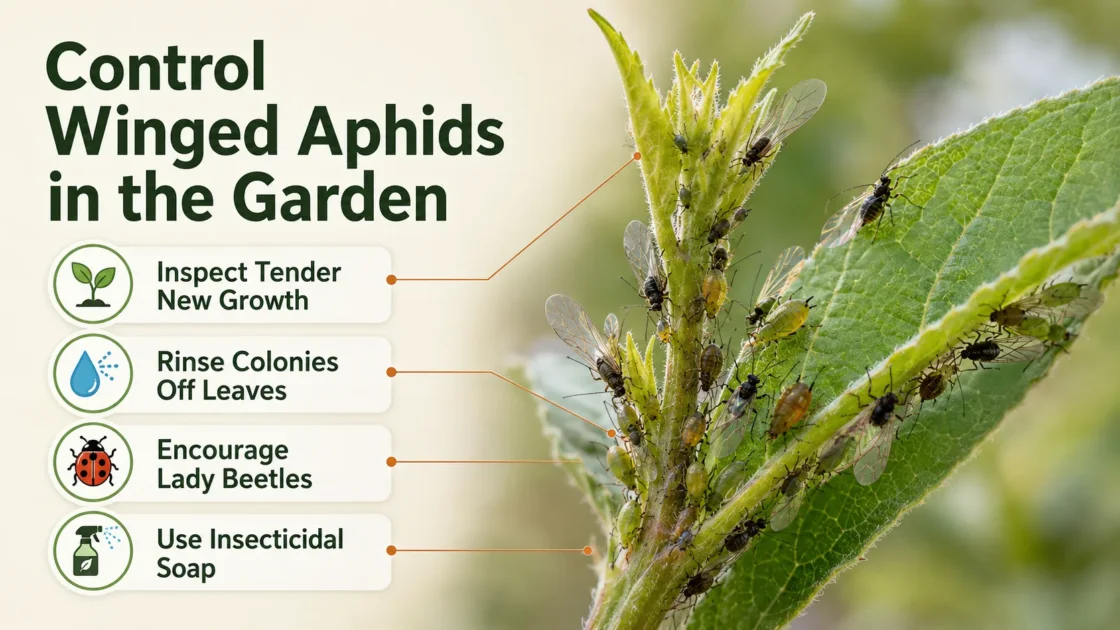
Removing only the visible fliers will therefore have little effect if a colony remains beneath leaves or inside curled new growth. Begin by locating the plants that are producing or receiving the winged aphids. Look for soft-bodied insects, pale shed skins, sticky honeydew, black sooty mold and ants repeatedly traveling onto the same shoots. Aphids are commonly found on tender growth where plant sap is easiest to reach.[a]
WHAT A FLYING APHID SIGHTING MEANS
One or two winged aphids may be temporary arrivals. Repeated fliers accompanied by colonies, honeydew, curled leaves or stunted shoots provide a stronger reason to intervene.
Check These Five Places Before Taking Action
- Turn over young leaves. Aphids often remain on protected lower surfaces.
- Inspect growing tips and unopened buds. Colonies favor tender, actively growing tissue.
- Open curled leaves carefully. Aphids sheltered inside distorted foliage may be hidden from water and contact sprays.
- Follow ant trails. Ants visiting stems and branches may be feeding on aphid honeydew.
- Check nearby plants and weeds. A colony on one host can produce winged adults that move into adjacent plants.
Confirm that the insects are consistent with aphids before treating. Aphids are small, soft-bodied and usually pear-shaped. Most have a pair of short tubes called cornicles near the rear of the abdomen, although these can be difficult to see without magnification. Winged adults may have a darker thorax than nearby wingless aphids. Color alone is unreliable because aphids can be green, yellow, brown, gray, red or black.
Match the Response to What the Plant Shows
| What is visible | Best first response | Reason |
|---|---|---|
| A few winged aphids but no colony or plant injury | Monitor the plant for several days | The adults may be temporary migrants rather than an established population. |
| Small exposed colonies on sturdy leaves or stems | Wash them off with a firm stream of water | Dislodged aphids have difficulty returning to the plant. |
| Aphids confined to a few curled leaves or shoot tips | Prune and remove the affected growth | Curled foliage protects aphids from water, predators and contact treatments. |
| Lady beetle larvae, lacewing larvae, hover fly larvae or aphid mummies are present | Delay spraying and continue monitoring | Natural enemies may reduce the colony without further intervention. |
| Colonies continue to distort seedlings or weaken new growth | Consider a labeled insecticidal soap or horticultural oil | A contact treatment may be justified when mechanical and biological control are insufficient. |
| Winged aphids repeatedly colonize young vegetable plants | Use preventive row protection or reflective mulch where appropriate | Preventing landing can be more useful than treating adults after arrival. |
A Low-Disruption Aphid Removal Sequence
1. Wash exposed colonies from the plant
Use a garden hose to direct a firm stream of water at the affected stems and leaf undersides. Support delicate shoots with one hand so they are not broken. The water removes aphids, cast skins and some honeydew. Repeat the inspection after the foliage dries and again over the next several days.
This method works best on sturdy vegetables, roses, shrubs and established ornamentals. Use gentler pressure on seedlings, soft herbs and flowers with fragile stems. University extension guidance identifies water removal as one of the first nonchemical options for garden aphids.[b]
2. Remove growth that protects the colony
Clip off a limited number of badly curled leaves or crowded shoot tips when the plant can tolerate pruning. Place the material in a closed garden-waste container or dispose of it away from susceptible plants. Do not remove so much foliage that the pruning causes more stress than the aphids.
3. Reduce conditions that support rapid regrowth
Avoid applying more nitrogen fertilizer than the plant needs. Heavy nitrogen growth produces tender tissue that can support faster aphid reproduction. Keep plants adequately watered, but do not try to force damaged plants into rapid growth with repeated high-nitrogen feeding. Inspect new transplants before placing them beside uninfested plants.
Give Predators Access to the Colony
Lady beetle larvae, lacewing larvae, hover fly larvae and small parasitoid wasps commonly attack aphids. A swollen tan or brown aphid fixed to the leaf may be an aphid mummy containing or previously containing a parasitoid. When predators, mummies and healthy plant growth are present, several days of monitoring may be more useful than immediate spraying.
Avoid broad-spectrum insecticides that kill these natural enemies. Removing predators can allow surviving aphids to rebuild with less biological resistance. Flowering plants that provide nectar and pollen across the season can support adult hover flies, lacewings and parasitoid wasps.
Interrupt ants that are guarding aphids
Ants often collect the sugary honeydew produced by aphids and may drive away predators or parasitoids. Where a steady ant trail leads to an aphid colony on a woody plant, manage the ant access route rather than spraying the entire canopy. Appropriate options may include enclosed ant baits or a trunk barrier installed according to its directions. Sticky material should not be placed directly on sensitive bark.[e]
When a Labeled Contact Spray Is Justified
A pesticide is usually unnecessary when an established plant has only a light aphid population and is growing normally. Consider a contact treatment when aphids remain abundant after water removal or pruning and the plant develops continuing leaf distortion, yellowing, dead shoots or poor growth.
Commercial insecticidal soap and horticultural oil products can control exposed aphids when the label lists the pest and the plant or use site. These products have little or no residual activity, so the spray must directly cover the insects. Treat leaf undersides and stems rather than spraying only the upper canopy. Aphids sealed inside curled leaves will be difficult to reach.
USE A PESTICIDE-LABELED PRODUCT
Do not substitute household dish detergent for a formulated insecticidal soap. Household cleaning products are not consistently formulated or tested as plant pesticides and may injure foliage, soil organisms or nearby water.
Test a labeled soap or oil on a small section of the plant when sensitivity is uncertain. Follow the current product label for dilution, temperature limits, repeat intervals, food-crop restrictions and protection of pollinators. Do not apply oil or soap to drought-stressed plants or under conditions prohibited by the label. Colorado State University Extension notes that insecticidal soaps require direct wetting, provide no lasting residue and can injure sensitive plants when misused.[c]
Reduce New Arrivals on Young Vegetable Crops
Young vegetable plants may need more protection than established ornamentals, especially where aphid-transmitted viruses have previously affected a crop. A winged aphid can probe a plant before a pesticide residue kills it, so repeated spraying does not always prevent virus transmission.
Reflective mulch can make young crop rows less attractive to incoming winged aphids by disrupting their ability to locate host plants. It is a preventive measure installed before colonization, not a treatment for colonies already hidden within foliage. Row covers may also exclude aphids when they are installed before infestation and kept sealed at the edges; crop pollination and heat buildup must be considered before using them.[d]
Practices That Can Make the Problem Harder to Control
- Chasing individual fliers: This leaves the reproducing colony untouched.
- Spraying before inspecting: Unnecessary treatment can kill insects already suppressing the aphids.
- Using broad-spectrum insecticides routinely: Predator loss can contribute to later aphid resurgence.
- Applying excess nitrogen: Rapid production of soft new growth can favor aphid buildup.
- Spraying only the tops of leaves: Contact products cannot control insects they do not reach.
- Treating curled leaves without opening or removing them: The protected aphids may receive little or no spray coverage.
- Relying on sticky cards as the cure: Yellow cards can reveal winged activity, but they do not remove colonies feeding on plants.
- Assuming every damaged leaf is caused by aphids: Persistent mottling, severe distortion or unusual decline may require plant-disease or local extension diagnosis.
The most useful follow-up check is not the number of winged aphids still flying through the garden. Reinspect the new growth and leaf undersides. Fewer colonies, less fresh honeydew and healthy expanding leaves show that management is working.
Sources
- [a] UC Statewide Integrated Pest Management Program — Aphids — Used to verify aphid identification, winged-form development, monitoring, pruning, fertilizer and garden-management guidance.
- [b] University of Minnesota Extension — Aphids in Home Yards and Gardens — Used to verify plant symptoms, water removal and the role of naturally occurring aphid predators.
- [c] Colorado State University Extension — Insect Control: Insecticidal Soap — Used to verify contact action, coverage requirements, plant-sensitivity precautions and the warning against household soap remedies.
- [d] UC Statewide Integrated Pest Management Program — Reflective Mulches — Used to verify how reflective surfaces can reduce colonization of young crops by winged aphids.
- [e] UC Statewide Integrated Pest Management Program — Ant Management in Gardens and Landscapes — Used to verify the relationship between honeydew-feeding ants, aphid protection and targeted ant management.