A maple samara is the winged fruit commonly called a helicopter seed, whirlybird or maple key. Its uneven distribution of mass and its thin wing allow it to enter autorotation after release, spinning as it descends instead of dropping rapidly. That slower descent keeps the samara airborne longer, giving wind more time to move it away from the parent tree. What happens after landing depends heavily on the maple species: some seeds can germinate soon after spring dispersal, while others remain dormant until they have experienced weeks or months of cold, moist conditions.
The “helicopter seed” is actually a winged fruit
Calling the entire structure a maple seed is convenient, but botanically it hides part of the story. In Acer, the fruit develops as a schizocarp that separates into two winged units. Each of those units is a samara: a dry, indehiscent fruit with a wing that assists wind dispersal. The University of Illinois describes maple fruits specifically as schizocarps that split into two samaras.[a]
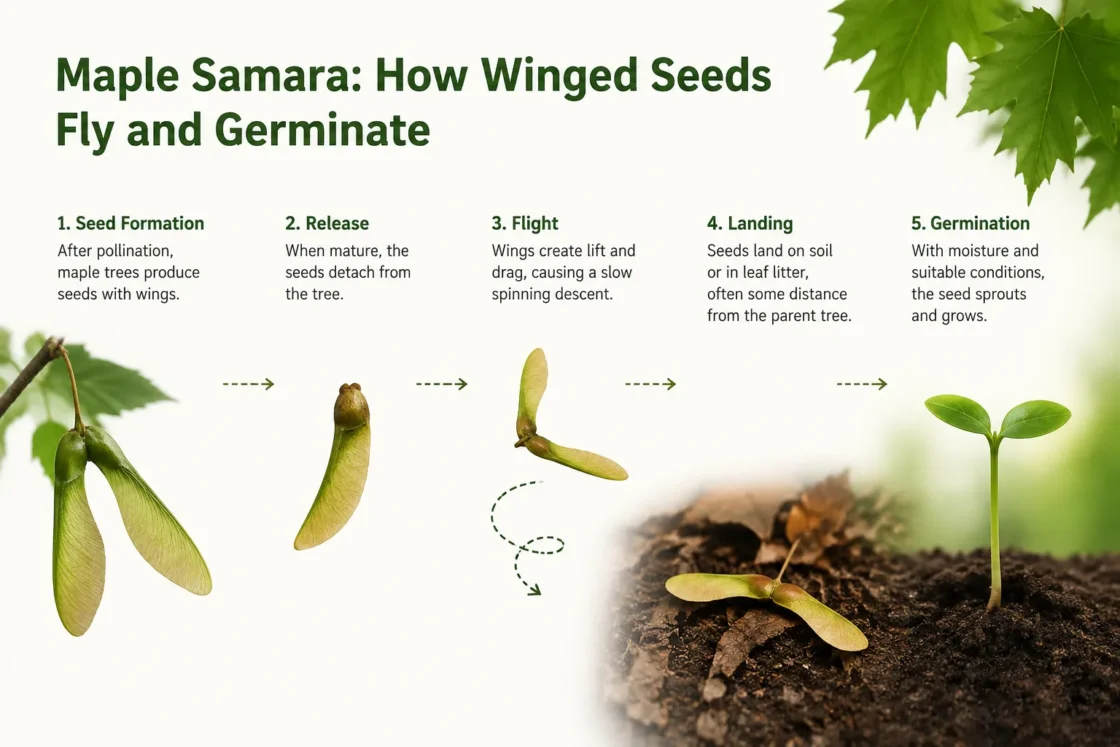
The familiar paired structure is therefore two future dispersal units joined together during fruit development. Once they separate, each samara carries its reproductive payload in the thicker nutlet at one end, while most of the remaining structure forms a thin wing. The wing is part of the fruit rather than a detachable propeller attached to a naked seed.
Botanical terminology
Paired maple fruit → two samaras → one seed-bearing unit in each samara. Everyday terms such as “maple seed” usually refer to the whole winged samara, even though the seed itself is enclosed within the fruit.
Why a maple samara spins instead of falling straight down
A released samara does not need a motor or stored mechanical energy to start spinning. Gravity pulls the fruit downward, air moves relative to the falling wing, and the samara’s structure converts that airflow into rotation. Most of the mass is concentrated near the nutlet while a much lighter wing extends away from it. The center of mass is therefore displaced toward one end rather than sitting near the geometric center of the wing.
As the fruit begins to fall, aerodynamic forces act differently along the length of the wing. The resulting torque brings the samara into a rotating descent. Once established, the fruit revolves around a roughly vertical axis while the wing travels around a circular path. This passive mode of descent is called autorotation.
Recent experimental work helps explain why mass placement matters so much. A 2025 study comparing samara-inspired falling bodies found that configurations with mass concentrated toward the terminal end produced maple-like autorotation, whereas more centrally distributed mass could produce spiral tumbling or other descent modes.[b] A maple’s characteristic flight is therefore tied to the relationship between its heavy seed-containing end and its lighter wing, not simply to the presence of a flat surface.
It resembles a helicopter, but it is not powered flight
The helicopter comparison describes the visible rotation well, but the mechanics differ. A powered helicopter turns its rotor with an engine and can generate enough thrust to climb or hover. A maple samara continually loses height. Its spinning motion develops during descent and uses the relative airflow created as gravity pulls it downward. Autorotation slows the fall; it does not make the samara capable of powered ascent.
A leading-edge vortex helps keep the samara aloft
The samara’s slower descent cannot be explained only by saying that a broad wing creates more air resistance. Experiments published in Science showed that rotating maple and hornbeam samaras generate a stable leading-edge vortex, or LEV, over the wing. Researchers measured three-dimensional flow around dynamically scaled seed models and confirmed the vortex on real specimens.[c]
As the wing sweeps through the air, flow separates near its leading edge and rolls into a concentrated vortex. The resulting pressure pattern increases the aerodynamic force opposing the samara’s downward motion. Rotation keeps the wing repeatedly moving through fresh air, allowing the vortex to remain associated with the spinning wing during descent.
From release to wind dispersal
- Release: gravity accelerates the samara downward.
- Rotation develops: uneven mass distribution and aerodynamic torque bring the wing into autorotation.
- LEV forms: rotating airflow creates a stable vortex near the leading edge.
- Descent slows: aerodynamic forces oppose part of the downward motion.
- Time aloft increases: wind has a longer interval in which to produce horizontal displacement.
Wing size alone does not determine flight performance
A larger wing can increase the area interacting with the air, but there is no universal rule that the maple with the largest samara must descend slowest or travel farthest. Samara performance also depends on mass, projected area, wing geometry, coning angle, rotation rate and the position of the center of mass.
A familiar aerodynamic quantity is wing loading, commonly expressed as the load carried relative to wing area. Lower loading can be associated with slower descent within suitable comparisons, but it should not be treated as a complete predictor across different maple species.
A 2024 study tested eight Acer species and found that a classical aerodynamic drag model accounted for interspecific descent behavior better than relying on wing-loading correlations alone.[d] That result is useful when interpreting visibly different samaras: shape and mass interact as a flight system, so a single measurement cannot capture everything that determines the descent.
Damaged wings can still autorotate
A dry samara wing looks fragile, yet partial damage does not necessarily end autorotation. In the same 2024 experimental study, researchers altered both samara mass and wing area. Tested samaras tolerated mass increases greater than 100% while changes in descent velocity remained below 15%. In wing-removal experiments, some continued to autorotate until roughly 40% of the wing area had been removed.
Those figures describe the experimental specimens and treatments rather than a universal damage threshold for every maple. They do show why a fruit with a torn edge, insect feeding damage or altered moisture content may still retain a functional spinning descent. Rotation can adjust through changes in variables such as angular velocity and the angle at which the samara forms its descending cone.
Even a raindrop may interrupt the flight only briefly
Rain creates a much more abrupt disturbance than gradual moisture gain. A falling droplet can strike the wing or nutlet, pitch the samara away from its normal orientation and momentarily disrupt rotation. Experiments published in Proceedings of the National Academy of Sciences in 2025 examined exactly this interaction.[e]
In the wind-tunnel tests, 71% of recorded impacts recovered autorotation before the samara reached the limits of the apparatus. Faster drops could be shed rapidly, with recovery occurring in less than 50 milliseconds in some cases. Across the study, raindrop collisions were estimated to reduce natural descent time and dispersal distance by less than 10%.
The location of the strike mattered. Impacts near the wingtip caused greater disruption than impacts near the heavier nutlet. Once the water was shed, spinning could resume. This helps explain how a very light biological flyer can keep functioning under weather that temporarily changes its mass and orientation.
Slower descent gives wind more time, not a guaranteed long-distance flight
Autorotation is useful because it extends the period between release and landing. If horizontal wind acts while the samara is descending, additional time aloft creates more opportunity for sideways transport. A fruit that reaches the ground quickly loses that opportunity sooner.
Actual dispersal distance is much less predictable than the spinning motion itself. It changes with release height, descent velocity, wind speed, gusts, turbulence, canopy structure, surrounding vegetation and the individual samara’s morphology. A twig, leaf, neighboring crown or patch of dense vegetation can intercept the fruit long before an aerodynamic calculation based on open air would suggest.
| Variable | Why it changes dispersal |
|---|---|
| Release height | A higher starting point can provide more time before the samara reaches the ground. |
| Descent velocity | A slower vertical fall extends the interval during which wind can act. |
| Wind and gusts | Horizontal airflow moves the descending samara away from its release point; changing winds also alter its trajectory. |
| Mass distribution | The position of the heavy nutlet relative to the lighter wing helps determine the stable descent mode. |
| Wing geometry | Area, curvature and shape influence the aerodynamic forces produced during rotation. |
| Vegetation and obstacles | Branches, foliage and ground cover can stop a flight before its aerodynamic potential is reached. |
For that reason, a simple “wind speed × flight time” calculator would give a misleading impression of precision. Field dispersal is a moving three-dimensional problem, especially within and below a tree canopy.
Maple germination cannot be reduced to one stratification recipe
Once the samara lands, the aerodynamic phase is over and the seed’s physiological state becomes decisive. This is where advice about “maple seeds” often becomes too broad. Different Acer species disperse at different times and do not share the same dormancy behavior.
Red maple (Acer rubrum) and silver maple (Acer saccharinum) mature and disperse their samaras in spring or early summer and can germinate soon after release. Sugar maple (Acer saccharum) and Norway maple (Acer platanoides) disperse later and normally require a period of moist chilling before spring germination. USDA Forest Service accounts document these contrasting strategies.[f][g]
| Maple | Typical seedfall pattern | Dormancy and germination | Practical implication |
|---|---|---|---|
| Red maple Acer rubrum | Fruit ripens April–June; dispersal may occur April–July across its range. | Seed can germinate immediately after ripening and does not normally need pregermination treatment. | Fresh spring or early-summer samaras can be sown without an artificial cold period. |
| Silver maple Acer saccharinum | Ripening and dispersal occur mainly April–June. | Seeds normally germinate soon after dispersal and lose viability if allowed to dry excessively. | Fresh sowing is preferable; treating it like a dry, dormant fall seed can be counterproductive. |
| Sugar maple Acer saccharum | Fruit matures later in the growing season and falls around autumn. | Requires moist stratification slightly above freezing; USDA Silvics reports about 35–90 days. | Cold and moisture are part of dormancy release before germination. |
| Norway maple Acer platanoides | Seeds disperse in fall. | Forest Service guidance reports an obligatory cold period around 3–4°C for 90–120 days. | Fall sowing can provide natural winter stratification where conditions are suitable, or the treatment can be reproduced under controlled refrigeration. |
| Japanese maple Acer palmatum | Samaras mature in fall. | Seed is normally treated as dormant and stratification is used for germination. | Seed propagation produces genetically variable seedlings; a named cultivar should not be expected to reproduce identically from seed. |
Do not cold-stratify every maple by default
A spring-dispersed red or silver maple samara and a dormant fall-dispersed sugar or Norway maple seed are biologically different starting materials. Identify the maple before choosing a germination treatment.
Spring-dispersing maples can use the same growing season
Red maple illustrates the fast route from dispersal to germination. USDA Silvics reports that its double samaras ripen from April to June, with dispersal occurring over a short period from April through July depending on geography. Seeds need no pregermination treatment and can begin germinating soon after ripening. Under favorable conditions, germination can occur within days.[h]
Silver maple follows a similar seasonal logic. Its seeds ripen and are released from April to June and usually germinate shortly after dispersal. The species also has relatively moisture-sensitive seed: drying can reduce viability, making fresh seed handling especially relevant.[i]
The ecological timing makes sense. A seed released in late spring or early summer still has part of the growing season available for root and shoot development. Delaying germination through a long winter-style dormancy would use that opportunity differently from a species whose mature seeds arrive just before winter.
Fall-dispersed maples often use winter to unlock germination
Sugar maple follows a different schedule. Its mature seeds require moist stratification at temperatures slightly above freezing. The USDA Silvics account gives a range of approximately 35–90 days and notes that individual seeds can differ in the amount of chilling needed.[j]
Sugar maple is especially notable for germinating at very low temperatures. The same Forest Service account reports an optimum near 1°C (34°F), with germination declining rapidly as temperatures rise and little or none occurring above about 10°C (50°F) in the cited work. In northern natural stands, cotyledons may begin growing while snow remains on the ground.
Norway maple also uses winter chilling, although the reported requirement is longer. Forest Service material describes spring germination following 90–120 days at approximately 3–4°C (37–39°F).[k] Fall dispersal places seeds outdoors before the winter period that can supply those conditions naturally.
How to germinate a maple samara collected from a tree
The safest starting point is the species, or at least the seasonal group to which the tree belongs. A fresh silver maple samara collected in May should not automatically receive the same treatment as a sugar maple samara collected in October.
1. Collect mature fruit
Maple samaras change as they mature. Depending on species, green or reddish developing fruits progress toward yellow, tan or brown tones and eventually detach. Color alone is not a universal maturity test because maple species differ, but fruit that is still soft and clearly immature should not be treated as equivalent to naturally ripened seed.
2. Keep the samara intact unless processing requires otherwise
The papery wing does not have to be removed for germination. Iowa State University Extension advises that mature maple fruit can be planted without removing the seed from the fruit.[l] Commercial seed processing may remove or trim wings to make storage and mechanical sowing easier, but wing removal is not a biological requirement for the embryo to germinate.
3. Match the dormancy treatment to the species
- Red maple and silver maple: sow fresh, mature samaras promptly; artificial cold stratification is normally unnecessary.
- Sugar maple: provide moist chilling rather than simply storing the seed dry in a refrigerator.
- Norway maple: use a longer cold, moist stratification period or allow suitable winter conditions to provide it naturally.
- Other maples: verify the species before borrowing a treatment from one of the better-known maples. Dormancy depth and required chilling can differ within the genus.
4. For stratification, moisture matters as much as cold
Cold stratification is a cold-and-moist treatment. Refrigerating a completely dry samara is not automatically equivalent to exposing a dormant seed to moist winter conditions. A moist, aerated medium can maintain contact with water while avoiding prolonged waterlogging. The goal is to allow the seed’s dormancy-related physiological processes to progress without depriving it of oxygen or encouraging decay.
5. Inspect stratifying seed instead of treating the calendar as exact
Published chilling periods are useful ranges, not timers that make every seed germinate on the same day. Seeds within a species can differ, and some maples begin producing a radicle while still under cold treatment. Periodic inspection catches early germination before a growing root becomes tangled, damaged or desiccated.
6. Sow into a moist medium without excessive burial
Iowa State gives a general planting depth of about ¼ to 1 inch for maple fruit. Exact handling can be adjusted to species, container and substrate, but deep burial is unnecessary. After the radicle emerges, consistent moisture becomes especially relevant because the young root has little capacity to tolerate prolonged drying.
What maple germination actually looks like
The first visible evidence of germination is not a miniature maple leaf. Water uptake activates the seed, after which the radicle breaks through the enclosing tissues and begins forming the primary root. Root development anchors the seedling and establishes access to water before the young shoot becomes the most conspicuous part above the substrate.
Maple germination is generally epigeal: the developing hypocotyl raises the cotyledons above the soil surface. The cotyledons are seed leaves and should not be confused with the lobed foliage associated with a mature maple. The first true leaves appear later and gradually make the seedling easier to recognize.
Samara to seedling
Water uptake → radicle emergence → root anchoring → cotyledon expansion → first true leaves
Germination and seedling establishment are different outcomes
A samara has germinated once embryonic growth resumes and the radicle emerges. That does not mean a new maple tree has become established. The seedling must still maintain contact with suitable moisture, develop roots into the substrate, produce photosynthetic leaves and survive competition, herbivory, pathogens, temperature extremes and periods of drying.
This distinction explains why a mature maple can release very large numbers of samaras without producing a dense stand of adult offspring beneath it. Flight improves the opportunity to reach new microsites; germination filters those arrivals again; establishment filters them further.
Why a maple samara may fail to germinate
Failure can occur before, during or after dormancy treatment. Several causes produce the same visible result—a samara that never develops a root—even though the biology behind them is different.
- The fruit was immature. A samara collected too early may contain an embryo that had not completed normal development.
- The samara is empty or the seed is not viable. An intact-looking wing does not prove that the enclosed seed is capable of germination.
- The wrong dormancy treatment was used. Giving immediate-germinating spring maple seed a long storage period, or sowing a dormant fall maple without chilling, can reduce success.
- Stratification was cold but too dry. Dormancy-breaking treatment for species such as sugar maple requires moisture as well as low temperature.
- The seed deteriorated in storage. Storage tolerance differs among maples; silver maple in particular is vulnerable to loss of viability as its seed dries.
- The seed germinated during refrigeration and was missed. An emerging radicle can be damaged if the seed remains unattended for too long.
- Germination occurred but the seedling died. Drought, saturation, disease, poor root contact or other establishment problems can kill a seedling after successful germination.
A seed-grown Japanese maple may not resemble the parent cultivar
Japanese maple adds another distinction between germinating a viable samara and reproducing a particular ornamental tree. Seed propagation is sexual reproduction, so seedlings contain new combinations of genetic material. Virginia Cooperative Extension notes that trees grown from seed generally do not display the cultivar characteristics of the parent and that Japanese maple cultivars are propagated by grafting.[m]
A samara collected from a named red-leaved, dissected or dwarf Japanese maple can therefore produce a healthy maple seedling without reproducing the same leaf form, color or growth habit. Successful germination does not create a genetic clone.
The wing solves only the first part of maple dispersal
The samara’s wing changes what happens between the branch and the ground. Uneven mass distribution promotes autorotation, the rotating wing generates aerodynamic forces that slow descent, and the extra time aloft allows wind to move the fruit horizontally. Once it lands, those aerodynamic advantages give way to a different set of constraints: seed maturity, dormancy, moisture, temperature and the quality of the microsite.
That sequence connects the samara’s distinctive shape to the maple’s reproductive biology: paired fruit formation → separation → autorotation → wind transport → landing → dormancy or immediate germination → root emergence → seedling establishment. The familiar spinning “helicopter” is one stage in that longer process.
Sources
- University of Illinois — Digital Flowers: Acer schizocarps and samaras [a]
- Communications Engineering (2025) — mass distribution and samara descent modes [b]
- Science (2009) — leading-edge vortices in autorotating plant seeds [c]
- Communications Biology (2024) — Acer flight under changes in mass and wing area [d]
- PNAS (2025) — maple samara recovery after raindrop collisions [e]
- USDA Forest Service — red maple seed dispersal and regeneration [f]
- USDA Forest Service — silver maple seed dispersal and germination [g]
- USDA Silvics of North America — Acer rubrum [h]
- USDA Silvics of North America — Acer saccharinum [i]
- USDA Silvics of North America — Acer saccharum [j]
- USDA Forest Service — Norway maple germination requirements [k]
- Iowa State University Extension — germination of maple seed [l]
- Virginia Cooperative Extension — Japanese maple propagation and cultivar inheritance [m]