Mayfly swarms are brief emergence and mating events, not attacks. Adult mayflies do not bite or sting people, feed on household materials, damage wood or establish colonies inside buildings. For most people, a swarm is harmless but temporarily annoying. Problems arise indirectly when very large numbers gather around lights, enter through open doors or accumulate on roads and walkways. Dense layers of dead insects can become slippery, interfere with visibility and produce an odor as they decompose. The number of insects may look alarming, but it does not by itself indicate a household infestation or a threat to human health. [a] [b]
A Mayfly Swarm Is a Brief Mating Event
Mayflies belong to the insect order Ephemeroptera. Most of their lives are spent underwater as aquatic nymphs. When development is complete, the insects rise to the surface and enter an unusual winged pre-adult stage called the subimago. After one final molt, they become reproductive adults.
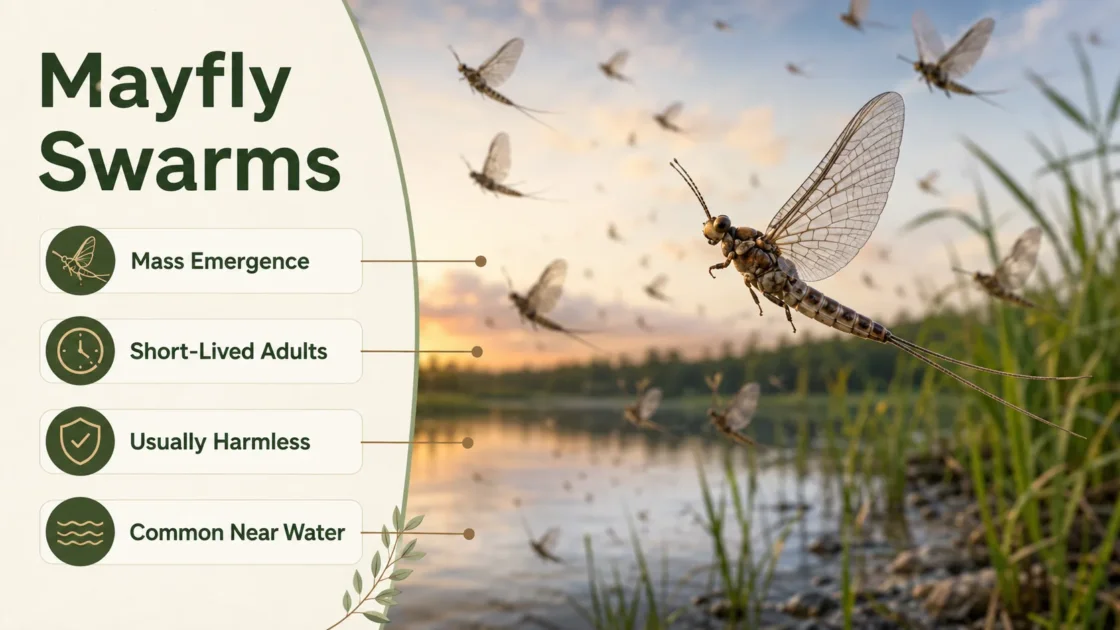
The adult stage is short because adult mayflies have no functional mouthparts and cannot feed. Depending on the species, a winged mayfly may survive for several hours or several days. Its remaining energy is used for dispersal, mating and egg laying.
Short adult lives make coordinated emergence useful. Large numbers become available as mates at the same time, while predators are less likely to consume every individual before reproduction occurs. Males commonly gather in aerial mating swarms, and females enter the swarm before returning toward the water to lay eggs.
Why Hundreds Can Appear at the Same Time
A visible swarm may combine several related events: insects emerging from the water, males forming mating groups, newly winged adults dispersing toward shore and insects concentrating around artificial light. The apparent size of the event can change quickly as wind moves weak-flying adults or lighting draws them into a smaller area.
There is no universal mayfly swarm date. Species, latitude, water temperature, oxygen conditions, weather and wind can all affect emergence. Even within one lake system, separate cohorts may emerge at different times. A locally reported date should therefore be treated as regional evidence, not a worldwide mayfly calendar. [e]
A SWARM IS NOT A HOUSEHOLD COLONY
Mayfly nymphs develop in fresh water, not in walls, furniture or structural timber. Adults found indoors usually entered from outside through a door, window, vent or damaged screen.
The Difference Between Harm and Nuisance
| Concern | What mayflies do | What it means |
|---|---|---|
| Bites or stings | Adults lack functional feeding mouthparts and have no stinger. | Normal contact with a mayfly is not a biting or stinging hazard. |
| Damage to a home | Adults do not eat wood, fabric, stored food or houseplants. | Mayflies on a building are temporary visitors rather than structural pests. |
| Indoor insects | Light can draw adults through open or poorly screened entry points. | A few indoors do not prove that insects are breeding in the building. |
| Outdoor activity | Large numbers may cover doors, patios, vehicles and light fixtures. | The effect is nuisance, cleanup and temporary interference with outdoor use. |
| Roads and walkways | Extreme accumulations can be crushed into a slick layer. | Dense events may create an indirect slipping or traffic hazard. |
Judge a mayfly event by the effect it is producing, not by insect count alone. A cloud beside a river may be harmless, while a much smaller accumulation on wet steps may need prompt cleanup.
When Numbers Create a Road or Walkway Hazard
Heavy emergences can cover illuminated bridges, petrol stations, pavements and waterfront roads. Flying insects may reduce visibility around headlights, while crushed bodies can make a driving or walking surface slick. Accumulated insects may also develop an unpleasant odor as they decompose.
These effects occur only when numbers are dense enough to alter the surface or obstruct vision. Mississippi State University Extension recommends physical methods such as light management, exclusion, sweeping, vacuuming and leaf blowers instead of relying on insecticides for mass emergences. [d]
DENSE ACCUMULATIONS NEED PRACTICAL CAUTION
Slow down when a swarm is crossing a lit roadway. Keep steps, ramps and entrances clear, especially after rain or washing has made insect remains wet.
Why Outdoor Lights Concentrate the Swarm
Mayflies often appear most abundant beside porch lights, windows, signs, streetlights and service stations. Artificial light can pull adults away from darker surroundings and concentrate them on walls or paved surfaces. A brightly lit property may therefore receive many insects even when the emergence began over nearby water.
Turning off unnecessary exterior lights during the flight can reduce this concentration. Closing blinds also limits light spilling through windows. Michigan State University Extension notes that adult flights are brief and that insecticides are not needed for ordinary mayfly nuisance. [c]
What to Do While Mayflies Are Emerging
- Reduce unnecessary lighting. Switch off porch, decorative and doorway lights when they are not needed.
- Limit entry points. Keep doors closed and check that window screens fit without large gaps.
- Clear walking surfaces. Sweep or vacuum dry insects before they are crushed or become wet.
- Move carefully through dense flight. Protect your eyes, reduce vehicle speed and avoid abrupt movement when visibility is poor.
- Wait for the adult flight to pass. Individual adults are short-lived, and local activity commonly declines without chemical treatment.
Spraying adults around lights may kill some insects without changing the emergence taking place over the water. Broad treatment can also affect other insects drawn to the same lights. Physical exclusion and cleanup address the immediate problem without treating a temporary visitor as a breeding household pest.
How to Check That the Insects Are Mayflies
An adult mayfly usually has a slender body, short antennae, clear triangular forewings held upright at rest and two or three long filaments extending from the end of the abdomen. The hind wings are much smaller and may be absent in some groups. Mayflies are most likely to be encountered beside lakes, rivers, streams and other fresh water.
Mayflies are not alates in the social-insect caste sense. An alate ant or termite is a winged reproductive produced by a colony. A mayfly is an aquatic insect passing through its normal adult life stage. Insects with elbowed antennae, a narrow waist or ant-like body segmentation should be checked against information about flying ants rather than identified as mayflies from the swarm alone.
What a Swarm Suggests About Nearby Water
Mayfly nymphs are part of the benthic macroinvertebrate community used in biological assessments of rivers and lakes. Their aquatic lives and differing tolerance to pollution make mayfly taxa useful to scientists evaluating ecological conditions.
A large emergence can be encouraging evidence that a nearby waterbody supports substantial aquatic insect production. It is not, however, a complete water-quality test. Formal assessments examine the variety and abundance of several macroinvertebrate groups, their pollution tolerances and other biological evidence. One swarm beside one light cannot establish the chemical or ecological condition of an entire lake or river. [f]
A POSITIVE SIGN, NOT A WATER TEST
Mayflies can contribute useful ecological evidence, but species composition, sampling methods and the wider aquatic community matter. Visible adults alone cannot certify that water is clean or safe for a particular use.
Sources
- [a] Royal Entomological Society — Ephemeroptera — verified adult anatomy, non-functional mouthparts, the subimago stage, short adult lifespan and mating-swarm behavior.
- [b] University of Minnesota Extension — Mayflies — verified identification features, association with water and the assessment that mayflies do not harm people or property.
- [c] Michigan State University Extension — Michigan Insects in the Garden: Mayflies — verified attraction to light, short adult activity, nuisance accumulations and the recommendation that insecticide control is unnecessary.
- [d] Mississippi State University Extension — Mayfly — verified mass-emergence hazards and physical management using light control, exclusion, vacuums, blowers and sweeping.
- [e] Michigan Sea Grant — When Will the Mayflies Arrive? — verified the influence of water temperature, wind, oxygen conditions and separate emergence cohorts in a documented Great Lakes setting.
- [f] U.S. Environmental Protection Agency — Indicators: Benthic Macroinvertebrates — verified how aquatic macroinvertebrate communities are used to evaluate the biological condition of waterbodies.