The small, papery objects that fall from many pine cones are winged seeds. The darker, thicker portion contains the seed itself; the thin extension changes how the seed moves through air. Instead of dropping rapidly beneath the parent tree, many conifer seeds descend more slowly, often while rotating, giving wind more time to carry them sideways. The cone controls when the seed becomes available for release, while seed mass, wing shape, release height and wind conditions influence where it lands.
This pattern is common in pines and other members of the pine family, but it is not universal. Some conifers have large seeds with reduced or absent wings and depend heavily on birds or mammals. Fir cones release seeds differently from typical pine cones, and fire can determine when seeds leave the cones of some serotinous pines. “Winged conifer seed” therefore describes a dispersal design rather than a single mechanism shared unchanged by every cone-bearing tree.
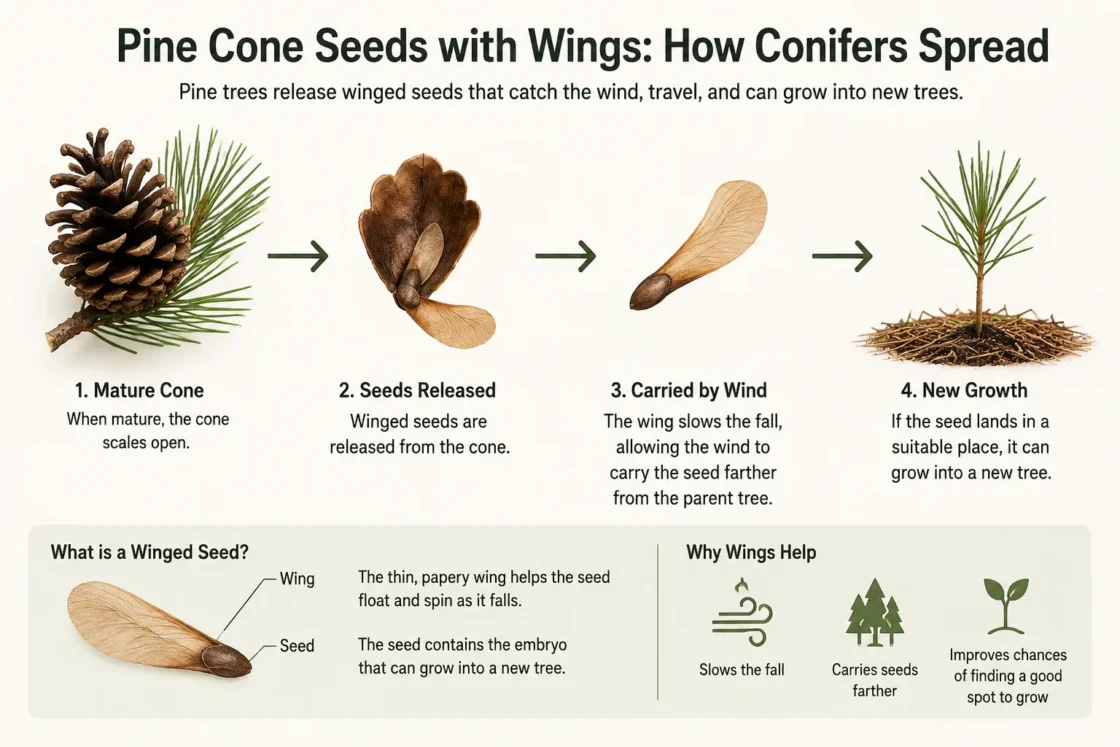
What Is the Wing on a Pine Seed?
A pine seed is not simply a flat wing with a tiny seed glued to one end. The seed body contains the embryo and nutritive tissue enclosed by the seed coat. The broad, thin portion beside it is a dispersal structure that interacts with moving air.
Its developmental origin is especially useful for understanding what has fallen out of a cone. In the pine family, Pinaceae, seed cones contain fertile structures called ovuliferous scales. A recent synthesis of conifer cone development describes two inverted ovules on each Pinaceae ovuliferous scale and reports that, at maturity, tissues on the upper side of that scale form the seed wing.[a] The papery wing is therefore closely tied to cone-scale development; it should not be described as a miniature leaf growing from the seed.
Botanical distinction
The word alate can describe a plant structure that is winged or has a wing-like expansion. In a conifer dispersal context, however, identifying the seed body, seed wing and cone scale is more informative than using “alate seed” alone.
What actually falls out of the cone?
Winged seed
Seed body + papery wing
Detached wing material
Thin, dry, membranous material
Cone scale
Thicker, woody structure
How a Cone Changes from Seed Container to Release Mechanism
A mature pine cone does not actively throw its seeds. Release usually depends on a combination of cone maturation, drying, movement of the scales, gravity and air flow. Once spaces open between fertile scales, the seed is no longer enclosed as tightly and can leave the cone.
Many woody conifer cones respond passively to humidity. Research on pine cones shows that their scales can close toward the cone axis under wetter conditions and spread outward as they dry. The movement comes from tissues within each scale that swell and shrink differently as their water content changes. It continues even after those tissues are no longer living in the ordinary metabolic sense.[b]
Dry conditions are well suited to wind dispersal because opening exposes the seeds at a time when the surrounding air is less likely to wet and weigh down the papery structures. In experiments and structural studies of pine-cone hygromorphy, the cone behaves as a passive humidity-responsive system rather than an organ powered by muscles, hydraulic pumping or a one-time spring mechanism.
- Seeds mature while protected within the seed cone.
- The mature cone loses moisture under suitable drying conditions.
- Seed scales change curvature and spaces open between them.
- A seed detaches or slips free as the cone moves, the branch moves or gravity pulls it downward.
- The exposed wing interacts with the air during descent.
- Ambient wind can convert part of that vertical fall into horizontal dispersal.
Dry and open does not mean permanently open
Humidity-responsive movement can be repeatable. A mature pine cone may become more closed again when it absorbs moisture and reopen as it dries. The exact behavior differs among species and with cone condition.
Why a Thin Wing Changes the Fall
The useful effect of a seed wing is not powered flight. The seed still moves downward because of gravity. The wing changes the aerodynamic forces acting on it, often reducing its vertical descent speed and extending the time before it reaches the ground.
Many single-winged conifer seeds enter autorotation: the falling seed spins without a motor or active wingbeat. An asymmetric distribution of mass and wing area allows air moving relative to the descending seed to generate a rotating motion. A slower descent gives horizontal wind longer to act on the seed before landing.
Seed mass matters, but mass alone does not predict performance. Wing area, the position of the seed body, wing shape, stiffness, release orientation and surrounding turbulence can all change the descent. A useful aerodynamic concept is wing loading, the relationship between the load being carried and the area available to interact with the air. Two seeds with similar masses can therefore behave differently if their wings differ in size or geometry.
Why one asymmetric wing can work so well
The familiar one-winged arrangement seen in many living wind-dispersed conifers has a long evolutionary history. Fossils of Manifera talaris from the Permian preserve conifer seeds with variable wing arrangements, including forms approaching a single dominant wing. The fossils are about 270 million years old and provide the earliest known evidence of conifer seeds adapted to autorotating wind dispersal.[c]
Biomechanical tests using models of those fossil seed forms found that single-winged models initiated slow autorotating descent more reliably than symmetrical double-winged models. When symmetrical double-winged models did rotate, they descended faster in the experiments than the single-winged form.[d] That does not mean every modern conifer seed has the same optimal geometry, but it helps explain why asymmetric one-winged seeds are so common among wind-dispersed conifers.
How Far Can a Winged Conifer Seed Travel?
There is no defensible universal distance for a “pine seed with wings.” Dispersal distance changes with species, seed mass, wing form, release height, wind speed, turbulence, topography and forest structure. Measurements from one conifer should not be converted into a distance rule for another.
Coast Douglas-fir illustrates the shape of this pattern well. USDA Forest Service records describe its seeds as relatively large and single-winged, dispersed primarily by wind and gravity. Most fall within about 100 m (110 yd) of the parent tree, while farther movements do occur; rare regeneration has been documented more than 0.8 km (0.5 mi) from a seed source after cutting.[e] The rare long-distance event should not be mistaken for the ordinary landing distance.
This produces a dispersal pattern in which seed density is often highest near the source and falls with distance, while a much smaller fraction reaches farther sites. Wind does not need to carry every seed far away for the system to work. Repeated crops over many years allow some seeds to arrive in canopy gaps, disturbed ground or other places where establishment may be possible.
Why release height matters
A seed that descends slowly from high in a crown has more time to encounter horizontal air movement than an identical seed released close to the ground. Canopy turbulence can complicate the path further, producing gusts and vertical motions that cannot be represented by a simple “wind speed × flight time” estimate. This is one reason real dispersal around trees forms a distribution rather than a neat circular boundary.
Pine, Spruce, Fir and Larch Do Not Empty Their Cones in the Same Way
“Conifer cone” covers several release architectures. Even within Pinaceae, a seed can reach open air through different combinations of cone orientation, scale movement and cone breakdown.
| Conifer | What happens at seed release | Typical seed-distribution feature |
|---|---|---|
| Pines — Pinus | In many species, woody scales separate as mature cones dry, allowing seeds to escape between them. | Many species have winged seeds carried by wind, but large-seeded exceptions occur. |
| Spruces — Picea | Mature hanging cones open and release their seeds rather than disintegrating completely. | Small winged seeds are commonly wind dispersed. |
| Firs — Abies | Upright cones can break apart on the branch. Cone scales and seeds leave while the central axis remains temporarily attached. | Winged seeds can disperse directly from the crown as the cone disintegrates. |
| Larches — Larix | Cones open to shed seeds and the empty cone may remain attached after dispersal. | Seeds are winged and chiefly wind dispersed in many species. |
| Douglas-firs — Pseudotsuga | Cones open as they dry; the cone itself can remain on the tree after most seeds have left. | Seeds have a single wing and are moved mainly by wind and gravity. |
The fir pattern is especially easy to miss. USDA Forest Service descriptions of subalpine fir report that ripe cones disintegrate on the tree; scales fall with the large winged seeds and leave a central, spike-like cone axis behind.[f] This is why intact mature fir cones are not always found beneath a fir in the same way that old pine cones may be.
Engelmann spruce provides a different example. Its cones open and release small, light, winged seeds, with nearly all seed dissemination attributed to wind in Forest Service silvical records.[g] Western larch likewise produces winged seeds, but its cones can remain on the tree after seed release.[h]
Not Every Pine Seed Is Built for Wind
The sentence “pine seeds have wings” is useful only as a broad description. Many pine species produce winged seeds; some do not produce an effective wind-dispersal wing. Larger seeds create a different trade-off because more mass must be moved through the air. In several large-seeded pines, animal transport has become more important than aerodynamic descent.
Limber pine, Pinus flexilis, is a clear case. Forest Service records note that most limber pine seeds are wingless, while some have only an ineffective vestigial wing. The seeds are moved largely by rodents and birds, especially Clark’s nutcracker (Nucifraga columbiana). The bird can carry seeds away from the source and bury small groups in soil caches; unrecovered seeds can later germinate.[i]
The contrast exposes two very different dispersal solutions. A small or moderately sized winged seed can exploit atmospheric movement, while a large nutritious seed may be worth collecting and transporting to an animal. Some conifer systems use both routes to different degrees, so “wind dispersed” and “animal dispersed” are not always absolute categories.
A wing is useful only if it changes dispersal
A reduced or vestigial wing may still be visible without providing the same aerodynamic performance as the broad wing of a strongly wind-dispersed seed. Presence of a wing-like structure alone does not reveal how far the seed normally moves.
Some Pine Cones Store Seeds Until Heat Changes the Timing
Ordinary humidity-responsive opening should be separated from serotiny. In a serotinous system, mature seeds can remain stored in closed cones in the canopy instead of being released promptly after maturation. Heat can later trigger cone opening, and fire is an important release cue in several pine systems.
Lodgepole pine populations in the Southern Rocky Mountains provide a well-studied example. A Forest Service–reported study describes serotinous lodgepole cones as cones that remain closed until heated and function as an aerial seed bank. Seeds can remain in these cones for years, although seed viability does not remain unchanged indefinitely.[j]
Fire therefore changes the timing and setting of seed dispersal rather than making a wing aerodynamically stronger. Once cones open, winged seeds still depend on gravity and air movement. The ecological opportunity is different because release can occur above newly disturbed ground with less canopy cover and altered competition.
Serotiny also varies among species, populations and individual trees. It should not be used as a general explanation for every closed pine cone or every pine growing in a fire-prone landscape.
A Winged Pine Seed Is Not the Same Thing as a Maple Samara
Pine seeds and maple “helicopters” can both rotate or drift through air, but they are not the same botanical structure. A samara is a dry, winged fruit containing a seed.[k] Maple samaras are fruits produced by flowering plants.
Conifers are gymnosperms. Their ovules and later their seeds are not enclosed inside an ovary that develops into a fruit. A winged pine seed is therefore a gymnosperm seed with a dispersal wing, not a maple-style fruit. Both can use autorotation, but similar flight behavior does not make the structures botanically equivalent.[l]
Pollination and Seed Dispersal Are Separate Wind Events
Conifers can interact with wind twice during reproduction, which sometimes causes pollen and winged seeds to be confused. Pollen dispersal happens before seed formation is complete. Pollen produced by male reproductive structures must reach the ovule-bearing reproductive structures for fertilization to become possible. Seed development follows.
Seed dispersal occurs only after a viable seed has developed and matured. The objects leaving an open mature seed cone are therefore not pollen grains. They are much larger reproductive units containing embryos, often equipped with structures that influence how they move away from the parent tree.
Pollen movement → fertilization → seed development → seed maturation → seed release and dispersal.
Landing Is Only the End of Transport
A good dispersal wing can place a seed away from its parent, but it cannot make the landing site suitable. After reaching the ground, the seed enters a different biological filter. It must be viable, encounter suitable moisture and temperature, and reach a substrate where germination and early root growth are possible.
Forest-floor conditions can differ sharply over short distances. Bare mineral soil, litter depth, competing vegetation, shade, drought, seed-eating animals, fungi and disturbance history can all affect what happens after arrival. A seed carried farther is therefore not automatically more successful than one that falls closer to the parent. Distance matters only in combination with where the seed actually lands.
This also explains why a conifer can release very large numbers of seeds without producing an equally large number of seedlings. Dispersal spreads reproductive chances across space. Only a fraction of those chances encounter conditions that permit germination, establishment and survival.
The Cone, Wing, Wind and Ground Each Control a Different Part of the Journey
The complete process is easier to understand when each structure is assigned its actual role. The cone protects developing seeds and controls their exposure at maturity. The seed wing changes descent behavior. Wind and turbulence determine much of the horizontal movement once a seed enters open air. The landing site then determines whether transport has delivered the seed to a place where a seedling can establish.
For many pines, spruces, firs, larches and Douglas-firs, a papery wing turns a rapid drop into a slower aerodynamic descent and gives moving air a longer opportunity to separate offspring from the parent tree. Other conifers solve the same dispersal problem through large animal-carried seeds, fleshy structures or delayed release. The familiar winged seed from a pine cone is one highly successful conifer solution, not the definition of conifer dispersal itself.
Sources and Verification
- Matsunaga — Homology and heterochrony in the evolution of conifer seed cones, New Phytologist — Conifer seed-cone morphology, Pinaceae ovuliferous scales and origin of seed-wing tissue. [a]
- Poppinga et al. — Hygroscopic motions of fossil conifer cones — Passive humidity-responsive opening and closing of pine-cone scales and its relationship to winged-seed release. [b]
- Looy & Stevenson — Earliest Occurrence of Autorotating Seeds in Conifers — Permian Manifera talaris and early evidence of autorotating conifer seed dispersal. [c]
- Paleobiology — When conifers took flight: a biomechanical evaluation of an imperfect evolutionary takeoff — Experimental comparison of single- and double-winged fossil seed models and their descent behavior. [d]
- USDA Forest Service — Coast Douglas-fir — Cone drying, single-winged seeds, wind and gravity dispersal, and reported dispersal distances. [e]
- USDA Forest Service — Subalpine Fir — Cone disintegration on the tree and wind dispersal of winged seeds. [f]
- USDA Forest Service — Engelmann Spruce — Cone opening and wind dissemination of small winged seeds. [g]
- USDA Forest Service — Western Larch — Cone opening, seed release and winged wind-dispersed seeds. [h]
- USDA Forest Service — Limber Pine — Wingless or vestigially winged seeds and dispersal by Clark’s nutcracker and rodents. [i]
- Rhoades et al. — Limited seed viability in long-dead serotinous lodgepole pine trees — Serotinous cones, heat-triggered release and long-term canopy seed storage. [j]
- North Dakota State University — Tree Handbook Glossary — Botanical definition of a samara as a dry, one-seeded fruit with a membranous wing. [k]
- General Botany — Conifers and Gnetophytes — Gymnosperm seed development and the distinction between exposed conifer seeds and fruit formation. [l]