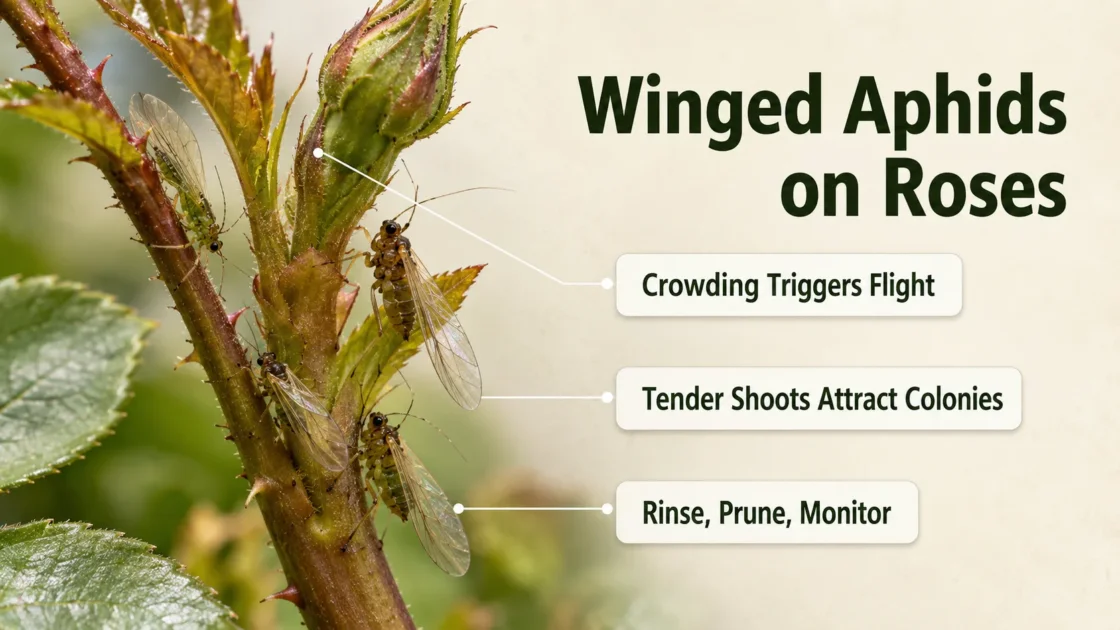
Winged aphids on roses usually mean an aphid colony is spreading, not that a separate flying pest has arrived. Rose aphids can occur as wingless or winged adults, and winged forms develop when colonies become dense, host quality declines, or aphids need to move to new shoots or nearby plants. On roses, check tender shoot tips, flower buds, young foliage, honeydew, cast skins, and ants before choosing treatment. Most established rose bushes do not need harsh insecticide; a forceful water spray, pruning of crowded tips, ant management, predator conservation, and careful use of insecticidal soap or horticultural oil are the usual first-line actions.[a][b]
Key Data Points
Likely group
Aphididae
Common rose species
Macrosiphum rosae
Body size
About 2-3.5 mm
Main feeding sites
Buds and new shoots
Winged form meaning
Dispersal signal
Primary risk
Bud distortion
First treatment
Water spray
Data confidence
Moderate to high
What Winged Aphids Mean on Roses
Winged aphids are alate forms produced within an aphid population. On roses, they are most often noticed when green, pink, reddish, or purplish aphids cluster around soft shoot tips and flower buds. The wings allow movement from an overused or crowded feeding site to fresher growth nearby.
The presence of wings does not automatically mean the rose is in severe decline. It does mean the plant should be checked closely: look for dense colonies, curled new leaves, sticky honeydew, black sooty mold, ant traffic, and pale cast skins left after aphids molt.[c]
Identification Checklist
| Marker | What to Look For | How Useful It Is | Source Context |
|---|---|---|---|
| Body shape | Soft, pear-shaped body. | High for aphid-level ID. | UMN and UC IPM describe aphids as pear-shaped. |
| Color | Green, pink, reddish, purplish, or related shades. | Medium; color varies by species and plant. | Rose aphid color varies across sources. |
| Cornicles | Two small tube-like structures near the rear of the abdomen. | High for aphids. | UC IPM notes cornicles as a separating aphid feature. |
| Wings | Clear wings held above or over the body in adult alate forms. | Medium; wings show dispersal form, not species by itself. | RHS notes winged forms develop when plants are heavily affected. |
| Feeding site | Clusters on rose buds, shoot tips, and young leaves. | High for rose aphid context. | RHS, UMN, and NC State list these rose feeding sites. |
| Residue | Sticky honeydew, ants, sooty mold, or white cast skins. | High as infestation evidence. | UC IPM and RHS connect honeydew with aphid feeding. |
Why Winged Aphids Appear on Roses
Winged aphids appear when the colony needs a dispersal route. In rose plantings, the usual field pattern is dense feeding on soft new tissue, followed by winged adults moving to nearby shoots or other suitable host plants. Overfertilized roses with flushes of tender nitrogen-rich growth can be more attractive to aphids, so feeding management matters as much as spray choice.
| Trigger or Condition | What It Means on Roses | Field Response |
|---|---|---|
| Crowded colonies | Aphids are concentrated on buds and young shoot tips. | Hose off, prune worst tips, and recheck in 3-5 days. |
| Fresh spring growth | Soft tissue gives aphids an easy feeding site. | Monitor new growth twice weekly during active flushes. |
| Host quality decline | Older feeding sites become less suitable, so winged adults disperse. | Inspect nearby roses and related plants. |
| Ant activity | Ants may protect aphids while feeding on honeydew. | Reduce ant access where practical to help predators work. |
| Broad-spectrum sprays | Natural enemies may be reduced, allowing aphids to rebound. | Use lower-impact options only when action is needed. |
Treatment Decision Table
| Action | Best Use Case | Benefit | Limit |
|---|---|---|---|
| Forceful water spray | Visible clusters on sturdy rose shoots. | Fast removal with low impact on predators. | May need repeat checks; avoid damaging soft buds. |
| Prune infested tips | Localized colonies on curled leaves or crowded buds. | Removes hidden aphids that contact sprays may miss. | Not ideal if infestation is spread across the whole plant. |
| Protect natural enemies | Lady beetles, lacewings, hoverfly larvae, or aphid mummies present. | Can reduce colonies without chemical treatment. | Predators may lag behind aphid buildup in cool spring weather. |
| Manage ants | Ants are moving up rose stems and tending aphids. | Helps parasitoids and predators reach aphids. | Sticky barriers must be used carefully on woody stems. |
| Insecticidal soap or horticultural oil | High aphid numbers remain after nonchemical steps. | Lower impact than broad-spectrum insecticides when used correctly. | Contact coverage is needed; avoid heat or drought-stressed plants. |
| Broad-spectrum insecticide | Rarely justified in home rose plantings. | Can reduce visible insects. | Can kill natural enemies and worsen later aphid pressure. |
Look-Alike and Symptom Checks
| Observation | Likely Explanation | How to Separate It from Winged Aphids |
|---|---|---|
| Small insects jump or move quickly | Leafhoppers or plant bugs may be involved. | Aphids usually move slowly when disturbed. |
| Black coating on leaves | Sooty mold growing on honeydew. | Look above the mold for aphid colonies or other honeydew producers. |
| Sticky buds with ants | Aphid honeydew is likely. | Inspect bud bases and shoot tips for clustered aphids. |
| Distorted red shoots and excess thorniness | Could be rose rosette or herbicide injury, not aphids alone. | Aphids are visible insects; rose rosette diagnosis needs disease-focused review. |
| Tiny orange insects in flowers | Thrips may be present. | Thrips are slender and often hide within blooms; aphids cluster on soft outer growth. |
Interactive Data Visuals
Rose Aphid Body Size Reference
Source-based size values used for field identification, shown in millimeters.
Source: RHS gives common rose aphid forms as 2-3.5 mm; UMN lists rose aphids up to about 1/8 inch, approximately 3.2 mm.
Treatment Suitability Score
Editorial interpretation score for home rose care, based on source guidance and expected impact on natural enemies.
Values are editorial interpretation scores for this guide, not species counts, occurrence records, or measured treatment trial results.
Data Interpretation Note
A winged aphid on a rose is best read as a movement form. The treatment decision should be based on colony density, plant damage, predator activity, ant traffic, and whether new buds are being distorted, not on wings alone.
Field Action Notes
- Check the underside of young leaves, bud clusters, and shoot tips before treating.
- Use a strong water spray early in the day so foliage dries faster.
- Prune only the worst curled or crowded tips when colonies are localized.
- Leave lady beetle larvae, lacewing larvae, hoverfly larvae, and aphid mummies in place.
- Avoid broad-spectrum sprays on flowering roses because they can harm natural enemies and pollinators.
- If using insecticidal soap or horticultural oil, follow the product label and cover aphids directly.
Where the Data Has Limits
Rose aphid timing varies by climate, cultivar, garden exposure, and local predator activity. Occurrence records and extension pages show reported evidence and management guidance; they do not prove exact local abundance in a specific garden.
Data Quality and Limits
Aphid identification is often reliable at family or general rose-aphid level, but species-level confirmation can be difficult from color alone. Different aphid species may share green or pink forms, and winged adults can be harder to identify without magnification.
Seasonal dates in sources should be treated as regional guidance. RHS lists rose aphid timing as March-August in its UK gardening context, while Minnesota diagnostic material lists June-October activity for its regional tool. Local climate, greenhouse protection, and rose growth cycles can shift the visible season.
Treatment advice is strongest when it comes from integrated pest management sources. Product availability, label restrictions, pollinator rules, and pesticide access can change by region, so any pesticide use must follow the current local label.
FAQ
Are winged aphids on roses worse than normal aphids?
Not always. Wings usually mean some adults are dispersing. Damage risk depends more on colony size, bud distortion, honeydew, and how much new growth is being attacked.
Why did aphids on my roses suddenly grow wings?
Winged forms can develop when aphids need to move away from crowded or declining feeding sites. RHS notes that winged rose aphids develop when plants are heavily affected and aphids need to migrate.
Should I spray roses as soon as I see winged aphids?
No. First check how many aphids are present, whether buds are being damaged, and whether predators are active. Water spray, pruning, and predator protection are often enough on established roses.
Do winged aphids kill rose bushes?
Low to moderate aphid numbers usually cause little lasting harm to established plants. Heavy populations can distort young leaves, stunt new growth, reduce flower quality, and produce sticky honeydew.
What is the safest treatment for aphids on rose buds?
A careful water spray is usually the first choice. If buds are badly crowded, prune the worst tips. If a spray product is needed, insecticidal soap or horticultural oil is usually preferred over broad-spectrum insecticides.
Do ants make aphids on roses worse?
They can. Ants feed on aphid honeydew and may protect aphids from predators and parasitoids. Reducing ant access can improve natural control on rose bushes.
Sources and Verification
- [a] UC IPM Aphids — identification, winged forms, monitoring, natural enemies, and treatment guidance.
- [b] UC IPM Roses: Insects and Mites — rose-specific aphid biology, natural enemies, water spray, oils, soaps, and systemic insecticide cautions.
- [c] RHS Rose Aphids — rose aphid symptoms, common species, timing, size range, and winged form biology.
- University of Minnesota Rose Aphid Diagnostic Page — rose aphid size, color, feeding site, timing, and damage notes.
- NC State Extension Rose Aphid — rose aphid description, host notes, life cycle, predators, and residential management recommendations.
- AphID: Macrosiphum rosae — host association, distribution context, and economic relevance for rose aphid.
- GBIF Backbone Taxonomy: Macrosiphum rosae rosae — taxonomic placement within Animalia, Arthropoda, Insecta, Hemiptera, Aphididae, and Macrosiphum.