Yes. Winged aphids can spread certain plant viruses after probing or feeding on an infected plant and then moving to a susceptible plant. Their wings increase the opportunity to travel between plants, gardens or fields, but they do not make every aphid infectious. Transmission still requires a compatible virus, aphid vector and host plant.[a]
Finding one winged aphid therefore shows that a possible vector has reached the plant. It does not show whether the insect previously visited an infected host, whether it can transmit the virus of concern or whether the plant is already infected. Some aphid-transmitted viruses can be inoculated during brief probes, so even low aphid numbers may matter in a susceptible crop.[c]
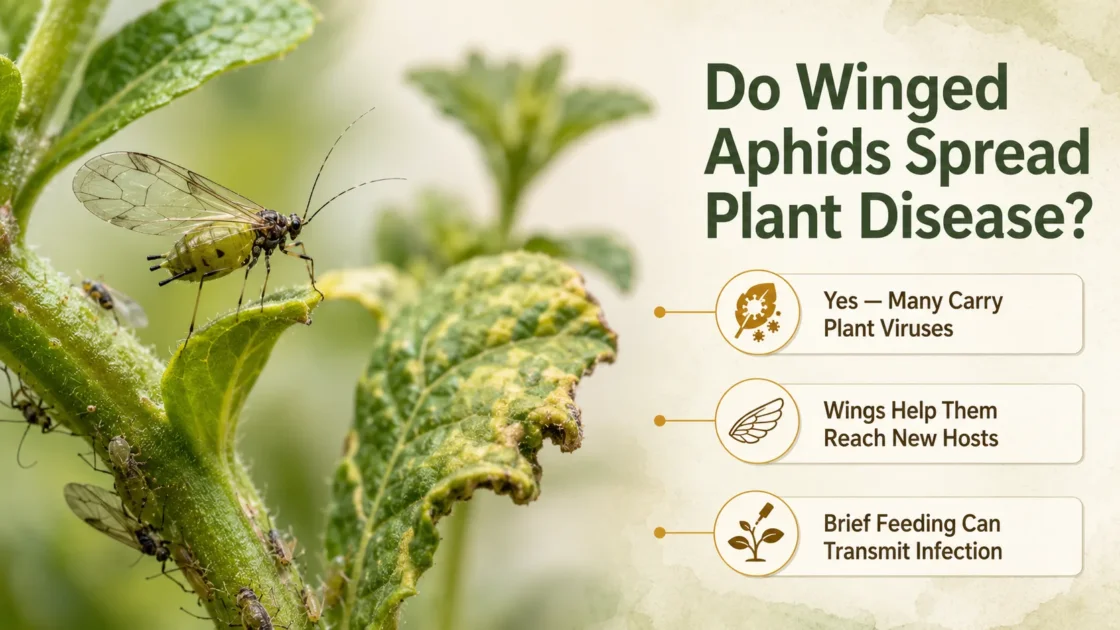
Why the Winged Form Changes the Pattern of Spread
The winged form of an aphid is an alate. Its main relevance to plant disease is movement. A winged aphid can leave a declining, crowded or unsuitable host and land on another plant. During host selection, it may make short test probes before either settling or flying again.
That movement can connect an infected plant with plants that were previously unexposed. In potato leafroll, for example, UC IPM distinguishes winged aphids carried over longer distances from wingless aphids involved in plant-to-plant spread. This is a crop-specific example rather than a fixed distance rule for every aphid and virus, but it shows why alates often matter when a virus first enters a new planting.[d]
Wings change how readily an aphid can disperse. They do not remove the need for virus–vector compatibility, prior contact with an infected plant or susceptibility in the plant that receives the probe.
How a Virus Travels With an Aphid
Aphid-transmitted viruses do not all use the insect in the same way. Plant pathologists commonly distinguish viruses retained on feeding structures from viruses that pass through internal tissues before reaching the salivary system. These routes affect how quickly an aphid can acquire a virus, how long it remains able to transmit it and which aphid movements matter most.[b]
| Transmission pattern | What happens in the aphid | Practical meaning |
|---|---|---|
| Short-retention, noncirculative transmission | Virus particles remain associated with the stylet or foregut instead of circulating through the aphid’s body. Acquisition and inoculation can occur during short probes in some virus systems. | An aphid that samples several plants may spread virus before settling. Its ability to transmit may disappear after a relatively short period, depending on the virus. |
| Persistent, circulative transmission | The virus is ingested, crosses the gut and reaches tissues connected with salivation. This process normally takes longer than simple stylet retention. | After the required acquisition and internal movement, the aphid may remain capable of transmission for an extended period. The exact retention time depends on the virus–vector pair. |
The distinction also explains why aphid abundance alone is an incomplete measure of virus risk. A small number of mobile aphids making repeated probes can matter for a rapidly acquired virus. A settled colony may be more relevant to direct feeding damage or local secondary spread. Neither pattern can be interpreted correctly without knowing the crop and the virus involved.
What a Winged Aphid Sighting Actually Tells You
A winged aphid on a plant is evidence of vector arrival, not a plant-virus diagnosis. Not all aphids carry viruses, and similar leaf symptoms can be produced by different viruses, herbicide exposure, nutrient disorders, mites or other stresses. University of Minnesota Extension advises that visual symptoms alone cannot confirm the virus affecting a plant; laboratory analysis may be needed when exact identification matters.[f]
Use Three Separate Evidence Levels
- Possible exposure: Winged or wingless aphids are present on the plant or nearby hosts. This establishes a possible transmission pathway.
- Compatible plant response: New leaves develop mosaic coloring, mottling, curling, vein changes, rings, distortion or unexplained stunting. These observations support closer investigation but are not specific to one virus.
- Confirmed infection: A plant diagnostic laboratory or another validated crop-specific test identifies the causal virus.
WHAT A PHOTO CANNOT SHOW
A clear photograph may support identification of a winged aphid and document where it was found. It cannot reveal whether that individual carries a plant virus. Viral status normally requires testing of the insect, plant or both under a defined diagnostic method.
Check the Plant Before Assuming Disease
The most useful response is to document the sighting and inspect for a pattern. A single alate that briefly landed outdoors carries less evidence than repeated aphid arrivals accompanied by developing symptoms on several susceptible plants.
- Record the host plant and location. Note the crop or ornamental, the date and whether the aphid was indoors, outdoors, in a greenhouse or beneath a plant covering.
- Inspect fresh growth and leaf undersides. Look for wingless adults, nymphs, cast skins, honeydew or growing colonies. A lone flying aphid and an established colony represent different movement patterns.
- Photograph the whole plant and individual symptoms. Include unaffected growth for comparison. Record whether changes appear on one leaf, one plant or several neighboring plants.
- Check nearby plants and weeds. Viruses and aphids may use other hosts, but the relevant reservoir plants differ among crops and virus systems. Use crop-specific extension guidance rather than assuming every nearby weed is involved.
- Track changes over several days. Mark affected plants or photograph the same leaves again. A spreading pattern deserves more attention than an isolated damaged leaf that remains unchanged.
- Request diagnosis when the result changes a decision. Laboratory confirmation is especially useful for valuable plants, propagation stock, commercial crops or symptoms appearing on several plants.
Why Spraying After Arrival May Not Prevent Infection
For viruses acquired and inoculated during brief probes, an aphid may transmit before an insecticide kills it. UC IPM describes this pattern for tomato potyviruses: spread is associated with aphids moving through the crop, and insecticides may not act before transmission occurs.[e]
This does not mean aphid management has no value. Reducing colonies may limit feeding damage or later movement in some systems. Exclusion, reflective mulches, resistant varieties, removal of confirmed reservoir plants and aphid control may each have a role in particular crops. Their usefulness depends on the virus transmission mode, local aphid pressure, plant stage and regional recommendations.
USE CROP-SPECIFIC GUIDANCE
Do not treat the sighting of one winged aphid as proof that spraying is required. Identify the plant, inspect for colonies and symptoms, and consult local integrated pest-management guidance before choosing a control method.
Sources
- [a] American Phytopathological Society — Introduction to Plant Viruses, the Invisible Foe — verified vector specificity, rapid stylet-associated transmission and circulative aphid transmission.
- [b] Ng and Perry — Transmission of Plant Viruses by Aphid Vectors — peer-reviewed review used to verify circulative and noncirculative transmission routes.
- [c] UC Statewide IPM Program — Aphids — verified that aphids transmit viruses on certain crops and that rapid infection can occur at low aphid numbers.
- [d] UC Statewide IPM Program — Potato Leafroll — provided the crop-specific example of winged aphids contributing to longer-distance spread and wingless aphids to plant-to-plant spread.
- [e] UC Statewide IPM Program — Mosaic Diseases Caused by Potyviruses — verified rapid, short-retention transmission associated with moving aphids and the limits of post-arrival insecticide use.
- [f] University of Minnesota Extension — Cucurbit Viruses — verified that not all aphids carry viruses and that symptoms alone cannot confirm a specific plant-virus infection.