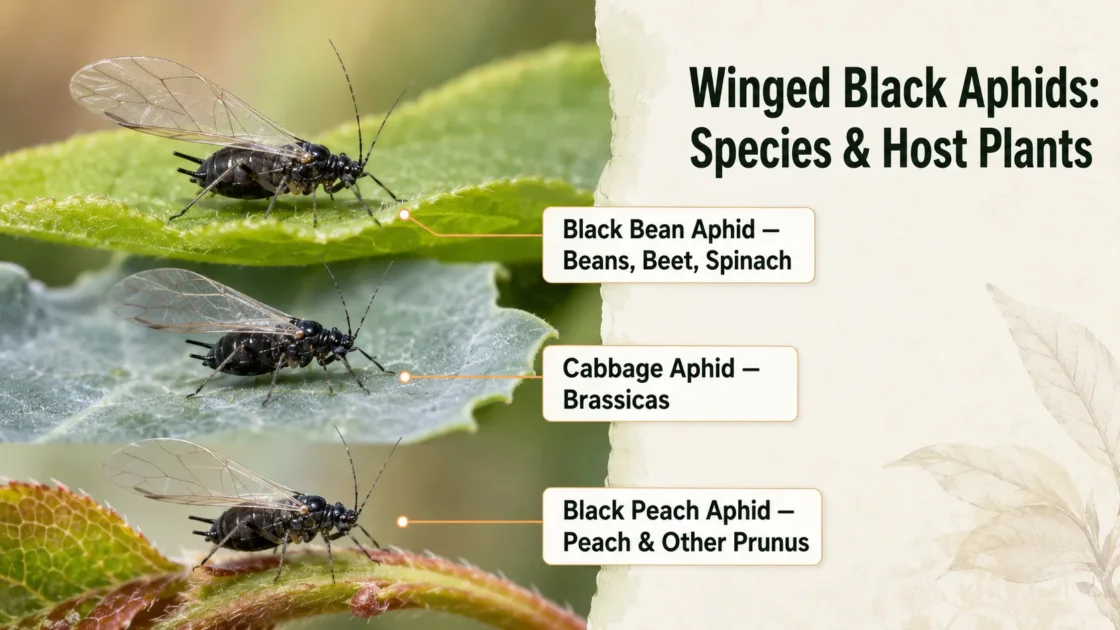
A winged black aphid is not one species. Several unrelated aphids can appear black, dark brown or purplish when they develop wings, including black bean aphids, cowpea aphids, brown citrus aphids, giant black bark aphids and dark conifer-feeding aphids. The host plant, the part of the plant being colonized and the appearance of nearby wingless aphids usually provide better identification evidence than color alone.
Most adult aphids are normally wingless, but many species can produce winged females when colonies become crowded or when the current plant becomes less suitable. These dispersing adults are called alates. UC Integrated Pest Management describes aphids as soft, pear-shaped insects with long antennae and a pair of rear-facing tubes called cornicles; it also notes that winged forms allow aphids to move to other plants.[a] A separate explanation of what “alate” means in entomology covers the term beyond aphids.
IDENTIFICATION LIMIT
“Black aphid with wings” is a visual description, not a taxonomic name. Dark color may narrow the possibilities, but it cannot confirm a species without the host plant and finer anatomical details.
Match the Aphid to the Plant Before Naming It
Begin with the plant on which the aphids are actively feeding. A colony containing nymphs, wingless adults and winged adults is stronger host evidence than one winged insect resting on a leaf. An alate may land temporarily on a plant that it cannot colonize.
| Possible aphid | Useful appearance clues | Representative host plants | Where to inspect |
|---|---|---|---|
| Aphis fabae Black bean or bean aphid | Dark olive, purplish-black or black; usually duller and less glossy than the cowpea aphid.[b] | Beans and other legumes, beet, celery, carrot, flowers and some woody ornamentals | Young shoots, leaf undersides, stems and developing growth |
| Aphis craccivora Cowpea aphid | Small and shiny black as an adult; pale or whitish sections of the legs and antennae often end in dark tips. | Cowpea, kidney bean, lima bean, alfalfa, carrot, asparagus and several weeds | Stems, young shoots, pods and leaves, often in compact colonies |
| Toxoptera citricida Brown citrus aphid | Wingless adults can be shiny black; winged adults are dark and have black basal antennal segments. | Citrus and other plants in the rue family, Rutaceae | Soft new citrus flush, curled young leaves and tender shoots |
| Pterochloroides persicae Giant black bark or brown peach aphid | Much larger and more bark-associated than the small aphids commonly seen on vegetable leaves; dark brown to black colonies may be conspicuous on woody surfaces. | Peach, almond and plum are documented hosts; other records involve related fruit trees | Trunks, branch bark, collars and other woody feeding sites |
| Cinara species Giant conifer aphids | Relatively large, long-legged aphids; many are brown or blackish and may be mistaken for ticks when viewed without magnification. | Pine, fir, spruce, cedar and related conifers | Needles, shoots, twigs, branches or bark, depending on the species |
The table is a host-based shortlist, not a species key. Microscopic characters involving the antennae, cornicles, cauda, body hairs and wing veins may be needed when closely related aphids use overlapping plants.
Dark Aphids Associated With Different Host Groups
Black Bean Aphid on Vegetables, Weeds and Ornamentals
Aphis fabae is the accepted scientific name associated with the black bean or bean aphid.[e] It is usually described as dark olive-green, purplish-black or black. On crops where both bean aphids and cowpea aphids occur, the bean aphid generally has a duller surface.
The common name can be misleading because the aphid is not restricted to beans. University references list legumes, beet, celery, carrot, flowers and various ornamentals among its plant associations. Some populations alternate between woody winter hosts and herbaceous summer hosts.
A DIFFICULT SPECIES COMPLEX
Research on the Aphis fabae complex has found several morphologically cryptic, host-associated lineages. A photograph of a black aphid may therefore support a group-level identification without resolving the exact taxon.[i]
Cowpea Aphid on Beans, Alfalfa and Other Legumes
Aphis craccivora is recognized as the cowpea aphid.[f] Adults are commonly shiny black, while younger individuals may look gray because of a light waxy coating. Pale legs and antennae with darker ends can help separate a clear specimen from the more matte black bean aphid.
UF/IFAS records cowpea, kidney bean, lima bean, carrot, asparagus and lettuce among its vegetable hosts. Dandelion, pigweed, dock, shepherd’s purse and other weeds may also support populations.[c] In alfalfa, UC IPM describes the cowpea aphid as the characteristic small, shiny black aphid, with slate-gray nymphs and pale appendages ending in darker tips.
Brown Citrus Aphid on Tender Citrus Growth
Toxoptera citricida is commonly called the brown citrus aphid, although mature wingless adults may appear shiny black. Winged and wingless individuals can occur together on new citrus growth. UF/IFAS identifies members of the Rutaceae, especially citrus, as its feeding plants.[d]
The host and feeding site are useful here. A colony concentrated on soft citrus flush is more consistent with a citrus-feeding aphid than a dark aphid found incidentally on an old, hardened leaf. Several aphid species can occur on citrus, so color should still be combined with antenna, cornicle and wing characters.
Giant Black Bark Aphid on Stone-Fruit Wood
Pterochloroides persicae is an accepted species name in Aphid Species File.[g] It differs in setting and scale from the smaller black aphids commonly clustered beneath vegetable leaves. Colonies feed on woody surfaces and may include large dark aphids, winged individuals and abundant honeydew.
Field research in Kashmir documented the species in almond, peach and plum orchards, with monitoring conducted in peach and almond plantings.[h] A large black aphid colony attached to the bark of one of these trees therefore points in a different direction from a shiny black colony on bean stems.
Dark Cinara Aphids on Conifers
Dark aphids on pine, spruce, fir or cedar may belong to Cinara, a large genus of conifer-feeding aphids. These insects are often larger and longer-legged than aphids on vegetables. They may feed along shoots, branches or bark and can be accompanied by ants collecting honeydew.
A genus-level identification is often more defensible than naming a Cinara species from a general photograph. The exact conifer, the feeding site and microscopic morphology can all matter.
Use the Colony, Not a Stray Landing, as Evidence
A winged aphid is built to disperse. It may be photographed on a window, wall, vehicle, garden furniture or an unrelated plant after leaving its colony. The surface beneath one insect should not automatically be entered as its host.
- Strong host evidence: multiple aphids are feeding, nymphs and wingless adults are present, and the colony is attached to growing plant tissue or bark.
- Moderate host evidence: several winged aphids occur on a plant that is a documented host, but no established colony is visible.
- Weak host evidence: one winged aphid is resting on a surface without feeding or associated nymphs.
Honeydew, ants and sooty mold can help locate an active colony, but none of these signs identifies the aphid species by itself. Other sap-feeding insects also produce honeydew.
A Host-First Identification Sequence
- Confirm the insect is aphid-like. Look for a soft pear-shaped body, long antennae and two cornicles projecting from the rear of the abdomen.
- Record the plant. Identify the plant as precisely as possible. “Bean,” “citrus,” “peach” or “pine” is more useful than “garden plant” or “tree.”
- Check for a colony. Search nearby leaves, shoots, stems, pods, branches and bark for nymphs and wingless adults.
- Compare surface texture. On beans and related crops, a shiny black adult supports cowpea aphid more than a dull or matte black adult.
- Record the feeding position. Leaf undersides, soft shoots, stems, pods and woody bark support different shortlists.
- Check the size in context. Large dark aphids on fruit-tree bark or conifer branches should not be forced into the same identification as tiny black aphids on vegetable shoots.
- Stop at the defensible level. Use “dark aphid,” “likely cowpea aphid,” “Cinara species” or another calibrated identification when the available evidence cannot support an exact species.
What a Photograph Should Record
One enlarged dorsal photograph is rarely enough. A useful identification record combines insect detail with plant context.
- Photograph the complete plant or branch before moving the insects.
- Record the leaf, shoot, stem, pod, trunk or bark area where feeding occurs.
- Take a clear top view showing the wings, abdomen and antennae.
- Add a side view that shows body depth and cornicle shape.
- Include nearby wingless adults and nymphs rather than photographing only an alate.
- Place a ruler beside the specimen without covering or crushing it.
- Record the location and date because available species differ between regions.
When Species-Level Confirmation Is Needed
Local confirmation is useful when the aphid is associated with a commercial crop, appears outside a known regional range, may be a regulated species or must be distinguished from a closely related taxon. Preserve several intact individuals rather than relying on a crushed specimen or detached wings.
- Keep winged and wingless adults from the same colony when possible.
- Save a small sample of the affected plant material if local guidance permits it.
- Record the plant name, exact feeding site, date and locality.
- Retain the original photographs at full resolution.
- Contact a university extension office, agricultural diagnostic laboratory, museum entomology service or qualified local specialist.
Sources
- [a] UC Statewide IPM Program — Aphids — verified general aphid anatomy, cornicles, production of winged forms and representative hosts for bean and giant conifer aphids.
- [b] UC Statewide IPM Program — Aphids in Dry Beans — verified the dull black bean aphid and shiny black cowpea aphid comparison.
- [c] University of Florida Entomology — Cowpea Aphid — verified adult appearance, winged forms and representative crop and weed hosts of Aphis craccivora.
- [d] University of Florida Entomology — Brown Citrus Aphid — verified the appearance and citrus-family host association of Toxoptera citricida.
- [e] Aphid Species File — Aphis fabae — verified the accepted taxonomic name and associated common names.
- [f] Aphid Species File — Aphis craccivora — verified the accepted cowpea aphid taxon and documented alate form.
- [g] Aphid Species File — Pterochloroides persicae — verified the accepted taxonomic name and nomenclatural record.
- [h] Journal of Threatened Taxa — Pterochloroides persicae on Fruit Trees — verified field records from almond, peach and plum orchards.
- [i] Heredity — Cryptic Diversity in the Black Bean Aphid Complex — verified host-associated, morphologically cryptic lineages within the Aphis fabae complex.