A winged green aphid is not one species. Many aphids produce winged adults, and several common species can be green, yellow-green or partly dark when they develop wings. Frequent candidates include the green peach aphid, potato aphid, pea aphid, melon or cotton aphid, and soybean aphid. Green coloration can narrow the field, but it cannot finish the identification. The host plant, body size, cornicles, antennae and dark markings on the head, thorax or abdomen provide better evidence when considered together.[a]
A winged aphid is an alate adult: a dispersing form of a species that may also produce wingless adults. The broader biological meaning of the term is covered in the definition of an alate. Within aphids, the winged and wingless forms of the same species can differ enough in color and markings to look like separate insects.
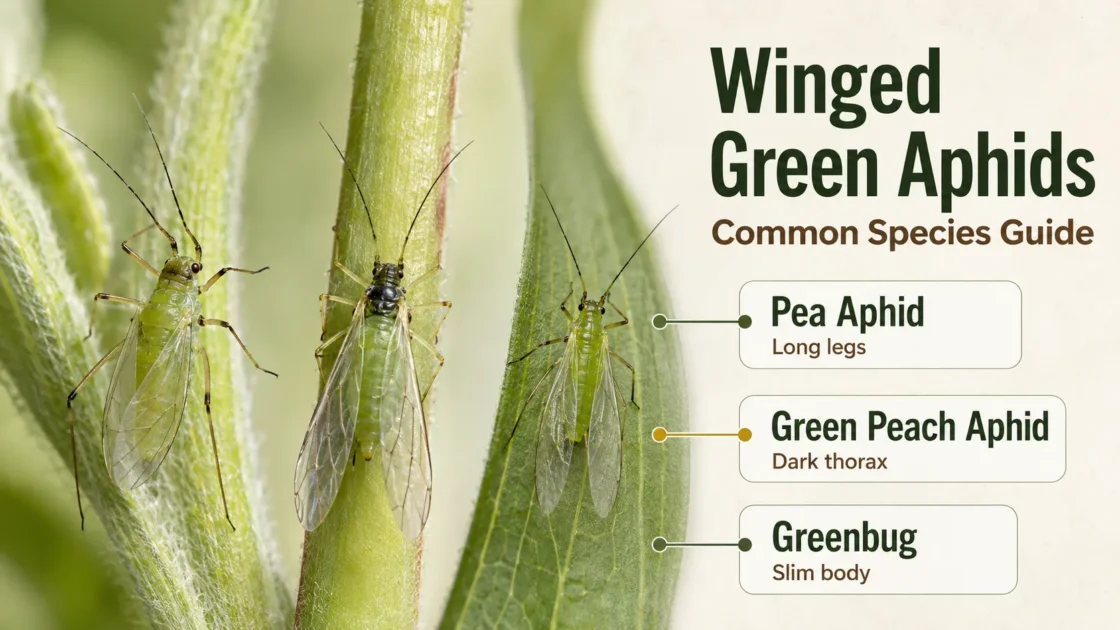
Start With Structure, Not Shade
First confirm that the insect is consistent with an aphid. Most aphids are small, soft-bodied and broadly pear-shaped. They have long antennae and a pair of tubelike projections called cornicles near the rear of the abdomen. Cornicles are often the most useful feature for separating an aphid from a small leafhopper, plant bug, whitefly or other winged insect.
- Look for two cornicles projecting from the rear half of the abdomen.
- Check whether the abdomen is rounded or pear-shaped instead of narrow and wasplike.
- Record the exact plant on which the insect was feeding or resting.
- Compare body length, leg length and cornicle length with nearby wingless aphids.
- Inspect the head, thorax and upper abdomen for black or dusky areas.
COLOR CANNOT FINISH THE IDENTIFICATION
One aphid species may occur in several colors, and a green wingless form may develop into a winged adult with a dark head, thorax or abdominal patch. Lighting, plant reflections and a translucent abdomen can also change how green the insect appears in a photograph.
Five Likely Candidates on Common Host Plants
The species below are practical starting points rather than a complete list. Which one is common depends on geography, crop, season and surrounding vegetation. A host association raises or lowers the likelihood of a species, but it does not prove the identification.
| Candidate | Useful clues in the winged adult | Host context | Main identification limit |
|---|---|---|---|
| Green peach aphid Myzus persicae | Usually small and relatively slender. Winged adults may be pale or bright green with a dark head and thorax and a large dusky patch on the upper abdomen. The frontal tubercles at the antennal bases converge toward one another.[b] | Occurs on many vegetables, field crops, flowers and stone-fruit hosts. It is a strong candidate on pepper, potato, spinach, lettuce and related crops. | The converging antennal tubercles and cornicle shape usually require a sharp macro image or microscope. |
| Potato aphid Macrosiphum euphorbiae | Often larger, longer-legged and more elongated than the green peach aphid. Green and pink forms occur. The cornicles are long, and the frontal tubercles slope outward rather than converging. | Commonly associated with potato, tomato, pepper, lettuce, spinach, peas, beans and other plants. | A side-by-side size comparison is unreliable when the photograph lacks a scale or shows insects of different ages. |
| Melon or cotton aphid Aphis gossypii | A small, comparatively rounded aphid. Individuals range from yellow or pale green to dark green. Winged adults can be largely dark or black even when wingless members of the colony are green.[c] | Frequently found on cucurbits such as cucumber and squash, as well as citrus, peppers, ornamentals and other hosts. | A dark winged adult alone may not look “green.” Colony color and host information are often more useful than the adult’s visible shade. |
| Pea aphid Acyrthosiphon pisum | A relatively large aphid with long legs. Forms can be pale green, yellow-green or pink. Dark bands on the antennae and dark cornicles help separate it from some aphids found on the same plants.[d] | Most strongly associated with peas, alfalfa and other legumes, often on stems and expanding leaves. | It can occur beside related legume-feeding aphids. Antennal banding must be visible before a photograph supports a species-level name. |
| Soybean aphid Aphis glycines | Very small and yellowish-green, with dark cornicles. Winged adults have a dark head and thorax, while much of the abdomen may remain greenish.[e] | Soybean is the strongest field clue. Colonies may include wingless adults, nymphs, winged adults and pale cast skins. | A tiny winged aphid caught away from soybean cannot be assigned to this species from green color and dark thorax alone. |
The Plant Narrows the Field Without Proving the Species
Host information becomes most useful when the insect was feeding within a colony rather than resting briefly on a leaf. A green alate found among aphids on soybean supports a different candidate than one found among a colony on peas, cucumber or potato. A lone winged adult may have landed while dispersing and may not use that plant as a regular host.
Examine the new growth, undersides of leaves, stems and flower buds for wingless adults and nymphs. Their color, size and arrangement may be easier to compare than the single alate. Honeydew, whitish cast skins and curled growth can help locate a colony, but these signs occur with many aphid species and do not identify one by themselves.
A LANDING PLANT IS NOT ALWAYS A HOST PLANT
Winged aphids disperse between plants and may pause on unsuitable vegetation. Give more weight to a plant supporting nymphs, wingless adults and repeated feeding than to a leaf holding one mobile adult.
Check the Same Features in the Same Order
1. Cornicles
Confirm that paired cornicles are present, then compare their length, color and shape. Long cornicles support candidates such as potato or pea aphids, while short cornicles point toward other groups. A rear view alone can hide their bases, so use a side or slightly angled photograph.
2. Body Size and Proportions
Compare the abdomen with the legs and antennae. Potato and pea aphids tend to look long-legged and elongated. Melon aphids are smaller and more compact. Size should be measured against a ruler or scale marker rather than estimated from an enlarged image.
3. Dark Areas on the Body
Note whether the dark coloration is confined to the head and thorax, forms a large patch on the abdomen or covers most of the winged adult. A green abdomen with a dark head and thorax fits several species, so this character must be combined with body size and host evidence.
4. Antennae and Frontal Tubercles
Look for dark antennal bands and inspect the raised areas at the bases of the antennae. Converging frontal tubercles support green peach aphid, while outward-sloping tubercles support potato aphid. These structures are usually beyond the resolving power of a distant phone photograph.
5. Host and Colony Position
Record the plant species and the exact feeding point. Some aphids favor growing tips, stems or lower leaves. This information may separate two visually similar candidates, although local identification keys are still needed when a formal species record matters.
Build a Photograph Set That Can Be Verified
One enlarged photograph may show green color and wings while hiding nearly every structure needed for identification. A small set of documented images gives an extension office, diagnostic laboratory or aphid specialist more usable evidence.
- Take a sharp photograph directly above the insect to show the abdomen and dark dorsal markings.
- Take a side view showing the cornicles, legs and body proportions.
- Add a millimeter ruler or another measured scale without covering the insect.
- Photograph the whole plant and then the exact leaf, stem or bud where the aphid was found.
- Include nearby wingless aphids, nymphs, cast skins or honeydew when present.
- Record the date, location, plant name and whether the insect was alone or part of a colony.
- Place several intact specimens in a clean, rigid container and ask the receiving diagnostic service for its preferred preservation method.
When the Identification Should Remain Tentative
A label such as “winged aphid,” “green aphid” or “likely green peach or potato aphid” is more accurate than a species name when the cornicles, antennal bases and host relationship are not visible. Closely related aphids may require microscope characters, a regional identification key or examination by a specialist.
Species-level confirmation is most useful when the result will support a formal occurrence record, a commercial crop decision, a plant-virus investigation or a comparison between closely related aphids. A clear but limited identification is preferable to certainty based only on green color.
Sources
- [a] UC Statewide Integrated Pest Management Program — Aphids — verified general aphid morphology, cornicles, winged forms and common host associations.
- [b] UC IPM Pest Management Guidelines — Potato — verified the winged green peach aphid abdominal blotch and the antennal-tubercle and body-proportion differences between green peach and potato aphids.
- [c] Utah State University Extension — High Tunnel Pest Management: Aphids — verified color, size and host descriptions for green peach, melon and potato aphids.
- [d] Utah State University Extension — Aphids in Alfalfa — verified pea aphid color, relative size, antennal banding, cornicles and legume association.
- [e] University of Minnesota Extension — Scouting for Soybean Aphid — verified soybean aphid body color, dark cornicles and the dark head and thorax of winged adults.