An alate thrips is a winged adult thrips. The phrase does not name a species or a reproductive caste, and it does not show that the insect is damaging the plant. Under magnification, a winged adult usually has a minute, slender body and two pairs of narrow wings edged with long hairs. Plant injury is more convincingly linked to thrips when these insects occur beside pale or silvery feeding scars, dark specks of frass, and distorted young leaves, buds, flowers, or fruit.
What “Alate Thrips” Means
The word alate means winged. It is most familiar in discussions of flying ants, termite swarmers, and winged aphids. When applied to thrips, it is best understood as a simple description of an adult with functional wings.
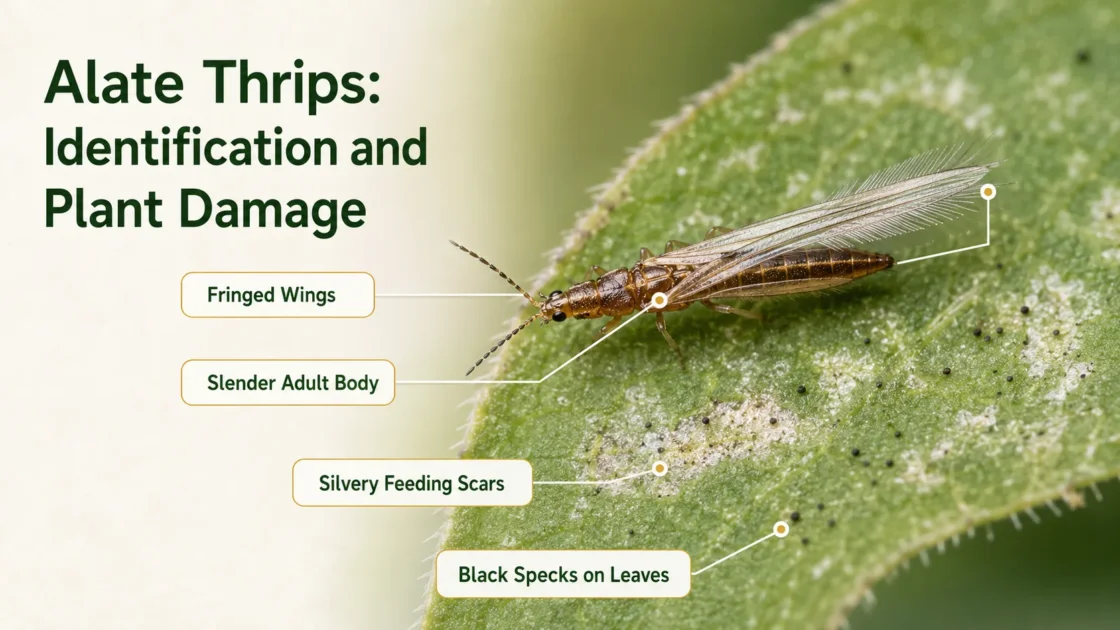
It does not carry the same caste meaning that it does in an ant or termite colony. Thrips do not become winged reproductive swarmers in that sense. Typical adult thrips have fringed wings, although adults of many species can be wingless, and some species produce both long-winged and reduced-wing forms.[a] Scientific descriptions may call these forms macropterous and micropterous rather than alate and apterous.[b]
TERM CHECK
“Alate thrips” tells only that wings are present. It does not identify the species, sex, host plant, feeding behavior, or pest status.
Five Features to Check Under Magnification
Thrips are difficult to examine with the unaided eye. A hand lens, macro photograph, or low-power microscope makes the useful features much easier to see.
- Size: Many plant-associated adults are about 1–2 mm long, although size varies among species.
- Body shape: The body is narrow, elongated, and often tapered at both ends. It may look like a moving grain of rice, a dark splinter, or a short thread.
- Wing shape: The two pairs of wings are long and narrow rather than broad. Long marginal hairs create a feathered or fringed outline.
- Resting position: The wings are usually folded lengthwise over the back and may be almost invisible until the insect is viewed from above with magnification.
- Nearby life stages: Young thrips resemble smaller adults but are wingless and commonly pale yellow, cream, or nearly translucent.
Color is a weak standalone marker. Depending on species, age, sex, and condition, adults can be yellow, tan, brown, or black. Species-level identification often depends on microscopic structures that are not visible in an ordinary phone photograph.[c]
| Observation | More Consistent with Thrips | What Weakens the Match |
|---|---|---|
| Body | Minute, narrow, active, and tapered at both ends | A broad, oval, pear-shaped, or mothlike insect |
| Wings | Two pairs of narrow wings with a visibly fringed edge under magnification | Broad powdery-white wings, which are more consistent with an adult whitefly |
| Location | Young leaves, leaf folds, buds, flowers, shoot tips, or leaf undersides | Insects concentrated only on damp potting mix, where springtails are more likely |
| Residue | Small dark, shiny or tar-like frass spots beside feeding marks | Fine webbing across leaves and stems, which supports a spider-mite diagnosis |
| Plant response | Silvery flecking, pale streaks, scars, curled young growth, or damaged petals | Symptoms without insects, frass, or a matching feeding location |
Match the Insect to the Plant Evidence
Plant-feeding thrips puncture surface cells and remove their contents. Groups of emptied or injured cells appear as pale flecks, streaks, stippling, or silvery patches. The final appearance depends on the plant part, the age of the tissue when feeding occurred, and the thrips species involved.
Direct Signs on the Plant
- Slender adults walking or jumping when a leaf or flower is disturbed
- Pale, wingless juveniles in the same protected feeding area
- Dark, varnish-like or tar-like frass spots stuck to the plant surface
- Adults collected on a sticky monitoring card near affected plants
Plant Responses That Support the Diagnosis
- Pale stippling that merges into irregular silver or bronze patches
- Crinkled, curled, rolled, or stunted leaves that were fed on while expanding
- White, pale, or dark streaks across flower petals
- Flower buds that become distorted, fail to open, or drop early
- Rough or scabby surface marks on developing fruit
- Injury concentrated in buds, shoot tips, leaf folds, or other sheltered sites
These patterns are well documented, but they remain symptoms rather than identification by themselves. Spider mites, broad mites, leafhoppers, plant bugs, disease, chemical injury, poor growing conditions, and physical abrasion can produce overlapping effects. University extension guidance therefore separates direct signs, such as insects and frass, from symptoms, such as discoloration and distorted growth.[d]
SILVERING IS NOT A DIAGNOSIS
Silver or bronze tissue supports a thrips diagnosis only when the insect, its frass, or another direct sign can be found on the same plant. Old scars can remain long after the insects have moved away.
Run the White-Paper Test
The white-paper test is a fast way to check flowers and foliage without relying on a damage photograph alone.
- Choose a leaf, flower, bud, or shoot tip that shows fresh discoloration or distortion.
- Hold a clean sheet of white paper directly beneath it.
- Tap or shake the plant part firmly several times.
- Watch the paper for minute yellow, tan, brown, or black insects that begin running.
- Use a hand lens to check whether the body is slender and whether the adults have narrow fringed wings.
- Inspect the original plant part for dark frass and feeding scars.
- Repeat the test on an apparently healthy part of the same plant for comparison.
Sticky cards can help detect flying adults, especially when thrips are difficult to find inside buds. A trap catch shows that adult thrips are present in the area, but it does not show which plant they came from or whether they caused the observed damage. The plant itself still needs to be inspected.
What Silvering and Scars Can Actually Prove
The strongest field-level case combines several forms of evidence at one location: living adults or juveniles, dark frass, fresh feeding marks, and injury on tissue that was developing when the insects were present.
Repeated adults and juveniles on fresh growth carry more diagnostic weight than one winged adult resting on an old damaged leaf.
A lone adult may have arrived on an air current, landed while dispersing, or entered with another plant. Thrips found inside a flower may also be feeding on pollen rather than injuring leaves. Some thrips are predators of mites or other small arthropods. Finding a thrips therefore does not automatically establish pest status.
Damage may also become visible after the responsible thrips have left. A leaf that was punctured while tightly folded can later open with broad scars or distorted sections. Spraying an old scar will not restore that tissue. New growth is the better place to judge whether feeding remains active.
Feeding Injury and Virus Symptoms Are Different Questions
Certain thrips species can transmit plant viruses, but most visible silvering and scarring is direct feeding injury. Ring patterns, widespread necrotic patches, unusual color breaks, severe stunting, or symptoms appearing across several plant parts cannot identify a virus or its vector. A plant diagnostic laboratory is needed when virus infection would change crop, greenhouse, or collection management.
When a Photo Is Not Enough
A clear macro photograph can often support identification to the order Thysanoptera. It may show the narrow body, wing fringe, antennae, and general color. It usually cannot reveal all of the minute setae, antennal segments, wing structures, or abdominal characters required for a reliable species name.
Seek local extension, agricultural, or plant-diagnostic assistance when:
- damage is spreading on a valuable plant, crop, or greenhouse collection;
- the suspected thrips may be a regulated or recently introduced species;
- species identity will determine biological control or pesticide selection;
- virus-like symptoms are present;
- thrips cannot be found despite continuing new damage; or
- several similar thrips species occur on the same host.
For a useful submission, collect several insects rather than relying on one damaged specimen. Record the host plant, date, indoor or outdoor location, and exact plant part. Photograph the insects and damage before removing them. A local diagnostician may recommend placing specimens in a small sealed vial of alcohol so they can be prepared for microscopic examination.
BEST EVIDENCE TO SAVE
Keep close photographs of the insect, the dark frass, the entire affected plant part, and a healthy comparison leaf. Record whether adults, wingless juveniles, or both were present.
Sources
- [a] CSIRO Entomology — Thysanoptera — Verified the typical fringed-wing form of adult thrips and the occurrence of wingless adults in many species.
- [b] Journal of Integrated Pest Management — Thrips Vectors of Tospoviruses — Verified adult size, two pairs of fringed wings, macropterous and micropterous terminology, and the limits of species identification from general appearance.
- [c] University of California Statewide IPM Program — Thrips — Verified adult and immature morphology, feeding injury, frass, monitoring methods, beneficial thrips, expert identification limits, and interpretation of trap catches.
- [d] University of Maryland Extension — Thrips in Home Gardens — Verified the slender adult form, hard-to-see fringed wings, common lookalikes, direct signs, plant symptoms, feeding areas, and white-paper inspection approach.