An alate is a winged form within an insect’s life cycle, not a universal developmental stage comparable to an egg, larva, pupa, or adult. In ants and termites, the word usually describes reproductive adults that leave an established colony to mate and disperse. In aphids, an alate is a winged morph that can move away from a crowded, declining, or seasonally unsuitable host. What happens before and after the winged phase therefore depends heavily on the insect group.
This distinction changes the shape of the life cycle. A female ant alate may mate, shed her wings, and attempt to become the queen of a new colony. A termite alate may pair with another reproductive and remain with that partner as a queen-and-king pair. A winged aphid may land on another plant and continue a population cycle without any equivalent of ant-style colony founding or termite dealation.
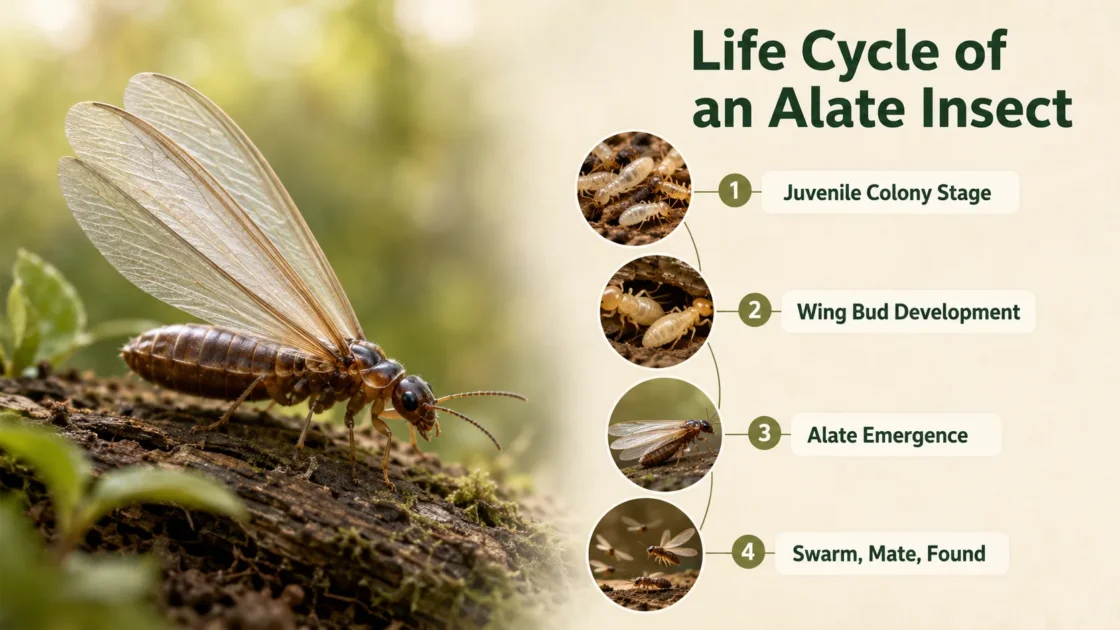
The central distinction
Alate describes wing condition and biological role, not one taxonomic group. An ant queen, a termite reproductive, and a dispersing aphid can all be alate while following very different reproductive pathways. The general meaning of alate therefore has to be separated from the life cycle of the particular insect being described.
Where the Alate Phase Begins
In social insects, the alate phase begins inside an existing colony. The colony produces individuals whose developmental and reproductive role differs from that of ordinary workers. In ants, workers do not simply age until they grow wings. Winged males and future queens are reproductive members of the colony. University of Minnesota Extension describes males and queens as the reproductive castes, with winged males leaving to mate and queens breaking off their wings after mating. [a]
Ant colonies produce a separate reproductive generation
A mature ant colony can invest resources in producing males and gynes, the reproductive females that may become queens. Until dispersal, these winged adults remain associated with the natal colony. Their role differs sharply from that of the wingless female workers that forage, maintain the nest, defend it, and care for brood.
When conditions appropriate to the species occur, reproductive ants leave during a mating flight. The conspicuous flying stage may last only a small fraction of the insect’s total life, but it is the point at which reproductive individuals can move genes away from the parent colony and potentially establish the next generation elsewhere.
Termite alates also develop as reproductives, but their caste pathway differs
Termite colonies contain reproductive and non-reproductive forms whose developmental pathways are different from those of ants. Mature colonies periodically produce winged male and female reproductives, commonly called alates or swarmers. These leave the colony for dispersal and reproduction rather than performing the feeding and nest-maintenance work carried out by worker-like castes. NC State Extension describes termite swarmers as winged reproductive adults produced by established colonies. [b]
The age at which a termite colony begins producing alates cannot be reduced to one universal number. It varies among species and colony conditions. For example, NC State reports that an eastern subterranean termite colony can mature in roughly three to five years before producing reproductive swarmers. That is a species-group reference, not a timetable for all termites. [i]
Aphids can switch between winged and wingless morphs
Aphids show why an alate cannot be treated as one fixed social-insect stage. Many aphid lineages can produce both alate and apterous forms. Wing production is part of aphid phenotypic plasticity: environmental information experienced by a population can alter the proportion or production of winged offspring. Research on aphid wing plasticity links alate production in various species with cues that can include crowding, host condition, predation, temperature, and photoperiod, although the response differs among species and life-cycle types. [d]
University of Minnesota Extension likewise notes that mature aphids may be wingless or winged. The winged aphid is therefore not a tiny equivalent of an ant queen. It is a dispersal morph embedded in an aphid reproductive system that can include repeated asexual generations, sexual generations, host switching, or simpler host-associated cycles depending on species. [e]
Three pathways from the winged form
Ant: reproductive development → alate → mating flight → female dealation → colony founding → workers → mature colony → new alates
Termite: reproductive development → alate → dispersal flight → male–female pairing → dealation → king and queen → growing colony → new alates
Aphid: population or seasonal cue → alate morph → dispersal → suitable host → reproduction and population growth → later morph changes
Why Produce a Winged Form at All?
Flight gives an insect access to places that a nest-bound reproductive or plant-bound feeder could not readily reach. At the population level, an alate can move away from its natal colony or host, encounter unrelated mates, reach unused habitat, colonize another plant, or escape local crowding. The exact benefit depends on the insect, but dispersal is the common biological thread.
Wings also carry costs. A flight-capable insect must develop wings, flight musculature, sensory systems, and an appropriate body form, then fuel movement. In aphids, the winged and wingless forms can differ in development, reproduction, morphology, and resource allocation. A population living on a suitable host may benefit from producing many wingless individuals that remain and reproduce locally, while conditions favoring movement can shift the advantage toward alates.
Weather can help trigger the departure of insects that are already reproductively prepared, but a rainstorm does not turn ordinary adult workers into alates. Winged forms are produced through developmental pathways before the visible flight begins.
The Ant Path: From Alate to Founding Queen
Ant reproductive flights are often called nuptial flights. Males and gynes emerge from established colonies and disperse to mate. The precise timing is species- and location-dependent. Temperature, moisture, recent rainfall, wind, time of day, season, and colony condition can all influence when particular species fly, so there is no universal calendar for an “ant alate season.”
Male and female life histories separate after mating
The male ant’s reproductive role is concentrated around mating. In many familiar ant life histories, males die relatively soon afterward and do not become permanent members of a newly founded nest. A successfully mated female faces a different problem: she must survive dispersal, find an acceptable founding site, and begin reproduction.
After landing, a female may remove or shed her wings. This transition is called dealation. The resulting reproductive is described as dealate. Wing scars can remain visible on the thorax after the wings are gone.
Dealation is part of a broader behavioral transition
Wing loss marks the end of the flight-oriented phase for many ant queens, but it should not be treated as a simple mechanical event that occurs identically in every species. The reproductive’s behavior and physiology are also changing as she shifts from dispersal toward nest founding and egg production.
Dealation research in fire ants
A 2025 study of Solenopsis invicta examined wing shedding in isolated virgin female alates and documented patterned timing of dealation even without normal post-mating colony-founding conditions. The result supports the view that dealation in this species is behaviorally and physiologically regulated rather than being only accidental wing breakage. It should not be used as a universal timetable for all ants. [g]
A founding queen does not always use the same strategy
Independent ant queens can differ in how they support the first brood. In claustral founding, a queen remains sheltered and raises the first workers largely from stored body reserves. In semi-claustral founding, the queen leaves the founding nest to forage while the first brood develops. Peer-reviewed work on ant colony founding describes both strategies and the trade-off between carrying sufficient reserves and exposing a foraging foundress to risks outside the nest. [f]
The first successful worker generation changes the colony’s organization. Workers can assume brood care, nest maintenance, defense, and foraging, allowing the queen to devote more of her activity and resources to reproduction. If the colony survives long enough and reaches the appropriate condition for its species, it may eventually produce its own winged reproductives. At the colony level, that production of new alates closes the reproductive cycle.
The Termite Path: Two Alates Can Become a King and Queen
Termites reach a very different post-flight outcome. Both male and female alates can participate in founding the new colony, and the male may remain as its king. UC Integrated Pest Management describes termite reproductives as winged alates before swarming and states that a male reproductive remains with the queen after colony establishment. [c]
After a dispersal flight, surviving termites land and lose their wings. Males and females locate partners and search for a protected site suitable for founding. The pair enters or constructs a small founding chamber, mates, and begins producing the first offspring. Early colony growth is often slow compared with the size that a mature termite colony may eventually reach.
Tandem behavior can connect flight with colony founding
Post-flight pairing can include tandem behavior, in which one termite closely follows the other during the search for a nesting location. The details differ among termite groups. UF/IFAS describes this sequence particularly clearly for the West Indian drywood termite, Cryptotermes brevis: alates shed their wings, a male and female pair, tandem together, locate a suitable opening in wood, and form a nuptial chamber. [h]
That species also demonstrates why colony-development numbers must remain taxon-specific. UF/IFAS reports alate production at roughly five years of colony age for C. brevis, whereas other termites have different developmental schedules. A number from one termite cannot define “the” alate life cycle for the entire group.
The king remains part of the reproductive unit
This is one of the clearest differences between ant and termite alates. A male ant normally does not accompany a queen through years of colony growth. A termite king can remain beside the queen as a functioning reproductive. As workers or worker-like individuals appear, they assume feeding, construction, brood care, and other colony tasks. Soldiers and additional reproductive pathways can develop later depending on the termite lineage.
The Aphid Path Does Not End With Dealation
Winged aphids follow a different biological logic. An alate aphid usually uses its wings to disperse to another host or another part of the habitat. It does not normally land, remove its wings, excavate a founding chamber, and become the queen of a eusocial colony.
In many aphids, several generations can be produced rapidly on a suitable host. When conditions favor dispersal, winged forms may appear and leave. An alate that reaches an acceptable host can feed and contribute to establishment of another population. Later generations may again be predominantly wingless if remaining on that host is advantageous.
Winged does not necessarily mean sexual
This is an especially useful distinction between aphids and the familiar ant-or-termite model. An alate aphid is not automatically a sexual reproductive. Many aphid species can produce winged females during parthenogenetic phases, when females produce offspring without the mating event expected in a nuptial flight. Other aphid life cycles include sexual forms at particular times of year. The exact sequence depends on the species.
Some aphids alternate between different seasonal hosts, while others remain associated with one host type. Some retain sexual and asexual phases; others have modified cycles. For this reason, an “aphid alate life cycle” cannot safely be represented as one fixed sequence of mating, wing loss, and nest founding.
Alate, Dealate and Apterous Describe Different Conditions
The terminology becomes easier once wing state is separated from age. Dealate and apterous are not interchangeable. A dealate individual previously possessed wings and subsequently lost them. An apterous morph is wingless as that form; it is not simply an alate whose wings disappeared.
| Term | Biological meaning | Previous functional wings? | Typical context |
|---|---|---|---|
| Alate | Winged form | Wings are currently present | Ant or termite reproductive; winged aphid morph |
| Dealate | Post-wing-loss adult | Yes | Ant queen or termite reproductive after flight |
| Apterous | Wingless form | Not simply the result of post-flight wing shedding | Common terminology for wingless aphid morphs |
A newly dealated ant queen and an apterous aphid may both appear wingless, yet they arrived at that condition through different developmental histories. That difference matters when reconstructing what stage of a life cycle has actually been observed.
What Controls the Timing of Alate Appearance?
Alates often appear abruptly because many individuals can become visible during a narrow dispersal period. The timing is produced by an interaction between the insect’s biology and its environment, not by one universal weather trigger.
- Colony or population condition: social-insect colonies must reach the reproductive state needed to produce alates; aphid populations can alter morph production as conditions change.
- Species biology: different species have different seasonal and daily flight patterns.
- Temperature: suitable temperatures can help determine when prepared reproductives emerge or fly.
- Moisture and rainfall: rain or increased humidity is associated with flights in some ants and termites, but the relationship is not universal.
- Time of day and light: some alates fly during daylight, others near dusk or at night.
- Host conditions: in aphids, crowding or deteriorating host quality can favor production of dispersal forms in many species.
- Seasonal cues: photoperiod and temperature can influence morph production and reproductive transitions, especially in aphids with seasonal cycles.
This is why a local observation such as “they flew after rain” can describe one swarm accurately without establishing a rule for every alate insect. Flight timing has to be interpreted at the species or regional level whenever precise seasonality matters.
Most Alates Do Not Complete the Founding Path
Producing many winged reproductives does not mean that each one will establish a colony or new population. Dispersal exposes insects to predators, unsuitable weather, dehydration, failure to locate mates, poor landing sites, and competition. A mated social-insect reproductive must then survive the vulnerable founding period and produce viable brood.
Termite colony founding illustrates the bottleneck clearly. UC IPM notes that only a small fraction of flying reproductives successfully pair and establish colonies, and only a fraction of those young colonies reach maturity. The large number of insects visible in a swarm should therefore not be read as the number of future colonies.
The same principle applies more broadly to dispersal: the alate phase creates opportunities for reproduction and movement, not guaranteed success.
Reading the Life-Cycle Stage From What Is Visible
Only a narrow portion of the cycle is normally visible without opening a nest or closely following a population. A flying insect, a recently dealated reproductive, and a pile of wings represent different biological moments.
| Observation | Life-cycle interpretation | What it does not establish by itself |
|---|---|---|
| Winged ants gathering near a nest opening | Reproductives are present and may be approaching a dispersal flight | Exact flight time or whether every individual will mate |
| Many ants in synchronized flight | Nuptial or reproductive dispersal activity | Number of colonies that will successfully be founded |
| Female ant walking with intact wings after a flight | Recently dispersed alate; mating or dealation status may still be uncertain | Whether she is mated or will establish a nest |
| Ant queen with visible wing scars | Dealate reproductive | Successful colony establishment |
| Male and female termites moving together after a swarm | Post-flight pairing or nest-site search is consistent with the observation | Whether the incipient colony will survive |
| Numerous detached termite-like wings | Recent alate presence and wing shedding may have occurred | Exact colony location, damage level, or species without additional evidence |
| Winged aphid on a plant | Dispersal or colonization phase is possible | That a large feeding population is already established on that plant |
One Word Covers Three Different Life-Cycle Strategies
| Life-cycle feature | Ant alate | Termite alate | Aphid alate |
|---|---|---|---|
| Typical biological role | Sexual reproduction and dispersal | Sexual reproduction and dispersal | Dispersal; reproductive mode varies with species and season |
| Where the winged form originates | Ant colony reproductive caste | Termite colony reproductive pathway | Wing polyphenism within an aphid population or lineage |
| Mating tied to the visible alate phase? | Usually associated with reproductive flight | Associated with post-dispersal pairing and reproduction | Not necessarily |
| Typical female post-flight outcome | May shed wings and attempt colony founding | May pair with a male, shed wings, and found a colony | May colonize a suitable host and reproduce |
| Typical male post-flight outcome | Usually no lasting role in a newly founded colony | Can remain as the king of the new colony | Depends on the species and seasonal life cycle |
| Dealation central to the pathway? | Common in founding queens | Common in founding reproductives | No equivalent standard pathway |
| New social colony formed? | Potentially, by a successful queen or another species-specific strategy | Potentially, by a reproductive pair | No eusocial colony equivalent |
| Later production of more alates | Possible after colony maturation | Possible after colony maturation | Possible in later generations as environmental or seasonal conditions change |
The Life Cycle Closes at the Next Dispersal Generation
For an ant colony, the broader cycle can run from a mature colony to winged reproductives, mating, a founding queen, the first workers, colony growth, and eventually another reproductive generation. For termites, it can run from mature colony to swarmers, a surviving male–female pair, a king and queen, colony growth, and later production of new alates.
Aphids close the dispersal cycle differently: environmental and seasonal conditions can favor a winged morph, the alate leaves, reaches another host, reproduces, and subsequent generations may later produce additional winged forms. The recurring feature is movement between generations and places, not a single universal sequence of developmental stages.
That is the most accurate way to understand the life cycle of an alate insect. Alate is a temporary biological condition embedded within a larger ant, termite, aphid, or other insect life history. The wings explain how the insect disperses; the insect group determines what happens next.
Sources and Verification
- University of Minnesota Extension — Ants — Ant reproductive castes, swarming, mating, male fate, queen wing loss, and nest founding. [a]
- NC State Extension — Termite Swarmers: What Do They Mean for You? — Termite swarmers as reproductive adults and their dispersal role. [b]
- University of California IPM — Subterranean and Other Termites — Termite social structure, alates, post-flight colony founding, queen-and-king biology, and founding mortality. [c]
- Deem et al. — Evolution and Molecular Mechanisms of Wing Plasticity in Aphids — Peer-reviewed review of aphid wing polyphenism and environmental control of winged and wingless forms. [d]
- University of Minnesota Extension — Aphids in Home Yards and Gardens — Winged and wingless adult aphid forms and general aphid biology. [e]
- Szabó et al. — Claustral Colony Founding Is Limited by Body Condition in Ant Queens — Claustral and semi-claustral founding strategies and their biological trade-offs. [f]
- Huang et al. — Dealation Pattern of Independent and Alate Virgin Females of Solenopsis invicta — 2025 experimental evidence on patterned wing shedding in red imported fire ant females. [g]
- University of Florida IFAS — West Indian Drywood Termite, Cryptotermes brevis — Species-specific alate emergence, dealation, tandem behavior, nuptial chamber formation, and colony maturation. [h]
- NC State Extension — Monitoring and Management of Eastern Subterranean Termites — Eastern subterranean termite colony maturity and reproductive-swarmer production. [i]