Some insects have wings because flight helps them disperse, find mates, escape deteriorating habitat, or reach new resources. Others are wingless because their lineage predates the origin of insect wings, because flight was later reduced or lost, or because only certain members of the same species need to fly. Winglessness is therefore not one biological condition. It can reflect ancestry, evolution, development, sex, social caste, environmental cues, life stage, or the loss of wings after they have already served their purpose.
That distinction matters because two insects with no visible wings can have very different histories. A silverfish belongs to a primarily wingless lineage. A flea descends from winged ancestors but is secondarily wingless. A worker ant develops as a wingless caste, while a queen of the same colony may begin adult life with wings. An aphid population can contain both winged and wingless morphs. A caterpillar has no wings because it has not yet reached the winged adult stage. A queen ant that has shed her wings is dealate: wingless now, but previously winged.
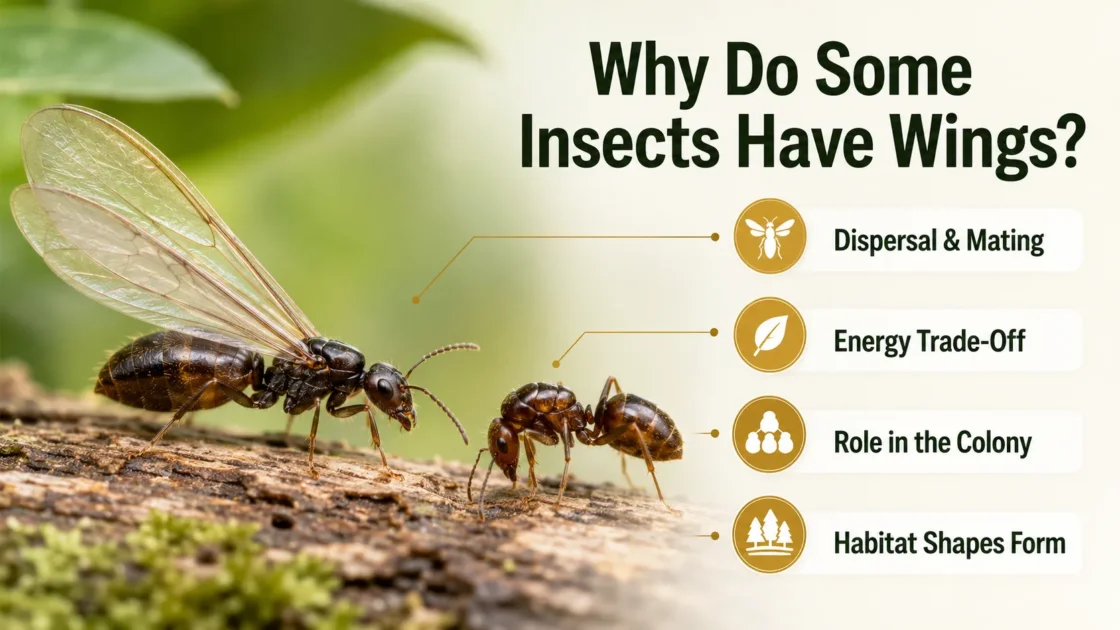
There Is More Than One Way to Be Wingless
The broadest useful distinction is between insects whose ancestors did not possess the wings of Pterygota and insects whose lineage had wings but later changed them, restricted them to certain individuals, or abandoned them. Archaeognatha, the jumping bristletails, and Zygentoma, which includes silverfish and firebrats, occupy early branches of insect evolution outside the winged-insect clade Pterygota. Modern phylogenetic work places Zygentoma close to the winged insects while retaining its primarily wingless condition.[a]
| Condition | What it means biologically | Typical context |
|---|---|---|
| Primary or ancestral winglessness | The lineage diverged before the winged-insect condition represented by Pterygota. | Jumping bristletails, silverfish, firebrats |
| Secondary wing loss | Winged ancestors gave rise to descendants in which wings or flight ability were reduced or lost. | Fleas, lice, many flightless beetles and other lineages |
| Reduced wings | Wings still develop but are shortened, vestigial, or unable to support normal flight. | Brachypterous forms in many insect groups |
| Alternative wing morphs | The same species can produce long-winged, short-winged, or wingless individuals. | Aphids, planthoppers, crickets and other insects |
| Caste-specific wings | Wing development differs according to an individual’s role in a social colony. | Ant and termite reproductives versus workers |
| Sex-specific wings | Males and females follow different wing-development programs. | Various cockroaches, moths, wasps and other insects |
| Stage-specific absence | The insect has not yet reached the life stage in which adult wings develop. | Caterpillars, beetle larvae, fly larvae, grasshopper nymphs |
| Dealation | An adult developed wings and later shed or lost them. | Many ant and termite reproductives after dispersal |
Wingless, flightless and dealate are not synonyms
A flightless insect may still have full-sized wings. An apterous insect or morph lacks wings. A brachypterous insect has reduced wings. A dealate insect had developed adult wings and subsequently lost them. The visible result can look similar even though the developmental history is different.
Why Keep Wings if Flight Is Expensive?
Flight gives insects access to opportunities that walking cannot easily provide. A flying adult can leave a depleted food source, move between isolated habitat patches, locate mates over a larger area, escape some local disturbances, follow seasonal resources, or establish populations beyond the place where it developed.
Those benefits require much more than a pair of thin membranes. Functional insect flight depends on the wings, their articulations with the thorax, flight musculature, sensory feedback, nervous control, respiration and the supply of metabolic fuel. Maintaining effective flight can therefore compete with other uses of resources. That does not mean that every wingless insect has redirected a predictable quantity of energy into reproduction, or that reproduction always rises when flight disappears.
Experiments illustrate why the trade-off cannot be reduced to a single rule. In the cockroach Eublaberus distanti, experimental wing removal did not improve the measured female fecundity traits, while males with altered wings experienced lower mating success because wings also take part in courtship. Wings can therefore have functions whose value depends on sex, behavior and species biology, even when long-distance flight is not the only issue.[b]
When Staying Local Becomes a Better Strategy
Flight is most useful when movement produces a return. If an insect lives in a habitat where food, shelter and mates are predictably nearby, dispersal may provide less benefit. Natural selection can then favor reduced investment in flight, especially when flying also creates a risk of leaving suitable habitat.
Wind can make dispersal costly
Remote islands provide a clear example of that balance. The idea that strong winds can favor flightlessness on islands dates back to Darwin, but modern comparative data allow the hypothesis to be tested instead of assumed. A study of insect flight loss across remote Southern Ocean islands found that mean wind speed had the strongest effect among the environmental variables examined, while also showing that wind was not the only explanation for the distribution of flightless insects.[c]
Similar logic can apply in cold, exposed, subterranean, cave-like or highly localized habitats, but the relationship is never automatic. Many insects living in harsh environments still fly. Habitat, lineage history, body size, reproductive biology, resource distribution and dispersal risk interact differently among groups.
A permanent host can reduce the value of long-distance flight
Parasites offer another route toward flight loss. Fleas and lice belong to lineages whose ancestors were winged, yet their present lifestyles depend heavily on remaining on, reaching, or moving around a host. In such a setting, structures that improve attachment, crawling through hair or feathers, or movement within a confined host-associated environment may matter more than an adult flight apparatus.
The broader evolutionary pattern is repeated in many unrelated insects: once dispersal by flight becomes less useful, flight ability can be reduced independently in different lineages. Research on carrion beetles, for example, found greater geographic genetic differentiation in flightless species and examined how reduced dispersal can alter diversification after flight is lost.[d]
The Same Species Can Have More Than One Wing Design
Species do not always belong permanently in either a “winged” or “wingless” box. Insects with wing polymorphism or wing polyphenism can produce alternative adult forms. One form may have fully developed wings and flight muscles, while another has shorter wings, greatly reduced wings, or no functional flight apparatus.
Polymorphism is often used when genetically influenced alternative forms occur within a species. Polyphenism emphasizes different phenotypes produced from the same or similar genotype in response to developmental or environmental conditions. Real insect systems can contain both genetic and environmental effects, so the boundary is not always captured by a simple either-or label.
A developmental switch can change the value of dispersal
The brown planthopper Nilaparvata lugens is a well-studied example. Experimental work showed that two insulin receptors have opposing effects on long-winged versus short-winged development through insulin-signaling activity and the transcription factor FoxO. The result demonstrates that alternative wing forms can arise through a regulated developmental decision rather than through physical damage to otherwise identical adults.[e]
The underlying biology continues to become more detailed. A 2026 single-cell study compared wing buds destined to become long- and short-winged forms in N. lugens and the firebug Pyrrhocoris apterus. The researchers identified shared cell types in the alternative morphs and found that long-wing development depended heavily on a longer period of cell proliferation, with particular wing-patterning and cell-cycle genes required for that outcome. Short-wing development was therefore associated with changes in how a shared developmental program was regulated, not with the absence of all machinery capable of producing a wing.[f]
Aphids Can Shift Between Staying and Dispersing
Aphids make the ecological meaning of alternative wing forms especially easy to see. Many aphid species can produce both apterous, wingless forms and alate, winged forms. When a host plant remains suitable, local reproduction can be highly effective. Under conditions that favor movement, a winged form can leave and colonize another plant.
Crowding is one well-documented cue, but “aphids grow wings when crowded” is too crude. Responses vary among aphid species, life stages and conditions, and other influences can include host quality, predators, season and genetics. In pea aphids, experimental manipulation of ecdysone signaling altered the proportion of winged offspring produced in response to crowding, showing that the mother’s environment can affect the developmental fate of offspring through endocrine regulation.[g]
An adult wingless aphid therefore does not normally encounter a crowded leaf and suddenly manufacture a full pair of wings. The switch acts through development. Depending on the species and reproductive system, conditions experienced by the mother or developing young can influence which morph is produced. The distinction between these forms is covered more narrowly in alate versus apterous aphids.
Social Colonies Can Reserve Flight for the Individuals That Need It
Ants and termites solve the flight question at the colony level. Instead of making every individual capable of leaving by air, their societies can produce winged forms for reproduction and dispersal while maintaining large numbers of wingless individuals that work within the colony.
Ant workers and ant alates are different developmental outcomes
In the familiar ant colony pattern, workers are wingless females responsible for activities such as foraging, brood care, nest maintenance and defense. Winged reproductive males and females are produced in much smaller proportions and can leave on mating and dispersal flights. Colorado State University Extension describes this basic contrast between overwhelmingly wingless workers and the smaller reproductive component of the colony.[h]
A worker ant is not simply a queen whose wings disappeared. Ordinary workers and winged reproductive females follow different caste-development pathways. This is why two wingless ants can mean different things: one may be a worker that never developed reproductive flight wings, while another may be a queen that previously flew and later discarded them. The word alate describes the winged form; it is not another name for worker, queen, male, or species.
Termite colonies also separate flight from colony work
Mature termite colonies can produce winged reproductive adults called alates or swarmers. These individuals disperse from the established colony, whereas workers and soldiers perform local colony functions without adult flight wings. University of Maryland Extension describes alates as the winged reproductive offspring produced periodically by mature colonies for dispersal and colony initiation.[i]
Termite development also warns against treating every caste system as identical to ants. Termite developmental pathways can be unusually flexible, and different termite groups do not all organize worker and reproductive development in exactly the same way. The useful broad distinction is narrower: the colony can maintain wingless local forms while producing winged dispersers when reproduction away from the colony is required.
Sex Alone Can Change Whether Wings Develop
In some insects, wing development differs sharply between males and females. One sex may retain functional wings while the other develops shorter wings or becomes effectively wingless. These differences occur in several unrelated insect groups, showing that sexual wing dimorphism has evolved repeatedly rather than belonging to one unusual lineage.
A 2026 study in Nature Ecology & Evolution examined female-specific wing regression across insects and experimentally investigated its developmental control in cockroaches. The work linked sex-specific forms of the sex-determination regulator Doublesex, or DSX, with different regulation of E93 during wing development. In the studied system, that regulatory difference promoted wing morphogenesis in males while suppressing wing-blade development in females.[j]
This gives a molecular explanation for a pattern that can otherwise look puzzling in the field: a winged male and wingless female can belong to the same species. Their difference may be part of the normal sex-specific developmental program rather than evidence that one individual is immature, injured, or a separate species.
A Young Insect Without Wings May Still Become a Winged Adult
Life stage creates another source of confusion. A caterpillar, beetle larva or fly larva belongs to a species that may have fully winged adults, but its larval body is not yet the adult flying body. During complete metamorphosis, adult structures develop through the larval and pupal developmental program before the adult emerges.
In insects with incomplete metamorphosis, the transition is more gradual. A young grasshopper or true bug is a nymph rather than a miniature adult with its wings missing. Wing pads become progressively apparent during development, and functional adult wings are completed at the adult molt in normally winged forms.
No wings visible now does not necessarily mean a wingless adult form
Age should be considered before interpreting winglessness. An immature insect, an adult apterous morph and an adult that has shed its wings can all lack obvious wings for entirely different reasons.
Having Wings and Being Able to Fly Are Different Traits
Wing evolution does not produce only two states. Some insects retain long, normally developed wings; others have shortened wings; others possess external wings but lack the muscular or physiological capacity for sustained flight. Flightlessness can therefore evolve before the wings disappear completely.
Entomological descriptions commonly use terms such as macropterous for long-winged forms and brachypterous for short- or reduced-winged forms. Apterous indicates a wingless condition. Usage can vary somewhat among taxonomic groups, so the terminology is most useful when paired with an actual description of wing development and flight ability.
This distinction also prevents a common evolutionary mistake. A lineage can lose effective flight while retaining visible wings for a time. Wings may also perform functions unrelated to long-distance locomotion, including roles in courtship, signaling, protection or other behaviors depending on the insect.
Losing Wings After Flight Is a Separate Biological Event
Ant and termite reproductives introduce one more route to a wingless appearance: dealation. A dealate insect developed adult wings first and lost them later, commonly around the transition from dispersal to colony founding. The wings have already performed their movement function before being discarded.
For that reason, an ant queen after a mating flight and a worker from the same colony should not both be described simply as “naturally wingless” without qualification. The queen’s current condition contains evidence of an earlier alate phase; the worker’s developmental pathway did not include the same reproductive flight form. The biology and evidence used to recognize that transition are treated separately in dealation and post-flight wing loss.
Detached wings can support a dealation interpretation, but loose wings alone do not establish everything that happened beforehand. In ants and termites, wing shedding may follow dispersal, but the presence or absence of wings by itself does not prove mating success, identify the exact species, or establish the condition of a colony.
Wing Loss Is an Old and Repeated Evolutionary Outcome
Secondary wing reduction has appeared independently across many branches of winged insects. That repetition is evidence that flight can be extremely valuable without being universally favored under every ecological condition. Selection acts on the reproductive consequences of a body plan in a particular environment, not on a ladder in which “more flight” automatically means “more evolved.”
Fossils show that alternative wing states are not confined to modern insects. A 2026 study described three species of the extinct wasp genus †Chaetochrysis from mid-Cretaceous Kachin amber. One species was fully winged, another preserved the condition interpreted as wings having been shed, and a third was wingless and lacked the tegulae and ocelli associated with the winged condition. The authors placed the fossils in the new family †Chaetochrysididae and interpreted them as rare fossil evidence for wing polymorphism in Hymenoptera.[k]
The fossil pattern is useful because it preserves three states that are still biologically meaningful: fully winged, previously winged, and wingless. They can look like points on a simple progression, but modern insects show that similar external states can arise through different genetic, developmental and ecological routes.
What a Wingless Specimen Can—and Cannot—Reveal
The absence of visible wings is a useful observation, but it is rarely enough by itself to explain why an insect is wingless. The surrounding biology narrows the possibilities.
- First consider life stage. A larva or nymph may simply be too young to possess adult wings.
- Look for reduced rather than absent wings. Short wing pads or vestigial wings point toward wing reduction, developmental stage, or a short-winged morph rather than complete aptery.
- Consider sex. If the opposite sex is normally winged, sexual wing dimorphism may explain the difference.
- Consider social caste. In ants and termites, colony role can be more informative than species identity alone when interpreting wings.
- Ask whether the species produces alternative morphs. Aphids, planthoppers and other insects can contain winged and wingless individuals within one species.
- Look for evidence of previous wings. Wing bases, scars, or associated shed wings can support a dealate interpretation in the appropriate group.
- Separate wings from flight ability. Visible wings do not prove that the insect can fly effectively.
The biological question is therefore not simply whether an insect has wings. It is whether flight is part of that lineage, that species, that sex, that caste, that developmental stage, and that individual’s current life-history strategy.
Why Evolution Keeps Producing Both Solutions
Wings remain extraordinarily effective when an insect benefits from moving between separated resources, escaping a deteriorating patch, locating distant mates, migrating, or colonizing new habitat. Winglessness can persist when movement is less valuable, when staying attached to a host is more useful, when dispersal is unusually risky, or when only a subset of a population needs flight.
Development makes that evolutionary flexibility even greater. A species does not always have to commit every individual to the same design. Environmental cues can alter wing morphs. Sex-determination pathways can produce different wings in males and females. Social colonies can assign flight to reproductive castes. Individuals can complete a dispersal flight and then shed the wings entirely.
That is why a silverfish, a flea, a worker ant, a wingless aphid, a caterpillar and a dealate queen should not be grouped under one explanation simply because none currently shows a functional pair of wings. The visible absence of wings is the endpoint; the biology that produced it is the real distinction.
Sources
- Song et al., Scientific Reports — mitochondrial phylogeny of palaeopteran insects and the relationship of primarily wingless Archaeognatha and Zygentoma to Pterygota [a]
- Kotyk & Varadínová, Scientific Reports — experimental study of wing reduction, reproduction and male mating success in cockroaches [b]
- Leihy & Chown, Proceedings of the Royal Society B — wind and the prevalence of insect flight loss on remote islands [c]
- Ikeda et al., Nature Communications — flight loss, geographic differentiation and diversification in beetles [d]
- Xu et al., Nature — two insulin receptors controlling alternative wing morphs in the brown planthopper [e]
- Wan et al., Nature Communications (2026) — single-cell analysis of long- and short-wing development in two hemipteran insects [f]
- Vellichirammal et al., Proceedings of the National Academy of Sciences — ecdysone signaling and crowding-induced transgenerational wing polyphenism in pea aphids [g]
- Colorado State University Extension — ant colony castes, wingless workers and winged reproductive forms [h]
- University of Maryland Extension — termite alates as winged reproductive offspring of mature colonies [i]
- Liao et al., Nature Ecology & Evolution (2026) — developmental regulation of female-specific wing regression in insects [j]
- Wu et al., Gondwana Research (2026) — Cretaceous fossil evidence for fully winged, shed-wing and wingless conditions in †Chaetochrysididae [k]