Alate insects have developed wings; apterous insects or morphs are wingless. That distinction sounds simple, but the biological meaning depends on the insect. In aphids, alate and apterous individuals may be alternative forms of the same species. In ants and termites, wings are closely tied to reproductive caste and dispersal. In other insects, apterous may describe a wingless sex, a wingless morph, or an adult body plan in which wings are absent.
Neither word identifies a taxonomic group. Alate describes a wing-bearing condition or form, while apterous means without wings.[a][b] The distinction becomes more useful when wing state is connected to development, dispersal, reproduction and caste.
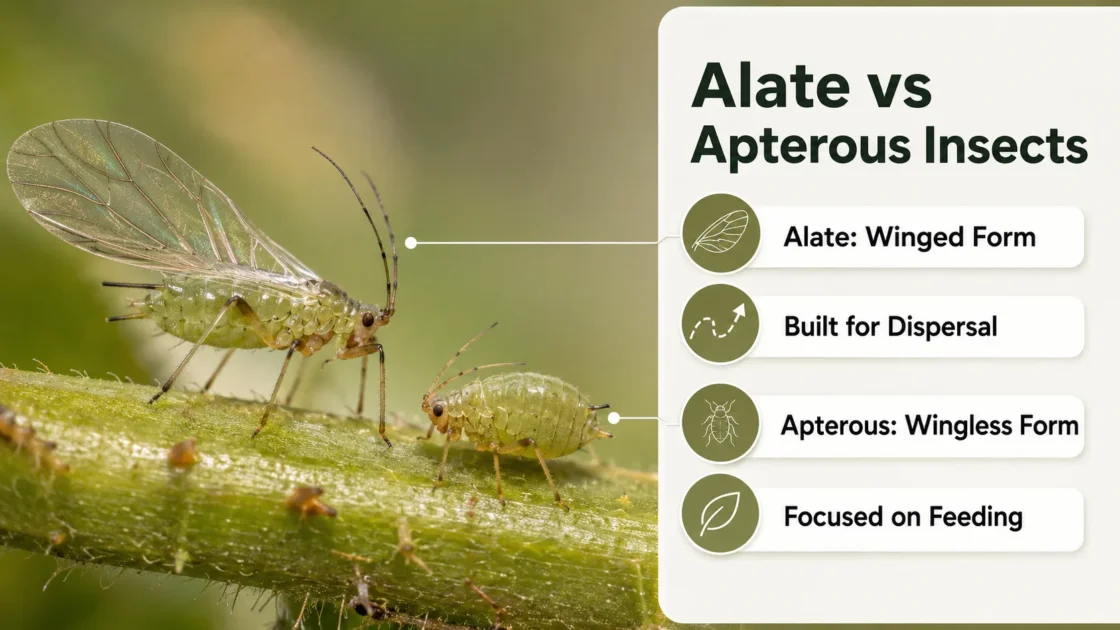
| Feature | Alate | Apterous |
|---|---|---|
| Adult wings | Developed wings are present in the form being described | Wings are absent |
| Taxonomic meaning | Not a species, family or order | Not a species, family or order |
| Common biological association | Dispersal, migration or reproductive flight, depending on the insect | Local feeding, reproduction, colony work or another non-flight role, depending on the insect |
| Can both occur in one species? | Yes, in many wing-polymorphic or polyphenic insects | Yes, in many wing-polymorphic or polyphenic insects |
| Same as dealate? | No | No. A dealate individual previously possessed wings |
Alate and apterous describe form, not taxonomic rank
An insect does not belong to an “alate species” merely because a specimen has wings. The same applies to apterous insects. These words can describe different physical forms within one species, different castes within a colony, different sexes, or a broader adult condition.
This distinction is especially clear in aphids. A single genetic lineage can produce winged and wingless individuals. By contrast, an ant worker and an alate queen belong to different castes even though they may belong to exactly the same species. In termites, colony development can produce wingless workers and soldiers as well as winged reproductive alates.
Terminology matters
Wingless does not automatically mean “an alate that lost its wings.” An insect that developed as a wingless form can be apterous. An adult reproductive that developed wings and later shed them is better described as dealate where that terminology applies.
The physical difference can extend beyond the wings
Wings are the defining visible distinction, but alternative wing forms can differ elsewhere in the body. A flight-capable adult must develop structures that support wing movement and flight. In wing-polymorphic insects, the winged and wingless forms may also differ in thoracic proportions, flight musculature, sensory anatomy, pigmentation, behavior and reproductive allocation. Which traits change depends on the species.
That is why removing the wings from an alate would not make it anatomically equivalent to an apterous morph. The developmental history of the two forms can be different even when both eventually appear wingless.
A 2026 aphid study found differences in sensory anatomy
Research on the aphid Semiaphis heraclei provides a direct example. Researchers compared adult alate and apterous morphs using scanning electron microscopy. The alates had antennae averaging 973.7 ± 12.1 µm, compared with 728.1 ± 9.4 µm in the apterous morphs—a 1.34-fold difference driven mainly by elongation of the flagellum.[c]
The difference also reached microscopic sensory structures. Secondary rhinaria were found only on the alate antennae in the specimens examined, while some primary rhinaria were larger in alates. The authors interpreted these traits in relation to the different ecological roles of dispersing alates and host-resident apterous aphids.[d]
Species-specific evidence
The Semiaphis heraclei measurements should not be treated as universal dimensions for aphids. They demonstrate that an alate–apterous difference can involve sensory morphology as well as wings.
The biological contrast changes between aphids, ants and termites
The words remain connected to wing state, but why the two forms exist differs among insect groups. Treating every alate as the same biological category can therefore be misleading.
| Insect context | Alate form | Apterous or wingless form | Main biological distinction |
|---|---|---|---|
| Aphids | Winged morph associated with dispersal and movement between hosts or habitats | Wingless morph that can remain on a suitable host | Alternative dispersal and resident strategies within a species |
| Ants | Winged reproductive male or female | Workers are naturally wingless; queens later may also be wingless after dealation | Reproductive dispersal versus colony caste roles |
| Termites | Winged reproductive male or female, commonly called a swarmer | Workers and soldiers are wingless; some other reproductive forms can also lack wings | Colony dispersal and founding versus established-colony roles |
| Other wing-polymorphic insects | Fully winged morph where one occurs | Wingless morph where one occurs | Often reflects alternative dispersal strategies, but the developmental mechanism varies |
Aphids can produce alate and apterous forms from the same genetic background
Aphids are one of the clearest examples of wing polyphenism. In species with environmentally responsive wing production, the same genotype can produce different adult phenotypes. Crowding is a well-studied cue in the pea aphid Acyrthosiphon pisum, but the response is not an identical switch in every genetic line.
A 2025 study of pea aphids found wide genetic variation in how strongly different lines responded to crowding by producing winged offspring. Experimental crosses supported a multigenic basis for variation in wing plasticity.[e] Environmental conditions therefore matter, but they operate through developmental systems whose responsiveness can itself vary genetically.
This also explains why “crowding causes wings” is too absolute as a general rule. Crowding can promote alate production in well-studied aphids, yet species, genotype, life cycle and environmental context affect the response. The broader biology of winged aphids is distinct enough to remain a separate subject from the cross-insect terminology used here.
In ants, “alate” is tied to the reproductive caste
For ants, alate usually refers to a winged reproductive, not simply any ant that happens to fly. Adult workers are wingless. Reproductive females and males develop wings before dispersal flights in species that use this strategy.
UF/IFAS describes the reproductive adults of Florida carpenter ants as alates and distinguishes them from workers. After mating and wing loss, a female reproductive may be described as a dealate queen rather than an apterous worker-like form.[f]
Termites add another layer because several wingless castes coexist with alates
A mature termite colony can contain wingless workers, wingless soldiers and winged reproductive alates. University of Georgia termite biology material describes alates as adult winged reproductives with functional wings and eyes, while workers and soldiers are wingless colony castes.[g]
Termites also show why a simple permanent division between “winged individuals” and “wingless individuals” can fail. In the subterranean termites described by the same source, individuals in worker pathways can pass through a nymphal stage with wing buds before developing into adult alates. The eventual wing condition depends on caste-development pathways, not on an adult worker suddenly producing finished wings.
Apterous is not the same as dealate
This distinction becomes important when an ant or termite reproductive is found without wings. Apterous describes winglessness. Dealate describes a history of wing loss: the adult previously possessed developed wings and later shed or lost them.
| Term | Present wing condition | Developmental meaning |
|---|---|---|
| Alate | Developed wings present | Wing-bearing form |
| Apterous | Wings absent | Wingless form or condition; the exact reason depends on the insect |
| Dealate | Wings no longer present | Previously winged adult that has shed or lost its wings |
| Brachypterous | Short or reduced wings present | Adult is short-winged rather than fully wingless |
Shortened wings should therefore not automatically be labeled apterous. Entomological terminology uses brachypterous for adults with shortened or reduced wings.[h] Other specialized terms may be used for particular degrees or forms of wing reduction.
For ants and termites, the distinction between apterous and dealate is especially useful because a post-flight queen may look wingless at first glance while retaining anatomical evidence of earlier wings. Dealation describes that transition in detail.
Can an apterous insect later become alate?
The answer depends on what is being called apterous and on the insect’s developmental system.
- In an adult aphid morph: an individual that completed development as an apterous adult does not later switch into an alate adult. A colony or genetic line can produce winged offspring in another generation.
- In adult worker ants: workers do not transform into winged reproductive alates after reaching the adult worker form.
- In termites: developmental pathways are less easily reduced to that rule. In some termites, immature individuals can enter a nymphal pathway, develop wing buds and eventually emerge as adult alates.[g]
The useful distinction is between an existing adult changing form and development producing a different adult form. Alternative morphs are normally established through development rather than by attaching wings to an already completed apterous adult.
Winglessness can represent specialization rather than an incomplete body form
An apterous insect should not be interpreted as a defective version of an alate. In insects that produce both forms, each can be suited to a different biological role. An alate aphid can disperse to another host, while an apterous morph can remain and reproduce on a suitable plant. Ant workers carry out colony tasks without adult wings. Termite workers and soldiers also operate as wingless castes while alates perform reproductive dispersal.
Flight requires a developmental investment in wings, associated thoracic structures and flight machinery. Where dispersal has high value, the winged form provides access to new habitat, hosts or mates. Where an individual remains within an established host or colony, the biological value of wings can be very different. The balance is species-specific, so “alate equals better” and “apterous equals less developed” are both poor interpretations.
How to interpret the terms in an insect description
Wing condition can usually be described more accurately by asking what happened during development rather than looking only at whether wings are visible at the moment.
- If an adult has normally developed wings and the taxonomic context uses the term, alate may be appropriate.
- If that form develops as an adult without wings, apterous may be appropriate.
- If the adult previously had wings and shed them, especially in reproductive ants or termites, dealate is the more informative description.
- If wings remain present but are conspicuously shortened or reduced, terminology such as brachypterous may fit better than apterous.
The shortest accurate distinction
Alate: wings are developed and present. Apterous: the form is wingless. Dealate: the adult was winged and subsequently lost the wings. The biological role behind those conditions must be interpreted from the insect group, caste, sex and developmental context.
Sources
- Amateur Entomologists’ Society — Alate. Terminological definition of alate as a wing-bearing condition and its common entomological usage. [a]
- Amateur Entomologists’ Society — Apterous. Definition and usage of apterous for insects without wings. [b]
- Jing, Wang, Guo & Xu — Journal of Insect Science (2026). Morphometric comparison of alate and apterous Semiaphis heraclei, including antennal length. [c]
- Jing, Wang, Guo & Xu — Antennal sensilla in alate and apterous Semiaphis heraclei. Documents alate-specific secondary rhinaria and differences in primary rhinaria dimensions. [d]
- Driscoll et al. — Journal of Heredity (2025). Experimental evidence for genetic variation and a multigenic basis in pea aphid wing plasticity. [e]
- University of Florida IFAS — Florida and Tortugas Carpenter Ants. Describes winged ant reproductives as alates and a queen after wing shedding as dealate. [f]
- University of Georgia — Biology of Subterranean Termites. Termite caste biology, alate development, wingless workers and soldiers, and the nymphal pathway to winged adults. [g]
- Amateur Entomologists’ Society — Brachypterous. Defines the short- or reduced-wing condition used to distinguish reduced wings from complete winglessness. [h]