Termite swarmers are the winged reproductive members of a termite colony, also called alates. They are produced by mature colonies for dispersal and reproduction rather than wood feeding. A typical swarmer has two pairs of wings of roughly equal length, straight or beadlike antennae, and a broad body without the narrow waist seen in winged ants. After a flight, surviving males and females land, shed their wings, pair, and may attempt to establish a new colony. Swarmers found indoors deserve closer inspection, while an isolated outdoor swarmer can simply reflect nearby natural termite activity.
Last reviewed: August 2026
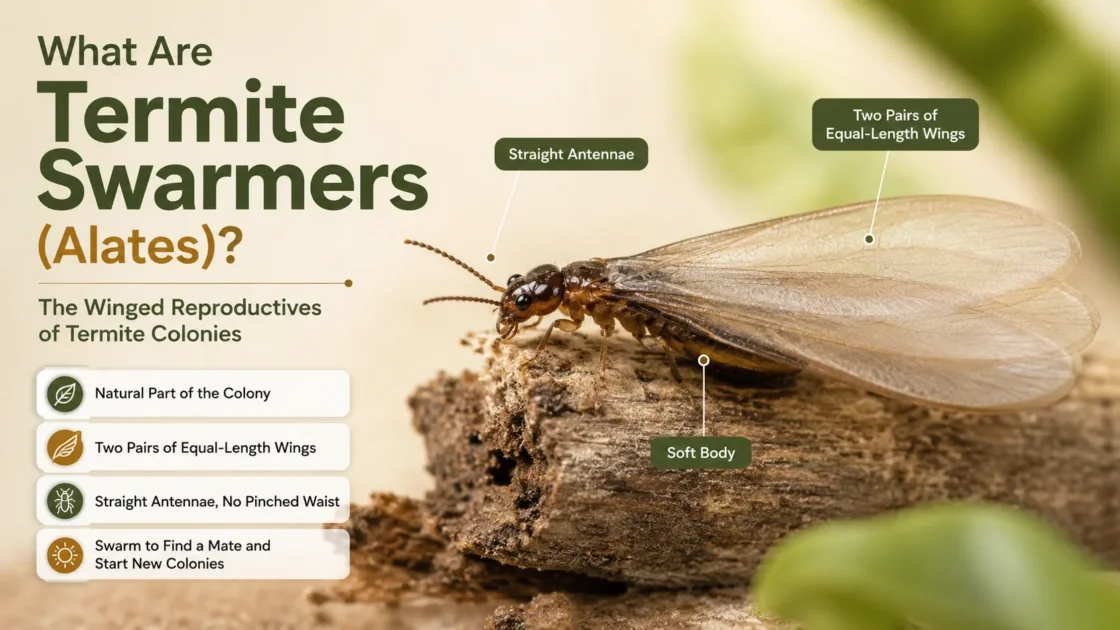
Termite Swarmer, Alate, and Colony Caste
A termite swarmer is not a separate termite species. It is a reproductive caste produced within a termite colony. UF/IFAS describes termite colonies as containing workers, soldiers, and reproductives. Workers perform most feeding and colony labor, soldiers defend the colony, and winged reproductives are the forms commonly called swarmers or alates. [a]
The word alate refers to the winged form. In termite discussions, swarmer usually refers to an alate participating in a reproductive flight. A mature colony may release many alates over a short period, allowing males and females to disperse beyond the parent colony.
| Term | Role | Winged? | Main Function |
|---|---|---|---|
| Swarmer / alate | Reproductive caste | Yes, before the wings are shed | Dispersal, pairing, and colony founding |
| Worker | Colony labor and feeding caste | No | Foraging, feeding, nest work, and care of colony members |
| Soldier | Defense caste | No | Colony defense |
| Established king and queen | Primary reproductive pair | Wings lost after the founding flight | Reproduction inside the established colony |
Anatomy of a Termite Swarmer
For field identification, the most useful visible parts are the wings, antennae, and body shape. University of Maryland Extension uses these same features to separate termite swarmers from winged ants. [b] Size and color can support an identification, but both vary among termite species and should carry less weight than structure.
Wings
A termite swarmer has two pairs of membranous wings. The front and hind pairs are usually similar in length and general shape, so all four wings extend beyond the body in a relatively even profile. This is one of the easiest characters to check when an intact insect is available. Winged ants usually have noticeably larger front wings than hind wings. [b]
Termite alates are built to lose their wings after dispersal. Detached wings may therefore remain after the insects have landed. Groups of similar pale or silvery wings can accumulate on floors, windowsills, near doors, around light sources, or in spider webs. A loose wing by itself is less useful than an intact swarmer because body characters are no longer available for comparison.
Antennae
Termite swarmers have antennae that appear straight, beadlike, or gently curved rather than sharply elbowed. Winged ants have a distinct bend in the antenna. Small specimens may require magnification before this feature can be judged reliably.
Waist and Body Shape
The termite body does not narrow into the strongly constricted waist typical of ants. From above, the body appears broader through the connection between the middle and rear portions. A winged ant has a visibly narrowed waist, often making the rear body section look more clearly separated.
Size and Color
UF/IFAS gives a general length of about 1/4 to 3/8 inch for winged termite alates in its termite overview. [a] That range should not be treated as a universal species measurement. Swarmer size, body color, wing tint, and other details vary among subterranean, drywood, dampwood, and other termite groups.
Termite Swarmer vs Flying Ant
Flying ants are the insects most often confused with termite swarmers. Check antennae, waist, and the relative length of the wing pairs before relying on color or where the insect was found. University of Maryland Extension lists straight antennae, equal-sized wings, and the absence of a constricted waist as the main visible termite characters. [b]
| Feature | Termite Swarmer | Flying Ant | How to Check |
|---|---|---|---|
| Antennae | Straight, beadlike, or gently curved | Elbowed or distinctly bent | View the head with a hand lens or close photograph |
| Waist | Broad, without a narrow constriction | Clearly pinched | Look from above or from the side |
| Front and hind wings | Roughly equal in length | Front wings noticeably larger than hind wings | Compare both pairs while they remain attached |
| Loose wings | Groups of shed wings are frequently found after a swarm | Less useful without the insect body | Save wings together with any intact insects |
| Color | Varies by termite species and group | Also highly variable | Do not use color as the deciding character |
An intact insect usually provides better identification evidence than a loose wing, swarm date, or body color alone.
What Happens After Termite Swarmers Fly
Swarming is the dispersal stage of termite reproduction. Male and female alates leave a mature colony, and surviving individuals may pair during or after the flight. Once on the ground, paired termites lose their wings and search for a suitable place to begin a nest. NC State Extension describes paired termites moving together while searching for a colony-founding site. [c]
Most swarmers do not establish successful colonies. Indoor alates commonly die from dehydration when they cannot return to suitable conditions. Their biological role is reproduction and dispersal; they are not the worker caste responsible for feeding on structural wood.
The timing of these flights varies widely among termite groups and regions. Seasonal months, rainfall, temperature, moisture, and time-of-day patterns are covered separately in Termite Swarm Season: When Do Termites Swarm?.
What Termite Swarmers Mean Indoors and Outdoors
Location changes how a swarmer sighting should be interpreted. Outdoor alates may have emerged from soil, stumps, buried wood, landscape timbers, trees, or another colony in the surrounding area. Their presence outdoors does not by itself establish that a nearby building contains termites.
Indoor emergence carries more weight. University of Maryland Extension lists flights of termite alates and piles of shed wings among the signs that can first reveal termite activity to a homeowner. [b] NC State Extension likewise distinguishes outdoor swarmers from termites emerging within a building. [c]
| Observation | What It Can Mean | What It Does Not Establish |
|---|---|---|
| Single swarmer outdoors | Termite reproductive activity somewhere in the surrounding area | That a building is infested |
| Outdoor swarm near soil or old wood | A mature colony may be present in the landscape | The location or size of the colony |
| Many swarmers emerging indoors | Stronger evidence of termite activity within or close to the structure | The amount or age of structural damage |
| Repeated piles of shed wings indoors | Recent reproductive activity that deserves inspection | Species identity from the wings alone |
Swarmers and Wood Damage Are Different Evidence
Winged reproductives are not the main wood-feeding members of a colony. UF/IFAS identifies workers as the caste responsible for termite feeding damage, while NC State Extension describes swarmers as indicators of a potential termite problem rather than the insects causing structural feeding. [a] [c]
Killing the insects that are flying around a room therefore removes the visible swarm but does not reveal whether workers are active elsewhere in the structure. Swarmers, mud or shelter tubes, damaged wood, repeated indoor emergence, and other evidence should be evaluated separately rather than treating one sighting as a measurement of colony size or damage.
Save an Intact Swarmer When Identification Matters
Termite group or species can affect inspection and management decisions. UF/IFAS notes that winged swarmers are particularly useful specimens for termite identification and recommends submitting actual insects when possible because photographs may not show the structures needed for confirmation. [a]
- Collect several intact insects if they are available.
- Keep detached wings with the insects rather than discarding them.
- Record whether the insects were found indoors or outdoors.
- Record the room, window, doorway, wall opening, light source, or outdoor location where they appeared.
- Photograph intact specimens from above and from the side before they are damaged.
- Use a rigid container if specimens will be transported for identification.
A local extension service, insect diagnostic laboratory, or qualified termite professional can use the specimen together with location and building evidence when a more exact identification is needed.
Sources
- [a] UF/IFAS — Termite Prevention and Control — termite colony castes, alate definition, general alate size, damage-caste distinction, and specimen-submission guidance.
- [b] University of Maryland Extension — Termites — straight antennae, similar-sized wing pairs, broad waist, shed-wing evidence, and indoor swarmer context.
- [c] NC State Extension — Termite Swarmers: What Do They Mean for You? — reproductive behavior, post-flight pairing, indoor and outdoor interpretation, and the distinction between swarmers and wood-feeding workers.