An alate is a winged form. In entomology, the term is used especially for the winged reproductives of ants and termites and for winged morphs of insects such as aphids. It does not name a species or taxonomic group. In botany, alate has the related meaning of having a wing or wing-like expansion.[a][b]
The word is pronounced AY-layt, /ˈeɪ.leɪt/.[c] Its meaning becomes more specific once the organism is known: an ant alate, a termite alate, and an alate aphid all have wings, but those wings are connected to different biological roles.
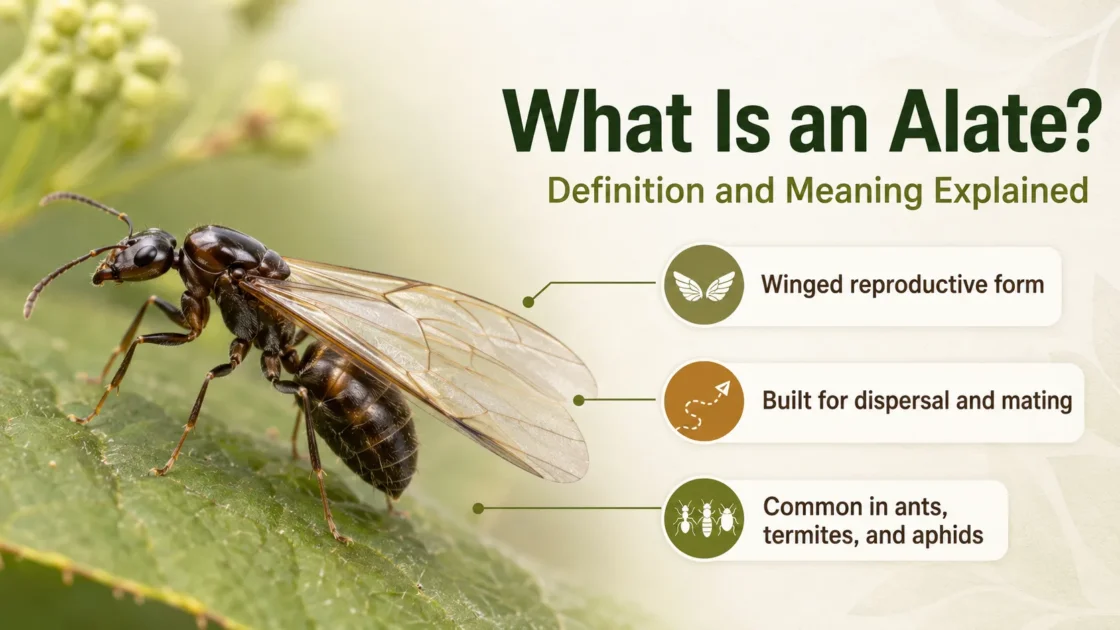
What Does “Alate” Mean?
Alate comes through Latin alatus, from ala, meaning wing. Modern English uses the word as both an adjective and a noun. Merriam-Webster defines the adjective in terms of having wings or a wing-like part, while entomological usage commonly applies the noun to the winged form of an insect where winged and wingless forms are distinguished.[d]
| Usage | Example | Meaning |
|---|---|---|
| Adjective | an alate ant | An ant in its winged form. |
| Noun | an alate left the colony | A winged individual described by that form. |
| Botanical adjective | an alate seed | A seed with a wing or wing-like expansion. |
The literal meaning is therefore broader than “flying ant” or “termite swarmer.” A winged ant can be an alate, but alate does not mean ant. A termite reproductive can be an alate, but alate does not mean termite.
The noun is also more specialized than simply calling anything with wings an alate. A moth, housefly, or beetle may be winged, yet entomologists do not ordinarily need the noun alate for every normal winged adult. The term is especially useful when the contrast between winged and wingless forms, castes, or morphs carries biological information.
An Alate Is a Form, Not a Species
Calling an insect an alate does not identify its genus, family, or species. It describes a winged condition interpreted within the insect’s biology. An ant, termite, and aphid can all be called alate without being closely related organisms.
It is also useful to separate form or caste terminology from developmental stages. Eggs, larvae, pupae, and adults are life stages. In social-insect terminology, workers, soldiers, and reproductives describe different colony forms or roles. BugGuide’s caste glossary explicitly distinguishes castes from stages and notes that reproductive individuals are commonly winged early in adult life and called alates.[e]
Terminology distinction
Alate is not a formal developmental stage equivalent to larva or pupa. In ants and termites it commonly describes a winged reproductive adult; in aphids it can describe a winged morph. The biological context determines what the winged form represents.
Why Alates Are Usually Reproductives in Ants and Termites
The word is strongly associated with ants and termites because their wings are closely tied to reproductive dispersal. Established colonies can produce winged individuals that leave the colony, mate, and take part in the formation of new colonies. The Amateur Entomologists’ Society therefore describes alate as especially common for the winged reproductives of ants and termites.[a]
Alates in ants
In the familiar ant-colony pattern, mature colonies produce winged reproductive females and males. The females may become new queens if they mate and successfully establish a colony; the males are reproductive alates as well. Colorado State University Extension describes mature ant colonies producing winged forms that include potential queens and males, while workers form the wingless labor caste.[f]
This is why “alate” is not another word for “queen.” A winged future queen can be an alate, but so can a male ant. The word describes the winged form; sex and reproductive status require additional context.
Ordinary workers in these ant-colony systems do not become flying ants by growing temporary wings as adults. The winged reproductives and workers follow different caste-development pathways.
Alates in termites
A termite alate is a winged reproductive termite. These are the termites commonly called swarmers when they leave an established colony during a reproductive flight. Mississippi State University Extension uses swarmers for winged reproductive ants and termites and describes the post-flight shedding of wings in both groups.[g]
The term does not identify which termite species is present, where its source colony is located, or whether structural damage exists. Those are separate identification and evidence questions. When the practical problem is distinguishing the two groups, flying ant versus termite identification depends on body features such as antennae, waist shape, and wing proportions rather than the word alate itself.
Aphids Show Why “Alate” Does Not Simply Mean Reproductive Caste
Aphids use the same terminology in a different biological system. An alate aphid is a winged morph, while an apterous aphid is wingless. Winged and wingless individuals can belong to the same species, and aphid colonies may produce different proportions of these forms as conditions change.
In many aphid systems, the winged form is associated with dispersal to other plants or habitats. Crowding, host condition, seasonal signals, genetics, and other cues can influence wing-form production, with the exact response varying among species. Colorado State University Extension, for example, notes that aphid colonies can contain both winged and wingless forms and that winged forms tend to become more common under crowding, declining plant quality, or conditions favoring dispersal.[h]
The difference can extend beyond the wings themselves. A 2026 Journal of Insect Science study comparing alate and apterous Semiaphis heraclei documented morph-related differences in antennal length and sensory structures. The result is species-specific, so those antennal traits should not be turned into a rule for all aphids; it does show why alate and apterous can represent broader alternative phenotypes rather than two otherwise identical insects with wings switched on or off.[i]
The biology of these forms is covered separately in winged aphids and alate aphids. For the definition of alate, the main point is narrower: the word does not automatically specify queen, male, sexual reproductive, or social-insect caste.
Alate, Dealate, Apterous, and Swarmer Mean Different Things
Several terms appear around alate insects, but they describe different conditions or contexts. The distinction is especially useful after an ant or termite reproductive has flown and lost its wings.
| Term | Meaning | What the term tells you |
|---|---|---|
| Alate | Winged or wing-bearing form | The individual currently has the winged morphology to which the term is being applied. |
| Dealate | Previously winged, with the wings shed or lost | The individual has a history as an alate but is now wingless. |
| Apterous | Wingless | The individual or morph lacks wings; the word by itself does not say that wings were previously present. |
| Swarmer | A reproductive associated with a swarming or dispersal event | Common field and pest-management wording, especially for winged ants and termites. |
Dealate and apterous are therefore not equivalent. A dealate queen is wingless now, but she previously developed wings. An apterous morph is described by its wingless condition without that post-flight history being implied. This difference is easy to see in ants: a dealate queen and a worker can both lack visible wings, yet they did not arrive at that condition through the same developmental route.
Swarmer overlaps with alate in ant and termite writing, but the words emphasize different information. Alate describes the winged form. Swarmer describes the reproductive in the context of dispersal or a swarm. A winged reproductive can exist inside a colony before it actually joins a flight.
What Happens When an Alate Loses Its Wings?
Wing loss changes the terminology. In many ants and termites, reproductive flight is followed by dealation—the shedding, breaking, or removal of the wings. A reproductive that was alate before wing loss can then be described as dealate.
Typical ant or termite reproductive sequence
Winged reproductive (alate) → dispersal or mating flight → wing loss in the applicable colony-founding reproductive → dealate reproductive.
The sequence should not be treated as the definition of alate. The word itself does not mean “an insect that will later lose its wings,” and the same post-flight pattern does not apply to every organism described as alate. Aphid wing morphs, for example, belong to a different biological system.
In ants, wing loss also does not transform a queen into a worker. She remains a reproductive individual after dealation. The change concerns wing condition and the transition from dispersal to post-flight reproductive life. The process and its terminology are treated in more detail under dealation and insect wing loss.
What Does “Alate” Mean in Botany?
Entomology does not own the word. In botanical description, alate means winged or furnished with a thin, wing-like expansion. Missouri Botanical Garden’s Botanical Latin dictionary gives the Latin adjective alatus, -a, -um and applies it to structures such as winged seeds, achenes, ovaries, and other plant parts.[j]
This botanical use is morphological. An alate seed is not being compared with a reproductive insect; both uses simply preserve the idea of a wing or wing-like extension. Wings on some seeds and fruits can aid movement through air, while alate can also describe winged margins or expansions on plant structures where the word is primarily describing shape.
How Context Changes the Meaning of “Alate”
| Expression | What is winged? | What “alate” means in that context |
|---|---|---|
| Ant alate | A reproductive ant | Usually a winged female capable of becoming a queen or a winged male. |
| Termite alate | A reproductive termite | A winged dispersing reproductive, commonly called a swarmer during reproductive flights. |
| Alate aphid | An aphid morph | A winged form commonly associated with dispersal and host colonization. |
| Alate seed or fruit | A plant structure | A seed, fruit, or related structure bearing a wing or wing-like expansion. |
This is the safest way to interpret the term in scientific writing. Start with its literal morphological meaning—winged—then use the organism and sentence around it to determine what that winged condition represents biologically.
What the Word “Alate” Does Not Tell You
- It does not identify a species. Alate is not a genus, family, order, or other taxonomic group.
- It does not automatically mean queen. Male ants and male termites can also occur as winged reproductives.
- It does not make every winged insect an “alate” in normal usage. The term is most informative where winged and wingless forms or castes are biologically distinguished.
- It does not mean “termite.” Ants, aphids, and other organisms can also be described with the term.
- It does not prove that a swarm is occurring. A reproductive may already possess wings before leaving its colony.
- It does not prove an infestation or structural damage. Those conclusions require identification and evidence beyond the presence of a winged insect.
- It does not mean the wings must later be shed. Dealation is a separate biological event associated with particular groups and reproductive strategies.
In its most precise everyday scientific reading, alate tells what is winged; the surrounding biology tells what that winged form means.
Sources and Verification
- Amateur Entomologists’ Society — Alate — Entomological definition and common use for winged reproductive ants, termites, and aphids. [a]
- Amateur Entomologists’ Society — Entomologists’ Glossary — Used to verify the broad meaning “possessing wings” and its specialized entomological context. [b]
- Cambridge Dictionary — Alate Pronunciation — Pronunciation /ˈeɪ.leɪt/. [c]
- Merriam-Webster — Alate — Adjective and noun meanings and Latin derivation from alatus and ala. [d]
- BugGuide — Caste Glossary — Used for the distinction between insect life stages and social-insect castes and for alate reproductive terminology. [e]
- Colorado State University Extension — Ants in the Home — Winged potential queens, males, workers, swarming, and post-flight wing loss in ants. [f]
- Mississippi State University Extension — How to Distinguish Termites from Ants — Swarmer terminology, reproductive wings, and post-swarm wing loss. [g]
- Colorado State University Extension — Aphids on Shade Trees and Ornamentals — Winged and wingless aphid forms and environmental conditions associated with dispersal-form production. [h]
- Jing et al. (2026), Journal of Insect Science — Antennal Morphological Differences Between Alate and Apterous Morphs of Semiaphis heraclei — Current peer-reviewed example of morphological differences between alate and apterous aphids. [i]
- Missouri Botanical Garden — A Grammatical Dictionary of Botanical Latin: Alate — Botanical meaning of alate and examples of winged plant structures. [j]