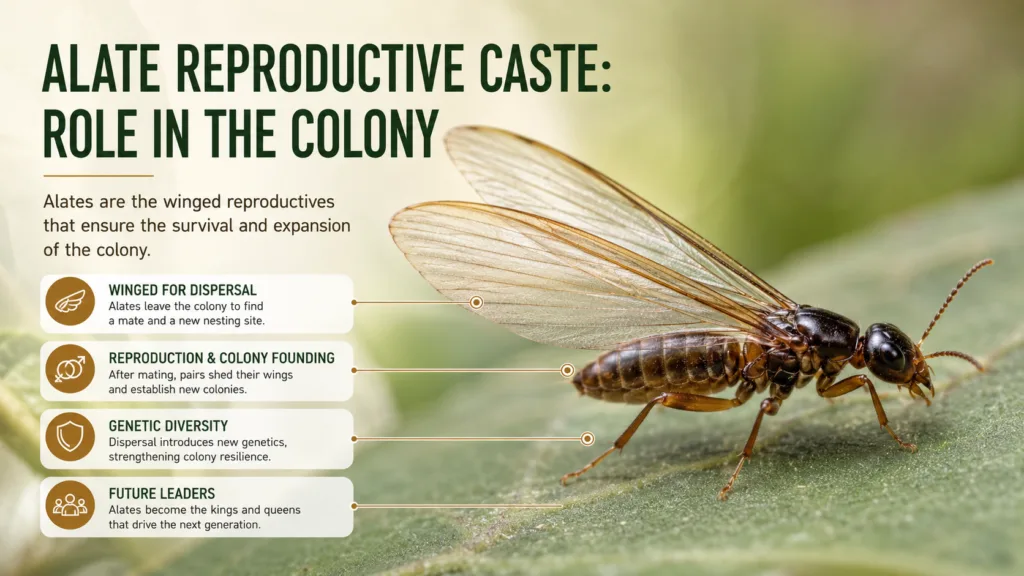
An alate reproductive caste is the winged reproductive form produced by a social insect colony. Its role is to leave the parent colony, mate, disperse, and, in successful cases, begin a new reproductive line through colony founding. In ants, alates are usually winged males and virgin queens; males die after mating, while mated females shed their wings and attempt to found a nest [a]. In termites, alates are winged primary reproductives that pair as future kings and queens after dispersal [b].
Key Data Points
Term
Alate reproductive caste
A winged reproductive form in colony-forming insects.
Primary colony role
Dispersal and reproduction
Alates are produced to move genes beyond the parent nest.
Main insect groups
Ants and termites
Other insects can be winged, but caste meaning differs by group.
Ant alate sex forms
Males and gynes
Gyne means a reproductive female before or around colony founding.
Termite alate sex forms
Future kings and queens
Termite colonies retain both king and queen reproductives.
Wing status after mating
Often shed or removed
Wing loss is part of the transition from flight to nest founding.
Pest evidence meaning
Context-dependent
Indoor termite alates deserve inspection; ant alates require group-level ID.
Data confidence
Medium to high
Caste role is well described; timing varies by species and climate.
Data Overview
The alate caste is best read as a colony dispersal system. Workers maintain the nest, care for brood, forage, and defend the colony. Alates do not perform those routine colony tasks as their main function. Their value appears during the reproductive phase, when mature colonies allocate resources to winged sexual forms.
In ants, the usual sequence is production of winged males and winged females, mating flight or mating near the nest, male death, female wing removal, and nest founding. BugGuide notes that winged reproductive ant castes are reared in spring or summer, with some genera overwintering alates inside the parent nest before spring flight [c].
In termites, alates are often the visible part of a larger hidden colony. University of Maryland Extension describes mature termite colonies producing winged reproductives called swarmers or alates, which disperse and initiate new colonies; shed wings indoors can be a useful evidence layer [d].
How to Read This Data
Alate observations are not equal to colony size, species abundance, or full distribution. They are evidence of reproductive activity near the observation point, shaped by season, weather, observer effort, building conditions, and species biology.
Taxonomic Scope
For this page, alate reproductive caste refers mainly to eusocial insects with colony castes, especially ants in Formicidae and termites in Blattodea. GBIF places Formicidae within Animalia, Arthropoda, Insecta, Hymenoptera, and family Formicidae [e].
The word alate can also mean simply “winged.” Aphids can produce winged migratory forms when colonies are crowded or host plant quality declines, but that is not the same as an ant or termite reproductive caste. UMN Extension describes aphid winged forms as migratory forms that move to new host plants [f].
Colony Role of the Alate Reproductive Caste
The alate caste connects the parent colony to the next colony generation. This is a colony-level investment: the parent nest must have enough resources to produce reproductives, maintain workers, and time release around environmental conditions that permit flight and survival.
| Caste or Form | Typical Wing Status | Main Colony Function | Reproductive Role |
|---|---|---|---|
| Worker ants | Wingless | Foraging, brood care, nest work, food sharing | Usually not the main reproductive caste; exceptions vary by species |
| Male ant alates | Winged before mating | Mate with reproductive females | Short-lived sexual form; usually dies after mating |
| Female ant alates / gynes | Winged before mating, wingless after dealation | Disperse and attempt colony founding | Can become queens if colony founding succeeds |
| Termite workers | Wingless | Feed nestmates, build tunnels, care for brood | Not the primary dispersal form |
| Termite alates | Winged before dispersal, shed wings after landing | Leave mature colony and pair off | Become primary king and queen if founding succeeds |
| Neotenic termite reproductives | Usually wingless or short-winged | Supplement or replace reproductives inside colony | Colony expansion or replacement role, not the main flying dispersal role |
A colony investment, not a routine worker stage
An alate is not a worker that simply grew wings for daily movement. The alate form is tied to sexual reproduction and dispersal. NC State Extension reports that mature carpenter ant colonies can contain 2,000–3,000 workers and produce 200–400 winged forms each year; those swarmers are reproductive adults that mate outside the nest [g].
Ant reproductive biology also has exceptions. Some ant workers can reproduce under defined conditions, especially in queenless or reproductively plastic species. A 2024 review in Current Opinion in Insect Science notes that reproduction in ant colonies usually relies on one or a few queens, while workers mostly handle colony maintenance and brood care, with some species showing worker reproductive plasticity [h].
Ant and Termite Alates Compared
Alate identification often begins with three visible traits: antennae, wing proportions, and waist shape. UC IPM states that winged ants have elbowed antennae, smaller hind wings than front wings, and a constricted waist; winged termites have non-elbowed antennae, front and hind wings of the same size, and a broad abdomen with no apparent waist [i].
| Identification Marker | Ant Alate | Termite Alate | Reliability |
|---|---|---|---|
| Antennae | Elbowed or bent | Straight or beadlike, not elbowed | High when head is visible |
| Waist | Constricted between thorax and abdomen | Broad body with no narrow waist | High when body is intact |
| Wing size | Front wings longer than hind wings | Front and hind wings about equal | High when wings remain attached |
| Shed wings | Possible after mating, but wing piles alone are weak evidence | Common clue near windows, doors, or light sources | Medium without body specimens |
| Colony implication | May indicate nearby mating flight or mature ant colony | Indoor evidence can point to a hidden termite colony nearby | Context-dependent |
Reproductive Sequence and Evidence
| Stage | Ant Pattern | Termite Pattern | Evidence Seen by Observers |
|---|---|---|---|
| Production inside colony | Mature colonies produce winged males and female reproductives | Mature colonies produce winged primary reproductives | Usually hidden until release |
| Dispersal | Nuptial flight or local mating activity, depending on species | Swarming flight, often triggered by seasonal conditions | Winged insects near lights, windows, soil openings, or nest sites |
| Post-mating transition | Males die; mated females shed or remove wings | Pairs shed wings and search for founding sites | Dealate queens, paired termites, or piles of wings |
| Founding attempt | Female begins the first brood alone or with species-specific help | King and queen begin a new colony together if conditions allow | Rarely visible without excavation or inspection |
| Inspection meaning | Requires ant group ID and nest context | Indoor termite alates or shed wings warrant inspection | Do not infer full range or abundance from one event |
Interactive Data Visuals
Carpenter Ant Colony Scale: Workers and Annual Swarmers
Source-reported ranges for mature carpenter ant colonies, used as one ant example rather than a universal ant value.
Source: NC State Extension carpenter ant biology. Values are reported ranges for mature carpenter ant colonies, not species-wide averages.
Identification Evidence Confidence Scale
A practical scoring scale for interpreting alate observations when a full specimen is not available.
Source: Alate.org editorial interpretation scale based on source-backed identification markers. Values are editorial interpretation scores for this guide, not species counts.
Data Interpretation Note
A winged reproductive is a strong clue about colony reproduction, but not by itself a complete identification. Antenna shape, waist structure, wing proportions, date, place, and whether the insects emerged indoors all change the interpretation.
Evidence Interpretation and Pest Context
Alate activity can be normal outdoor biology or a building-related clue. The difference depends on the insect group, location, number of individuals, repeated events, and whether bodies or wings are found indoors. For termites, indoor swarmers or piles of shed wings near windows should be treated as evidence that needs inspection, not as proof of colony size.
| Observation | Likely Evidence Type | Interpretation Limit | Suggested Response |
|---|---|---|---|
| One winged ant outdoors | Seasonal reproductive flight | Cannot identify nest location from one specimen | Photograph body, antennae, waist, and wings if ID is needed |
| Many winged ants indoors | Possible nearby nest or accidental entry | Species group matters; not all ants damage wood | Check moisture-prone wood and collect specimens for ID |
| Termite-like alates indoors | Possible active colony nearby | Alates themselves are not the wood-feeding caste | Arrange a structural pest inspection if confirmed as termites |
| Piles of equal-sized shed wings | Possible termite swarming evidence | Wings alone are weaker than intact specimens | Preserve wings and look for bodies, mud tubes, or repeated events |
| Winged aphids on plants | Plant-colony dispersal morph | Not the same as ant or termite caste biology | Use plant host, cornicles, and colony pattern for aphid ID |
Data Quality and Limitations
Where the Data Has Limits
Alate timing varies by species, geography, rainfall, humidity, temperature, and colony maturity. Occurrence records may reflect where people collect or photograph insects, not true abundance. Building observations are also biased toward visible indoor events near lights and windows.
- Sampling bias: Alate events are brief, so observer timing strongly affects records.
- Taxonomic uncertainty: Winged forms can be harder to identify than workers in some ant groups.
- Geographic variation: The same broad group can swarm at different times in different climates.
- Amateur vs professional records: Photo-based reports help detection but should not replace specimen confirmation when pest decisions are involved.
- Occurrence records vs true range: Available records suggest observed evidence, not full distribution.
- Pest risk: Risk should be assessed from local inspection evidence, not from the presence of wings alone.
FAQ
What is the role of an alate reproductive caste?
Its role is reproduction through dispersal. Alates leave the parent colony, mate, and may start a new colony if survival conditions are suitable.
Are all alates queens?
No. In ants, alates include males and winged reproductive females. In termites, alates include future kings and queens.
Do alates work inside the colony?
Their main function is not routine labor. Workers and soldiers handle feeding, defense, nest maintenance, and brood care, while alates are produced for the reproductive phase.
Why do alates lose their wings?
After mating or landing, wings are no longer useful for nest founding. Ant queens often remove their wings; termite alates shed wings after dispersal and pairing.
Do indoor alates always mean an infestation?
No. Ant alates may enter from outdoors, but repeated indoor emergence can indicate a nest. Confirmed termite alates indoors are stronger evidence that inspection is needed.
Can occurrence records prove where alates live?
No. Records show reported evidence. They may reflect sampling effort, photographer location, season, and reporting habits as much as true insect distribution.
Sources and Verification
- [a] BugGuide — Family Formicidae: Ants — Used for ant alate timing, male post-mating fate, and dealation context.
- [b] NC State Extension — Biology and Behavior of Eastern Subterranean Termites — Used for termite reproductive caste roles, king and queen function, and colony structure verification.
- [c] BugGuide — Formicidae Life Cycle Notes — Used for ant winged reproductive timing and overwintering notes in selected genera.
- [d] University of Maryland Extension — Termites — Used for termite alate dispersal, shed-wing evidence, and indoor inspection interpretation.
- [e] GBIF — Formicidae Taxonomy — Used for family-level taxonomy and occurrence-record context.
- [f] University of Minnesota Extension — Aphids — Used to distinguish aphid winged migratory forms from ant and termite reproductive caste use.
- [g] NC State Extension — Biology and Control of Carpenter Ants — Used for mature carpenter ant colony worker range and annual winged-form range.
- [h] Carmona-Aldana et al. 2024 — The Phenomenon of Reproductive Plasticity in Ants — Used for queen, worker, and reproductive-plasticity context in ants.
- [i] UC IPM — Winged Ant Identification — Used together with UC IPM termite identification notes for antenna, wing, and waist comparison.