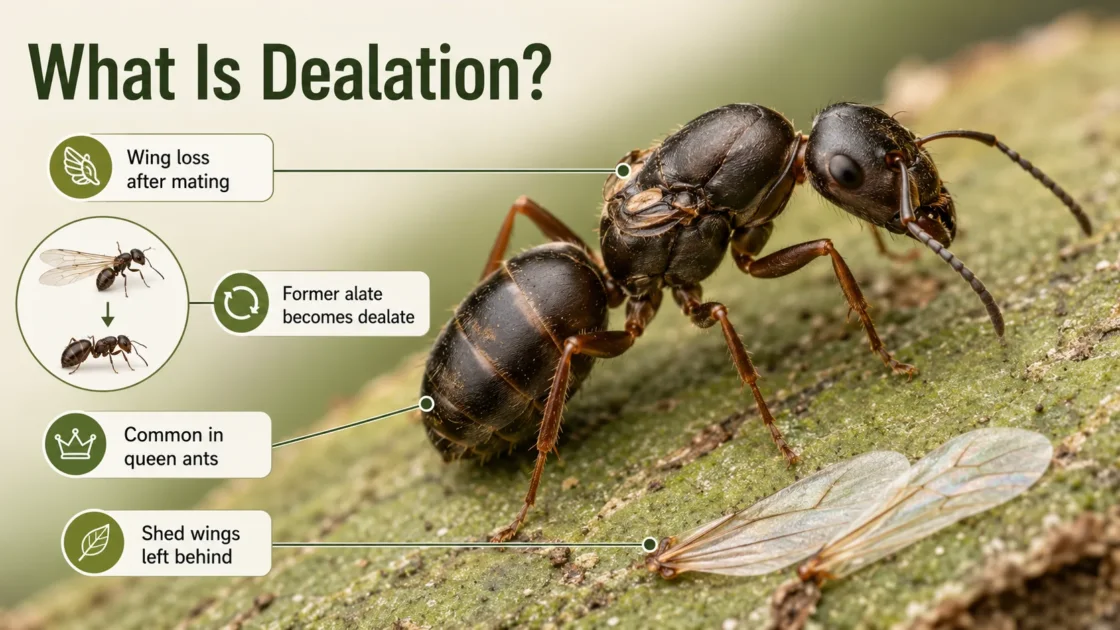
Dealation is the shedding or loss of fully developed adult wings after a winged phase. In ant and termite biology, a reproductive individual with wings is commonly described as an alate; after those wings are shed, the individual is dealate. The term refers to a change in the same adult insect, not the creation of a new species or caste.[a]
Dealation is closely associated with dispersal, mating and colony founding, but wing loss does not by itself prove that mating occurred. That distinction is especially clear in the red imported fire ant, Solenopsis invicta: newly mated females can cast their wings rapidly after landing, while unmated females removed from the suppressive influence of a colony queen can also become dealate over a period of days.[b][c]
What dealation does not prove
A dealate female ant has passed from a winged condition to a wingless one. That observation alone cannot confirm insemination. Mating is a common route to dealation in many ants, but it is not the only physiological route documented in every species.
What Counts as Dealation?
The defining feature is a previously winged adult losing its wings. Simply finding an insect without wings is not enough. Workers, naturally wingless reproductive forms and adults with damaged wings can all be wingless without being dealates.
| Condition | What happened to the wings? | Does “dealate” apply? |
|---|---|---|
| Alate | The adult still has its functional wings. | No. It is still in the winged condition. |
| Dealate | Fully developed wings were shed after the winged stage. | Yes. |
| Partly dealate | Some wings have detached while others temporarily remain. | The dealation process has begun, but complete wing shedding has not occurred. |
| Naturally wingless adult | The adult form did not first possess a normal set of functional dispersal wings. | No. |
| Accidental wing damage | Wings were torn or lost through injury, predation, handling or another mechanical event. | Not on wing damage alone. |
Partial wing loss is biologically possible and can complicate identification. In a 2025 laboratory study of S. invicta, researchers explicitly recorded incomplete shedding and classified dealation as complete only when all four wings had been cast.[c]
How Termite Wings Are Built to Break Away
Termite dealation is a controlled mechanical process. The wings do not need to tear randomly across the membrane. Research on the Japanese subterranean termite Reticulitermes speratus documented a specialized weak region at the wing base, described as the basal suture.[d]
During flight, the alates hold their wings in a three-dimensional arrangement that helps prevent premature separation. During dealation, the posture changes: the wings are lowered and held in a flatter arrangement while the abdomen bends back toward them. The resulting pressure at the basal sutures separates the wings from the body.[d]
The break point is therefore part of the insect’s normal post-flight biology. A clean detachment at the wing base is fundamentally different from an intact flying insect having a wing torn through its membrane by an external force.
The same R. speratus experiments also showed why species-specific evidence matters. Isolation from other alates promoted dealation in that termite, while pairing itself did not determine the timing. The researchers also found that dealated individuals faced lower predation risk than winged alates when exposed to a termite-hunting ant during the ground-running period between dispersal and colony foundation.[d]
Ant Dealation Can Follow More Than One Biological Trigger
For many ant queens, the familiar sequence is dispersal flight → mating → landing → wing casting → colony founding. That sequence is real, but it should not be turned into a rule that every wingless queen must have mated.
Rapid dealation after mating in fire ants
The reproductive transition of Solenopsis invicta has been studied in unusual biochemical detail. Winged female reproductives inside the natal colony are kept in a reproductively inhibited state partly through a primer pheromone associated with the colony queen. Once a female mates, that inhibition can be overridden rapidly.[b]
Experimental work reported that newly mated S. invicta queens commonly cast their wings within about 30 minutes after mating and landing. By contrast, winged females removed from queen influence without mating required roughly 1.5–6 days in earlier experiments. Juvenile-hormone treatment shortened that delay, showing that endocrine state is involved as well.[b]
Male-derived compounds can accelerate the reproductive switch
A 2021 study identified another part of the fire-ant pathway. Males produce compounds called tyramides and transfer them to winged females during mating. Newly mated females convert those compounds to the biogenic amine tyramine. Elevated tyramine accompanies the rapid activation of reproductive physiology, and experimental tyramine injection caused winged females to dealate faster than controls.[b]
This mechanism should not be generalized to every ant. It demonstrates that, in at least one well-studied species, dealation is linked to social signals, endocrine regulation and mating-associated chemistry, rather than being a purely mechanical consequence of landing.
Virgin Fire Ant Females Can Become Dealate Without Mating
A large 2025 experiment provides direct evidence against using wing loss as a mating test. Researchers collected virgin female alates from polygyne S. invicta colonies, isolated them individually from queen pheromonal influence and checked their wing status every two hours for 15 days.[c]
A total of 1,035 females entered the experiment. After individuals that died or never shed their wings were excluded from the timing analysis, 1,000 dealating virgin females were analyzed. The earliest dealation occurred within 24 hours. The strongest concentration of wing shedding occurred during days 3–5, and 93.3% completed dealation within 2–6 days.[c]
Cumulative dealation in isolated virgin Solenopsis invicta females
Selected directly reported points from the 2025 laboratory study of polygyne alate virgin females isolated from queen pheromonal influence.
48 h: 8.9% • 96 h: 60.9% • 144 h: 94.1% • 300 h: 100%
These values describe the analyzed experimental cohort under controlled isolation conditions. They are not a universal timetable for ant queens, other fire-ant social forms or field populations.
The increase followed an S-shaped pattern. Only 8.9% of the analyzed females had completed dealation by 48 hours, compared with 60.9% at 96 hours and 94.1% at 144 hours. All individuals retained in the dealation analysis had shed their wings by 300 hours.[c]
The study also detected a daily pattern under its controlled light–dark cycle. Most recorded dealation events occurred during the defined daytime period, with concentrations between 9:00 AM and 2:00 PM and again around 7:00–8:00 PM. The authors noted that further constant-light, constant-dark and field experiments would be needed to determine how broadly that rhythm applies.[c]
Why the fire-ant timing cannot be used as a general countdown
The females were virgin, individually isolated, from the polygyne social form of one species and maintained under controlled laboratory conditions. A mated queen of the same species may dealate far faster, while another ant species may use different cues altogether.
Wing Loss and Flight-Muscle Loss Are Separate Events
The visible disappearance of wings is only one part of the post-flight transition in many ant queens. Wing casting is the external event; flight-muscle histolysis is an internal physiological process. They are related, but they should not be treated as two names for the same event.
In newly mated S. invicta queens, the reproductive transition includes dealation, degeneration of flight musculature, development of the ovaries and production of queen-associated pheromonal signals.[b] In independently founding carpenter ants, university entomology guidance likewise describes the unused flight muscles being broken down after the queen has shed her wings, supplying resources while she raises her first brood in the founding chamber.[e]
Dealation does not turn a female ant into a queen. A winged reproductive female already differs developmentally from a worker before the wings are lost. Dealation marks a transition away from the dispersal form and, in many species, toward a post-flight reproductive role.
In some ants, the wings themselves are tied to behavioral state
Experiments with the Indian jumping ant Harpegnathos saltator show how strongly wing state can be connected with physiology in a particular species. Researchers compared young winged queens with naturally dealate queens and queens whose wings had been experimentally removed. Dealate individuals displayed higher frequencies of worker-like behaviors during reproductive competition, a worker-like range of ovarian activity and changes in cuticular chemical profiles.[f]
That result does not mean removing the wings of any queen will reproduce the same biological response. It shows that wing state can participate in a wider phenotypic switch and that the consequences of dealation depend on the species being studied.
Ant and Termite Dealation Lead Into Different Reproductive Lives
Ants and termites can both leave conspicuous piles of discarded wings, but the social biology after wing loss is different. One of the clearest distinctions is what happens to the male.
| Feature | Ant reproductive | Termite reproductive |
|---|---|---|
| Winged stage | Reproductive females and males can leave the colony as alates. | Reproductive females and males leave as alates or swarmers. |
| Most familiar dealate | Female queen after dispersal. | Both the future queen and future king can become dealate. |
| Male after pairing | In many familiar ant life cycles, males die after mating and do not establish the new nest. | The male remains as the founding king with the female. |
| Colony-founding pattern | Varies widely among ants; many species have independently founding queens, while others use different strategies. | A female–male reproductive pair commonly searches for and establishes the founding site. |
| Meaning of dealation | Often marks the female’s transition out of dispersal and toward post-flight reproduction. | Marks the transition of both reproductive sexes away from flight and into ground-based pairing or nest founding. |
Termites Do Not Always Shed Their Wings Before Pairing
The often-described termite sequence is straightforward: dispersal → landing → dealation → mate search → tandem movement → nest-site search. Research published in 2026 showed that the order itself can differ.[g]
In many studied termites, dispersed adults shed their wings before beginning tandem pairing, and retained wings can interfere with coordination between the sexes. In the Australian termite Microcerotermes nervosus, however, researchers found the opposite order: tandem running begins while the termites are still winged, and dealation follows.[g]
A reordered termite sequence
Commonly documented sequence: landing → wing shedding → tandem pairing
Microcerotermes nervosus: landing → tandem pairing begins → wing shedding
Video tracking showed that removing the wings improved movement coordination in M. nervosus, while tandem running itself helped facilitate dealation. The study therefore places wing shedding inside the mechanics of pair coordination instead of treating it as a fixed preliminary step that every termite must complete before pairing.[g]
Why Shed the Wings at All?
Wings solve the dispersal problem: they allow reproductive insects to leave the natal colony and reach new locations or mates. Once the dispersal phase has ended, the demands change. The insect may need to move over the ground, enter a narrow founding site, remain concealed and shift resources toward reproduction.
The benefit is not identical in every taxon. In R. speratus, experimental evidence linked dealation with reduced exposure to ant predation during ground movement.[d] In M. nervosus, wing removal improved tandem coordination.[g] In independently founding ant queens, losing the flight apparatus accompanies the shift toward nest founding and, in some species, the reuse of flight-muscle resources.[e]
These examples support a broader interpretation of dealation as a transition out of the dispersal phenotype. They do not support one universal explanation for every ant, termite or other insect described as dealate.
How to Recognize Evidence of Dealation
A wingless body is most convincing as a dealate when there is evidence that the adult previously carried normal wings. Useful clues include wing attachment scars or basal remnants on the thorax, partially retained wings, or recently discarded wings associated with the same reproductive event. Identification becomes weaker when only a loose damaged wing or a naturally wingless insect is present.
- Four intact wings: the reproductive is still alate, not dealate.
- Clean wing loss at the normal attachment area: consistent with dealation when the insect belongs to a winged reproductive form.
- One or more wings still attached: may represent dealation in progress rather than accidental damage.
- Irregularly torn wing membranes: physical damage remains a plausible explanation.
- No evidence of previous wings: do not assume that a naturally wingless adult is dealate.
Wing scars are especially useful on ant queens because the thorax retains evidence of the structures that supported the former wings. With termites, discarded wings can be conspicuous because many swarmers may shed them during the same emergence period.
What Shed Wings Indoors Actually Tell You
Indoor dealation evidence needs to be interpreted by insect group. A pile of termite wings and one wingless ant queen do not carry the same meaning.
| Observation | What it supports | What it does not establish by itself |
|---|---|---|
| One dealate ant queen indoors | A reproductive female has shed her wings and may be searching for a nesting site. | It does not by itself prove that a colony is already established inside the building. |
| Many winged ants emerging indoors | Stronger evidence that an ant nest may be present within the structure. | It does not identify the ant species or the extent of any damage. |
| Numerous similar termite wings indoors | Supports a recent termite swarming or dealation event and warrants investigation of the source. | The wings alone do not measure colony size or structural damage. |
| Termite swarmers outdoors | Shows that reproductive termites are active in the surrounding environment. | Outdoor swarmers alone do not establish that the building is infested. |
University of Minnesota Extension notes that a wingless carpenter-ant queen indoors is not, by herself, evidence of an indoor nest; recently mated queens can enter while searching for founding sites. Large numbers of winged carpenter ants emerging indoors provide much stronger evidence of an internal nest.[h]
Termite evidence deserves different treatment. University of Maryland Extension describes flights of termite alates or accumulations of shed wings as common first signs noticed by homeowners and recommends investigating the source, especially when swarming occurs indoors. The alates themselves are not what damages structural wood; the relevant question is whether an established termite colony is present.[i]
Dealation Does Not Mean Every Alate Must Eventually Lose Its Wings
Alate is a broader descriptive term for a winged form. It is used beyond ants and termites, including other insects in which winged and wingless forms may have different developmental or ecological meanings. Dealation should therefore be applied to insects that actually pass from a winged adult condition to a wing-shed condition, not treated as a mandatory second stage for every organism described as alate.
Do Dealate Ants and Termites Grow Their Wings Back?
Normal dealation in ant and termite reproductives is a permanent transition to the wingless condition. Once the dispersal wings have been cast, they are not replaced with a new functional set for another flight. The insect proceeds into its post-flight reproductive life as a dealate.
Sources and Verification
- Mississippi Entomological Museum — Formicidae Glossary — Entomological definition of dealate as having shed the wings. [a]
- Vander Meer et al. (2021), Communications Biology — Fire-ant queen inhibition, rapid post-mating wing casting, tyramide transfer, tyramine production and reproductive activation. [b]
- Huang et al. (2025), Journal of Insect Science — High-resolution observations of 1,000 analyzed virgin polygyne Solenopsis invicta females, including dealation timing, incomplete wing shedding and daily pattern. [c]
- Matsuura & Nishida (2002), Insectes Sociaux — Mechanical separation at termite basal wing sutures, dealation cues and the predation experiment in Reticulitermes speratus. [d]
- NC State Extension — Biology and Control of Carpenter Ants — Post-mating wing loss, colony founding and use of flight-muscle resources in carpenter-ant queens. [e]
- Pyenson et al. (2022), Journal of Experimental Biology — Behavioral and physiological effects associated with natural or experimental wing loss in Harpegnathos saltator gynes. [f]
- Carroll et al. (2026), Proceedings of the Royal Society B — Tandem running before dealation in Microcerotermes nervosus and the effect of wing removal on movement coordination. [g]
- University of Minnesota Extension — Carpenter Ants — Interpretation of wingless queens and larger indoor reproductive emergences. [h]
- University of Maryland Extension — Termites — Interpretation of termite alate flights and accumulations of shed wings in and around buildings. [i]