A flying red ant is not a single species. It is usually a winged reproductive ant—an alate queen or male—from a species whose body appears red, reddish brown, rust-colored, or red-and-black. Fire ants are one possibility, but so are carpenter ants, field and mound ants, harvester ants, and other members of the family Formicidae.
The most useful identification starts with body structure, then adds the location of the red coloration, body size, sex or caste, nest architecture, worker ants nearby, and geographic location. Color by itself is weak evidence: university identification guidance notes that ants may be yellow, reddish, black, or black-and-red, and that color is not always definitive for identification.[a]
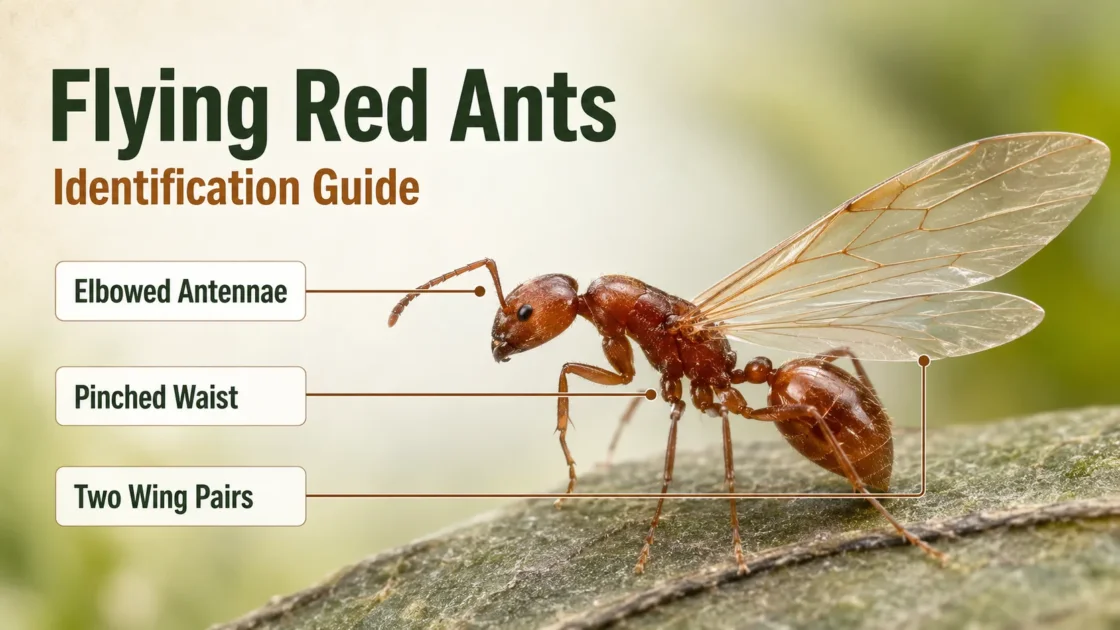
First confirm that the insect is an ant
A reddish insect with wings is not automatically an ant. The first useful split is between an ant alate and another winged insect, especially a termite swarmer. Typical winged ants have a visibly constricted waist and two pairs of wings in which the forewings are larger than the hind wings. Termite swarmers have a broader connection between the thorax and abdomen and two pairs of wings that are much more similar in size.[a]
| Feature | Winged ant | Termite swarmer | How useful it is |
|---|---|---|---|
| Waist | Narrow and constricted, usually with one or two petiole nodes | Broad connection between the middle and rear body | Very useful when the body is intact |
| Wings | Two pairs; front pair larger than hind pair | Two pairs of broadly similar size and shape | Useful in a side or top view |
| Antennae | Usually distinctly bent in queens and workers | Straighter and bead-like | Useful, but not absolute for every ant male |
| Body color | Highly variable, including red and red-black | Variable | Poor diagnostic character by itself |
An antenna exception worth knowing
The familiar “ants have elbowed antennae” rule works well as a general field character, especially for queens and workers, but it should not be treated as an absolute test for every male. Utah State University describes male imported fire ants as dark, winged, small-headed, and non-elbowed in the antennae.[b] A narrow ant waist, wing proportions, nearby workers, and nest context therefore matter when a suspected fire-ant male looks unusually wasp-like.
Look at where the red occurs, not simply whether the ant is red
“Red” covers several visually different patterns. A useful photograph separates the body into the head, the mesosoma—the large middle section carrying the legs and wings—and the gaster, the large rear portion of the abdomen. The distribution of color across those regions carries more information than a general description such as “red flying bug.”
- Reddish head and mesosoma with a darker gaster: compatible with several ant groups, including red imported fire ants and some Formica. It does not confirm either group.
- Mostly reddish or chestnut brown: possible in fire-ant queens and other reddish ant species. Size, nest type, workers, and locality become more informative.
- Red-and-black body: can occur in carpenter ants and field ants as well as other groups. A black rear body does not make an ant a fire ant.
- Orange or amber appearance: may represent genuine pigmentation, but strong sunlight, flash, translucent body surfaces, wet insects, and viewing through glass can all alter apparent color.
Color should narrow the candidate list, not finish the identification. Ant specialists often need characters such as petiole structure, antennal segmentation, thorax shape, surface sculpture, hairs, spines, or other features that a casual photograph may not resolve.[a]
Which ants can produce a “flying red ant” sighting?
Fire ant reproductives — Solenopsis
Fire ants deserve consideration when a reddish winged ant appears around open sunny ground, lawns, pastures, fields, or soil mounds, especially where imported fire ants are established. Yet the reproductive castes do not necessarily resemble the reddish workers that make the colony noticeable.
Utah State University describes a red imported fire ant queen as about 3/8 inch (around 1 cm) long, with an elongated abdomen and light reddish-brown coloration. The male is very different: it is darker, more slender, smaller-headed, and winged.[b] NC State similarly notes that males may take flight first and can resemble wasps more than the familiar worker-ant form; female alates follow, mate during flight, land, and remove their wings before attempting colony founding.[c]
This creates a useful field clue: reddish worker ants around a mound and darker winged insects leaving the same mound can belong to the same fire-ant colony. The color mismatch is not evidence that two unrelated insects are present.
Carpenter ant reproductives — Camponotus
A large red-and-black or dark reddish alate associated with wood deserves comparison with carpenter ants. Carpenter ants are not uniformly black. University of Minnesota Extension notes that workers may be black or red-and-black, while queens and males are winged and larger than the workers. The group also has a single petiole node and a smoothly rounded thoracic profile when viewed from the side.[d]
Location adds far more evidence than color. Repeated emergence from wood, wall voids, window frames, structural cavities, trees, stumps, fences, or damp timber fits carpenter-ant biology better than a single individual landing on an outside light. Carpenter ants excavate nesting spaces in wood rather than eating the wood as termites do. Moisture-damaged or softened wood is especially useful context when winged carpenter ants are repeatedly appearing indoors.[d]
Field and mound ants — Formica
Formica contains many species and cannot be reduced to one color pattern. Some field and mound ants have conspicuous red or reddish middle body regions combined with a much darker abdomen. NC State describes red wood ants and Allegheny mound ants in its regional turf guidance as two-tone reddish ants whose abdomen may be darker than the thorax, while colonies produce winged reproductives that leave the nest to mate.[e]
The practical distinction is contextual. A reddish alate associated with a long-established outdoor mound, visible worker trails, thatch, exposed soil, or a sunny field site may fit a Formica group better than a structural carpenter ant. Exact species identification should not be inferred from the red-and-black pattern alone.
Harvester ants — Pogonomyrmex and related ants
Large reddish ants around dry, exposed soil may be harvester ants rather than fire ants. Utah State University describes Pogonomyrmex harvester ants as red, brown, or black and generally larger-bodied ants, with nests that can form broad bare patches of ground.[f]
Nest architecture is particularly helpful here. Texas A&M notes that harvester-ant nests may have a large cleared area and an obvious entrance hole, while imported fire-ant mounds characteristically lack a central opening visible at the top.[g] An observer who only photographs the flying ant loses one of the strongest pieces of field evidence.
| Candidate group | Useful appearance clue | Stronger contextual evidence | What should not be overinterpreted |
|---|---|---|---|
| Fire ants, Solenopsis | Reddish queen possible; males can be much darker | Soil mound, reddish workers of noticeably different sizes, defensive colony response, suitable region | Red coloration alone |
| Carpenter ants, Camponotus | Often relatively large; black, red-black, or reddish forms occur | Wood, tree cavities, structural voids, damp or softened timber, repeated indoor emergence | A single large ant near a house |
| Field or mound ants, Formica | Some species show a reddish thorax with darker abdomen | Outdoor mound, sunny soil, thatch, established worker activity | Assuming every red-black ant is one Formica species |
| Harvester ants, Pogonomyrmex | Often large and red to brown or black | Dry exposed ground, broad cleared nest area, obvious nest entrance | Using redness alone to separate them from fire ants |
The nest can tell more than the flying ant
Alates are temporary reproductive forms, and they can look very different from the workers used in conventional identification keys. The place from which the insects actually emerge can therefore carry more diagnostic value than an isolated alate found several metres away.
| Observation | What it supports | What it does not prove |
|---|---|---|
| Winged ants emerging directly from a soil mound | A mature ground-nesting ant colony is releasing reproductives | Which species occupies the mound |
| Mound with no obvious opening on top | Supports comparison with imported fire ants where geography also fits | Fire-ant identity without worker or specimen confirmation |
| Wide bare patch with an obvious entrance | Supports comparison with harvester ants in suitable regions | Identification from nest shape alone |
| Winged ants repeatedly emerging from wood or a wall void | A nesting ant associated with the structure should be investigated | That the wood is being eaten or that termites are present |
| Several alates around an outdoor lamp | A mating flight occurred somewhere within flying range | That the nest is inside the building or immediately beside the lamp |
| Ant floating in a pool or water container | A flying ant landed or fell into the water | Where the colony is located |
Fire-ant colonies provide another useful clue through their workers. Texas A&M describes red imported fire ant workers as showing strong size variation within the same colony, while many other ants encountered around soil nests have more uniform-looking workers.[g] Size variation is supportive evidence, not a substitute for taxonomic identification.
Queen, male, or a queen that has already lost her wings?
The reproductive caste changes the silhouette of a flying ant. A winged female that may become a queen typically has a substantial mesosoma because it contains the musculature needed for flight. The abdomen is often fuller than that of a male. Males commonly have a smaller head and a more slender body and may look less like the workers of their colony.
Fire ants make this contrast especially noticeable. NC State reports that red imported fire ant males may fly before the females and can appear wasp-like. After mating, the female lands and removes her wings before attempting to start a colony.[c]
A large red ant without wings after a swarm
A wingless ant found shortly after alates were flying may be a dealate queen—a female that possessed wings and then shed them after the mating flight. This is different from an ordinary worker, which did not simply “turn into” a queen. Small wing scars may remain on the mesosoma, although they are not always easy to see without magnification.
A sudden swarm does not mean the ants suddenly appeared
Winged ants can seem to appear from nowhere because reproductive emergence is concentrated into relatively short flight periods. The colony existed before the alates became conspicuous. Once mature, it can produce males and young queens that leave for mating rather than remaining hidden with the workers.
Weather can help synchronize flights, but there is no universal “red flying ant” date or temperature. Species, region, colony condition, soil conditions, humidity, recent weather, and season all influence when alates become active. A swarm noticed after rain is therefore compatible with reproductive flight behavior but is not a fire-ant identification character. Different ant groups can respond to favorable flight conditions.
One flying red ant and a mass emergence mean different things
The number of insects matters mainly because it changes how much can be inferred about the source.
- One alate outdoors: provides little evidence about nest location. A reproductive ant can travel away from its source colony.
- Several around an outdoor light: supports nearby flight activity, but the light itself may simply be attracting insects from surrounding properties or habitat.
- Many emerging directly from one mound: strongly ties the alates to that colony and makes the workers and mound useful identification evidence.
- Winged ants repeatedly emerging from the same indoor crack, wall void, trim, or wood: gives much stronger evidence of an indoor or immediately adjacent nest than a stray ant at a window.
- Reddish workers and darker alates leaving the same mound: can represent different castes or sexes within one colony rather than two species.
A single indoor sighting should not automatically be called an infestation. Repeated emergence from a fixed point carries substantially more evidence than an isolated insect that may have entered through a door, window, vent, or lighted opening.
Geography can change which red ant is plausible
A visual match should always be checked against location. The same red-and-black body pattern can belong to unrelated ants on different continents, and a species common in one region may be absent, localized, or invasive in another.
Imported fire ants in the United States
USDA APHIS reports imported fire ants across much of the southern United States, with additional occurrence in parts of California and Puerto Rico, and maintains federal quarantine areas intended to reduce human-assisted spread through materials such as soil, nursery stock, hay, and soil-moving equipment.[h] In those areas, a reddish mound-building colony merits closer comparison with imported fire ants than the same sighting would in a region where they are not established.
Europe cannot be treated as automatically outside the range
The red imported fire ant, Solenopsis invicta, now has a confirmed established population in Europe. A peer-reviewed study documented 88 nests across about 4.7 hectares in Sicily near Syracuse during the winter of 2022–2023.[i] The EPPO Global Database continues to list Italy and Sicily as present with restricted distribution.[j]
That does not mean a red flying ant elsewhere in Europe should be labeled S. invicta. It means that “fire ants are not established in Europe” is no longer a reliable exclusion rule. Locality must be interpreted at an appropriate geographic scale, and suspected invasive ants outside known populations require stronger evidence than color resemblance.
The most useful identification photographs show more than the wings
A single top-down photograph can hide the waist, antennal shape, and relationship between the two wing pairs. Several simple views preserve much more diagnostic information.
- Side view: shows the waist, petiole area, mesosoma profile, head proportions, and relative wing length.
- Top view: records the distribution of red, brown, and black across the head, mesosoma, and gaster.
- Head close-up: helps show antenna shape and proportions.
- Scale reference: a ruler beside the specimen is more useful than estimating size from a photograph.
- Workers from the same colony: often provide better identification evidence than the alate alone.
- Nest and surrounding ground: can show a mound, central entrance, cleared vegetation, thatch, wood association, or other habitat evidence.
For a suspected fire ant, the alate, workers, mound, and location together are far stronger evidence than a close-up of one reddish winged insect.
When the identification changes what should happen next
Most outdoor alate flights are normal reproductive events. The situations that deserve closer attention are those in which the surrounding evidence points toward a stinging invasive ant, an indoor nesting ant, or a termite misidentification.
| Evidence | Reasonable interpretation | Useful next step |
|---|---|---|
| One reddish alate outside | Normal reproductive ant activity is plausible | Document anatomy and location if identification is of interest |
| Many alates emerging from a mound with reddish workers | A mature ground-nesting colony is reproducing | Photograph workers and mound without handling or disturbing an unknown stinging species |
| Variable-sized reddish workers, mound traits, and defensive swarming in an imported-fire-ant region | Evidence is more consistent with imported fire ants | Use local extension or regulatory identification where confirmation affects management or reporting |
| Large red-black alates repeatedly emerging from damp wood or a wall void | Carpenter ants or another structural nesting ant become more plausible | Inspect the emergence point, moisture source, and associated wood |
| Broad-waisted swarmers with nearly equal wings | The insects may be termites rather than ants | Preserve specimens and obtain termite identification rather than treating them as flying ants |
Fire-ant handling caution
Imported fire ants can respond rapidly when a colony is disturbed and can sting repeatedly. USDA APHIS advises identification assistance when the species is uncertain.[h] An unknown reddish mound should not be disturbed by hand merely to test whether the ants behave aggressively.
Sources
- [a] University of Minnesota Extension — “Ants.” Ant coloration, identification characters, and the ant-versus-termite distinction using waist, antennae, and wing proportions.
- [b] Utah State University Extension — “Imported Fire Ants.” Imported fire ant queen size and coloration, male reproductive appearance, antenna form, worker variation, and identification limits.
- [c] NC State Extension — “Biology & Behavior of Red Imported Fire Ant (RIFA).” Male and female alates, nuptial flight behavior, male wasp-like appearance, mating, and post-flight wing loss.
- [d] University of Minnesota Extension — “Carpenter Ants.” Carpenter-ant coloration, one-node waist, winged queens and males, wood association, and structural identification.
- [e] NC State Extension — “Arthropod Pests of North Carolina Turf: A Guide.” Regional descriptions of reddish Formica species, mound nesting, and production of winged reproductives.
- [f] Utah State University Extension — “Harvester Ants.” Pogonomyrmex coloration, body size, nesting habits, and broad cleared nest areas.
- [g] Texas A&M AgriLife Extension — “Fire Ant Frequently Asked Questions.” Imported fire ant worker-size variation, lack of a central opening on typical fire-ant mounds, and comparison with harvester-ant nests.
- [h] USDA Animal and Plant Health Inspection Service — “Imported Fire Ants.” Current U.S. distribution context, quarantine program, appearance, mound characteristics, defensive behavior, and sting risk.
- [i] Menchetti et al., Current Biology — “The invasive ant Solenopsis invicta is established in Europe.” Peer-reviewed documentation of 88 nests across approximately 4.7 hectares near Syracuse, Sicily.
- [j] European and Mediterranean Plant Protection Organization, EPPO Global Database — Solenopsis invicta World Distribution. Current distribution status listing Italy and Sicilia as present with restricted distribution.