Flying fire ants are the winged reproductive members of a fire ant colony, not a separate species. Seeing them in the air does not carry the same sting exposure as stepping on an active mound. The classic fire-ant attack comes mainly from worker ants defending the colony, while the flying forms are males and young reproductive females leaving for a mating flight.
That distinction matters. Male red imported fire ant alates have no stinger, whereas workers can grip skin with their mandibles and sting repeatedly. A swarm overhead is therefore usually more useful as evidence of reproductive activity and a mature colony nearby than as evidence of an aerial attack. [a] [b]
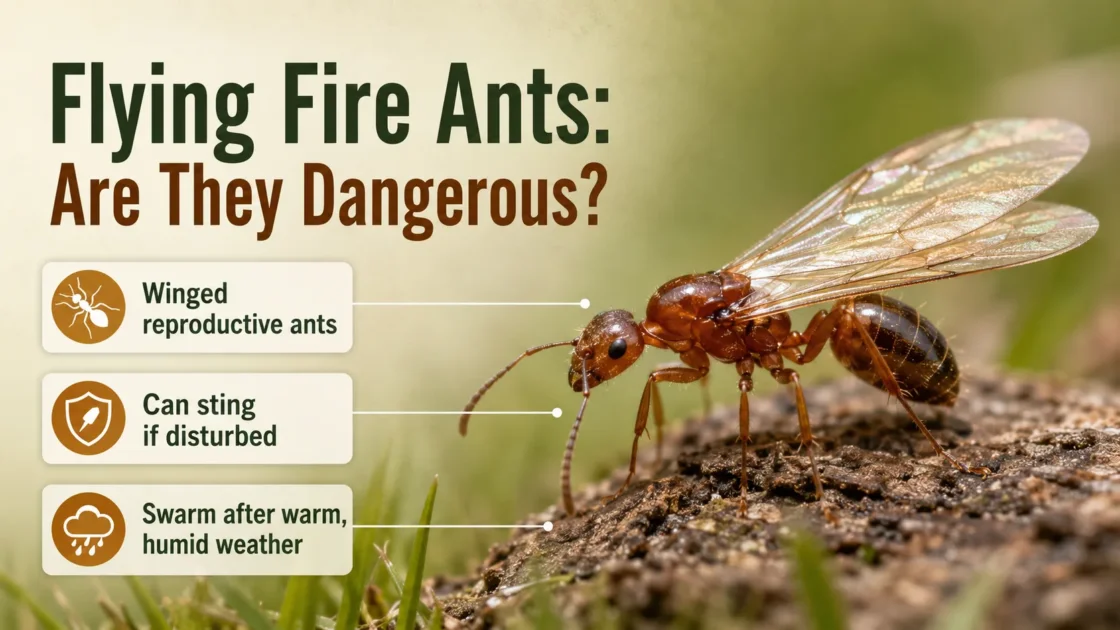
The danger depends on which fire ant caste is present
A fire ant colony contains ants with very different jobs. Workers defend the nest and gather food. Winged males and females are reproductives, commonly called alates. Treating all three as if they pose the same encounter risk obscures what is actually happening during a swarm.
| Fire ant caste | Wings | Main role | What it means for a person nearby |
|---|---|---|---|
| Worker | Wingless | Foraging, brood care and colony defense | Main source of the familiar mass-stinging response when a mound is disturbed |
| Male alate | Winged | Mating | Male Solenopsis invicta alates lack a stinger |
| Female alate | Winged before colony founding | Mating and dispersal | A potential future queen; avoid handling unidentified winged ants by hand |
| Dealate queen | Wings shed after mating | Attempts to establish a new colony | More relevant as evidence of colony founding than as evidence of a swarm still underway |
LSU AgCenter describes male red imported fire ant alates as solid black, with smaller heads and reduced mandibles, and specifically notes the absence of a stinger. Male and female alates both carry wings that extend beyond the abdomen. Sex can be difficult to determine from a moving insect or a poor photograph, so an unidentified winged ant should not be declared harmless simply because it is flying.
The mound is usually more dangerous than the swarm above it
Imported fire ants are defensive around their nests. USDA APHIS reports that disturbed colonies can produce a rapid response in which large numbers of ants move onto the intruder, and a single worker can sting repeatedly. The worker first holds onto skin with its mandibles, then uses the stinger at the end of the abdomen to deliver venom. [c]
This explains a pattern that can otherwise seem contradictory: a person may watch many reproductive ants flying without being attacked, then receive numerous stings after accidentally stepping beside the mound they emerged from. The reproductive flight and the defensive worker response are different behaviors occurring around the same colony.
Exposure is therefore more likely during activities that place feet, hands, tools or animals directly into nest territory—mowing, edging, gardening, moving soil, kneeling in grass or walking barefoot—than from simply seeing alates pass through the air.
What a fire ant sting does to the skin
Fire ants both bite and sting, but the two actions are not equivalent. The jaws help the worker maintain its grip. The sting delivers the venom responsible for the characteristic burning pain and skin reaction. UF/IFAS describes a white pustule commonly appearing by the following day after a red imported fire ant sting. [d]
Local reactions can include pain, redness, itching and swelling. A cloudy or white blister-like pustule may develop later. MedlinePlus also notes that multiple stings can produce more extensive symptoms and that people allergic to fire ant venom may develop systemic reactions. [e]
Severe allergic reaction
Difficulty breathing, swelling of the throat or tongue, dizziness or fainting, widespread hives, loss of consciousness or other rapidly developing whole-body symptoms after a sting can indicate anaphylaxis and require immediate emergency medical care. The American Academy of Allergy, Asthma & Immunology identifies fire-ant anaphylaxis as a potentially life-threatening reaction. [f]
Why flying fire ants can appear suddenly after rain
The sudden appearance of hundreds of winged ants does not mean hundreds of colonies appeared overnight. The reproductives developed inside established colonies and remained there until conditions favored a nuptial flight.
For red imported fire ants, UF/IFAS reports mating flights from spring through fall in the conditions described for the southeastern United States, commonly on warm, sunny days following rain. The same source cites older biological work reporting several mating flights from a mature colony and as many as 4,500 alates in a flight. These figures describe S. invicta biology in the cited setting; they are not a universal swarm forecast for every fire ant species or climate. [g]
Rain-linked activity is also being used operationally in Australia. The National Fire Ant Eradication Program states that under warm, humid conditions, winged fire ants may emerge in large numbers within about 24 hours of rainfall. That is a useful observation cue, not a rule that every rainfall event will produce a swarm. [h]
Rain does not create the infestation
A swarm after rain usually reveals reproductive activity that was already developing inside a mature colony. Weather helps determine when the alates leave; it does not mean the colony itself formed because of that day’s rain.
What happens after the mating flight
The male and female paths separate quickly. Males die after fulfilling their reproductive role. A successfully mated female lands and removes her wings along a natural break point near their bases. This transition from a winged reproductive to a wingless reproductive is known as dealation.
UF/IFAS describes newly mated red imported fire ant queens seeking sheltered sites such as spaces beneath rocks or leaves and small cracks near pavement, then excavating a chamber in the soil. If colony founding succeeds, the female becomes the queen of a new colony.
This makes a female reproductive biologically different from a male sighting: the male represents a short-lived mating stage, while a mated female has the potential to begin another colony.
What the location of the swarm can tell you
Where the insects are found can be more informative than the number seen. A mass emergence directly from soil carries a different interpretation from several alates trapped in a swimming pool.
| Observation | What it can indicate | What deserves attention |
|---|---|---|
| Winged ants emerging directly from a mound | An active reproductive colony is releasing alates | Workers around the emergence site and accidental mound disturbance |
| Large numbers flying after warm, wet weather | A nuptial flight may be underway | Nearby ground where the reproductives originated |
| Alates floating in a swimming pool | Flight activity in the surrounding area; UF/IFAS records this as a common observation for S. invicta | The pool itself does not identify the nest location |
| One winged ant beside a window or light | A stray reproductive may have arrived from outside | A single insect alone does not prove an indoor colony |
| Repeated emergence from the same crack or soil-filled structural gap | A local nesting or emergence site becomes more plausible | Repeated observations carry more evidence than one isolated alate |
| Large wingless queen-like ant after a swarm | A possible post-flight dealate female | Potential colony-founding activity, especially when found on soil |
Swimming pools can collect remarkable numbers of alates because insects from a flight may end up on the water surface. UF/IFAS specifically records homeowners finding thousands of red imported fire ant alates in pools after mating flights. That observation points to flight activity in the area; it does not establish that the colony is under the pool.
Confirm that the insects are fire ants before assigning fire-ant risk
Red or reddish coloration is not enough to identify a fire ant. Other ant groups can produce reddish winged reproductives, and male red imported fire ant alates may be much darker than expected. The site’s flying red ant identification guide covers the broader color-based identification problem.
First establish that the insect is an ant. Winged ants generally have elbowed antennae, a constricted waist and front wings larger than the hind wings. Termite swarmers have a broader waist, straighter or bead-like antennae and front and hind wings that are much closer in size. Those structural differences are covered separately in the flying ants versus termites comparison.
Once an ant is confirmed, the surrounding colony evidence becomes useful. Red imported fire ant workers are polymorphic, meaning workers of noticeably different sizes can occur together. UF/IFAS gives a worker range of about 2.4–6 mm and describes a two-segmented waist, 10-segmented antenna ending in a two-segmented club, and a sting at the tip of the gaster. Those finer characters are more useful on a specimen than on an insect seen only in flight.
A mound plus differently sized workers that rapidly emerge when the nest is accidentally disturbed can support a fire-ant identification, but deliberate disturbance is unnecessary and creates avoidable sting exposure. Species-level confirmation can also matter because several Solenopsis species occur in regions where people use the name “fire ant.”
Sicily status in 2026: Syracuse, Acireale and Messina
A 2023 Current Biology report documented the first established European population of Solenopsis invicta in Sicily. During the winter 2022–2023 survey, researchers recorded 88 nests across about 4.7 hectares near Syracuse. That number describes the original surveyed site and should not be read as a current total for Sicily. [i] [j]
The official picture expanded in 2026. On 12 May 2026, the Municipality of Acireale reported that the species was established in some areas of the Syracuse area and had also been found in the municipal territory of Acireale, in Catania province. [k]
A further expansion was reported in October. A 12 October 2026 notice from the Municipality of Gioiosa Marea, citing a 9 October communication from the Prefecture of Messina, stated that S. invicta had recently been confirmed in Rodia, within the Municipality of Messina. A separate municipal notice based on the same emergency communications described confirmed presence in Rodia and neighboring areas and said operational inspections and eradication treatments were being extended in the Messina area. [l] [m]
For a winged-ant sighting, the practical point is geographic: the 2023 Syracuse survey no longer represents the full known Sicilian context. Alates are the dispersing reproductive stage, so a plausible fire-ant reproductive found in an area under surveillance can carry a biosecurity meaning in addition to a sting concern. Sicily’s official eradication program provides a regional portal for identification guidance and geolocated public reports. [n]
The European Commission sent Italy a reasoned opinion in June 2025 over failures involving early notification, eradication measures and surveillance under the EU invasive alien species rules. Suspected records in monitored locations should be handled through the applicable official reporting procedure rather than moved between sites. [o]
What to do when flying fire ants appear
The best response depends on whether the sighting is an isolated alate, an active mound emergence or a suspected invasive-species record.
- Do not handle unidentified winged ants with bare fingers. Male fire ant alates lack a stinger, but sex and species may not be obvious from a casual sighting.
- If alates are emerging directly from soil, keep feet, hands, children and animals away from that area. The workers around the nest present the larger immediate sting exposure.
- For ants found around a pool, porch or exterior light, look at the surrounding ground in daylight rather than assuming the insects came from inside the structure.
- Do not kick, rake or dig into a suspected mound to test whether it contains fire ants. A defensive response can expose skin to many workers at once.
- Where imported fire ants are regulated or under eradication surveillance, use the applicable official reporting channel if the identification is plausible. In Sicily, suspected records can be submitted through the regional fire-ant reporting portal. Do not transport soil, plants or collected live ants from the site.
- If control is needed in an established fire-ant area, focus on the colony and locally approved management methods. Killing visible alates during a mating flight does not by itself remove the queen, brood and workers remaining underground.
A swarm is therefore most useful as biological evidence: it shows that reproductive ants are moving, and when they are emerging from a mound, it points to a mature colony capable of producing new reproductives. The immediate human hazard becomes much greater when defensive workers and direct mound contact enter the same encounter.
Sources and Verification
- [a] LSU AgCenter — Solenopsis invicta, Red Imported Fire Ant — Male alate morphology, absence of a stinger in males, winged reproductive characteristics and fire-ant biology.
- [b] USDA APHIS — Imported Fire Ants — Repeated stinging, colony defense, pest status and quarantine context.
- [c] USDA APHIS — Imported Fire Ants: What To Look For — Worker response to disturbed nests and human sting exposure.
- [d] UF/IFAS — Red Imported Fire Ant, Solenopsis invicta — Identification, bite-and-sting behavior, pustule formation, mating flights and colony founding.
- [e] MedlinePlus — Fire Ants — Local sting reactions and symptoms associated with multiple stings or venom allergy.
- [f] American Academy of Allergy, Asthma & Immunology — Fire Ant Allergy — Anaphylaxis symptoms, repeated stinging behavior and emergency medical context.
- [g] UF/IFAS — Biology and Life Cycle of Solenopsis invicta — Reproductive flights, rainfall association, alate numbers and post-mating queen behavior.
- [h] National Fire Ant Eradication Program — Wet Weather Increases Fire Ant Activity — Rain-linked alate emergence under warm and humid conditions.
- [i] Menchetti et al., Current Biology — The Invasive Ant Solenopsis invicta Is Established in Europe — Scientific report documenting the first established European population and the winter 2022–2023 Sicily survey.
- [j] European Alien Species Information Network — Solenopsis invicta in Sicily — European establishment context and the 88-nest, approximately 4.7-hectare baseline near Syracuse.
- [k] Municipality of Acireale — Fire Ant Presence in the Municipality, 12 May 2026 — Official notice reporting S. invicta in Acireale as well as affected areas of the Syracuse area.
- [l] Municipality of Gioiosa Marea — Fire Ant Emergency Notice, 12 October 2026 — Notice citing the Prefecture of Messina and reporting confirmed presence in Rodia, Municipality of Messina.
- [m] Municipality of Venetico — Fire Ant Emergency Notice, 12 October 2026 — Official local notice describing confirmed presence in Rodia and neighboring areas and ongoing inspection and eradication work in the Messina area.
- [n] Sicilian Region — Fire Ant Eradication and Reporting Portal — Official identification, monitoring and public reporting channel for Solenopsis invicta in Sicily.
- [o] European Commission — June 2025 Infringements Package — Reasoned opinion concerning Italy’s obligations to prevent and manage the introduction and spread of Solenopsis invicta.