Flying black ants are usually winged reproductive ants—males or young queens—not a single species called a “black flying ant.” Outdoors, a sudden group of them usually reflects a mating flight from one or more mature colonies. Indoors, the meaning depends much more on how many appear and where they emerge: one ant at a window is weak evidence of an indoor nest, while repeated emergence from the same wall crack, floor edge, or wooden void is much stronger evidence that a colony is inside the structure or immediately beside it.[1]
Black coloration narrows the visual possibilities, but it does not identify the species. Dark winged reproductives occur in several unrelated ant groups, and males, queens, and workers from the same species can differ in size, proportions, and sometimes appearance. Body structure, geographic location, nesting habitat, accompanying workers, and the exact emergence point carry more identification value than color alone.
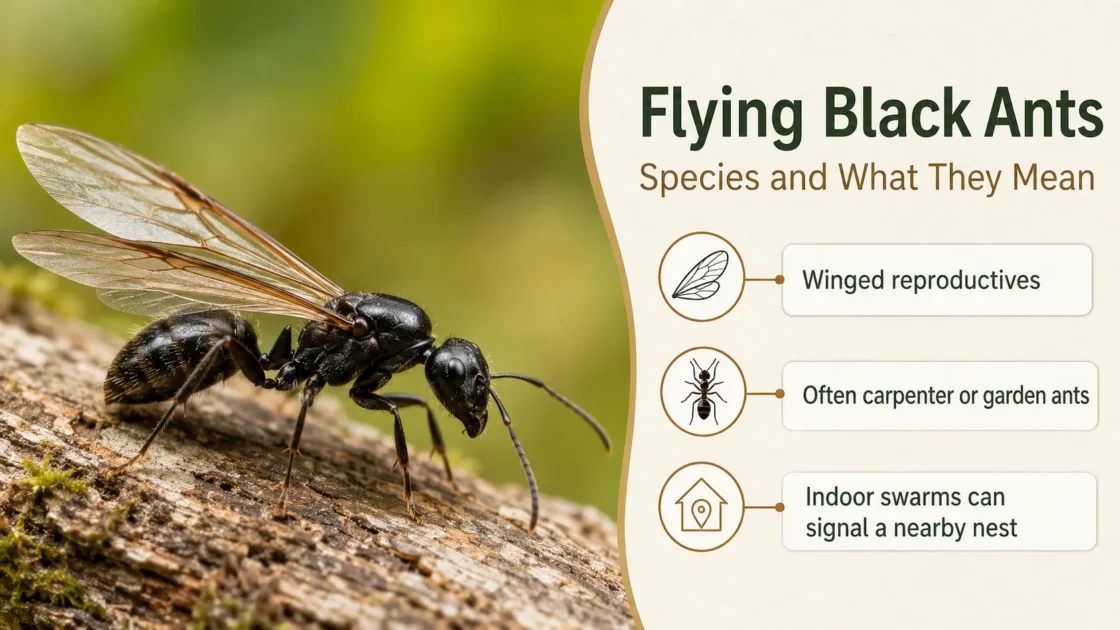
“Black Flying Ant” Describes an Appearance, Not a Species
Most ants visible around a colony are wingless female workers. A mature colony can also produce reproductive males and young queens. Before mating, these reproductives usually have wings and are called alates. Their temporary winged stage explains why a familiar ground-dwelling ant colony can appear to produce a completely different insect when swarming begins.[1]
The sexes can look different from each other as well. Ant queens generally have a large mesosoma—the middle body region that contains the flight muscles—and a relatively large abdomen. Males commonly have a smaller head, prominent eyes, and a more slender outline. In some species, a queen can be dramatically larger than the workers that normally reveal the colony’s presence. After mating, a queen may discard her wings before searching for or establishing a nest site.
Color can cross caste boundaries in unexpected ways
A dark alate does not necessarily come from a species whose workers would be described as black. Male red imported fire ants, Solenopsis invicta, provide a useful example: UC IPM describes the winged males as black, with smaller heads and antennae that are not elbowed in the same way as the females.[7] Where that species occurs, a black male could therefore be misleading if color or antenna shape were considered in isolation.
Which Species Can Produce Flying Black Ants?
Several species and broader groups can fit the description. The useful shortlist changes with geography. A large black alate in eastern North America raises different possibilities from a mass emergence of black alates from paving in a British garden.
| Possible match | Clues that support it | Geographic or habitat context | Identification limit |
|---|---|---|---|
| Carpenter ants Camponotus spp. | Large alates; association with trees, structural voids, moisture-damaged wood, or fibrous excavated debris | Many regional species occur. Camponotus pennsylvanicus is a familiar black carpenter ant in northeastern North America. | Not every large black ant is a carpenter ant, and not every carpenter ant is uniformly black. |
| Black garden ant Lasius niger | Dark alates emerging from soil, lawns, paving, patios, or similar ground nests | A leading candidate for familiar summer flying-ant swarms in Britain and parts of Europe | Its familiar common name should not be used to identify dark alates worldwide. |
| Immigrant pavement ant Tetramorium immigrans | Small dark ants associated with sidewalks, slab edges, foundations, pavement cracks, and urban soil | Established widely in North American urban environments; also part of the European Tetramorium fauna | Close relatives can be difficult to separate without detailed morphology. |
| Little black ant Monomorium minimum | Very small, shiny dark workers; nesting may occur in soil, under objects, or in structural voids | North American species; winged males and females are produced seasonally | “Tiny and black” is not enough for species-level identification. |
| Other dark local ants | Appearance may overlap with Lasius, Formica, Camponotus, Tetramorium, and other genera | Local ant fauna becomes decisive outside the best-documented examples above | A photograph may support a genus or broader group without supporting a species name. |
This is a sorting table, not a visual species key. Fine characters used by ant taxonomists can include the number and shape of petiole nodes, antennal segmentation, sculpture of the head and mesosoma, propodeal spines, hairs, and other structures that may not be resolved in an ordinary photograph.[1][4]
Large Black Flying Ants Put Carpenter Ants High on the List
A conspicuously large, dark alate is often where concern about carpenter ants begins. Carpenter ants in the genus Camponotus include large dark species, and their queens and males are winged during the reproductive stage. In the northeastern United States, the black carpenter ant Camponotus pennsylvanicus is a common structural invader.[2]
Size is a clue, not a diagnosis. Carpenter ant workers themselves can vary markedly in size within a colony, and reproductives are larger than ordinary workers. Other ants can also appear large when the insect being observed is a queen rather than a worker.[3]
Wood association is more informative than black color
Carpenter ants excavate galleries for nesting. They do not consume wood as termites do. Parent nests are commonly associated with moisture or decayed wood, while satellite nests can also occur in wall voids, insulation, hollow spaces, and relatively dry structural sites.[3]
The case for carpenter ants becomes stronger when large dark alates repeatedly appear beside a window frame with a leak history, softened timber, a roof or plumbing moisture problem, a wall void, or another wood-associated cavity. Fibrous material excavated from galleries can provide additional evidence.
A single large winged ant does not establish an indoor carpenter-ant colony
A newly mated carpenter-ant queen can be encountered while searching for a nest site, and outdoor carpenter ants can enter buildings. The evidence changes when numerous winged carpenter ants appear indoors or repeatedly emerge from a structural opening. Penn State Extension notes that numerous winged reproductives found at windows inside a house probably originated from an indoor nest.[2]
Small Black Alates Are Better Sorted by Habitat and Region
Small dark alates create a harder identification problem because many species overlap in general appearance. The surrounding nest habitat often provides better evidence than trying to judge subtle shades of brown or black.
Pavement, sidewalk, patio, or slab cracks: Tetramorium becomes relevant
Tetramorium immigrans, the immigrant pavement ant, is a common urban ant in much of North America. Its workers range from dark brown to nearly black, while the winged males and queens are larger than the workers. The species is closely associated with built environments, making a swarm from pavement joints, sidewalk edges, foundations, or compacted urban soil more informative than body color alone.[4]
Older North American material may call these ants Tetramorium caespitum. North American pavement ants were historically placed under that name. Later genetic, phylogenetic, and morphological work separated the widespread introduced North American form, and the 2017 revision of the Tetramorium caespitum complex associated it with the name Tetramorium immigrans.[4]
Even the modern name should not be applied solely because a small black alate appeared beside concrete. Closely related Tetramorium species can overlap geographically and may require characters too fine for a casual photograph.
British gardens, lawns, and paving: Lasius niger is often the stronger candidate
In Britain, the familiar black garden ant Lasius niger is strongly associated with the conspicuous summer flying-ant phenomenon. The Natural History Museum notes that, particularly in UK urban areas, many of the winged ants seen during these events are sexually mature queens and males of this species. Colonies commonly occupy dry soil, lawns, flower beds, paving, patios, and spaces beneath stones or slabs.[5]
The queen is much larger than the ordinary workers and also larger than the winged males. A swarm can therefore contain individuals with noticeably different body sizes without representing several species. That caste difference is especially useful when a large winged ant appears among much smaller black ants around the same nest entrance.
Lasius niger should remain a regional interpretation. A dark alate photographed in North America, Asia, or another region should not be labelled “black garden ant” simply because an image resembles a British specimen.
Extremely small black ants: Monomorium minimum is one possibility in North America
The little black ant, Monomorium minimum, has very small shiny-black workers and can nest in lawns, beneath stones, bricks, wood, and logs, as well as in masonry, woodwork, wall voids, and other protected spaces in buildings. Texas A&M records production of winged males and females during summer.[6]
The common name can tempt an identification based on size and color alone. That is unsafe. Many tiny ants are dark, and the characters required to separate small ant taxa may be difficult to see without magnification. Where the specimen is tiny, “small dark ant alate” can be a more defensible identification than forcing a species name from a low-detail image.
What Flying Black Ants Mean Depends on the Pattern of the Sighting
The presence of wings shows that the ant is, or recently was, part of the reproductive caste. It does not by itself reveal where the parent colony is located. The number of ants, their emergence point, associated workers, and whether the event repeats change the interpretation.
| Observation | What it supports | What it does not prove |
|---|---|---|
| One or two winged ants at an indoor window | Accidental entry, attraction toward light, or a nearby indoor or outdoor source are all plausible. | It does not by itself prove that a colony is nesting in the wall. |
| A short outdoor swarm over a lawn, garden, or paved area | A reproductive flight from mature colonies fits the observation well. | It does not imply that the building is infested. |
| Many alates emerging from the same baseboard, crack, floor edge, or wall opening | A colony in the structure or immediately connected to that opening becomes much more plausible. | The emergence point alone may not identify the ant species. |
| Large dark alates repeatedly appearing beside damp or damaged wood | Carpenter ants deserve closer consideration, especially if workers or excavated fibrous debris are also present. | Black color and large size alone do not confirm Camponotus. |
| Small dark alates leaving cracks in pavement or beside a slab | A ground-nesting urban species such as a pavement ant may fit the setting. | The nest location does not distinguish among every small dark ant species. |
| Loose wings with no intact insects | A reproductive emergence may have occurred nearby. | Wings alone may not establish whether the insects were ants or termites. |
Repeated emergence carries more weight than a single sighting
A winged ant can travel. That makes an isolated individual a poor indicator of the exact nest location. A group emerging directly from a fixed opening is different: the insects can be traced to a physical route associated with the structure. If the same pattern occurs again, the possibility of a nearby established colony becomes harder to explain as accidental entry.
Worker activity adds another layer of evidence. Large wingless ants moving between a wooden structural area and an outdoor tree, for example, tell a different story from a single alate found on a curtain. Small workers disappearing beneath a patio slab likewise provide more useful habitat information than the color of one airborne reproductive.
A Swarm Can Appear Suddenly Even Though the Colony Is Not New
Large numbers of flying ants can seem to appear within minutes because reproductives remain associated with an established colony until conditions favor emergence. When mating-flight conditions arrive, many males and young queens can leave over a short period. Nearby colonies responding to similar local conditions can make the event look even larger.
The timing is species- and region-dependent. British Lasius niger flights are well known from the warmer part of the year, but even there the phenomenon is better understood as a flight season with multiple local peaks than a single nationwide “flying ant day.” Local weather affects when emergence occurs.[5]
Carpenter ants follow different schedules, and flight timing can vary among Camponotus species. UC IPM, for example, describes species-specific differences in western carpenter-ant mating flights.[3] A calendar date therefore cannot identify an unknown black alate by itself.
Flying Black Ant or Dark Termite Swarmer?
Dark termite reproductives are one of the main sources of confusion. Color does little to solve the problem because termite swarmers can also be dark. Several body characters should be assessed together.[8]
| Feature | Winged ant | Winged termite |
|---|---|---|
| Waist | Usually clearly constricted between the middle and rear body regions | Broad transition without the narrow ant-like waist |
| Front and hind wings | Forewings are larger than the hind wings | Front and hind wings are approximately similar in size |
| Antennae | Common household-ant females show the familiar elbowed form | Not elbowed; typically straighter or beadlike |
| Body color | Can be black, dark brown, reddish, mixed, or lighter depending on species and caste | Reproductive termites can also be dark |
The waist and wing proportions are especially useful because the antenna rule has exceptions among male ants. The black males of Solenopsis invicta, for example, are described by UC IPM as lacking the elbowed antenna form seen in females.[7] An identification based on a single character can therefore fail.
Detached wings are also incomplete evidence. Mated ant queens can shed their wings, and reproductive termites shed wings after flight as well. Where only loose wings remain, an intact specimen provides much more information than the wings by themselves.
The Same Black Alate Can Mean Different Things Indoors and Outdoors
An outdoor alate on a patio, lawn, tree trunk, or garden wall is often simply an insect participating in reproductive activity. Outdoor sightings are especially weak evidence of a structural problem when there is no repeated entry into the building and no worker activity associated with the structure.
Inside a building, the distinction is between entry and emergence. An ant resting on the inside of a window may have flown in. Ants actively leaving a hole in trim, a wall joint, flooring, or another concealed space are providing direct evidence of a route from that location. Numerous winged carpenter ants inside a home deserve particular attention because mature carpenter-ant colonies produce reproductives, and indoor swarming can indicate a nest within the building.[2]
That does not mean every indoor swarm represents structural damage. Ant species differ in nesting biology, and many ants occupying wall voids or spaces around slabs are primarily nuisance insects. Finding the species group and the source of emergence is what determines the meaning of the swarm.
What to Examine Before Deciding What the Ants Mean
Treatment decisions are more useful after the observation has been narrowed down. Broad spraying of visible alates can remove the insects in view without answering whether the source is a temporary outdoor flight, a soil colony beside the building, or a nest within a structural void.
- Keep an intact specimen if possible. A body with antennae and wings attached contains far more diagnostic information than crushed insects or loose wings.
- Confirm ant versus termite before attempting species identification. Examine the waist and the relative sizes of the two wing pairs; use antenna form as part of the evidence rather than the only test.
- Record the exact emergence point. A window, ceiling light, wall crack, wooden joint, slab edge, lawn, tree, and pavement crack imply different possible nest settings.
- Look for workers associated with the same location. Worker morphology and foraging trails can narrow the identification more effectively than a single reproductive caste.
- For large dark ants, examine the wood and moisture context. Leaks, damp timber, decayed wood, structural voids, and fibrous excavated debris increase the relevance of carpenter ants.
- Treat repeated emergence differently from an isolated insect. Reappearance from the same point provides stronger evidence of a local colony than a lone alate with no traceable source.
When species-level identification matters, especially for a recurring indoor swarm, a clear dorsal and side photograph or a preserved specimen is preferable to color descriptions such as “large black flying ant.” Some species can be narrowed from ordinary photographs; others require magnification and regional taxonomic confirmation.
Sources and Verification
- [1] University of Minnesota Extension — “Ants.” Used for ant caste biology, limitations of color and size in identification, male and queen morphology, swarming behavior, and ant-versus-termite characters.
- [2] Penn State Extension — “Carpenter Ants,” June 24, 2026. Used for Camponotus pennsylvanicus context and interpretation of numerous winged carpenter ants found indoors.
- [3] University of Minnesota Extension — “Carpenter Ants”; UC Statewide IPM Program — “Carpenter Ants.” Used for carpenter-ant morphology, wood excavation, nesting habitat, moisture associations, satellite nests, and species-dependent mating flights.
- [4] University of Florida IFAS Extension, EENY-600/IN1047 — “Immigrant Pavement Ant, Tetramorium immigrans Santschi.” Used for appearance, urban habitat, North American distribution context, identification limits, and the revised treatment of North American pavement ants formerly identified as Tetramorium caespitum.
- [5] Natural History Museum, London — “Flying ant day: when winged ants take their nuptial flight”; Royal Horticultural Society — “Ants.” Used for Lasius niger in Britain, garden and paving nest habitats, queen–male differences, nuptial flights, and variation in summer emergence timing.
- [6] Texas A&M Urban and Structural Entomology Program — “Little Black Ant, Monomorium minimum.” Used for appearance, nesting settings, distribution context, and production of winged males and females.
- [7] UC Statewide IPM Program — “Red Imported Fire Ant.” Used for the black coloration and unusual antenna form of male Solenopsis invicta alates.
- [8] UC Statewide IPM Program — “Ant identification: Winged ants” and “Ant identification: Winged termites.” Used for waist, wing, and antenna characters separating most winged ants from termite swarmers.