Flying carpenter ants are the winged reproductive males and females of carpenter ant colonies in the genus Camponotus. They are not a separate species of flying ant. Finding one near an open window can simply mean an outdoor reproductive entered the building, while large numbers emerging indoors, repeated activity from the same structural area, coarse fibrous debris, worker trails, or moisture-damaged wood provide much stronger evidence that a carpenter ant nest may be associated with the structure.[a]
The wings themselves do not show how much damage exists. Identification and risk interpretation depend on several pieces of evidence together: body structure, the number of ants, where they appeared, whether workers are active nearby, the condition of the wood, and whether nesting debris is present.
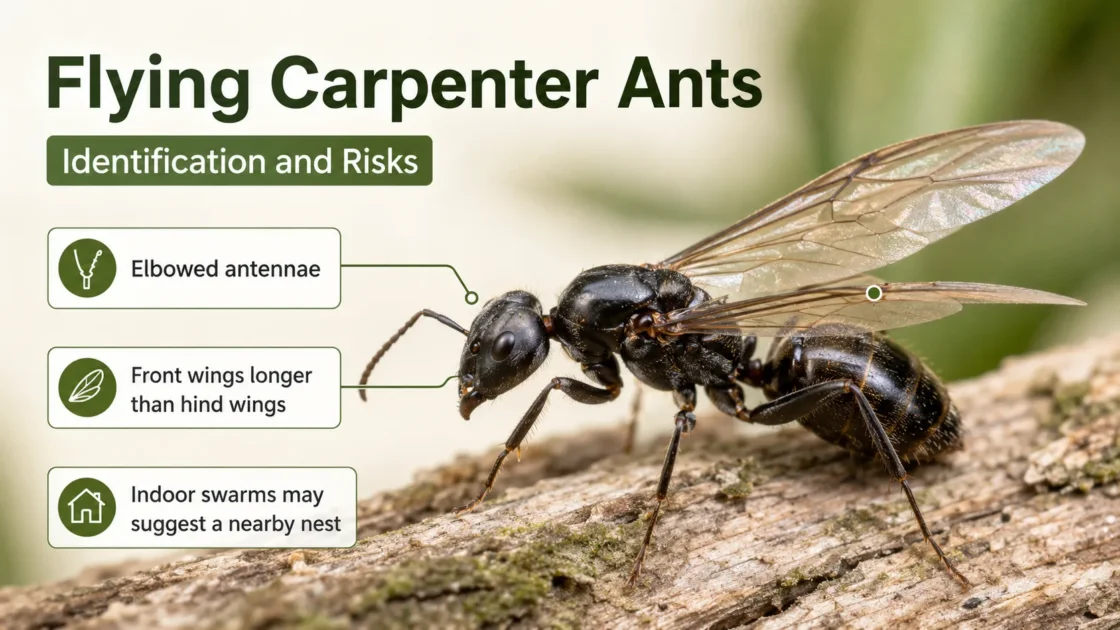
A Flying Carpenter Ant Is a Reproductive Form of Camponotus
Most carpenter ants encountered during ordinary foraging are wingless workers. A mature colony can also produce winged males and reproductive females, or alates, that leave during mating flights. After mating, males die, while inseminated females disperse in search of suitable places to begin new colonies. A female that has landed may break off or shed her wings and continue as a dealate queen.
Production of alates is associated with colony maturity. UC Statewide IPM notes that carpenter ant colonies grow slowly at first and generally begin producing winged reproductives only after several years. The presence of alates therefore says something about the colony that produced them, but it does not reveal that colony’s exact age, size, location, or level of structural damage.[b]
Identification Depends on Structure More Than Color
A large black ant with wings may be a carpenter ant, but size and color alone are not reliable identification characters. Camponotus contains many species, and appearance varies by species, sex and caste. Some are dark, some are reddish or bicolored, and workers within one colony can occur in noticeably different size classes.
| Feature | What supports carpenter-ant identification | What can mislead |
|---|---|---|
| Waist | A clearly constricted ant waist with a single petiole node between the mesosoma and gaster | The node can be difficult to see from above or beneath folded wings |
| Antennae | Distinctly elbowed antennae | Broken antennae or blurred photographs can obscure the bend |
| Wing pairs | Forewings longer than the hind wings | This character disappears after wings are shed or broken |
| Mesosoma profile | A smooth, arched profile supports Camponotus, especially in workers and dealate specimens | Wing-bearing males and females have an enlarged flight-related mesosoma, so profile alone should not determine an alate ID |
| Color | Black, dark brown, reddish and bicolored forms all occur | “Large and black” is not a diagnostic combination |
| Body size | Many carpenter ants are conspicuously large, and reproductive females can be larger than nearby workers | Species, caste and sex create broad variation; another large ant can easily be mistaken for Camponotus |
The single petiole node is especially useful
Carpenter ants have one petiolar segment forming the narrow connection between the main body and gaster. This helps separate them from ant groups with two obvious waist nodes. The node can be partly concealed, however, so an uncertain view should be combined with antenna shape and other body characters rather than treated as a failed identification.
Large does not automatically mean carpenter ant
Field ants in the genus Formica are one useful example of a look-alike. Colorado State University Extension notes that some field ants resemble carpenter ants in size and coloration but normally nest outdoors in soil. In side view, the more uniformly arched mesosoma of a carpenter ant can help separate the groups.[e]
Winged Females and Males Can Look Surprisingly Different
A carpenter ant swarm does not consist of identical insects. Winged reproductive females are generally heavier-bodied than males, with a more substantial thorax for flight muscles and a body capable of founding a colony after mating. Males are typically more slender and can have proportionally smaller heads and more conspicuous wings.
This sexual difference matters when several alates are collected from the same event. A small, narrow-bodied male beside a much larger female can look like a different insect at first. Conversely, a newly mated female that has already discarded her wings may resemble an unusually large worker. Wing loss does not convert her into a worker; she remains a reproductive female.
Carpenter Ant or Termite Swarmer?
Termite swarmers and carpenter ant alates can appear in the same kinds of places—around windows, doors, lights and wood—yet their body structure is different. A carpenter ant has an ant-like narrow waist, elbowed antennae and unequal wing pairs. A termite swarmer has a broader body connection, non-elbowed antennae and forewings and hind wings that are much more similar in length.
| Check | Flying carpenter ant | Termite swarmer |
|---|---|---|
| Waist | Narrow and visibly constricted | Broad body connection |
| Antennae | Elbowed | Straighter or bead-like |
| Wing proportions | Front pair longer than hind pair | Front and hind pairs similar in length |
| Wood relationship | Excavates nesting spaces; does not use wood as food | Termites consume cellulose |
Detached wings by themselves are a poor basis for choosing between the two. When bodies remain, waist and antenna structure should be checked as well. The broader comparison is covered separately in Flying Ants vs Termites: How to Tell the Difference.
What an Indoor Sighting Actually Tells You
The same insect can have very different meaning depending on where and how it was found. One alate beside an open window is weak evidence of a structural nest. Large numbers emerging from a wall, ceiling, window frame or another indoor location are much harder to explain as accidental entry.
| Observation | What it can indicate | What it does not establish |
|---|---|---|
| One alate at a window or exterior door | An outdoor reproductive may have entered or been attracted to light | An indoor colony or structural damage |
| A few newly dealate queens indoors | Mated females may be searching for new nesting sites | An established nest in the building |
| Many alates appearing in one room | A mature nest associated with the building becomes much more plausible | The exact nest position or amount of wood affected |
| Alates emerging directly from a wall, ceiling, trim or void | Strong evidence that reproductive ants are originating within the structure | Whether the visible opening is the entire nest |
| Repeated coarse fibrous debris below the same gap | Wood or other material may be being excavated nearby | Species identity without insect evidence |
| Workers repeatedly entering the same void after dark | An active route toward a nest or satellite nest | Whether the colony’s parent nest is indoors or outdoors |
| Ant activity beside chronically damp or decayed wood | A nesting environment associated with many carpenter ant problems | That the ants caused the original moisture damage |
Indoor evidence
A swarm should be interpreted by its point of origin, not simply by where dead ants eventually accumulate. Alates emerging from a hidden indoor space often move toward windows and light, so a pile on a windowsill can be some distance from the nest itself.
Frass, Galleries and Moisture Are Different Types of Evidence
Carpenter ants do not eat wood. They remove material while creating and enlarging nesting galleries. The excavated material can appear outside the nest as coarse, fibrous or sawdust-like debris. It may also contain fragments of insects and other material carried out of the nesting space.
Inside occupied wood, the galleries themselves tend to be clean, smooth and relatively free of loose debris because material is carried or pushed outside. University of Minnesota Extension describes established galleries as having a smooth, sanded appearance. Damage develops at variable rates; severe, long-standing excavation can weaken structural wood, but carpenter ant damage commonly develops over a much longer period than a sudden swarm might suggest.
Sawdust under a board is not enough by itself
Construction dust, deteriorating wood and other wood-boring insects can also leave debris. A stronger carpenter-ant pattern is coarse material repeatedly appearing beneath the same crack or opening while carpenter ants are active nearby. The debris becomes more informative when its location aligns with trails, damp wood, a void entrance or visible galleries.
Moisture can explain where a colony started
Water leaks, condensation, poor ventilation and pre-existing decay can make wood easier to occupy. Carpenter ant nests frequently begin in softened or moisture-affected material and may later extend into sound wood. The relationship should not be reversed: finding carpenter ants near wet wood does not prove that the ants caused the water damage.
Parent and Satellite Nests Explain Many Indoor Sightings
A carpenter ant problem can involve more than one nesting site. The parent nest is often associated with moist wood and may be outdoors in a tree, stump, root system, buried wood, landscape timber, fence post or firewood. Colonies can establish satellite nests elsewhere, including inside buildings.
Satellite nests help explain why ants can repeatedly appear in a dry wall void even when the main colony is outside. University of Minnesota Extension reports satellite sites in relatively dry places such as insulation, hollow doors, sound wood and wall voids. Workers can move between the parent colony and satellites, so a trail disappearing into a wall does not automatically prove that the colony’s queen is behind that wall.
The same biology explains why eliminating visible ants without locating the nesting system can fail. A few workers seen at a sink or windowsill may represent only a small part of a colony moving between food, moisture and one or more nest sites.
Where Indoor Alates Make the Most Sense to Investigate
When carpenter ant alates repeatedly appear indoors, the most useful inspection areas are places where voids, wood, moisture and access routes overlap. UC IPM lists wall voids, hollow doors and insulation among indoor nesting sites and recommends correcting water and access problems around structures.
- Window and door framing: especially where condensation, failed seals, leaking flashing or previously softened wood is present.
- Bathrooms and kitchens: around tubs, showers, sinks, dishwashers and plumbing penetrations where moisture can persist out of sight.
- Roof and attic areas: beneath roof leaks, around fascia and soffits, and in poorly ventilated damp spaces.
- Subfloors and crawl spaces: particularly where plumbing leaks, ground moisture or wood-to-soil contact has affected timber.
- Wall voids and hollow building elements: including hollow doors and spaces around pipes, cables and utility entrances.
- Exterior wood: decks, landscape timbers, fence posts, dead wood, stumps and stored firewood near the building.
- Tree-to-building routes: branches touching roofs or siding can provide access from outdoor colonies.
- Utility routes: carpenter ants can follow wires and cables toward upper parts of structures.
Worker Trails Can Be More Informative Than the Swarm
The mating flight may last only a short time. Worker activity can persist and provide better information about where the colony is operating. Many carpenter ants forage heavily after sunset, which is why extension guidance commonly recommends observing trails during evening or nighttime activity.[d]
A worker carrying food toward a crack, repeatedly crossing the same sill, following a utility line, or moving between a tree and a building can reveal an access route. The direction of traffic matters more than the simple presence of ants. A trail leading outside may connect an indoor satellite with an outdoor parent nest, while ants entering the same concealed opening repeatedly can narrow the area that needs inspection.
Disturbing or spraying the trail before its route has been observed can remove that information. Surface treatment of a few visible foragers also does not demonstrate that a hidden nest has been eliminated.
How Much Structural Risk Does Camponotus Actually Represent?
Structural risk is real for some carpenter ant infestations, but the genus should not be treated as though every species excavates buildings in exactly the same way. UF/IFAS notes that not every species placed in Camponotus is a wood-excavating carpenter ant in the strict sense; some use soil or existing cavities instead.[c]
Regional species biology can change the practical interpretation. UF/IFAS, for example, distinguishes Florida carpenter ants that commonly use existing voids or excavate soft, rotten or pithy material from black carpenter ants that are more associated with damaging wood. A genus-level household identification therefore cannot provide a universal damage estimate.
Where a wood-excavating species has an established structural nest, the amount of damage depends on how long the colony has been present, where galleries are located, how extensive the nesting system is, and the condition and role of the affected timber. Severe excavation can weaken structural members, but a flight of alates does not measure any of those variables.
What the swarm cannot tell you
The number of winged ants visible in a room is not a direct measurement of wood damage. A large emergence supports the presence of a mature colony associated with the building, but inspection is still needed to determine where the nest is and whether structural wood has actually been excavated.
Indoor Timing Can Change the Meaning of a Sighting
Many North American carpenter ants produce mating flights in spring or early summer, but there is no single carpenter-ant swarm calendar that applies everywhere. Species, latitude, local climate, rainfall, temperature and the thermal environment inside a building can all shift activity.
Warm-climate species illustrate the problem with fixed monthly rules. UF/IFAS records alates of Florida carpenter ants across a broader spring-to-fall period, depending on locality and environmental conditions. A month that is useful for identification in Minnesota cannot simply be transferred to Florida or another climate zone.
In cold-winter regions, carpenter ant activity inside a heated building during winter or very early spring carries more weight because outdoor colonies would normally be much less active. University of Minnesota Extension uses winter indoor activity as evidence pointing toward an indoor nest. That interpretation should remain climate-specific rather than being applied to warm regions where ants can remain active through much of the year.
Carpenter Ants Can Bite, but They Do Not Sting
Carpenter ants lack a functional sting. Workers can defend themselves with their mandibles, and formicine carpenter ants can apply formic acid to a bite, producing a localized burning sensation. This is generally secondary to the household issue presented by an indoor colony; the main concern after finding flying carpenter ants in a building is usually identification and nest evidence rather than envenomation.
Preserve a Specimen Before Removing the Evidence
When identification is uncertain, an intact specimen can provide more information than photographs of scattered wings. Before cleaning the area, useful evidence can be preserved without attempting to dismantle walls or expose a hidden nest.
- Keep at least one intact winged ant or recently dealate specimen.
- Photograph the insect from the side as well as from above.
- Include the antennae, waist and both wing pairs when they remain attached.
- Record the exact room and point where the ants first appeared rather than only where they later collected near light.
- Note whether the event involved one insect, a few individuals or a concentrated emergence.
- Check the same area for worker traffic, coarse debris, damp wood or a concealed opening.
Species-level identification may require characters that are not visible in an ordinary household photograph. When the specimen only supports identification as Camponotus, the evidence should remain at genus level rather than forcing a species name from color or size.
When the Evidence Supports a Closer Structural Inspection
A professional inspection becomes more reasonable when several lines of evidence converge. Examples include many alates emerging from inside the structure, repeated swarms from the same area, persistent worker trails entering a void, recurring coarse debris, activity around moisture-damaged structural wood, or visible smooth galleries. Rustling from a concealed space can add context when other carpenter-ant evidence is already present.
A single reproductive beside an open window without further activity belongs in a different evidence category. It can be collected and identified while the area is monitored for recurrence. The observation becomes more informative if additional ants emerge from a consistent indoor source.
When visible flying ants need to be removed, treating the insects in the room should not be confused with locating the colony that produced them. General indoor control and removal methods are covered separately in How to Get Rid of Flying Ants Indoors; a suspected carpenter ant nest requires attention to its location, moisture conditions and any affected wood.
The most informative carpenter-ant finding is not the presence of wings alone. A narrow waist, elbowed antennae and appropriate ant morphology establish the identification; the number of insects, emergence point, worker trails, frass, moisture and gallery evidence determine what that identification means inside a building.
Sources and Verification
- [a] University of Minnesota Extension — Carpenter Ants — identification characters, parent and satellite nests, indoor alates, seasonal interpretation, galleries, debris and structural damage.
- [b] University of California Statewide IPM Program — Carpenter Ants — reproductive flights, colony maturity, nesting biology, wood excavation, moisture associations and nighttime trail inspection.
- [c] University of Florida IFAS Extension — Florida Carpenter Ants — variation within Camponotus, Florida nesting behavior, alates, seasonal variation, bite defense and structural-risk differences among carpenter ants.
- [d] Colorado State University Extension — Carpenter Ants — ant-versus-termite characters, structural nesting, nighttime inspection, gallery appearance and moisture-associated nesting.
- [e] Colorado State University Extension — Ants in the Home — field ants as carpenter-ant look-alikes and profile-based identification context.