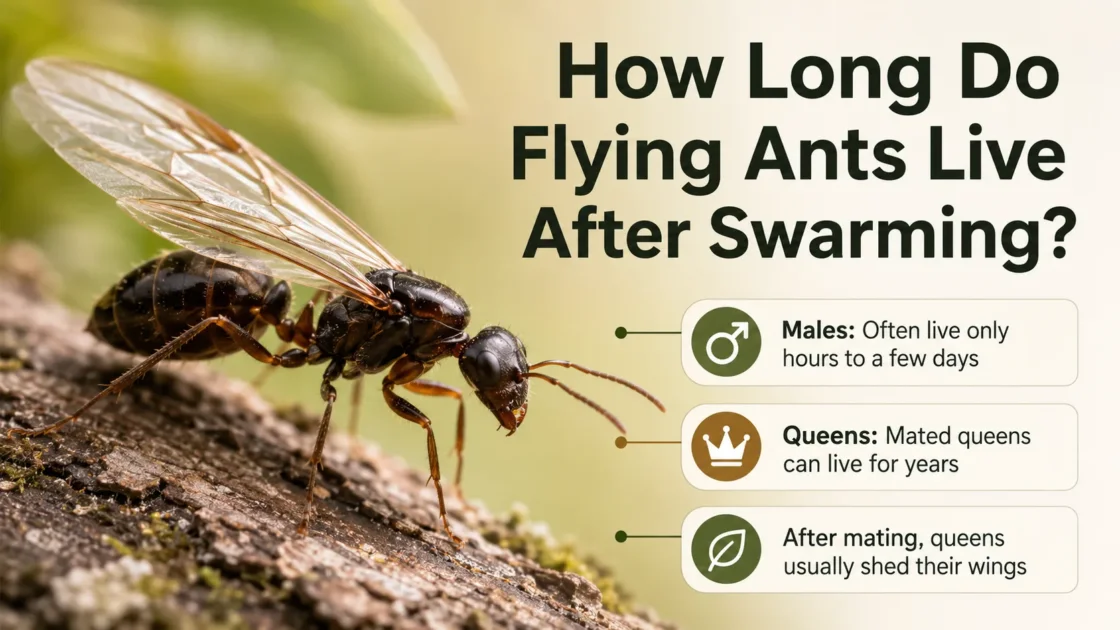
Male flying ants usually live only a short time after swarming because their role ends after mating. Mated female flying ants, which are future queens, shed their wings and may live for years if they find a nest site and establish a colony. The exact lifespan depends on caste, species, weather, predation, and whether the female is successfully fertilized.
A flying ant is not a separate species. It is a winged reproductive ant, or alate, produced by a mature colony during a mating season. The short answer is simple: males die soon after mating, while mated queens can become long-lived colony founders. Extension sources report carpenter ant queens living as long as 15 years, while red imported fire ant queens may live 7 years or more under colony conditions. [a] [b]
Key Data Points
Common name
Flying ants
Taxonomic group
Family Formicidae
Male lifespan after mating
Shortly afterward
Mated female outcome
Sheds wings
Queen lifespan examples
7+ to 15 years
Main data limit
Species dependent
Short Answer
Most visible flying ants disappear quickly after a swarm. Male alates usually die soon after mating. Mated female alates land, remove their wings, and try to start a new nest. If that founding attempt fails, the female may die soon. If it succeeds, she becomes a queen and may live for years.
So the practical answer is: flying males may be gone within a short post-mating period, while successful queens can live for many years after the same swarm event.
What Happens After a Flying Ant Swarm?
A swarm is a reproductive flight. Mature colonies release winged males and winged virgin queens when seasonal and weather conditions favor flight. Natural History Museum guidance describes these winged males and virgin queens leaving the nest to mate away from the parent colony. [d]
After mating, the two sexes follow very different paths. UC IPM notes for carpenter ants that males die after the mating flight, while inseminated queens search for nest sites and begin laying eggs. [e] NC State Extension reports the same pattern for carpenter ants: males die shortly after mating, while mated females shed their wings and seek a new nest site. [f]
Post-Swarm Lifespan by Caste
| Caste or form | What happens after swarming | Likely lifespan after the event | Data confidence |
|---|---|---|---|
| Winged male | Mates with a female reproductive, then has no colony-founding role. | Usually dies soon after mating. | High for the general pattern; exact hours or days vary by species. |
| Mated female alate | Lands, removes wings, searches for a protected nest site, and begins founding. | May die during founding, or may become a queen and live for years. | High for the behavior; lifespan varies strongly by species and colony success. |
| Unmated female alate | May remain exposed, be eaten, dry out, or fail to start a colony. | Often short-lived compared with established queens. | Moderate; field survival is hard to measure from casual observations. |
| Established queen | Lives inside the nest and produces eggs for the colony. | Years in many species; carpenter ant examples reach 15 years. | High for cited species examples, not for all ants globally. |
| Worker ants | Workers do not normally take part in nuptial flights. | Not the main answer to post-swarm lifespan. | High; workers are wingless sterile females in typical colonies. |
The First Hours, Days, and Years After Swarming
| Time after swarm | Male flying ants | Female flying ants | What a homeowner may notice |
|---|---|---|---|
| Same day | Mate or fail to mate; many are eaten or exhausted. | Land and begin searching for nest sites. | Large numbers near windows, lights, pavement, decks, or soil. |
| Next few days | Post-mating death is expected for males. | Mated females may shed wings and hide in soil, wood, or small cavities. | Discarded wings or large wingless females may be seen. |
| First month | No continuing role in the colony. | Some queens begin early brood development; fire ant sources report small workers developing in about one month after egg laying. | Most swarmers are gone; remaining activity depends on nest success. |
| Several years | No survival path after mating. | Successful queens may become long-lived egg layers. | A mature colony may later produce its own winged forms. |
Data Interpretation Note
A flying ant seen indoors is not automatically proof of an established indoor nest. A few alates may enter from outdoors. Repeated indoor swarms, especially from walls, floors, or damp wood, deserve closer inspection because some ant species nest in structures.
Source-Based Queen Longevity Examples
Queen lifespan is the main reason this question has two answers. The male’s post-swarm life is short. The queen’s post-swarm life can be long if colony founding works. NC State Extension and Rutgers both report carpenter ant queens living as long as 15 years. Texas A&M reports red imported fire ant queens living 7 years or more. [g] [h]
Queen Lifespan Benchmarks from Extension Sources
These are cited examples, not a universal lifespan for all ant species.
Sources: NC State Extension and Rutgers for carpenter ants; Texas A&M Fire Ant Research and Management Project for red imported fire ants.
Post-Swarm Survival Path
The survival path depends less on the wings and more on caste. Wings are temporary equipment for reproduction. After the flight, a male has no colony role. A mated female changes from flying reproductive to dealate queen. That change is why discarded wings are common after a swarm.
Post-Swarm Survival Interpretation Scale
Values are editorial interpretation scores for this page, not species counts or field survival measurements.
Source basis: published descriptions of mating, male death, wing shedding, and queen founding behavior; scores are editorial interpretation values.
Indoor vs Outdoor Swarms: How to Read the Risk
| Observation | Most likely reading | Risk level | Practical note |
|---|---|---|---|
| A few flying ants near an open door or window | Outdoor swarmers may have entered accidentally. | Low | Remove them, check screens, and watch for repeated activity. |
| Many alates emerging from a wall, floor gap, or ceiling void | A nearby or indoor nest may be present. | Moderate to high | Identification matters before control decisions. |
| Large ants plus wood debris near damp wood | Carpenter ant inspection may be needed. | Moderate | Look for moisture, damaged wood, and recurring activity. |
| Discarded wings after a swarm | Mated queens may have shed wings after landing. | Context dependent | Wings alone do not identify species or prove a colony. |
How to Confirm They Are Flying Ants
Winged ants are often confused with termite swarmers. UC IPM describes winged ants as having elbowed antennae, a thin constricted waist, and hind wings that are smaller than the front wings. [i]
| Marker | Flying ant | Why it matters |
|---|---|---|
| Antennae | Elbowed | One of the most useful quick markers for ants. |
| Waist | Narrow and constricted | Separates ants from broad-waisted termite swarmers. |
| Wing pairs | Front wings larger than hind wings | Termite wings are more similar in size. |
| After mating | Female removes wings | Discarded wings may appear near the landing or nesting area. |
Where the Data Has Limits
Post-swarm lifespan is not measured easily from casual sightings. Many alates die from predation, dehydration, failed mating, or failed nest founding. Published pest and extension sources usually describe the outcome pattern rather than exact hour-by-hour survival.
Data Quality and Limitations
Ant lifespan data is caste-specific. A male, worker, virgin queen, mated queen, and established queen cannot be treated as one category. The phrase “flying ant” usually refers to a temporary reproductive stage, so the same swarm may contain short-lived males and females capable of founding long-lived colonies.
- Species differ in colony structure, mating season, nest site, and queen longevity.
- Weather affects swarming timing and survival after landing.
- Indoor sightings may overrepresent nuisance species and structural nesters.
- Occurrence records show reported evidence, not complete distribution or true abundance.
- Identification should be verified with physical markers where possible.
FAQ
Do flying ants die after they swarm?
Many do. Males normally die soon after mating. Mated females may survive if they shed their wings and find a suitable nest site.
How long do male flying ants live after mating?
Extension sources usually state that males die shortly after mating rather than giving an exact number of hours or days.
Can a flying ant become a queen?
Yes. A winged female that mates successfully can remove her wings and attempt to found a new colony.
Why are there dead flying ants after a swarm?
Swarming exposes alates to predators, drying conditions, exhaustion, and failed mating. Male death after mating is also part of the normal reproductive pattern.
Do flying ants in the house mean a nest is inside?
Not always. A few may enter from outdoors. Repeated indoor swarms or ants emerging from structural gaps should be inspected more carefully.
Why do flying ants lose their wings?
Mated females shed their wings after the mating flight. Wing removal marks the shift from flying reproductive to nest-founding queen.
Sources and Verification
- [a] NC State Extension — Biology and Control of Carpenter Ants — Used for carpenter ant swarmer behavior, male death after mating, female wing shedding, and queen longevity.
- [b] Texas Imported Fire Ant Research and Management Project — Biology — Used for red imported fire ant mating flight behavior, queen founding, worker development, and queen lifespan example.
- [c] BugGuide — Family Formicidae: Ants — Used for family-level taxonomy and classification context.
- [d] Natural History Museum — Flying ant day and nuptial flight — Used for public-facing explanation of winged males, virgin queens, nuptial flight, and wing loss after mating.
- [e] UC IPM — Carpenter Ants — Used for carpenter ant mating flight, male death, queen dispersal, nest founding, and structural context.
- [f] NC State Extension — Carpenter ant swarmers — Used for post-mating male death, female dealation, and queen lifespan statements.
- [g] Rutgers NJAES — Carpenter Ants and Their Control — Used for carpenter ant queen lifespan, worker lifespan, colony maturity, and swarmer production.
- [h] Texas A&M — Fire ant biology — Used for red imported fire ant queen lifespan and mating flight sequence.
- [i] UC IPM — Ant identification: winged ants — Used for winged ant identification markers: elbowed antennae, unequal wings, and constricted waist.