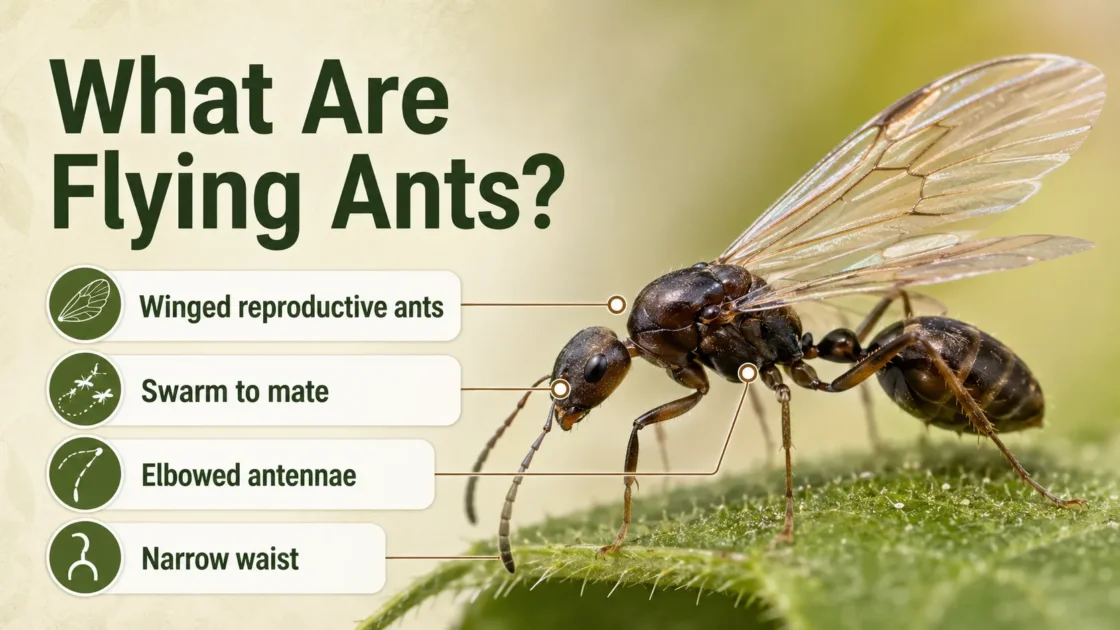
Flying ants are winged reproductive ants—usually males and unmated females capable of becoming queens. They are not a separate species, and ordinary adult worker ants do not suddenly grow wings. A mature colony produces winged reproductives, called alates, and releases them when reproductive timing and suitable flight conditions coincide. What looks like an overnight explosion of ants is usually a short mating and dispersal event involving insects that developed inside established colonies before the swarm began. [a]
Identification is based most reliably on body structure rather than color. A typical winged ant has a visibly constricted waist, two pairs of wings with the front pair larger than the hind pair, and usually elbowed antennae. Those traits are especially useful because flying ants are often confused with termite swarmers and, at smaller sizes, with true flies and other winged insects.
The basic distinction
A worker ant does not turn into a flying ant. Workers and winged reproductives are different colony castes. The wings belong to reproductive adults produced for mating and dispersal.
The Wings Come From the Reproductive Caste
An ant colony contains individuals with different biological roles. Workers are wingless females responsible for foraging, brood care, nest maintenance and defense. Reproductive males and females are produced by colonies capable of investing resources in reproduction. When these sexual forms mature, they may leave the nest with wings.
This explains why a familiar trail of small wingless ants can exist for months before larger winged ants suddenly appear nearby. The workers have not changed form. The colony has released a different caste that was developing out of sight.
Colony maturity is therefore part of the underlying cause of a swarm. Rain, heat or humidity cannot create reproductive ants overnight. Weather can influence when reproductives that already exist leave the nest, but the colony must first have produced them.
Why Flying Ants Can Appear All at Once
A swarm may seem abrupt because ant reproduction has two very different time scales. Developing reproductive ants can remain associated with a colony before departure, while the visible emergence may be compressed into a short period. Several nearby colonies of the same or different species can also encounter suitable conditions within the same local weather window.
That produces a familiar pattern: no obvious flying ants on one day, followed by dozens, hundreds or more around soil, paving, lawns, walls or other nest areas on another. The swarm represents concentrated dispersal, not a population that suddenly multiplied above ground.
Weather influences departure, but there is no universal trigger
Temperature, wind, humidity, rainfall, soil conditions and time of day can all be associated with ant mating flights, but their effects differ among species and regions. A large UK citizen-science study dominated by Lasius niger found that local temperature and wind speed were associated with flight observations, while the exact temporal pattern changed between years. [d] Older work comparing several European ant species also found species-specific differences in the weather conditions surrounding nuptial flights.
Rain is not the biological cause
A swarm after rain does not mean rainfall produced the flying ants. In species where rain is associated with flight, it acts as part of the environmental setting around an already mature colony and its already developed reproductives.
Recent research reinforces the need to avoid one weather formula for all ants. A 2026 Scientific Reports study examined alates recovered from swifts around Barcelona–El Prat Airport and detected 16 ant taxa. Within that sampling design, the researchers did not detect a statistical relationship between ant-flight detections and the tested temperature, humidity, wind, rainfall and pressure variables. The authors noted that colony-level biology, species differences and sampling effects may help explain the pattern. [e]
The practical result is simple: warm weather, calm air or recent rain can be useful context, but none should be treated as an identification test or a universal swarm forecast.
What Happens During the Flight
The visible flying stage exists for reproduction and dispersal. Once conditions align with the biology of the species, winged males and females leave their natal colony. The event is commonly called a nuptial flight or mating flight.
- Winged males and females leave an established colony.
- They disperse and mating occurs according to the reproductive behavior of the species.
- Males have no colony-founding role after mating and are generally short-lived afterward.
- Mated females land and may remove or shed their wings.
- The now-wingless female searches for a suitable founding site or begins a colony-founding phase appropriate to her species.
- Many attempts fail before a lasting worker-producing colony is established.
Colorado State University Extension notes that males die within a short period after leaving the colony and that only a small fraction of founding females successfully establish new colonies. A queen landing beside a building therefore does not mean a new infestation has already formed. Landing, selecting a site, surviving colony founding, producing the first workers and eventually developing a mature colony are separate steps.
Why Mated Queens Lose Their Wings
Wings serve the dispersal and mating phase. After a reproductive female has mated and landed, continued flight is no longer required for the typical independent colony-founding pathway. She may shed or remove her wings and become a dealate—an individual that was winged but is now wingless.
A dealate queen can be mistaken for a large worker because both are wingless. They are not the same caste. A recently dealated female may retain visible wing scars on the mesosoma, and her body proportions may differ markedly from nearby workers.
Loose wings are therefore useful evidence that a reproductive flight may have occurred, but wings without a body should not be used to identify an insect to species. Ants and termites can both lose wings around reproductive events.
How to Recognize a Flying Ant
The best first-pass identification comes from several structures agreeing with one another. University of Minnesota Extension describes ants by their constricted petiole, generally elbowed antennae and, in winged individuals, the characteristic ant wing arrangement. [b]
Look for the narrow waist first
Ants have a distinct narrowing between the mesosoma and the gaster. This connection includes the petiole, which may have one or two visible nodes depending on the ant group. From above or from the side, the body usually looks clearly constricted rather than continuously broad.
For an intact specimen, waist shape is especially useful because it can remain visible even after the wings have been lost.
Compare the two wing pairs
A winged ant has two pairs of wings. The forewings are generally larger and longer than the hind wings. With a still specimen, the smaller rear pair can often be seen partly beneath the front pair.
This is easier to assess on an insect that has landed than on one in flight. Crushed specimens, overlapping wings and missing wings can make the feature difficult to judge.
Antennae are useful, but do not rely on them alone
Most familiar identification guides describe ants as having elbowed or distinctly bent antennae. That remains a useful group-level marker, especially when combined with the ant waist and unequal wing pairs.
There are exceptions that make a one-character rule unsafe. Utah State University Extension, for example, describes male imported fire ants as having non-elbowed antennae, while the queens have the familiar elbowed form. [f] An unfamiliar winged insect should therefore not be classified as a termite solely because its antennae appear straighter than expected.
Color is supporting evidence, not a diagnosis
Winged ants can be black, dark brown, reddish, yellowish or patterned depending on species and caste. Even individuals from related groups can differ markedly in color. Lighting and translucent wings can change how colors appear in photographs.
“Black flying ant” describes appearance. It does not establish species identity. The same applies to labels such as red flying ant or brown flying ant.
Flying Ant, Termite Swarmer or True Fly?
Termite swarmers cause the most consequential confusion indoors because both groups can appear suddenly with four wings. University of Maryland Extension separates winged ants from termites using antenna shape, waist structure and relative wing size. [c] True flies provide a different comparison: adults in the order Diptera normally have only one functional pair of wings, with the hind pair reduced to balancing structures called halteres. [g]
| Feature | Flying ant | Termite swarmer | True fly |
|---|---|---|---|
| Functional wing pairs | Two pairs | Two pairs | One pair |
| Waist | Clearly constricted, with a petiole | Broad connection without an ant-like pinched waist | No ant-like petiole |
| Front vs. rear wings | Forewings generally larger than hind wings | Front and hind wings similar in size and shape | Hind wings reduced to halteres |
| Antennae | Usually elbowed; exceptions occur in some males | Generally straight or bead-like | Highly variable among fly groups |
| Color | Variable | Variable | Variable |
No color category in the table is diagnostic. If the waist, antennae and wings cannot be seen clearly, group-level identification may remain uncertain. A whole specimen is much more useful than a photograph of a detached wing.
Male Flying Ant or Future Queen?
A swarm contains reproductive ants, but that does not mean every flying individual is a queen. Males also have wings and participate in mating flights. The two sexes can look different enough that people sometimes assume they are different ant species.
In many ants, reproductive females are more heavily built, with a substantial mesosoma that housed the flight musculature and a relatively large gaster. Males are often more slender and may have a smaller head and conspicuous eyes. University of Minnesota Extension describes male ants generally as having a small head with large eyes, while queens tend to be the largest colony members. These are useful tendencies, not a universal sexing formula.
Species can differ greatly in body size and proportions. A large alate beside a smaller one may represent female and male reproductives, two different species, or normal variation within the local ant fauna. Size alone cannot establish sex or species.
Where the Insect Emerged Matters More Than Where It Landed
Location becomes especially useful when flying ants are found around buildings. The place where an insect is discovered and the place where it originated are not necessarily the same.
A winged ant resting on a windowsill may have flown in from outdoors. A group visibly emerging from a wall gap, baseboard, floor crack or other fixed opening provides much stronger information about the source. University of Minnesota Extension notes that swarming winged ants inside a building can indicate an indoor ant nest, although identification and context are still needed before drawing conclusions about the species or any damage.
| Observation | What it may indicate | What it does not prove |
|---|---|---|
| One winged ant beside an open window | Outdoor entry is plausible | An indoor colony |
| Several winged ants noticed during an outdoor swarm | A nearby reproductive flight | That the building contains the source colony |
| Many ants emerging directly from one indoor crack | A nest in, beneath or close to the structure becomes more plausible | The exact ant species or extent of a colony |
| The same indoor emergence point produces alates repeatedly | A persistent nearby source deserves investigation | Termite activity unless the insects have termite traits |
| Loose wings with no intact insects | A reproductive event may have occurred | Whether the insects were ants or termites |
| Winged ants plus established worker traffic into the same void | Ant nesting evidence becomes stronger | Colony size, duration or structural damage |
Source evidence is stronger than landing evidence. An insect found at a bright window gives less information about nest location than insects seen coming through the same structural opening.
Does a Flying Ant Indoors Mean an Infestation?
Not by itself. A single winged ant indoors is compatible with accidental entry during an outdoor flight. The evidence changes when numbers, recurrence and emergence location are added.
Repeated emergence from the same indoor area supports the possibility of a nest within or immediately adjacent to the structure more strongly than a single insect near an open door. Worker activity, moisture conditions, nest material and the identity of the ant can provide additional context.
The presence of flying ants also does not establish structural damage. Most ant species are not wood-damaging structural pests. Carpenter ants can excavate wood to create nesting galleries, particularly where moisture or decay is present, but even a large dark alate should not be labeled a carpenter ant from color and size alone.
When the identification changes the interpretation
A broad-waisted insect with straight or bead-like antennae and four similarly sized wings may be a termite swarmer rather than a flying ant. Indoor termite swarmers carry a different structural-pest meaning, so the insect should be identified before ant-control assumptions are made.
Why Flying Ants Are Often Noticed Around Windows
Windows can concentrate attention on insects that would otherwise be difficult to notice. A dark flying insect silhouetted against glass is conspicuous, and individuals already inside a room may accumulate at a boundary while moving through the space. That makes the window a discovery location, not automatically an emergence location.
The useful question is therefore not simply “Where was the ant found?” but “Was it seen coming from somewhere?” An intact alate on glass, repeated emergence from the window frame itself, and numerous insects appearing throughout a room are three different observations and should not be given the same evidential weight.
A Swarm Does Not Mean the Colony Appeared That Day
Winged reproductives come from an existing colony that has already invested in brood development and reproductive production. The colony can remain unnoticed because much of its activity occurs underground, inside natural cavities or in other concealed nest spaces.
The reproductive flight is therefore evidence of colony reproduction, not the birth of the source colony. This distinction also explains why killing the visible alates does not necessarily reveal what happened to the nest they left. Those reproductives are departing individuals; the established colony may remain in place with its workers and resident queen or queens.
What Makes a Useful Identification Photo
A blurry image of a dark insect against a window may confirm that something has wings while hiding the features needed to determine what it is. Identification improves when the specimen is photographed at rest and several views are preserved.
- Photograph the whole body from above so the waist and wing arrangement can be seen.
- Take a side view that shows the body profile and the connection between the mesosoma and gaster.
- Keep the antennae in focus rather than photographing only the abdomen or wings.
- If the insect still has its wings, photograph both pairs without pressing them together.
- Include a ruler or another reliable scale reference when body size may matter.
- Record where the insect emerged, not only where it was eventually found.
- If nearby wingless workers are present, photograph them separately; worker morphology can be more useful for species-level ant identification.
Species-level identification can require details that ordinary phone photographs do not resolve, including petiole structure, antenna segmentation, thoracic shape, surface sculpture, hairs, spines and other taxonomic characters. Recognizing an insect as a winged ant is often easier than determining exactly which ant species it is.
The Most Useful Evidence Comes From Several Clues Together
A narrow waist, appropriate wing proportions and ant-like body structure provide much stronger identification evidence than color, weather or season alone. The observation becomes more informative when morphology agrees with context: winged ants emerging from an ant nest, worker ants of the same colony nearby, or a reproductive female later seen without wings.
By contrast, statements such as “it was black,” “it appeared after rain,” “it was near wood,” or “it was found at a window” leave several possible identities open. Context can support identification, but it cannot replace anatomy.
| Evidence | What it contributes |
|---|---|
| Constricted ant waist | Strong group-level evidence when clearly visible |
| Two unequal wing pairs | Supports winged-ant identification when the wings are intact |
| Elbowed antennae | Useful ant evidence, but should be combined with other traits |
| Nearby matching workers | Adds colony and identification context |
| Direct emergence from a nest opening | Provides information about the source location |
| Color | May narrow possibilities after stronger traits are known |
| Weather or season | May support biological context but cannot identify the insect |
| One loose wing | Weak evidence without an intact body or additional material |
Sources and Verification
- [a] Colorado State University Extension — Ants in the Home — Used for worker and reproductive caste biology, colony maturity, mating swarms, male survival after flight, queen wing loss and colony-founding success.
- [b] University of Minnesota Extension — Ants — Used for ant morphology, petiole structure, caste differences, male and queen characteristics, swarming behavior and interpretation of indoor winged ants.
- [c] University of Maryland Extension — Ants and Termites: How to Tell the Difference — Used for antenna, waist and wing-pair distinctions between winged ants and termite swarmers.
- [d] Hart, Hesselberg, Nesbit & Goodenough — Ecography — Used for evidence on local temperature, wind, annual variation and mating-flight timing in a large UK winged-ant dataset dominated by Lasius niger.
- [e] Garcia-Garin et al. — Scientific Reports (2026) — Used for recent evidence on multi-species ant flight phenology around Barcelona–El Prat Airport and the absence of a detected statistical relationship with the tested weather variables in that sampling design.
- [f] Utah State University Extension — Imported Fire Ants — Used for the documented non-elbowed antennae of male imported fire-ant reproductives, illustrating why antenna shape should not be used alone.
- [g] Smithsonian Institution — True Flies (Diptera) — Used for the one-functional-wing-pair distinction of true flies and the presence of halteres.