Flying ants can bite or sting, but there is no single answer for every winged ant. A flying ant is usually an alate—a winged reproductive male or female produced by an ant colony—not a separate kind of ant. Wings identify a reproductive stage; they do not reveal whether the insect has a functional stinger or is likely to injure a person.
Many ants have mandibles capable of pinching or gripping, although most species rarely bite people. Stinging is more restricted. Fire ants and some harvester ants are familiar examples of ants that can sting.[a] The ant’s species group, sex, caste and the circumstances of contact are therefore more informative than the presence of wings.
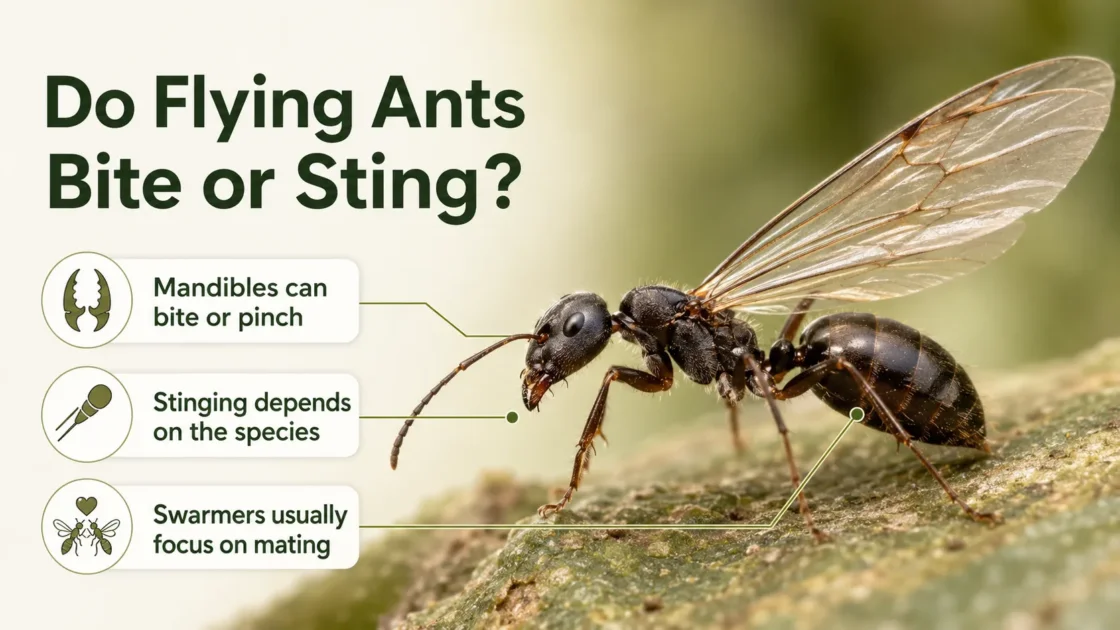
One distinction is especially useful: male flying ants cannot sting. In ants and other aculeate Hymenoptera, the stinger is derived from the female ovipositor. Males lack an ovipositor and therefore cannot possess that sting apparatus.[b] A winged female is different, but even female sex does not automatically mean an ant can sting; some ant lineages have lost the functional sting altogether.
What the wings actually tell you
Wings indicate that an ant is, or recently was, part of the reproductive caste. They do not make an ant more aggressive, do not create a stinger, and do not turn a normally non-stinging ant lineage into a stinging one.
Biting, stinging and chemical defense use different anatomy
The words bite and sting are often used interchangeably after an unpleasant encounter with an ant, but biologically they describe different actions.
A bite comes from the mandibles
Ants use their paired mandibles for tasks such as carrying food, manipulating nest material, fighting and defense. When an ant bites a person, these jaws close on the skin. The result may feel like a pinch and can leave localized redness or irritation, but the effect varies greatly among ant species and with the size of the individual.
Having mandibles does not mean an ant normally attacks people. Many ants that are physically capable of biting rarely use their jaws against human skin unless they are handled, trapped against the body or defending a nest.
A sting delivers venom from the rear of the abdomen
In ant groups with a functional sting, the sting apparatus is located at the end of the abdomen and can introduce venom into tissue. The presence of a sting is a lineage-level anatomical trait. Two winged ants of similar size and color may therefore have very different defensive capabilities.
Some ants bite and apply venom without a stinger
A third mechanism explains why burning does not necessarily prove that an ant stung. Formicine ants—including carpenter ants in the genus Camponotus—lack a functional sting. Their venom is released through an abdominal opening called the acidopore. Venom can be smeared or sprayed, and in close defensive contact it may be applied to a wound made by the mandibles.
| Contact | Structure involved | What happens |
|---|---|---|
| Bite | Mandibles | The jaws pinch, grip or break the skin. |
| Sting | Functional sting apparatus | Venom is delivered through the stinger. |
| Bite plus sting | Mandibles and sting | The ant may grip with its jaws and then sting, as fire-ant workers can do. |
| Bite plus external venom | Mandibles and acidopore | A stingless formicine ant can bite and apply venom to the wound. |
Male or female changes the sting question
A mating swarm can contain both sexes, which is one reason the label flying ant is too broad for judging sting capability. The same colony can also contain wingless workers whose defensive role is very different from that of the reproductives leaving to mate.
| Ant form | Wings | Can it sting? | How to interpret it |
|---|---|---|---|
| Male alate | Yes | No | A reproductive male. Male sex rules out a sting, although bite capability still depends on the ant’s anatomy. |
| Female alate | Yes | Depends on the ant lineage | A reproductive female and potential future queen. Females from stingless lineages still cannot sting. |
| Worker | No | Species- and lineage-dependent | Workers perform much of the colony’s defense and are often the ants involved when a nest disturbance produces many bites or stings. |
| Dealate female | Wings shed | Depends on the ant lineage | A reproductive female after losing her wings. Wing loss does not change whether her lineage possesses a functional sting. |
Red imported fire ants provide a particularly clear example. LSU AgCenter describes male Solenopsis invicta alates as having smaller heads, reduced mandibles and no stinger.[c] That fact applies to the male reproductives; it should not be generalized to the workers defending the same colony.
A mating swarm is not a colony attack
The sudden appearance of dozens or hundreds of winged ants can look threatening, but a nuptial flight is primarily a mating and dispersal event. Alates leave established colonies, fly, mate, and in the case of successfully mated females, eventually attempt to establish new colonies. Their flight is not an organized attempt to attack people.
A bite or sting requires close physical contact. A flying ant passing overhead is not biting or stinging a person simply because it is nearby. Contact becomes more plausible when an ant lands on skin, is caught under clothing, is squeezed in a hand, or when the person is standing beside a defensive colony.
The distinction becomes especially important around fire ants. A person may see reproductive fire ants flying without being attacked, then encounter a very different response after stepping on or disturbing the mound from which they emerged. The ants rapidly climbing onto shoes and skin in that situation are primarily defensive workers, not an airborne attack force.
Fire ants can bite and sting in the same encounter
Fire ants illustrate why everyday descriptions of an “ant bite” can be misleading. A red imported fire ant worker can use its mandibles to hold onto the skin and then sting. Because the ant can reposition itself while maintaining contact, one worker may sting repeatedly. UC IPM describes rapid worker responses when a red imported fire ant nest is disturbed and notes that individual workers can both bite and sting.[d]
The painful burning sensation and later skin reaction are associated with the venomous sting, while the jaws help maintain the ant’s grip. This is why the immediate exposure around an active mound is more closely tied to the wingless workers than to the reproductive males flying away from it.
The distinction is explored in more detail for flying fire ants, where reproductive flight behavior and mound-defense behavior need to be separated before judging human exposure.
Swarm above, workers below
Winged reproductives leaving a nest and workers defending that nest are participating in different behaviors. Seeing many alates in the air does not by itself mean that many ants are attempting to sting.
Carpenter ants can bite but do not have a functional sting
Carpenter ants are a useful counterexample to fire ants. Ohio State University Extension reports that carpenter ant workers have strong mandibles and can bite readily when handled. They can also introduce formic acid into the bite wound, but they do not sting.[e]
This means a painful or burning reaction after contact with a carpenter ant should not automatically be described as a sting. The ant can combine mechanical injury from its jaws with chemical defense delivered without a stinger.
Research published in Science Advances on May 13, 2026 adds a finer biochemical layer to this mechanism. Researchers examined venom from eight geographically separated Camponotus species and identified 35 venom peptides, termed formicitoxins, belonging to two gene families. Several showed antifungal activity. The study also describes Formicinae as stingless ants that release venom through the acidopore.[f]
The finding changes the older picture of formicine venom as little more than concentrated formic acid: carpenter-ant venom can contain formic acid, peptides, proteins and lipids. It does not show that carpenter ants have developed a sting, nor does the study establish that ordinary carpenter-ant bites have become a greater human health hazard. Much of the work concerned venom chemistry and possible colony-level protection against fungi.
Harvester ants show why species group still matters
Harvester ants include stinging species, and UC IPM lists native fire ants and harvester ants among the more familiar stinging ants in California.[a] A winged reproductive seen in an area with harvester ants therefore cannot be evaluated from “flying ant” alone. Sex still matters—males cannot sting—and identification below the broad flying-ant category remains necessary.
This is also why color is a poor shortcut. Black, reddish, brown or yellowish winged ants can occur in many unrelated groups. A red flying ant is not automatically a fire ant, and a large dark alate is not automatically a carpenter ant.
What happens when a flying ant lands on skin?
Simply landing on a person does not mean an ant has bitten or stung. Alates may land while dispersing, collide with clothing, or accumulate around lights and windows during a flight. If there is no pinch, burning sensation or developing skin reaction, the encounter may have involved no defensive contact at all.
Handling changes the situation. Closing fingers around an unidentified ant, pressing it against skin, or trapping it beneath tight clothing can create the close contact needed for mandibles, a functional sting, or chemical defenses to be used. Gently removing an unidentified winged ant without squeezing it avoids creating that contact unnecessarily.
The setting matters even more near a nest. If winged ants are emerging from soil and numerous wingless ants are also present, walking away from the emergence point is more useful than trying to catch alates by hand. Deliberately kicking, probing or opening a suspected fire-ant mound can turn a reproductive observation into direct exposure to defensive workers.
A skin reaction can suggest a mechanism, but not identify the ant
A brief pinch followed by limited redness may fit a mechanical bite. Burning after a bite can also occur when a stingless formicine ant applies acidic venom to damaged skin. A true venomous sting may produce pain, itching, redness and swelling. None of those reactions alone establishes which ant species was responsible.
Fire-ant stings have a more recognizable pattern. MedlinePlus lists localized swelling, redness, itching and pain and notes that pus-filled blister-like lesions can follow a fire-ant sting.[g] The cloudy white pustule associated with imported fire ants is produced by the sting reaction and is not evidence that the ant merely pinched the skin with its jaws.
Skin appearance still should not be used as a species identification tool. Different insects and skin responses can overlap visually. A specimen, the location of the encounter, nearby workers or nests, and regional species information provide stronger identification evidence than a red bump by itself.
Sometimes the nest is more relevant than the flying ant
A single alate beside a porch light and a mass emergence directly from a nest should not be interpreted in the same way. The first may be a reproductive that flew in from elsewhere. The second connects the alates to an established colony at that location and may place defensive workers close to feet or hands.
Indoors, repeated emergence also changes the meaning of the observation, though primarily as nest evidence rather than bite evidence. One stray winged ant near a window does not prove an indoor colony. Repeated swarms from the same wall gap, trim, ceiling area or other interior point make a local source more plausible. The inspection and control implications are covered separately in the site’s guide to flying ants indoors.
If the insect itself is uncertain, first confirm that it is an ant. Winged ants and termite swarmers can appear together in seasonal searches, yet their body plans and structural implications differ. Elbowed antennae, a constricted waist and unequal front and hind wing pairs support an ant identification; the full comparison belongs in the flying ants versus termites identification guide.
When a sting reaction needs emergency attention
Most minor ant contacts remain localized, but venom allergy can produce a systemic reaction. This is especially relevant when a known or suspected stinging ant is involved.
Severe allergic reaction
Difficulty breathing, swelling of the throat or tongue, dizziness or fainting, widespread hives, loss of consciousness, or rapidly developing symptoms affecting more than one part of the body after a sting can indicate anaphylaxis and require emergency medical treatment. The American Academy of Allergy, Asthma & Immunology identifies these among the symptoms of serious fire-ant allergy.[h]
For an unknown flying ant, the most useful sequence is to determine whether it is actually an ant, whether it is male or female when that can be established, which ant group it belongs to, and whether the contact occurred during ordinary dispersal or nest defense. A male alate at a window and workers pouring from a disturbed fire-ant mound can both be encountered during a “flying ant” event, but they do not present the same bite or sting situation.
Sources
- UC Statewide IPM Program — Ants — Used for the distinction between ant biting and stinging and examples of stinging ant groups. [a]
- Purdue University — Stinging Insects — Used for the relationship between the ovipositor and sting apparatus and the absence of stinging ability in male ants. [b]
- LSU AgCenter — Solenopsis invicta, Red Imported Fire Ant — Used for male red imported fire ant alate anatomy, including reduced mandibles and absence of a stinger. [c]
- UC Statewide IPM Program — Red Imported Fire Ant — Used for mound-defense behavior, worker biting and repeated stinging. [d]
- Ohio State University Extension — Carpenter Ants — Used for carpenter-ant biting, formic-acid application and absence of a sting. [e]
- Koch et al., Science Advances (2026) — Beyond formic acid: Peptides in carpenter ant venoms aid in disease protection — Used for Formicinae venom delivery through the acidopore and the identification of 35 formicitoxins across eight studied carpenter-ant species. [f]
- MedlinePlus — Fire Ants — Used for localized fire-ant sting symptoms and blister or pustule development. [g]
- American Academy of Allergy, Asthma & Immunology — Fire Ant Allergy — Used for serious systemic allergic-reaction symptoms and emergency-care context. [h]