Flying ants usually have elbowed antennae, a visibly pinched waist, and front wings that are larger than the hind wings. Termite swarmers have antennae without the ant-like elbow, a broad waist, and two pairs of wings that are roughly similar in size and shape. Those three body features are far more useful than color or overall size when deciding which insect is present. [a]
The comparison is specifically between winged reproductive ants and winged reproductive termites. Both are alates produced by colonies for dispersal and mating, so both can suddenly appear in numbers and both can have four wings. A dark insect with long wings is therefore not automatically a termite, and an insect that looks like a large ant is not automatically an ant.
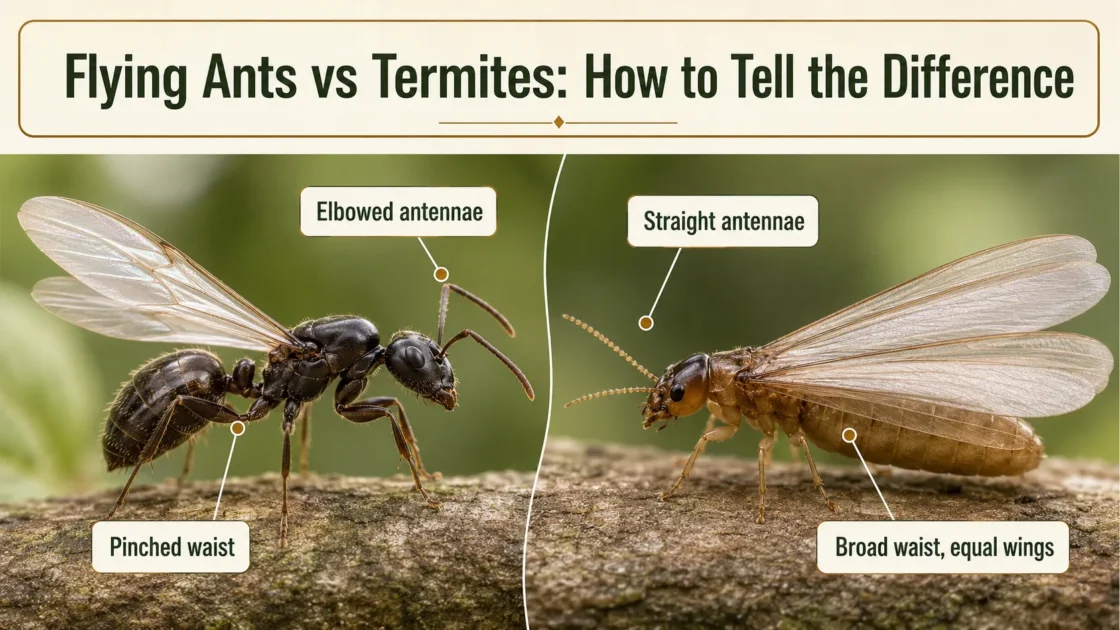
ANTENNAE
Ant: distinctly elbowed
Termite: bead-like, without the ant-style elbow
WAIST
Ant: narrow and constricted
Termite: broad, without a pinched waist
WINGS
Ant: front pair larger
Termite: both pairs roughly similar
The Antennae Often Separate Them Before Color or Size Does
A winged ant has geniculate, or elbowed, antennae. The long basal portion of each antenna is followed by an obvious change in direction, giving the antenna a bent profile. The bend may be easy to see on a still specimen even when overlapping wings make the rest of the body difficult to judge.
A termite swarmer lacks that pronounced ant-style elbow. Its antennae are made of a series of visible segments that can produce a bead-like appearance. Describing termite antennae simply as “straight” can be misleading: an individual antenna may curve naturally. The useful distinction is the absence of the sharply elbowed construction characteristic of ants.
Antennae become less useful when the head is blurred, crushed, partly hidden by wings, or photographed from too far away. In that situation, the waist may provide a clearer distinction rather than forcing an identification from an unseen feature.
A Pinched Waist Points Toward an Ant
The middle-to-rear body outline differs noticeably between the two groups. Ants have a constricted connection between the mesosoma and gaster, producing the familiar narrow-waisted appearance. Depending on the ant, one or more small petiole segments form part of this constriction.
A termite swarmer has a much broader transition between the thorax and abdomen. Viewed from above, the body tends to continue rearward without the abrupt narrowing seen in an ant. NC State Extension describes this practical contrast as the ant’s “pinched” waist versus the termite’s more uniform, tube-like body. [b]
The waist becomes especially useful after the wings are missing. A specimen that has already shed its wings can no longer be judged by forewing-versus-hindwing length, but the basic body constriction remains visible if the insect is intact.
Both Have Four Wings; the Proportions Are Different
Wing count alone does not distinguish a flying ant from a termite swarmer. Both have two pairs of wings. The useful character is the relationship between those pairs.
In a winged ant, the forewings are larger than the hind wings. On an intact specimen, the rear pair should appear shorter or smaller when the wings can be separated visually. In a termite swarmer, the two pairs are roughly similar in length, size, and general shape. Termite wings also commonly extend well beyond the abdomen. University of Minnesota Extension uses this same combination of unequal ant wings and similarly sized termite wings in field identification. [c]
When the wings overlap
Do not assume two visible wings means the insect has only one pair. The four wings can lie directly over one another. Wing proportions are useful only when the front and hind pairs can actually be distinguished.
Flying Ant vs Termite Swarmer Comparison
| Feature | Flying ant | Termite swarmer | How useful it is |
|---|---|---|---|
| Antennae | Distinctly elbowed | Bead-like, without the pronounced ant-style elbow | Very useful when the head is visible |
| Waist | Narrow and visibly constricted | Broad connection between body sections | Very useful, including after wing loss |
| Front vs. hind wings | Front pair larger than hind pair | Pairs roughly similar in size and shape | Very useful on an intact specimen |
| Number of wings | Four | Four | Does not separate them |
| Color | Variable | Winged reproductives may also be dark | Weak by itself |
| Overall size | Varies among species and reproductive castes | Varies among termite groups and castes | Weak without other characters |
| Discarded wings | Wing loss can occur after mating | Swarmers readily shed wings | Useful context, not a stand-alone diagnosis |
If the Wings Are Gone, the Insect Can Still Be Identified as Ant-Like or Termite-Like
Finding a wingless specimen does not mean it was never a swarmer. Reproductive ants and termites can both lose their wings after dispersal. Ant queens commonly remove or shed their wings after mating, while termite swarmers are well known for leaving detached wings near emergence or landing sites. [d]
With a wingless specimen, ignore wing length and concentrate on waist shape and antenna construction. A narrow waist combined with elbowed antennae supports an ant identification. A broad waist combined with bead-like, non-elbowed antennae supports a termite identification.
Only loose wings were found
A pile of detached wings shows that winged insects were present, but wings without a body provide less evidence than an intact specimen. Preserve any bodies found nearby rather than identifying the insect from loose wings alone.
Loose Wings on a Windowsill Need Context
Termite wings detach readily, and accumulations of similar translucent wings around windows or other emergence areas can accompany a termite swarm. Windows attract attention because winged insects often collect there after appearing indoors, and the insects themselves may be gone by the time the wings are noticed.
The finding becomes more informative when it can be paired with a body specimen. Detached wings plus a broad-waisted, bead-antennaed insect provide a much clearer termite pattern than wings alone. The exact place where the insects emerged also matters. Wings simply lying near an open door do not carry the same implication as repeated emergence from a wall gap, trim, floor joint, or another point within a structure.
Black Does Not Mean Ant, and Pale Does Not Mean Termite Swarmer
Color is responsible for many incorrect identifications. People often associate termites with pale workers, but the winged reproductive caste can be dark brown or nearly black. University of Minnesota Extension specifically distinguishes light-colored termite workers from dark-colored winged kings and queens. Ant alates can also occur in black, brown, reddish, yellowish, or mixed tones depending on the species.
Lighting adds another problem. Transparent wings can reflect gray, silver, brown, or iridescent tones, while a dark abdomen may appear much lighter in a bright phone photograph. Color can support an identification after structural characters are visible, but it should not overrule the antennae, waist, and wing pattern.
Size Is Better for Narrowing Species Than Separating Ants from Termites
A winged ant can be much larger than the workers normally seen around the same property. Ant colonies produce reproductive males and queens, and these castes do not necessarily resemble workers in size or body proportions. Termite swarmers also vary among termite groups. A statement such as “it was too large to be an ant” therefore carries little diagnostic value without visible body characters.
Scale becomes useful later, particularly when an identification is being narrowed to a species or species group. For the broader flying-ant-versus-termite question, body construction is the better evidence.
An Indoor Swarm Means More Than a Single Insect That Flew Through a Door
Where the insects were found changes how the observation should be interpreted. A single alate found beside an open window may have entered from outside during a reproductive flight. A cluster repeatedly emerging from the same interior opening is different evidence.
When the insects are ants
Winged ants seen outside on siding, vegetation, pavement, or around exterior lights may simply reflect a nearby colony conducting a mating flight. Indoors, one or a few reproductive ants can still have arrived from outside. Large numbers emerging from baseboards, window casings, vents, floors, or wall openings provide stronger evidence of an indoor or structure-associated ant nest. NC State Extension documents these emergence points in carpenter ant infestations. [e]
When the insects have termite characters
Termite swarmers outdoors can originate from colonies in soil, stumps, trees, landscape wood, or other nearby material and do not by themselves establish that a building is infested. Termite-like swarmers emerging indoors deserve closer investigation, particularly when the observation is repeated or accompanied by discarded wings or other termite evidence.
An indoor sighting cannot reveal how large a colony is, where all of its galleries are located, or how much structural damage exists. Those questions require inspection of the building rather than identification of the swarmer alone.
Wood Does Not Automatically Make the Insect a Termite
Carpenter ants create a particularly convincing termite look-alike because both insects can be associated with wood in buildings. The biology is different. Carpenter ants excavate wood to make nesting galleries; they do not consume the wood as food. They are often associated with moist, softened, or deteriorating wood, although some satellite nests can occur in other cavities. Termites feed on cellulose-containing material and produce different forms of gallery evidence depending on the termite group.
A winged carpenter ant still retains ant anatomy: an obvious waist, elbowed antennae, and a smaller hind-wing pair. Seeing a large dark winged insect beside damaged or damp wood is therefore not enough to call it a termite. The body should be identified before interpreting the wood evidence.
Rain and Warm Weather Explain Swarming Better Than They Identify the Insect
Ant and termite reproductive flights are both influenced by environmental conditions, but their timing varies by species, region, colony maturity, temperature, moisture, and local weather. Some termite species are especially noticeable after warm or wet conditions; ant mating flights can also coincide with favorable temperature and humidity.
“They appeared after rain” is therefore not an identification character. Nor is a universal month-by-month rule reliable across climates. Weather can explain why many alates became visible at once, but antennae, waist shape, and wing proportions identify the broader group more directly.
Why Flying Ants and Termite Swarmers Appear So Suddenly
Neither “flying ant” nor “termite swarmer” describes an insect that spends its entire adult life flying around a house. These are reproductive forms produced by established social-insect colonies. Ant colonies produce winged males and future queens; mature termite colonies produce winged reproductives that leave to mate and potentially establish new colonies.
This reproductive strategy explains why dozens or hundreds can appear within a short period even when none were obvious beforehand. It also explains the discarded wings that may remain after the flight. The sudden appearance is biologically normal for an alate event; what it means for a particular building depends on which insect it is and where the insects originated.
How to Examine a Specimen Without Losing the Useful Characters
A still, intact specimen is far easier to identify than a moving swarm. If possible, preserve one or more insects without crushing the waist or antennae. A clear container can allow the body outline to be examined while keeping loose wings with the specimen.
- Start with the waist. Look from above for a pronounced constriction between the middle and rear body.
- Examine the antennae. Look for a definite elbow rather than judging whether an antenna happens to curve.
- Check both wing pairs. Compare forewings with hind wings only if all four remain attached and can be distinguished.
- Record the emergence point. Note whether the insect was merely beside a window or was actually seen coming from a structural gap.
- Keep detached wings with any bodies. The combination provides more evidence than either alone.
A Useful Identification Photograph Shows More Than the Wings
A phone photograph taken from several feet away may show that an insect has wings while hiding the characters needed to decide what it is. A better identification set includes different views of the same intact specimen.
TOP VIEW
HEAD VIEW
WING VIEW
ORIGIN VIEW
A blurry swarm photograph may support only a broad identification. If the waist, antennae, and separate wing pairs cannot be seen, color and silhouette should not be used to manufacture certainty that the image does not contain.
When Several Features Point Toward Termites
A specimen with a broad waist, non-elbowed bead-like antennae, and two similarly sized wing pairs is consistent with a termite swarmer. The case for investigating a structure becomes stronger when termite-like specimens are repeatedly found indoors, appear to emerge from the building, or occur with additional termite evidence.
Depending on the termite group and region, other evidence may include discarded wings, mud shelter tubes, damaged cellulose material, or characteristic debris. These signs should not be mixed together indiscriminately: for example, subterranean termites and drywood termites can leave different evidence. The presence of a swarmer establishes an identification question first; the condition of the structure is a separate inspection question.
If termite characters match indoors
Preserve specimens and note exactly where they appeared before disturbing the area. Identification from an online photograph cannot determine the extent of structural activity. Where termite treatment is needed, some methods involve regulated termiticides and applications that are normally performed by trained pest-management professionals. [f]
Sources and Verification
- University of Minnesota Extension — Ants — Used to verify the ant-versus-termite comparison, ant antennae and waist structure, unequal ant wing pairs, termite wing form, reproductive ant castes, and wing loss after mating. [a]
- NC State Extension — Termite Swarmers: What Do They Mean for You? — Used to verify the field distinction between termite and ant antennae, waist shape, and wing proportions, and to support cautious interpretation of swarmer evidence. [b]
- University of Minnesota Extension — Carpenter Ants — Used to verify dark coloration in winged termites, carpenter-ant identification characters, queen wing loss, and the distinction between wood excavation by carpenter ants and termite feeding. [c]
- NC State Extension — Biology and Behavior of Eastern Subterranean Termites — Used for termite alate biology, swarming context, environmental variation, and the antenna-wing-waist comparison. Its regional flight information is not treated as a universal calendar. [d]
- NC State Extension — Biology and Control of Carpenter Ants — Used for indoor-versus-outdoor carpenter-ant swarmer interpretation, emergence locations, wood excavation, and moisture-associated nesting context. [e]
- U.S. Environmental Protection Agency — Termites: How to Identify and Control Them — Used for treatment and termiticide safety context and the role of trained pest-management professionals in many structural termite applications. [f]