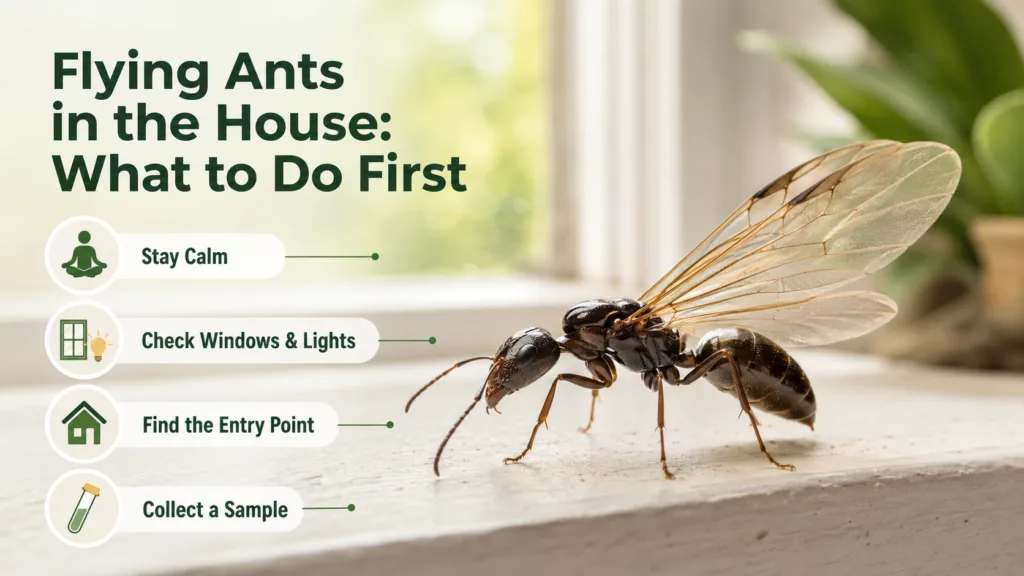
If you find a few flying ants in the house, vacuum them up, empty the vacuum contents into an outdoor trash container, and save one or two specimens for identification. If many winged ants appear indoors, especially from a wall void, window frame, crawl space, or damp wood area, treat the event as evidence that a colony may be inside the structure or very close to it, not as proof by itself.
Flying ants are not a separate species. They are alates: winged reproductive males and queens produced by mature ant colonies. Their job is to leave the colony, mate, and disperse. In homes, the practical question is not only “What insect is this?” but “What evidence is attached to it?” A few insects at a window call for a different response than repeated indoor swarms, shed wings, sawdust-like debris, or termite-like body features.[a]
Key Data Points
Common situation
Winged ants indoors
Usually noticed at windows, lights, doors, or wall openings.
Taxonomic group
Family Formicidae
Ants belong to Hymenoptera: Formicidae; species-level ID needs closer examination.
Biological form
Alate reproductive
Winged males and queens are produced by mature colonies during mating periods.
Immediate action
Vacuum and inspect
Best first step for a small number of indoor swarmers.
Termite confusion risk
High
Check antennae, waist, and front-versus-hind wing length.
Professional-help threshold
Repeated indoor swarm
Also escalate if termite markers, damp wood, mud tubes, or carpenter-ant debris are present.
Main data limit
Specimen condition
Wings may be shed after swarming, so body shape and antennae matter.
Pest risk level
Variable
Nuisance ants, carpenter ants, and termite swarmers require different responses.
First 15 Minutes: What to Do
Start with evidence control, not spraying. Flying ants gathered at a window or light can be removed with a vacuum. Keep one or two intact insects in a small container or sealed bag before disposal. A clear specimen helps separate ant alates from termite swarmers, which are often confused in homes.[b]
After removal, inspect the area where the insects were concentrated. Look at window sills, baseboards, wall gaps, utility penetrations, damp trim, crawl-space access points, attic edges, and any wood that has previous water damage. Avoid applying broad indoor sprays while you are still trying to locate activity. Visible swarmers may be only a small part of the colony, and surface sprays can interfere with bait-based control.
| What you see | First action | Why it matters | Escalation point |
|---|---|---|---|
| One to a few flying ants near a window | Vacuum, discard outdoors, save a specimen | They may have wandered in or followed light. | Escalate only if repeated or paired with trails, damp wood, or debris. |
| Dozens or hundreds emerging indoors | Vacuum, photograph, trace emergence point | A large indoor swarm may indicate a colony inside or near the home. | Consider professional inspection, especially if the source is hidden. |
| Loose wings on a sill or floor | Collect wings and bodies for ID | Both ants and termites may shed wings after swarming. | Escalate if wings are equal-sized and termite body markers are present. |
| Sawdust-like material near wood | Check for carpenter-ant activity | Carpenter ants excavate wood and may leave fibrous debris. | Seek inspection if debris returns or wood is damp/soft. |
| Mud tubes, blistered wood, or termite-shaped swarmers | Do not rely on ant treatment | Termite evidence requires a different inspection and control path. | Arrange termite inspection as soon as practical. |
Data Interpretation Note
A swarm is evidence, not a full diagnosis. The number of insects, the place they emerged, body structure, shed wings, moisture, wood condition, and repeated sightings must be read together.
Confirm It Is an Ant, Not a Termite
The ant-versus-termite check should happen before any treatment decision. Flying ants usually have elbowed antennae, a pinched waist, and front wings that are longer than the hind wings. Winged termites usually have straight antennae, a broad waist without a pinched middle, and front and hind wings that are similar in size.[c]
| Feature | Flying ant | Termite swarmer | Household reading |
|---|---|---|---|
| Antennae | Elbowed or bent | Straight, often beadlike | One of the easiest body clues when the specimen is intact. |
| Waist | Narrow, pinched waist | Broad body, no clear waist pinch | Use this clue if wings have already fallen off. |
| Wing pairs | Front wings longer than hind wings | Front and hind wings about equal length | Useful when wings remain attached; less useful after wing shedding. |
| Typical concern | Nuisance ants or carpenter ants, depending on species and evidence | Possible structural termite activity | Termite-like markers raise the inspection priority. |
| Wood relationship | Most ants do not damage wood; carpenter ants excavate galleries | Termites consume wood or cellulose-based materials | Wood signs change the response path. |
Do not identify the insect from color alone. Ant and termite swarmers can vary from pale brown to dark brown or black. Body structure is more useful than color.
What Indoor Flying Ants Usually Mean
A small number of flying ants indoors can be a short-lived nuisance. They may have entered through a gap, followed light, or emerged near an opening. A large indoor swarm means more. University extension sources treat indoor emergence as evidence that a nest may be present inside the building or close enough to release swarmers indoors.[d]
Carpenter ants deserve a separate check because they can nest in moisture-damaged wood. They do not eat wood like termites, but they excavate it to make galleries. Repeated large winged ants indoors, fibrous debris, damp trim, roof leaks, clogged gutters, poor ventilation, or earth-to-wood contact all raise the need for a closer inspection.[e]
| Evidence level | Likely meaning | Risk reading | Next step |
|---|---|---|---|
| Single event, few insects | Possible outdoor origin or accidental entry | Low if no other signs appear | Vacuum, seal obvious gaps, monitor for recurrence. |
| Repeated flying ants from same indoor point | Possible indoor or nearby nest | Moderate to high | Trace source, avoid surface-only spraying, consider inspection. |
| Large black ants plus damp or damaged wood | Possible carpenter-ant nesting area | Higher than nuisance ant activity | Check moisture source, debris, wall voids, and structural wood. |
| Equal wings, straight antennae, broad waist | Possible termite swarmers | High inspection priority | Use termite-specific inspection path; do not treat as household ants. |
| Workers trailing to food or water | Foraging activity | Often manageable if nest is outside | Remove food residues, use bait strategy only when activity is present. |
Control Options and When to Escalate
Control should match the evidence. Vacuuming removes the swarmers you see. Sanitation reduces foraging pressure. Baits can work when ants are actively feeding and the product is placed where ants will find it. Spraying visible ants alone often fails because the colony and queen may be hidden.[f]
If you use any pesticide product, follow the product label exactly and keep products away from children, pets, food-preparation surfaces, and drains unless the label allows that use. Do not mix treatment methods blindly. UC IPM notes that sprays can interfere with baiting, and baits need time because the active ingredient must be carried back through the colony.[g]
| Method | Best use | Limits | Safety note |
|---|---|---|---|
| Vacuuming | Few or many visible swarmers | Removes insects present, not the hidden colony | Discard contents outdoors after collection. |
| Sanitation | Ants attracted to food, sweet residues, pet food, or spills | Will not remove a nesting colony by itself | Clean cracks near sinks, pantries, and feeding areas. |
| Sealing entry points | Gaps around doors, windows, pipes, siding, and utility lines | Less useful if nest is already indoors | Pair with moisture correction and monitoring. |
| Slow-acting ant bait | Active foraging trails where ants are feeding | May take days or weeks; species food preference changes | Do not place bait where children or pets can access it. |
| Moisture and wood repair | Carpenter-ant risk areas | Does not replace nest treatment if a nest is confirmed | Fix leaks, gutters, ventilation, and decayed wood. |
| Professional inspection | Termite markers, repeated indoor swarms, hidden source, or structural wood signs | Cost and scope vary by building and pest | Use when evidence exceeds a simple nuisance event. |
When Not to Treat It as a Simple Ant Problem
Do not rely on household ant spray if the insects have termite-like features, if shed wings appear in repeated piles, if you see mud tubes, if wood is blistered or softened, or if large ants keep emerging from damp structural areas.
Interactive Evidence Charts
The first chart counts how many selected extension sources in this article support each action category. It is a source-review count, not a measure of treatment efficacy. The second chart is an editorial response-priority score for household triage; it is not a species count or infestation probability.
Source Support for Household Response Steps
Count of selected extension sources supporting each response category used in this page.
Source review: K-State Entomology, University of Kentucky Entomology, UC IPM, Extension.org, Mississippi State Extension, and University of Maryland Extension. This is a source-support count, not a treatment success rate.
Response Priority by Evidence Type
Editorial triage score for what a homeowner should treat as higher-priority evidence.
Values are editorial interpretation scores for this guide, not species counts, occurrence counts, or infestation probabilities.
Data Quality and Limitations
Household flying-ant reports are hard to read from a single sighting. The insect may be intact, damaged by vacuuming, missing wings, or mixed with other insects at a light source. Many ant species produce alates, and species-level identification can require a clear specimen, magnification, and regional keys. Public occurrence datasets can document records for ant groups, but they do not tell whether a specific house has an active nest.[h]
Seasonal timing also varies. Extension sources describe ant swarming during warmer parts of the year, often tied to species, rainfall, calm weather, local climate, and colony maturity. Indoor heat can also shift activity. A calendar month alone should not be used to rule out ants, carpenter ants, or termites.
How to Read This Data
The page uses source-based identification markers and household action thresholds. It does not claim a species diagnosis, a complete geographic range, or a confirmed infestation from a single swarm event.
FAQ
Are flying ants in the house an emergency?
A few flying ants are usually not an emergency. A large indoor swarm, repeated emergence, termite-like features, mud tubes, damp wood, or sawdust-like debris should be inspected more closely.
Should I spray flying ants indoors?
Do not start with broad spraying. Vacuum first, save a specimen, and inspect. If baiting is used, sprays may reduce bait performance by killing foragers before they carry bait back to the nest.
How do I know if they are termites?
Check for straight antennae, a broad waist, and front and hind wings that are similar in length. Ants usually have elbowed antennae, a pinched waist, and longer front wings.
Do flying ants mean there is a nest inside my wall?
Not always. A few may enter from outside. Many emerging from the same indoor point can mean a colony is indoors or close to the building.
Why are there wings on the windowsill?
After swarming, reproductive ants and termites may shed wings. Collect bodies and wings if possible because wing size, waist shape, and antennae help with identification.
When should I call a professional?
Call for inspection if you see termite markers, mud tubes, repeated indoor swarms, large ants from damp wood, sawdust-like debris, or activity that returns after sanitation and monitoring.
Sources and Verification
- [a] K-State Entomology — Winged Ants vs Termites — Used for ant swarmer biology, vacuum-first response, and indoor swarm interpretation.
- [b] Mississippi State University Extension — Are These Termites or Ants? — Used for household ant-versus-termite triage and wing-shedding cautions.
- [c] University of Maryland Extension — Ants and Termites: How to Tell the Difference — Used for antenna, wing, waist, and body-shape identification markers.
- [d] University of Kentucky Entomology — Ant Control for Householders — Used for indoor swarm interpretation, ant trails, hidden nests, and bait-based control.
- [e] UC IPM — Carpenter Ants — Used for carpenter-ant life cycle, wood excavation, moisture association, and prevention steps.
- [f] Colorado State University Extension — Ants in the Home — Used for indoor ant ecology, swarming behavior, and bait-control context.
- [g] UC IPM — Ants — Used for bait placement, sanitation, pesticide-label cautions, and avoiding sprays during baiting.
- [h] BugGuide — Family Formicidae: Ants — Used for taxonomy context and ant reference verification.