Flying ants indoors are usually winged reproductive ants, not a separate household species. Remove the visible insects with a vacuum or soapy wipe, confirm they are not termite swarmers, then trace entry points or nest evidence before choosing bait, exclusion, moisture repair, or professional inspection. A few winged ants near a window can be a short-lived mating-flight event; repeated indoor swarms, large numbers of winged ants, frass, moisture-damaged wood, or termite-like traits require closer inspection before any treatment is used. University extension guidance favors baiting and targeted nest work over routine indoor spraying because bait can reach hidden colony members while sprays often give only short-term relief [a].
How to Get Rid of Flying Ants Indoors
The safest sequence is identification first, removal second, colony control third. Flying ants are alates: winged males or queens produced by a mature colony for mating flights. Indoors, they are often drawn to windows and lights after emerging from a nest, entering through gaps, or being trapped inside after a flight.
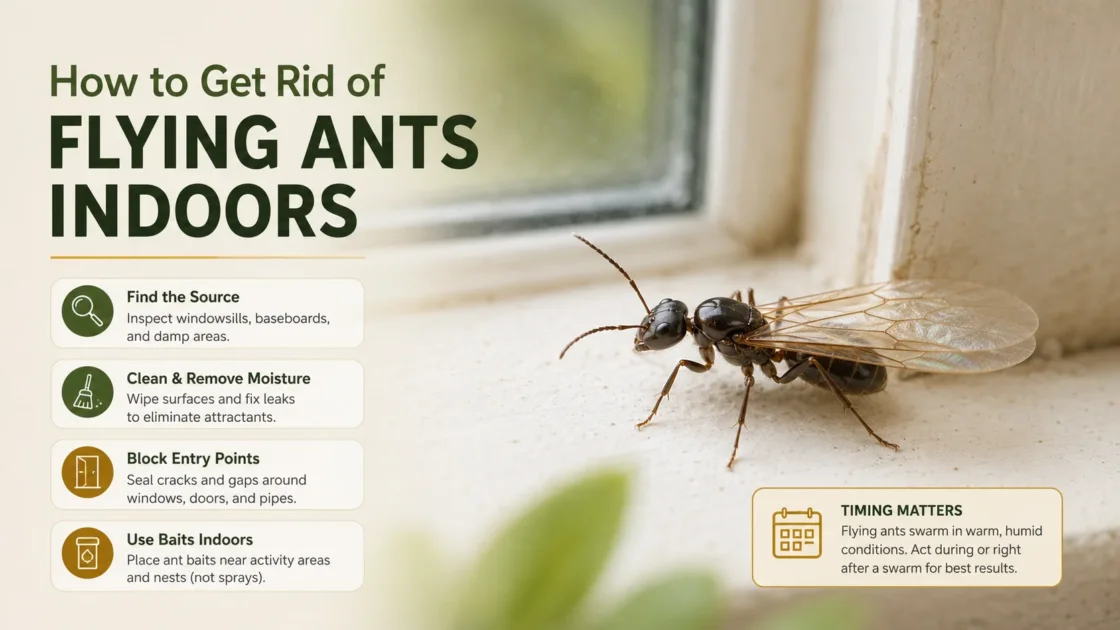
Do not start with a broad indoor spray if the insects are still unidentified. If the insects are termite swarmers, ant bait will not solve the problem. If they are pharaoh ants, repellent sprays can spread the colony into more nesting sites.
Key Data Points
Target organism
Winged ant alates
Immediate indoor action
Vacuum or soapy wipe
First ID check
Ant vs termite
Preferred colony tool
Slow-acting bait
Indoor nest signal
Repeated or large indoor swarm
Main structural risk
Carpenter ant or termite confusion
Expected bait response
Days to months
Conservation status
Data not available
First Decision: Ants, Termites, or Another Winged Insect
A flying ant has elbowed antennae, a pinched waist, and front wings that are longer than the hind wings. A termite swarmer has straight antennae, a broad waist, and wings that are similar in size and shape. The University of Maryland Extension uses these traits as the main visual split between winged ants and termite swarmers [b].
| Feature | Flying Ant | Termite Swarmer | Action Meaning Indoors |
|---|---|---|---|
| Antennae | Elbowed or bent | Straight | Ant traits support bait and nest tracing; termite traits require termite inspection. |
| Waist | Pinched | Broad, not pinched | A broad waist should stop ant-only treatment decisions. |
| Wings | Front wings longer than hind wings | Front and hind wings similar in length | Equal wings raise termite-swarmer concern. |
| Body color | Black, brown, reddish, or mixed | Often dark-bodied when winged | Color alone is not enough for identification. |
| Loose wings on sill | Possible after mating flight | Possible termite evidence | Collect specimens and compare body traits before treatment. |
Indoor Removal Actions
Visible winged ants can be removed without changing the colony. The removal step should make the room usable, preserve specimens for identification, and avoid disrupting bait trails too early.
| Situation | What to Do First | What to Avoid | Next Check |
|---|---|---|---|
| A few winged ants near a window | Vacuum them, save one specimen, wipe the sill with soapy water. | Do not fog the room. | Watch the same area for two to three days. |
| Many winged ants from a crack, vent, or wall gap | Collect specimens, mark the emergence point, and inspect adjacent moisture sources. | Do not seal the opening before identification and nest tracing. | Look for workers, frass, damp wood, or repeat emergence. |
| Ants following a trail to food | Remove food sources and place bait near the trail, not on top of it. | Do not spray the trail while bait is being used. | Check whether ants feed on the bait and return to the trail. |
| Ants from potted plants | Move infested potted plants outdoors for treatment. | Do not place indoor bait where children or pets can reach it. | Check soil, saucers, and plant stands for nesting activity. |
| Termite-like swarmers | Keep specimens and request termite-specific inspection. | Do not treat as ants. | Look for equal wings, straight antennae, mud tubes, or shed wings. |
Data Interpretation Note
UC IPM recommends cleaning invading ants with soapy water, sealing entry openings, and using baits to address the colony. It also notes that sprays provide temporary control and may not be safe indoors when used broadly [c].
Source-Based Size Data for Common Indoor Ant Forms
Size does not identify a flying ant by itself, but it helps separate small nuisance ants from carpenter-ant-sized specimens. The chart uses measurements reported by university extension sources for common indoor ant forms and converts inch values to millimeters where needed.
Reported Body Lengths for Indoor Ant Forms
Source-based body length values help sort specimens before species-level confirmation.
Source: USU Extension, UMN Extension, UMD Extension, and NC State Extension. Values show reported body length, not abundance.
Measurement Notes Used in the Chart
| Ant Form | Reported Measurement | Converted Value Used | Control Meaning Indoors |
|---|---|---|---|
| Odorous house ant worker | About 3 mm | 3.0 mm | Small brown-to-black ants often need bait and food/moisture correction. |
| Pavement ant worker | 1/8 to 3/16 inch | 4.0 mm midpoint | Common indoor nuisance forager; bait and entry blocking are usually more useful than broad spraying. |
| Pavement ant male | 3/16 inch | 4.8 mm | Winged males indoors can indicate a nearby or indoor pavement ant nest. |
| Pavement ant queen | 1/4 inch | 6.4 mm | Winged queens may appear May through July and during winter in some indoor settings. |
| Carpenter ant worker | 1/4 to 1/2 inch | 9.5 mm midpoint | Large workers, especially with moisture or frass, require nest tracing. |
| Carpenter ant winged reproductive | Up to 3/4 inch | 19.1 mm | Large indoor swarmers can point to a mature indoor or structural nest. |
When an Indoor Swarm Points to a Nest
Indoor flying ants do not always mean a nest is inside the building. A few newly mated queens may enter from outdoors and die near lighted windows. The evidence changes when winged ants emerge from the same indoor crack, appear in large numbers, or occur with workers, damp wood, or frass.
| Evidence Indoors | Interpretation | Data Confidence | Recommended Action |
|---|---|---|---|
| One to three winged ants at a window | May be outdoor alates attracted to light. | Low for indoor nest. | Remove, save a specimen, and monitor. |
| Large numbers of winged carpenter ants indoors | UMN Extension treats this as strong evidence of an indoor nest. | High for indoor nest concern. | Inspect damp wood, wall voids, sills, plumbing zones, and exterior sources [d]. |
| Coarse sawdust-like frass | May indicate carpenter ant gallery activity nearby. | High when paired with large ants. | Trace workers at night and inspect moisture-damaged wood. |
| Winged pavement ants May through July or winter | UMN notes indoor winged pavement ants can indicate a home nest, usually nuisance rather than building damage. | Moderate to high for pavement ant nest evidence. | Use bait, sanitation, and entry-point control [e]. |
| Tiny yellow ants with many indoor sites | Could fit pharaoh ant behavior in some regions. | Requires specimen-level confirmation. | Use species-specific bait and avoid repellent sprays. |
Control Method Comparison
Control depends on whether the winged ants came from outdoors, from an indoor ant nest, or from a structural wood-associated nest. The table separates visible removal from colony-level control.
| Method | Best Use | Colony Effect | Limit |
|---|---|---|---|
| Vacuuming | Visible flying ants on windows, floors, or lights. | None unless the nest is removed separately. | Does not control hidden colony members. |
| Soapy wipe | Removing dead ants, food residue, and scent trails. | Low. | Trail cleanup can help, but it does not reach the queen. |
| Ant bait | Foraging workers and suspected indoor or outdoor ant colony connection. | Moderate to high when accepted and placed correctly. | Can take weeks to months; competing food sources reduce feeding. |
| Caulk and exclusion | Known entry points after activity is mapped. | Prevents access but does not kill the colony. | Early sealing can hide an active emergence point. |
| Moisture repair | Carpenter-ant-prone areas near leaks, wet sills, roof edges, and plumbing. | Reduces nest suitability. | Often needs wood inspection and repair. |
| Direct nest treatment | Confirmed nest site in a wall void, wood, soil void, or outdoor source. | High when the nest is located. | Wrong location wastes product and may scatter some ant species. |
| Repellent indoor spray | Limited spot use only when label allows and identification is clear. | Often temporary. | Can interfere with bait and may worsen pharaoh ant problems. |
Where the Data Has Limits
Bait choice depends on ant species, current colony food needs, and competing food sources. UMN Extension notes that different household ant species are not equally attracted to all baits, and that spraying while baiting can interfere with bait movement back to the nest.
Interactive Indoor Action Priority Chart
The next chart is an editorial scoring tool for decision-making, not a species-count dataset. It ranks indoor evidence by how strongly it should move the response from simple cleanup toward nest tracing or professional inspection.
Indoor Evidence Action Priority Score
Higher scores mean the evidence should trigger more careful identification and nest investigation.
Values are editorial interpretation scores for this guide, not species counts.
Step-by-Step Indoor Protocol
- Collect a specimen. Place one intact insect in a small container or sealed bag before cleanup. Wings, antennae, and waist shape matter.
- Remove visible alates. Vacuum or wipe with soapy water. Empty the vacuum contents outdoors or into a sealed trash bag.
- Check termite traits. Equal-length wings, straight antennae, and a broad waist should shift the response to termite inspection.
- Map the emergence point. Record where ants appear: window sill, baseboard, wall gap, vent, sink cabinet, plant pot, fireplace, or attic access.
- Remove competing food and water. Store food in sealed containers, clean grease and crumbs, fix leaks, and empty trash frequently.
- Use bait where workers are active. Place bait near trails or suspected entry areas, while keeping it inaccessible to children and pets.
- Avoid spraying baited trails. Repellent products can keep workers from carrying bait back to nestmates.
- Escalate when evidence points to a nest. Repeated indoor swarms, large carpenter-ant-sized alates, frass, damp wood, or termite-like traits justify professional inspection.
Species-Specific Cautions
Different indoor ants respond differently to treatment. Odorous house ants can form multiple nesting sites and may reproduce by budding; USU Extension describes them as brown-to-black ants about 3 mm long, with colonies that can contain many workers in urban habitat [f]. Pavement ants can form indoor nuisance problems and may respond to bait, while NC State Extension notes workers are about 1/8 to 3/16 inch long and that colonies may exceed 10,000 workers [g].
Carpenter ants require a different level of inspection because they excavate wood for nests, especially damp or moisture-compromised wood. UMD Extension notes that winged ants inside suggest a nest in the home, while MSU Plant & Pest Diagnostics cautions that summer winged carpenter ants indoors do not always prove a home nest unless other seasonal or nest evidence is present [h].
Pharaoh ants are a special caution. USU Extension recommends bait specific to pharaoh ants and warns against liquid or dust insecticides because those treatments can spread ants into more nesting sites [i].
Data Interpretation Note
How to Read This Data
Indoor flying-ant evidence is not the same as a complete species distribution record. A household sighting can reflect a short mating flight, a nearby outdoor nest, a hidden indoor nest, a plant-pot nest, or accidental entry. Identification should be verified against physical specimens where possible. Seasonal timing varies by geography, building heat, rainfall, and local species. Pest risk should be assessed from local inspection evidence, not from occurrence records alone.
Data Quality and Limitations
Evidence Limits for Indoor Flying Ants
Sampling bias is strong in household insect reports because people notice insects near lights, windows, sinks, and food areas more than hidden nest sites. Amateur records may label winged ants, termite swarmers, small wasps, or flying gnats incorrectly. Taxonomic uncertainty is common without magnification because nodes, antenna segments, wing venation, and thorax shape may be hard to see. Geographic variation also affects timing: the same ant group may swarm at different times under different rainfall, heat, and building conditions. Available occurrence records suggest where a species has been documented, but they do not define the complete range, indoor abundance, or treatment risk for a single home.
FAQ
Why do I suddenly have flying ants indoors?
A mature ant colony may release winged males and queens during a mating flight, or outdoor alates may enter through gaps and gather near lights or windows. Repeated indoor emergence from the same area is stronger evidence of a nest than a single short event.
What kills flying ants indoors right away?
Vacuuming or soapy wiping removes visible flying ants quickly. This does not remove the colony unless the nest is also treated, excluded, or corrected through bait and habitat changes.
Should I spray flying ants inside my house?
Broad indoor spraying is usually a poor first step. It can interfere with bait, provide only temporary control, and create problems with some species. Use a labeled product only when the insect is identified and the label allows the location and method.
How can I tell flying ants from termites?
Flying ants have elbowed antennae, a pinched waist, and front wings that are longer than the hind wings. Termite swarmers have straight antennae, a broad waist, and wings that are similar in length.
Do flying ants mean there is a nest in the wall?
Not always. A few winged ants may have entered from outdoors. Large numbers emerging indoors, repeated swarms, carpenter-ant-sized specimens, frass, or damp wood raise the likelihood of an indoor or structural nest.
How long does ant bait take to work?
Some bait programs show fewer ants in days, while difficult indoor colonies can take weeks or months. Species, bait type, bait acceptance, moisture, competing food, and nest location all affect timing.
Last reviewed: June 19, 2026.
Sources and Verification
- [a] University of Minnesota Extension — Ants — indoor baiting, bait limits, spray limits, and household ant control guidance.
- [b] University of Maryland Extension — Ants and Termites: How to Tell the Difference — antenna, waist, wing, and body-shape distinctions.
- [c] UC IPM — Ants in the Home — cleaning trails, sealing entry points, bait use, and pesticide caution.
- [d] University of Minnesota Extension — Carpenter Ants — carpenter ant size, winged ants indoors, nest evidence, frass, and moisture-associated inspection.
- [e] University of Minnesota Extension — Pavement Ant Queen — pavement ant queen length, indoor timing, and nuisance interpretation.
- [f] Utah State University Extension — Odorous House Ant — odorous house ant size, odor trait, colony behavior, food sources, and management notes.
- [g] NC State Extension — Pavement Ant — pavement ant worker size, colony size notes, swarming timing, and residential recommendations.
- [h] University of Maryland Extension — Carpenter Ants — carpenter ant wood excavation, damp wood association, indoor winged ants, and nest-location clues.
- [i] Utah State University Extension — Pharaoh Ant — bait-specific control and warning against liquid or dust insecticides for pharaoh ants.