There is no single flying ant season for the United States. Across much of the temperate country, outdoor mating flights are most noticeable from late spring through late summer. In warmer parts of the South, winged ants may appear from spring into fall, while northern and high-elevation areas have a much shorter outdoor window. Hawaii does not fit a mainland calendar well at all.
The reason is biological as much as climatic. A flying ant is a reproductive male or queen produced by a mature colony, and different ant species fly at different times. University of Minnesota Extension notes that each species has its own swarming period, while extension records from Pennsylvania, Oregon, Utah, Florida and the Southeast document spring, early-summer, late-summer and long warm-season flight patterns in different ants.[a][b][c][d]
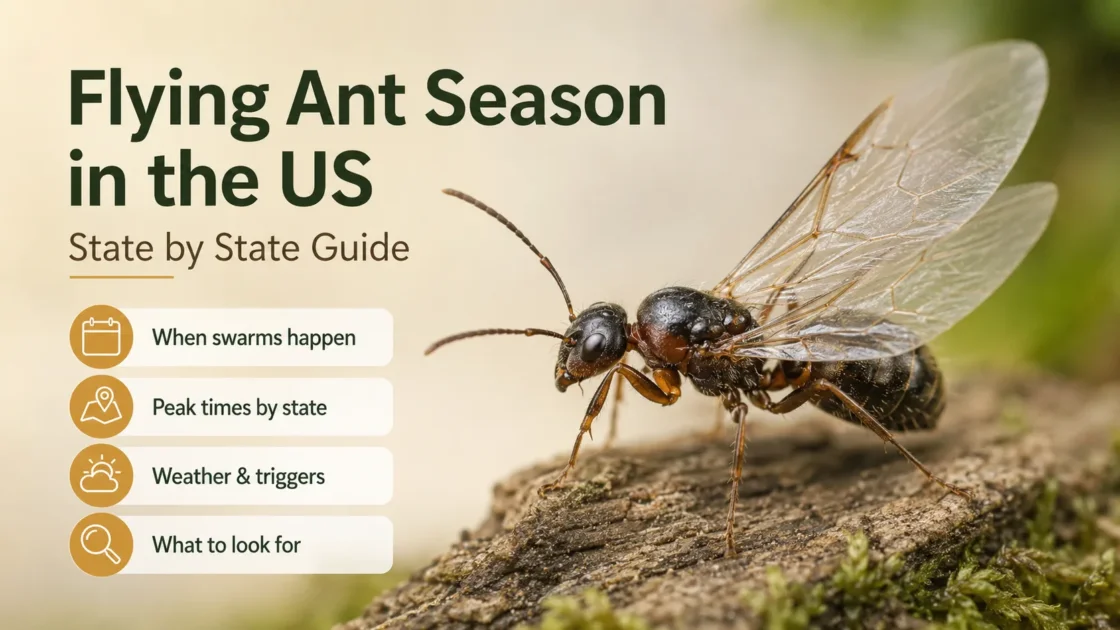
About the state ranges
The periods below are broad outdoor watch windows, not emergence forecasts. State borders do not define ant biology, and there is no standardized scientific calendar that independently establishes a flying-ant season for every state. The ranges synthesize documented species timing, regional extension guidance and U.S. climate seasonality. A local species, elevation difference, rain event or heated building can place a swarm outside the broad state window.
Flying Ant Season by State
The most useful way to interpret the table is to treat the season column as the period when outdoor flying-ant activity becomes more plausible across a large part of the state. It does not mean every species flies throughout that period. NOAA climate normals also show why one statewide date would be misleading: seasonal temperature and precipitation vary sharply across the country and within large or mountainous states.[e]
| State or District | Broad Outdoor Watch Window | Local Timing Context |
|---|---|---|
| Alabama | Spring through fall | Imported fire ant flights can extend from spring through late fall and are especially noticeable after rain following a dry period. |
| Alaska | Short summer window | The brief outdoor warm season compresses the useful watch period. Coastal, interior and far-northern locations should not be treated as one calendar. |
| Arizona | Warm-season, strongly location dependent | Low desert communities and high-elevation locations can be on very different schedules. Rainfall pattern and elevation are more useful than one statewide month. |
| Arkansas | Spring through fall | A long warm season permits several possible flight periods. Imported fire ant context applies in at least part of the state. |
| California | Spring through summer in many areas | Southern lowlands, the Central Valley, coast and mountains differ sharply. Imported fire ants also occur in parts of the state, so one California peak would be misleading. |
| Colorado | Late spring through summer | Lower valleys warm before mountain communities. Summer flights following wet weather may occur while high-elevation locations remain comparatively cool. |
| Connecticut | Late spring through summer | Species differences can create separate spring and later-summer events even within the same locality. |
| Delaware | Spring through late summer | The Mid-Atlantic climate supports a longer outdoor window than northern New England, with timing still dependent on species and short weather events. |
| District of Columbia | Spring through late summer | Warm spring conditions can bring early flights, while other species remain active into summer. |
| Florida | Spring through fall | This is one of the least suitable states for a single peak month. Imported fire ants can fly between spring and fall, while Florida carpenter ant reproductives may fly during the May–November rainy season. |
| Georgia | Spring through fall | Warm-season activity can recur rather than forming one annual event. Imported fire ants add a long post-rain flight pattern. |
| Hawaii | Weather-driven during much of the year | Rainfall, humidity and the species involved are more informative than a mainland spring–summer calendar. Local flying-ant events have been associated with still, humid conditions following nighttime rain. |
| Idaho | Late spring through summer | Elevation and local moisture can shift flights considerably. Mountain areas generally reach suitable outdoor conditions later than lower valleys. |
| Illinois | Spring through late summer | Several species can contribute to separate swarm periods rather than one statewide flying-ant day. |
| Indiana | Spring through late summer | Spring-active species can overlap with ants whose reproductive flights occur later in summer. |
| Iowa | Late spring through late summer | Cold spring conditions can delay the start, while warm humid periods after rain can produce short visible pulses later in the season. |
| Kansas | Spring through late summer | Weather can interrupt the season. Extended dry conditions may separate one visible flight event from another. |
| Kentucky | Spring through late summer | Southern parts of the state can remain favorable longer than cooler upland locations. |
| Louisiana | Spring through fall | The long warm season and imported fire ant presence allow repeated opportunities for mating flights following favorable weather. |
| Maine | Late spring through summer | A shorter warm season concentrates outdoor activity. Coastal and inland timing can still differ. |
| Maryland | Spring through late summer | Low-elevation coastal areas may become favorable earlier than cooler western Maryland. |
| Massachusetts | Late spring through summer | Most useful outdoor watching centers on the warm season, but the species involved determines the actual flight date. |
| Michigan | Late spring through late summer | The Upper Peninsula and southern Lower Peninsula should not be expected to follow the same local timing. |
| Minnesota | Late spring through late summer | Species timing matters strongly. Winged pavement ants are recorded indoors from May through July, while heated nests can produce off-season activity. |
| Mississippi | Spring through fall | Imported fire ant flights can occur repeatedly during the warm season, especially around favorable rain events. |
| Missouri | Spring through late summer | Southern locations may retain suitable flight conditions longer than northern Missouri. Different species can produce separate events. |
| Montana | Late spring through summer | A relatively short warm season combines with large elevation differences, making county-level conditions more useful than a fixed statewide date. |
| Nebraska | Late spring through late summer | Warm spells and wet-weather episodes can produce short swarm periods inside the broader summer window. |
| Nevada | Warm-season, location dependent | Low desert areas and high basins differ substantially. Elevation and local moisture can move activity earlier or later. |
| New Hampshire | Late spring through summer | Outdoor activity is concentrated into the warmer part of the year, with later timing possible in cooler uplands. |
| New Jersey | Late spring through late summer | Warm coastal and urban locations may become suitable before cooler inland areas, but species remains the stronger biological control on flight timing. |
| New Mexico | Warm-season, elevation and rain dependent | Desert lowlands and mountain communities should not share one swarm date. Current federal imported-fire-ant status should not be inferred from older quarantine maps. |
| New York | Late spring through summer | New York City and Long Island can run earlier or longer than the Adirondacks and other cooler upstate areas. |
| North Carolina | Spring through late summer; longer in warmer fire-ant areas | Imported fire ants are established in the state, and NC State records reproductive flight under warm spring and fall conditions. |
| North Dakota | Late spring through late summer | The useful outdoor window is comparatively compressed by the northern climate. |
| Ohio | Spring through late summer | Different ants may fly in spring and later summer, so one statewide peak month is not biologically realistic. |
| Oklahoma | Spring through fall in warmer areas | Imported fire ants are part of the state’s current federal distribution context, while other ants may use shorter spring or summer windows. |
| Oregon | Spring through summer | Oregon State documents early-summer swarming for pavement ants; warmer indoor colonies can swarm outside the outdoor season. |
| Pennsylvania | Spring through late summer | Penn State notes spring and late-summer lawn-ant swarms, while citronella ants most commonly swarm in mid- to late summer. |
| Rhode Island | Late spring through summer | The main outdoor opportunity is concentrated in the warm season, with species-specific variation inside it. |
| South Carolina | Spring through fall | A long warm season and imported fire ant presence make repeated post-rain flights possible. |
| South Dakota | Late spring through late summer | Spring warmth arrives later than in the South, leaving a more compressed outdoor period. |
| Tennessee | Spring through fall in warmer areas | Imported fire ant presence extends the seasonal context in affected parts of the state; cooler uplands may have a shorter window. |
| Texas | Spring through fall | The Gulf Coast, central Texas, west Texas and the Panhandle cannot be reduced to one peak. Imported fire ants add repeated warm, post-rain flights across infested areas. |
| Utah | Spring through late summer | Local species differ: pavement ants primarily swarm in late spring, while Utah carpenter ant swarms are usually reported from late spring through late summer. |
| Vermont | Late spring through summer | The short northern warm season limits the broad outdoor window, especially in cooler uplands. |
| Virginia | Spring through late summer; longer in southern fire-ant areas | Imported fire ants are established in parts of Virginia, adding a warm-season pattern that does not apply equally across the entire state. |
| Washington | Spring through summer | Western maritime areas and the warmer, drier interior have different seasonal patterns, so local weather should refine the statewide range. |
| West Virginia | Spring through late summer | Elevation can delay activity in cooler mountain locations relative to lower valleys. |
| Wisconsin | Late spring through late summer | Outdoor flights are concentrated into the warm season, while heated structural nests can create misleading off-season sightings. |
| Wyoming | Short late-spring through summer window | Elevation strongly affects local timing. High mountain areas may remain unsuitable well after lower basins have warmed. |
Interpretation: “Spring through fall” does not mean continuous swarming for seven or eight months. It means that one or more ant species in that climatic setting may have suitable flight periods somewhere within that broader span. An individual colony normally releases reproductives during much shorter events.
One State Can Have More Than One Flying Ant Season
A state calendar becomes misleading when “flying ants” are treated as one biological unit. Ant colonies in the family Formicidae produce winged reproductives, but the timing of those reproductives is controlled partly by the biology of the species. Two ants living in the same county may therefore fly weeks or months apart.
Penn State reports that ants in home lawns may swarm during spring and late summer. Its citronella ant guidance narrows the most common swarm period for that group to mid- to late summer, while also recording swarmers from homes during late autumn and early spring.[f] Utah State describes pavement ants as primarily late-spring swarmers but gives a broader late-spring-to-late-summer period for carpenter ants.[g][h] Oregon State places pavement-ant mating swarms in early summer.[i]
| Ant Group or Example | Documented Flight Pattern | What It Shows |
|---|---|---|
| Pavement ants in Utah | Primarily late spring | A common urban ant can have a relatively concentrated spring period. |
| Pavement ants in Oregon guidance | Early summer | The same general ant type need not produce identical calendar wording across regions. |
| Utah carpenter ants | Late spring to late summer | Another ant group can occupy a wider window in the same state. |
| Citronella ants in Pennsylvania | Most commonly mid- to late summer | A later swarm does not make the state table wrong; it may simply involve another species. |
| Red imported fire ant | Spring through fall in southern guidance | Warm-region colonies may have repeated mating-flight opportunities instead of one annual flight date. |
| Florida carpenter ants | Winged reproductives recorded during the May–November rainy season | Florida’s rainy-season pattern cannot be represented accurately by a single midsummer month. |
The month is therefore supporting evidence, not an identification feature. A July swarm in Pennsylvania, a July swarm in Florida and a July swarm in Utah may involve ants with very different nesting biology and seasonal patterns.
Rain Can Release a Swarm Without Creating the Season
Flying ants often seem to appear immediately after a summer shower, but rain does not create winged adults overnight. The colony must already be mature and must already contain developed reproductive males and queens. Weather determines when those ready-to-fly alates have a suitable opportunity to leave.
The clearest U.S. examples come from imported fire ants. Alabama Extension reports swarming from spring through late fall and notes that events are especially common a day or two after rain that follows a dry period.[j] University of Florida guidance describes red imported fire ant mating flights between spring and fall, commonly on warm, sunny days following rain.[k] North Carolina State University likewise reports reproductive flight during warm spring and fall conditions.[l]
| Field Condition | How to Interpret It |
|---|---|
| Warm weather during the normal local season | Supports flight activity, but does not show that a colony has mature alates ready to emerge. |
| Rain after a dry period | Can provide a strong short-term trigger for some ants, especially imported fire ants in the South. |
| Warm, humid and relatively still conditions | Can favor a conspicuous local event when reproductives are already ready; this pattern has also been described for flying ants in Hawaii. |
| A long dry spell | May separate visible flight events even when the calendar remains within the broader seasonal window. |
| Warmth from a slab or heated building | Can produce an indoor swarm outside the normal outdoor calendar. |
Calendar versus weather
A date such as “mid-July” cannot predict a flight on its own. A more defensible interpretation is: the species must be in its reproductive period, the colony must have mature alates, and local conditions must allow departure.
The Southern Calendar Changes Where Imported Fire Ants Are Established
Imported fire ants deserve a separate seasonal layer because their reproductive flights occupy a long portion of the warm season and can repeat after favorable weather. This does not mean that every flying ant seen in an affected state is a fire ant.
USDA APHIS currently reports imported fire ants across more than 367 million acres in Alabama, Arkansas, California, Florida, Georgia, Louisiana, Mississippi, North Carolina, Oklahoma, South Carolina, Tennessee, Texas and Virginia, as well as Puerto Rico.[m] Some states are only partly affected, and federal quarantine boundaries are not the same thing as the range of every native or non-native ant species.
The distinction matters for seasonal interpretation. In a northern state, a broad late-spring-to-summer window can describe much of the useful outdoor observation period. In an imported-fire-ant area along the Gulf Coast, however, spring, summer and fall can all contain suitable mating-flight events. A recent rain can be more informative than the fact that July has passed.
New Mexico also illustrates why old distribution maps should not be carried forward automatically. APHIS removed Doña Ana County from the federal imported fire ant quarantined area on August 21, 2025, and New Mexico is not included in APHIS’s current list of infested states.[m] That regulatory change does not establish the distribution of every fire-ant species, but it changes how current federal imported-fire-ant context should be represented.
Florida Cannot Be Reduced to One Flying-Ant Month
Florida provides a clear example of why a state-by-state page needs species context. UF/IFAS describes red imported fire ant mating flights from spring through fall, with multiple flights possible after a colony reaches reproductive maturity. Warm, sunny conditions following rain are associated with these flights.[k]
Florida carpenter ants follow another pattern. UF/IFAS reports winged reproductives flying in the evening or at night during the May through November rainy season, while carpenter-ant complaints associated with spring swarming are especially common from April through June.[n] Florida harvester ants provide yet another pattern: winged forms have been observed in nests in May, with mating flights recorded from June and broader swarming described from June into October.[o]
A statement such as “Florida flying ant season peaks in July” would therefore hide more information than it provides. The species and the immediate weather pattern are often more useful than the month alone.
Large and Mountainous States Need Local Interpretation
State borders become especially weak biological boundaries in California, Texas, Arizona, New Mexico, Colorado, Utah, Nevada, Idaho, Montana and Wyoming. NOAA’s station-based climate normals show large spatial differences in temperature and precipitation across the country, which is why climate information can help interpret a broad swarm window but cannot identify an ant or forecast a specific emergence.[e]
California
A northern coastal site, the Central Valley, southern California and a Sierra Nevada community do not experience the same seasonal conditions. A single statewide month would imply precision that the geography does not support. Imported fire ants also occur in parts of California, creating an additional warm-region flight pattern that should not be generalized to the whole state.
Texas
Texas spans humid Gulf Coast environments, central grasslands, dry western landscapes and a cooler Panhandle. The useful statewide statement is therefore a long spring-to-fall possibility, especially where imported fire ants are established, rather than one Texas swarm week.
The Mountain West
Elevation can move local seasonal conditions by enough that a valley and nearby mountain community are poor calendar substitutes for each other. Utah provides direct species examples: pavement ants primarily swarm in late spring, while carpenter ant swarms are usually observed from late spring through late summer. The exact period at a specific site can still shift with local conditions.[g][h]
Alaska Has a Compressed Outdoor Window
Alaska should not inherit a calendar designed for the contiguous northern states. Its seasonal temperature pattern creates a much shorter practical outdoor window, concentrated in the warm part of the year. Even within Alaska, south-coastal, interior and far-northern locations differ enough that a single exact month would be an inference beyond the ant-specific evidence available for the state.
The state table therefore uses a short-summer planning range rather than claiming a documented statewide alate peak. That distinction matters: climate can describe when outdoor flight becomes more plausible, but climate normals are not ant phenology records.
Hawaii Follows Weather More Closely Than a Mainland Calendar
Hawaii’s tropical conditions make a spring-versus-summer label less useful. A University of Hawaiʻi CTAHR report on flying-ant swarms in Windward Oʻahu described still, humid mornings following nighttime rain as conditions associated with increased mating activity.[p]
That does not establish one weather rule for every Hawaiian ant species or island. It does show why the mainland idea of waiting for a particular summer month can fail: local rain, humidity and species biology can be more informative than season name.
Indoor Flying Ants Can Appear Outside the State Season
An outdoor state calendar should not be used to dismiss a winter or early-spring indoor swarm. Heated structures create conditions that outdoor colonies do not experience. Utah State notes that pavement ants can swarm even during winter when colonies are near heated slabs, and Oregon State reports that colonies in warm buildings can swarm at other times of year.[g][i]
The number and location of the insects change the interpretation. University of Minnesota Extension states that large numbers of winged carpenter ants indoors are strong evidence of a nest within the building, while one or a few winged queens may simply have entered after mating.[q] In cold regions, carpenter-ant activity indoors during winter is particularly informative because an outdoor colony would normally be inactive.
Indoor exception
A winter swarm emerging repeatedly from the same wall, window area, floor gap or structural void should be interpreted as indoor evidence, not compared mechanically with the state’s outdoor season. A single winged ant near an open door or window carries much less evidence than repeated emergence from one indoor location.
Season Alone Cannot Confirm That the Insect Is an Ant
Spring and summer are also common periods for other winged insects, including termite reproductives. A swarm appearing during the expected flying-ant season is therefore not enough for identification.
| Visible Feature | Winged Ant | Termite Swarmer |
|---|---|---|
| Antennae | Elbowed or distinctly bent | Relatively straight or bead-like |
| Waist | Narrow, visibly constricted | Broad connection between thorax and abdomen |
| Wings | Forewings usually longer than hind wings | Two pairs more similar in length |
| Month of observation | Useful only as supporting context | Useful only as supporting context |
Alabama Extension uses the narrow waist, unequal wing pairs and elbowed antennae as visible characters for separating fire-ant swarmers from termite swarmers.[j] These structural traits carry more identification value than whether the swarm occurred in May, July or September.
What Happens After a Flying-Ant Swarm
The visible swarm is the dispersal phase of colony reproduction. Mature colonies produce winged males and queens; the reproductives leave, mate and separate from the original colony. Males generally die after mating. Fertilized queens land and shed their wings before attempting to establish a nest.[a]
That is why a large outdoor swarm can be followed by scattered wingless queens on pavement, soil, near foundations or beneath cover. Finding a dealate queen after a flight does not by itself prove that a new colony has become established. Colony founding is a later process, and many queens fail before producing a mature nest.
Typical reproductive sequence
Mature colony → reproductive alates develop → mating flight → mating → queen lands → wings are shed → colony-founding attempt
The timing of the flight portion varies by species and local conditions; the sequence itself explains why flying ants appear suddenly and then disappear just as quickly.
Sources and Verification
- [a] University of Minnesota Extension — “Ants.” Used for ant reproductive-caste biology, mating swarms and the principle that each ant species swarms during its own period.
- [b] Penn State Extension — “Ants in Home Lawns.” Used for spring and late-summer swarming context in temperate lawn ants.
- [c] Oregon State University Extension — “Integrated Pest Management for Ants in Schools.” Used for early-summer pavement-ant swarming and the warm-building exception.
- [d] Utah State University Extension — pavement-ant and carpenter-ant guidance. Used for species-level seasonal differences in the interior West.
- [e] NOAA National Centers for Environmental Information — “U.S. Climate Normals.” Used only to interpret broad geographic seasonality and within-state climate differences. Climate normals are not ant occurrence or swarm records.
- [f] Penn State Extension — “Citronella Ants.” Used for the most common mid- to late-summer swarming period and documented off-season indoor swarmers.
- [g] Utah State University Extension — “Pavement Ants.” Used for primary late-spring swarming and winter swarming near heated slabs.
- [h] Utah State University Extension — “Carpenter Ants and Control in Homes.” Used for Utah carpenter-ant swarms from late spring through late summer.
- [i] Oregon State University Extension — “Integrated Pest Management for Ants in Schools.” Used for pavement-ant early-summer mating swarms and year-round possibilities in warm structures.
- [j] Alabama Cooperative Extension System — “Swarming Fire Ants.” Used for spring-through-late-fall fire-ant flights, post-rain timing and visible ant-versus-termite characters.
- [k] University of Florida IFAS — “Red Imported Fire Ant, Solenopsis invicta.” Used for spring-to-fall mating flights and warm post-rain flight conditions.
- [l] NC State Extension — “Fire Ants in Commercial Turfgrass, Home Lawns and Roadsides.” Used for reproductive flight during warm spring and fall conditions.
- [m] USDA APHIS — “Imported Fire Ants.” Used for current federal distribution context, the more-than-367-million-acre figure, listed affected states and the 2025 removal of Doña Ana County, New Mexico, from federal quarantine.
- [n] University of Florida IFAS — “Florida Carpenter Ants.” Used for rainy-season flights from May through November and the April–June spring complaint period.
- [o] University of Florida IFAS — “Florida Harvester Ant.” Used for May winged forms and documented June-to-October swarming context.
- [p] University of Hawaiʻi CTAHR — “Flight of the Ants.” Used for the Windward Oʻahu observation linking flying-ant activity with still, humid mornings after nighttime rain.
- [q] University of Minnesota Extension — “Carpenter Ants.” Used for interpreting large indoor swarms, small numbers of newly mated queens and winter indoor activity.