Flying ant season in Australia does not fall on one national date. Winged males and young queens appear when a mature colony is ready to reproduce and local conditions suit dispersal, so the useful timing depends on species, rainfall, temperature and location. Northern Australia is strongly shaped by its wet-season cycle, while southern populations can have much narrower and species-specific flight periods.
A warm, humid spell after rain is one of the most useful field clues, but it is not a guarantee. Some Australian ants fly in spring, others later in summer or autumn, and suitable weather does nothing if the colony has not produced reproductive ants. This is why a swarm can suddenly cover one lawn or street while another nearby area remains quiet.
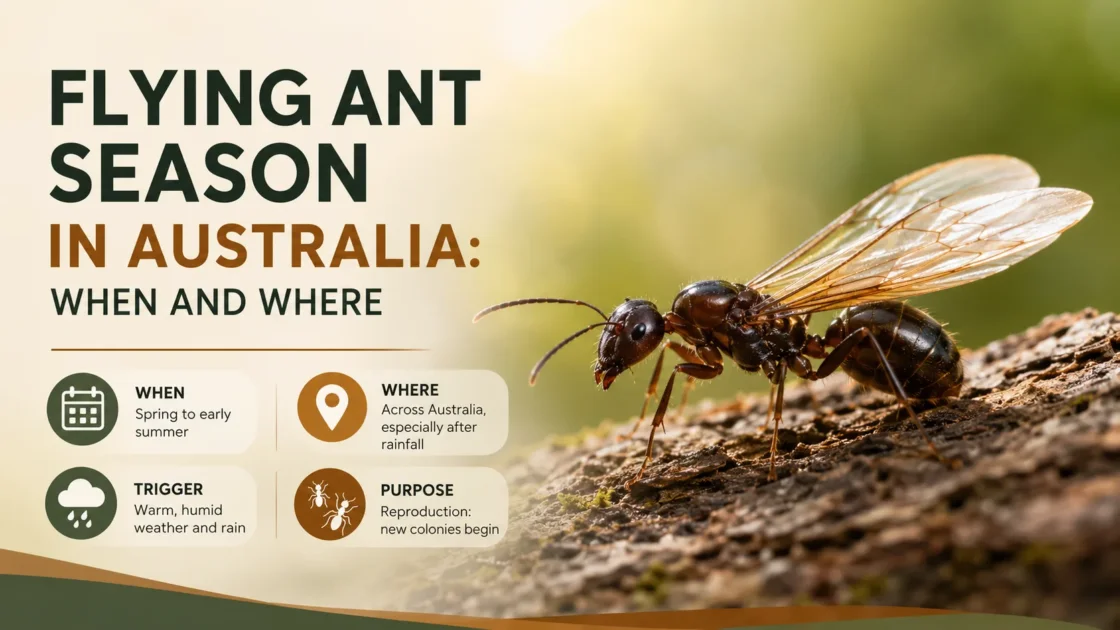
Australia’s Flying-Ant Calendar Changes With Climate
Australia spans tropical, subtropical, temperate, Mediterranean-type and arid rainfall regimes. The Bureau of Meteorology defines the northern Australian wet season as 1 October to 30 April, with the dry season running from 1 May to 30 September.[a] The Bureau’s seasonal rainfall classification also shows why a single ant calendar is a poor fit for the continent: some areas receive most of their rain in the warmer part of the year, some in the cooler part, while others have weak or irregular rainfall seasonality.[b]
| Australian region | Most useful seasonal cue | How to interpret flying-ant timing |
|---|---|---|
| Top End, Kimberley, Cape York and tropical north Queensland | Wet-season transition, warm humid conditions and recent rain | The October–April wet season is a useful climatic watch period, but it is not an all-species flight calendar. |
| South-east Queensland and the subtropical east | Warm weather combined with rain or storms | Local flights may occur across a long warm part of the year. Fire-ant biosecurity changes how suspicious swarms should be handled in affected areas. |
| New South Wales and the ACT | Warm post-rain periods and local species activity | Species biology matters more than assigning Sydney, coastal NSW and Canberra one fixed month. |
| Victoria and other temperate southern districts | Warm-season conditions, recent moisture and species-specific mating periods | Flights are not confined to midsummer; documented Australian species can fly into early autumn. |
| South Australia, south-west Western Australia and Tasmania | Local warmth, soil moisture and reproductive timing | A national summer rule is weak because rainfall regime, latitude and species composition differ substantially. |
| Arid and semi-arid interior | Rainfall events occurring while temperatures remain suitable for activity | Recent conditions are more informative than a fixed month because rainfall can be episodic. |
A season is not a forecast
A region can have weather suitable for flying ants without producing a visible swarm. The colony must also be mature, the reproductive caste must be ready to leave, and the species must be within its own mating period.
Northern Australia Is Better Read by Rain Than by Summer
Darwin, the Top End, the Kimberley, Cape York and tropical north Queensland do not fit a southern Australian spring–summer model neatly. The formal northern wet season covers October through April, and the transition toward wetter conditions brings the combination of heat, humidity and increasing soil moisture that can favour reproductive activity in some ants.
This does not mean that flying ants should be expected throughout every wet-season month. Rainfall onset varies geographically and from year to year, while ant species respond differently. A better field interpretation is to watch for short local windows when rain has recently fallen, temperatures remain warm and mature colonies are visibly active.
Darwin and the Top End
In the Top End, the transition from the dry season toward wetter, more humid weather is more biologically informative than waiting for a particular summer month. A stormy period can create a local reproductive window even though another location farther inland has not accumulated comparable moisture.
Cairns, Cape York and Tropical North Queensland
Tropical north Queensland also has a long warm season, so temperature alone provides little precision. Rainfall pattern, humidity and species identity become more useful than a simple statement that flying ants appear in summer. Different colonies can respond to different rain events across the same broad wet-season period.
Along the East Coast, Local Weather Can Shift a Swarm by Days or Weeks
The east coast covers tropical Cairns, subtropical Brisbane, coastal Sydney and much cooler districts farther south. Treating this entire corridor as one flying-ant season removes the climatic differences that actually matter.
Brisbane and South-East Queensland
Warm, humid weather and rainfall can create repeated opportunities for local mating flights around Brisbane and south-east Queensland. A swarm on one warm post-storm day does not establish a fixed annual date for the region. Several ant species may be present, colonies do not all mature at the same time, and later weather events can produce separate flights.
South-east Queensland also requires a second layer of interpretation because red imported fire ants occur within the Australian eradication response area. A normal native-ant flight and a fire-ant reproductive flight can both be associated with rain, so location and identification matter before deciding what a swarm represents.
Sydney, Coastal New South Wales and Canberra
New South Wales educational guidance describes males and young queens being produced when colonies are ready to reproduce and notes that, in some species, winged ants leave after rain or during warm weather.[c] That is a better basis for interpreting a Sydney or Canberra sighting than assigning every local species one calendar month.
Sydney’s coastal conditions and Canberra’s inland climate are also different enough that simultaneous flights should not be assumed. A warm, damp evening near the coast can coincide with much cooler or drier conditions inland. Even within one metropolitan area, recent showers, irrigation, shade and surface heating can create different nest-level conditions.
Australian Species Show Why One Month Cannot Define the Season
The strongest reason to avoid a universal calendar comes from the ants themselves. Different Australian species have documented reproductive periods in different parts of the warm season.
Meat ants can produce separated seasonal flight periods
A long-term population study of the Australian meat ant Iridomyrmex purpureus recorded nuptial flights from multiple nests in October and again in March–April. In the reported events, the ground was wet from recent rain.[d] The observation is useful precisely because it does not support one simple summer peak: the same species can show flight activity in separated seasonal windows under suitable conditions.
Those dates should not be copied to every meat-ant population in Australia. They are species- and study-specific field evidence showing that moisture and local reproductive biology can matter as much as the name of the season.
A bull ant can fly in late summer and early autumn
Research on the Australian bull ant Myrmecia pyriformis reports that its mating flights occur during daylight in late summer and early autumn.[e] That provides a documented reason not to treat an autumn flying-ant sighting in southern Australia as automatically “out of season.”
It also illustrates another complication: flight time is not universally tied to dusk or night. Some species can fly during the day, while others are more conspicuous around evening conditions. Time of day may therefore help describe a swarm, but it cannot identify an Australian ant by itself.
Rain Can Open a Flight Window, but It Does Not Start a Countdown
“Flying ants appear after rain” is useful only when the mechanism is understood. A colony does not manufacture winged reproductives because a storm arrives. Males and virgin queens must already have developed inside a reproductively mature colony. Weather determines whether conditions are suitable for those alates to leave; it does not create them overnight.
- Reproductive readiness comes first. A mature colony has produced males and young queens.
- Rain changes the immediate environment. Soil moisture rises and the air may become more humid.
- Suitable flight weather follows. Warm conditions after the rain can provide an opportunity for departure.
- Several nearby colonies may respond to the same weather. This produces the sudden impression that flying ants have appeared everywhere at once.
- The opportunity can close quickly. A change in temperature, wind or other local conditions can end visible activity even though the broader seasonal period continues.
Why “after rain” does not mean “during heavy rain”
A rain event and a flight event should not be treated as the same thing. Wet ground may form part of the reproductive opportunity, while active aerial dispersal still requires conditions that allow the insects to leave the nest and fly. The observable swarm can therefore follow the rain rather than coincide with the heaviest rainfall.
Useful weather sequence
Recent rain → moist local conditions → warm, humid flight opportunity → alates emerge. This describes a plausible sequence, not a guaranteed forecast. Species biology and colony maturity still determine whether a flight occurs.
Why One Australian Suburb Can Swarm While the Next Does Not
Flying-ant activity is regional at one scale and extremely local at another. Two suburbs can share the same weather forecast while their ant colonies differ in species, reproductive maturity, nest exposure and recent soil moisture.
A brief shower may wet one part of a city and miss another. Irrigated lawns can retain moisture that adjacent dry ground does not. Paving and built surfaces can create warmer local conditions, while shaded soil remains cooler. Most importantly, one colony may already contain mature alates while another colony of the same or a different species does not.
The result is a patchwork. Hundreds of winged ants can emerge from several nests in a small area without implying that the whole city has entered a synchronized “flying ant day.”
Where Flying Ants Become Most Noticeable
The “where” in flying-ant season has two meanings: the part of Australia where conditions are suitable and the immediate place where a reproductive flight becomes visible.
- Soil nest entrances and lawns: reproductive ants may gather at or near an underground nest before leaving.
- Garden edges and open ground: soil-nesting colonies can produce concentrated emergence from a small area.
- Footpaths, driveways and paved edges: ants emerging nearby are easier to see against hard surfaces than in vegetation.
- Bushland and woodland: native ant flights occur away from houses as part of normal reproductive ecology.
- Windows, walls and lights: winged insects become conspicuous when they land on buildings or gather near illumination.
- Ground surfaces after the flight: newly mated queens may be seen walking alone after losing or beginning to shed their wings.
A cluster around a light does not necessarily identify the nest location. The insects may have flown from nearby ground and only become obvious after reaching the illuminated structure.
The Swarm Is Only One Stage of the Event
Before take-off, winged males and young queens can appear around the nest entrance while workers remain active nearby. The visible flight then disperses the reproductive ants and creates opportunities for mating between individuals from different colonies.
After mating, a queen may land, shed her wings and begin searching for a suitable founding site. This explains why large, apparently wingless ants can suddenly be found walking across paving or soil after a swarm. A dealate queen is not simply an oversized worker; the missing wings can be evidence that the reproductive flight has already occurred.
The intense visible part of a local flight may be brief, but that does not mean the regional season is over. Different nests and different species can fly on later days when another suitable window develops.
A Post-Rain Swarm May Be Termites Instead
Season and rainfall are weak identification characters because termites also produce winged reproductive forms. Australian Museum guidance separates winged ants and termites most reliably by antennae, waist shape and wing proportions.[f]
| Feature | Flying ant | Termite swarmer |
|---|---|---|
| Antennae | Distinctly elbowed | Straighter, bead-like appearance |
| Waist | Clearly constricted between the middle and rear body | Broad body line without the ant-like narrow waist |
| Wings | Forewings and hindwings differ in size, with the forewings generally larger | Two pairs are much more similar in size and shape |
| Shed wings | Queens may lose wings after mating | Reproductives also shed wings after dispersal |
Loose wings alone are therefore not enough. If the insect body is still available, the waist and antennae usually provide much stronger evidence than the month or the weather.
An Outdoor Swarm and Repeated Indoor Emergence Mean Different Things
Large numbers of ants flying above a lawn after suitable weather are consistent with a natural reproductive flight. A few that reach windows or lights can also originate outdoors. The interpretation changes when winged insects repeatedly emerge from the same indoor location.
| Observation | What it can indicate | Useful response |
|---|---|---|
| Many winged ants leaving lawn or soil after warm rain | Outdoor reproductive flight | Confirm that the insects are ants and allow the short-lived event to pass unless another issue is present. |
| A few winged ants at a window during an outdoor swarm | Outdoor alates that reached the building | Check whether activity stops when the local flight ends. |
| Repeated emergence from the same crack, wall edge or indoor area | A nest or emergence route may be close to or within the structure | Locate the emergence point and identify a specimen before deciding on control. |
| Numerous loose wings with uncertain insect identity | Ant or termite reproductive activity | Do not identify the insect from the wings alone. |
Red Imported Fire Ants Add a Biosecurity Layer in Australia
Most flying ants seen in Australia are not red imported fire ants. However, Solenopsis invicta has an active eradication response in Australia, so winged ants associated with a suspicious fire-ant nest require a different response from an ordinary native-ant swarm.
The National Fire Ant Eradication Program reported in May 2026 that winged fire ants, or alates, can emerge in large numbers within about 24 hours of rainfall, gathering on nests before mating flights.[g] The program states that new queens usually establish nests within about 500 metres of the parent colony, although some may travel as far as 5 kilometres.
Australian fire-ant biosecurity
A reddish or brown flying ant is not automatically a fire ant. Suspicion becomes more meaningful when winged ants are associated with a fire-ant-like nest, small workers of noticeably different sizes, aggressive mass activity, painful stings or a location within or near a current response area. Suspect nests should not be disturbed simply to obtain a closer look.
Static suburb lists age quickly. The program’s confirmed-detections map is updated daily, so it is a better source for current location context than an old list embedded in an article.[h] Queensland’s fire ant biosecurity zones are reviewed and updated monthly as detections and movement risk change.[i]
Australia’s official outbreak information provides state-specific reporting routes for suspected red imported fire ants. In Queensland, suspect sightings can be reported to the National Fire Ant Eradication Program on 132 ANT (13 22 68); New South Wales uses the NSW Biosecurity Helpline on 1800 680 244.[j]
Can the Next Flying-Ant Swarm Be Predicted?
Weather can identify a watch window, but an Australia-wide swarm calculator would imply more precision than the evidence supports. The strongest prediction requires knowing both the local weather and the ant involved.
- Has rain fallen recently?
- Has warm weather returned after the rain?
- Is the air humid rather than very dry?
- Are nearby ant colonies visibly active?
- Are winged reproductives already gathering around a known nest entrance?
- Is the species known to be within its reproductive period?
Several of these conditions occurring together make a local flight more plausible, but none of them confirms that a swarm will occur. Colony readiness remains the part that a weather forecast cannot reveal.
For Australia, the most useful seasonal rule is therefore local rather than national: identify the climate pattern, watch what happens after suitable rain, and let species biology override the calendar. A Darwin wet-season flight, a Brisbane post-storm emergence and a southern bull-ant flight in early autumn can all be normal expressions of the same reproductive process without belonging to one Australian “flying ant day.”
Sources and Verification
- Bureau of Meteorology — Climate Knowledge Centre — official definitions of northern Australia’s wet and dry seasons and southern calendar seasons. [a]
- Bureau of Meteorology — Climate Classification Maps — seasonal rainfall zones used to explain why rainfall timing differs across Australia. [b]
- NSW Department of Education, Field of Mars Environmental Education Centre — Ant Fact Sheet — ant reproductive biology and the observation that some species leave nests after rain or during warm weather. [c]
- Greaves — The Population Biology of the Meat Ant — field evidence for Iridomyrmex purpureus nuptial flights in separated seasonal periods associated with recently wet ground. [d]
- Australian Journal of Zoology — Foraging Ecology of the Night-Active Bull Ant Myrmecia pyriformis — evidence for daylight mating flights in late summer and early autumn. [e]
- Australian Museum — What Are the Differences Between Ants and Termites? — comparison of antennae, waist and wings in reproductive ants and termites. [f]
- National Fire Ant Eradication Program — Wet Weather Increases Fire Ant Activity — official 2026 guidance on post-rain fire-ant alate emergence and queen dispersal. [g]
- National Fire Ant Eradication Program — Fire Ant Map — current confirmed-detection mapping and update frequency. [h]
- National Fire Ant Eradication Program — Fire Ant Biosecurity Zones — current Queensland movement-control zones and monthly review cycle. [i]
- Australian Government Outbreak — Red Imported Fire Ant — national outbreak status and official Queensland and New South Wales reporting channels. [j]