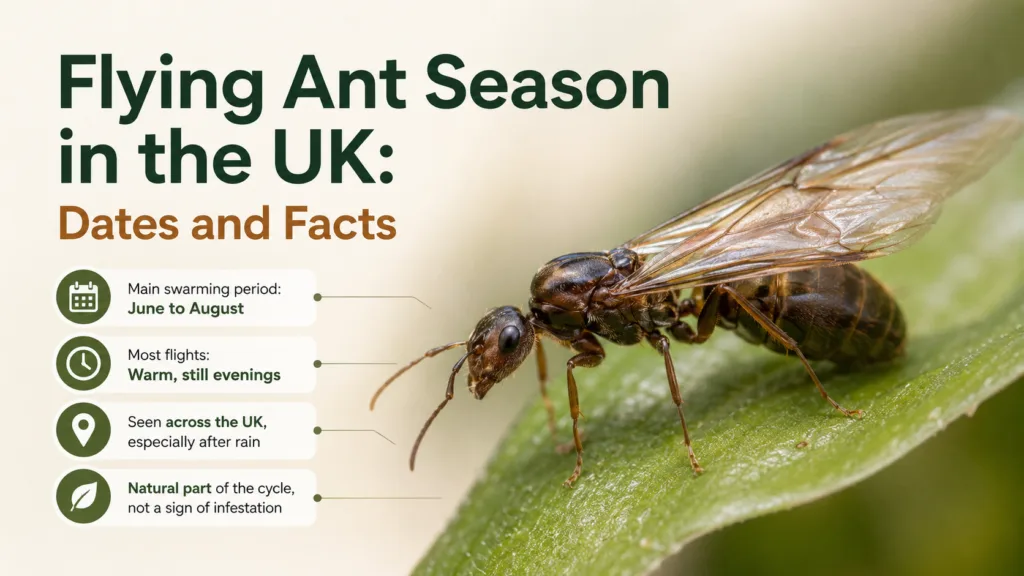
Flying ant season in the UK is not one fixed national day. Most black garden ant flights are seen in July and August, but reliable records and museum guidance place the wider season from June to the start of September, with short local peaks driven by warm, still weather. [a]
The insects usually called flying ants are alates: sexually mature winged queens and males leaving established nests for a nuptial flight. In UK towns and gardens, the most reported species group is the black garden ant, Lasius niger, though field identification should be treated carefully because related Lasius species can look similar.
Key Data Points
Common UK phrase
Flying ant season
“Flying Ant Day” is better read as a local seasonal peak.
Main reported ant
Lasius niger
Black garden ant / small black ant in UK records.
Main UK timing
July–August
Peak period across citizen-science records and field profiles.
Wider season
June–early September
Low-level or regional activity can occur outside the peak.
Weather pattern
Warm, still, often after rain
Temperature and low wind are the clearest recorded signals.
Outdoor pest risk
Low
Outdoor swarms are mating flights, not attacks on people or food.
Queen size marker
Up to about 15 mm
Queens are larger than the smaller winged males.
Data confidence
Good for season, limited for exact date
Local weather makes annual prediction uncertain.
UK Flying Ant Season Dates
The most defensible UK answer is: expect the main flying ant season in July and August, with possible sightings from June into early September. A three-year citizen-science study gathered 16,139 submitted records, cleaned them to 13,394 analysable records, and found that July and August accounted for 97% of observations. [b]
The phrase “Flying Ant Day” survives because many colonies in the same town can respond to the same weather window. To an observer, it can look as if all ants fly on one day. At national scale, the records show a season with several local peaks rather than a single UK-wide event.
| Period | Expected activity | Evidence-based reading | Practical meaning |
|---|---|---|---|
| June | Possible but usually low | Early records exist, but this is not the main UK peak. | Watch after warm spells, especially in southern or urban areas. |
| July | High | Largest share of records in the 2012–2014 dataset. | Main month for sudden pavement, lawn and garden swarms. |
| August | High to moderate | Second major month; local peaks can still be strong. | Late flights remain normal, especially after unsettled weather turns warm. |
| Early September | Occasional | Small share of records, reported in some years. | Late sightings are possible but should not be treated as the usual peak. |
Taxonomic Scope: Which Ants Are Flying?
Most UK public sightings are likely to involve the black garden ant, Lasius niger. The Natural History Museum notes that the winged insects seen in UK urban areas are almost always the sexually mature queens and males of this species, while the 2013 specimen-checking part of the citizen-science study identified 88.5% of submitted winged ants as Lasius niger.
There is a useful caution: BWARS treats many records as Lasius niger aggregate unless they are known to be Lasius niger in the strict sense, because Lasius platythorax is a closely related and similar species. [c]
| Taxonomic item | Best reading for this page | Data caution |
|---|---|---|
| Order | Hymenoptera | Ants are grouped with bees and wasps, not flies. |
| Family | Formicidae | Flying ants are reproductive ants, not a separate insect family. |
| Main species name | Lasius niger (Linnaeus, 1758) | Accepted species name in major biodiversity indexes. |
| UK occurrence layer | NBN Atlas lists Lasius niger as native and accepted, with recorded evidence in Britain. [d] | Live record totals can change as datasets are updated. |
| Global taxon reference | GBIF treats Lasius niger as an accepted species sourced through Catalogue of Life classification. [f] | Occurrence records are not a complete range map. |
What Triggers Flying Ant Flights?
Flying ant emergence is mainly a weather-timed reproductive event. The strongest recurring pattern is a warm day with low wind, often after rain has softened the ground. Local heat also matters: urban sites, paving, stones, brick walls and compost-heated nesting areas can shift flights earlier by a few days.
| Trigger | Recorded pattern | How to interpret it | Limit |
|---|---|---|---|
| Temperature | Most observations occurred above 13°C; all days with mean daily temperature above 25°C had ants observed somewhere in the UK. | Warm conditions raise flight likelihood. | This does not mean every warm town will swarm on the same day. |
| Wind | Most observations occurred below 14 mph / 6.3 m s-1. | Still conditions make flight more likely. | Wind readings are station-based, not nest-level measurements. |
| Recent rain | Survey and monitoring pages describe flights after rain as common. | Rain may soften soil for queens starting new nests. | Rain is not the only trigger and does not guarantee flights. |
| Urban heat | Urban observations were about 3 days earlier than rural observations in the 2012–2014 study. | Pavements and built surfaces can warm nests. | The effect is local and does not fix a national date. |
Data Interpretation Note
A forecast of “Flying Ant Day” should be treated as a local probability, not a calendar fact. Warmth, low wind and recent rain can align across a neighbourhood, but records show weak national synchrony.
Identification: Flying Ants, Not Termites or Flies
UK flying ants are often noticed when large queens walk on pavements after landing or when smaller males cluster near nest exits. Queens are much larger than workers and males. After mating, a queen breaks off her wings and searches for soil or a crevice where she can begin a new nest.
| Feature | Flying ant | Termite swarmer | Small fly or midge |
|---|---|---|---|
| Body shape | Narrow waist between thorax and abdomen. | Broad waist; termites are not typical UK garden swarmers. | Usually no ant-like waist. |
| Antennae | Elbowed antennae. | Straighter antennae. | Variable, often short or feathery. |
| Wings | Two pairs; front wings usually larger than hind wings. | Two pairs of more equal length in termite swarmers. | One pair in true flies. |
| Seasonal clue | Sudden summer emergence from soil, paving, lawns or walls. | UK household termite risk is not the normal explanation for garden swarms. | May appear near water, compost or lights for different reasons. |
Habitat and Pest Risk in UK Homes and Gardens
Lasius niger is strongly associated with dry, open ground warmed by sun. BWARS lists parks, gardens, roadside verges, pavements, coastal areas and brownfield sites as typical habitats, while nests are often under stones, paving slabs or other heat-retaining cover.
| Situation | Likely meaning | Risk level | Evidence-based response |
|---|---|---|---|
| Outdoor swarm over paving or lawn | Normal nuptial flight from nearby nests. | Low | Wait; flights usually pass quickly when weather changes. |
| Large winged queens walking after a swarm | Mated queens searching for nest sites after shedding wings. | Low | No action usually needed outdoors. |
| Winged ants emerging indoors | Possible nest route or nest close to the building fabric. | Moderate | Trace entry points and inspect repeated emergence sites. |
| Small black ants entering for sweet food | Foraging workers, not necessarily flying ants. | Low to moderate | Remove food access and seal obvious gaps. |
Interactive Data Visuals
UK Flying Ant Records by Month, 2012–2014
Share of analysable citizen-science records reported in each month of the survey period.
Source: Hart et al., Ecography, 2012–2014 UK citizen-science records.
Flight Condition Match Score
Editorial scoring of weather and habitat signals used when reading local flying-ant likelihood.
Values are editorial interpretation scores for this guide, not species counts.
Why the Season Moves Across the UK
The season shifts because nests respond to local conditions. A warm spell in London, Bristol or Exeter may not match conditions in Glasgow or northern England. In the 2012–2014 study, some focal weather-station areas showed peaks several days apart, and Exeter had a first major peak almost 9 days earlier than other stations in one year.
Current monitoring projects also treat flying ants as a season rather than one date. The BioDAR project uses public sightings together with weather-radar research to help test how mass insect movements can be detected at larger scales. [e]
Data Quality and Limitations
Where the Evidence Is Strong
The seasonal pattern is well supported: July and August dominate UK flying-ant observations, and temperature plus low wind are strong signals in the 2012–2014 dataset.
Where the Data Has Limits
Citizen-science records may reflect where observers live, where media coverage encouraged reporting, and which insects people noticed. Occurrence records are evidence layers, not complete range maps. A single winged ant record should not be used alone to infer true abundance, nest density or pest pressure.
Identification also has limits. Many public records are not specimen-verified, and the Lasius niger / Lasius platythorax split means that casual sightings should be treated as likely Lasius alates unless a specimen has been checked using suitable keys.
FAQ
When is flying ant season in the UK?
The main season is July and August. The wider recorded window runs from June to the start of September, depending on local weather.
Is there one Flying Ant Day?
No single UK-wide date is reliable. Local colonies can fly on the same warm, still day, which creates the impression of one sudden event.
Why do flying ants appear after rain?
Rain may soften soil and improve conditions for newly mated queens to start nest chambers. Warmth and low wind still matter.
Are UK flying ants dangerous?
Outdoor swarms are mainly a mating event and are not directed at people. They can be annoying in large numbers, but they are usually short-lived.
Why are some flying ants much larger than others?
The larger individuals are usually queens. Smaller winged ants are males. After mating, queens shed their wings and search for a nest site.
Do indoor flying ants mean there is a nest in the house?
Repeated indoor emergence can suggest a nest route close to the building or under floors, walls or paving. A few insects entering through open windows during a local swarm is a different situation.
Sources and Verification
- [a] Natural History Museum — Flying Ant Day — UK season range, alate biology, queen size and local weather timing.
- [b] Hart et al. — The spatial distribution and environmental triggers of ant mating flights — peer-reviewed citizen-science dataset for UK mating-flight timing and weather correlates.
- [c] BWARS — Lasius niger species profile — UK habitat, flight period and taxonomic caution for Lasius niger records.
- [d] NBN Atlas — Lasius niger — UKSI accepted name, native establishment status and record-based evidence layer.
- [e] National Centre for Atmospheric Science — UK flying ant survey — BioDAR monitoring context and weather-linked seasonal explanation.
- [f] GBIF — Lasius niger taxon page — accepted species name and Catalogue of Life classification reference.