Termite swarmer wings fall off because they are temporary dispersal structures with a specialized separation region near the wing base. After the reproductive flight, an alate changes its wing and body posture and can shed the wings along these basal sutures. The process is called dealation. It is a normal transition from a flying reproductive to a termite that will spend the next stage of its life on the ground or inside a protected founding site.
The wings are therefore not best understood as structures that simply become weak after flight. In an experimentally studied subterranean termite, Reticulitermes speratus, the same basal separation system that permits wing shedding after landing is protected by the way the wings are held during flight. Wing loss also does not establish that mating has already occurred.
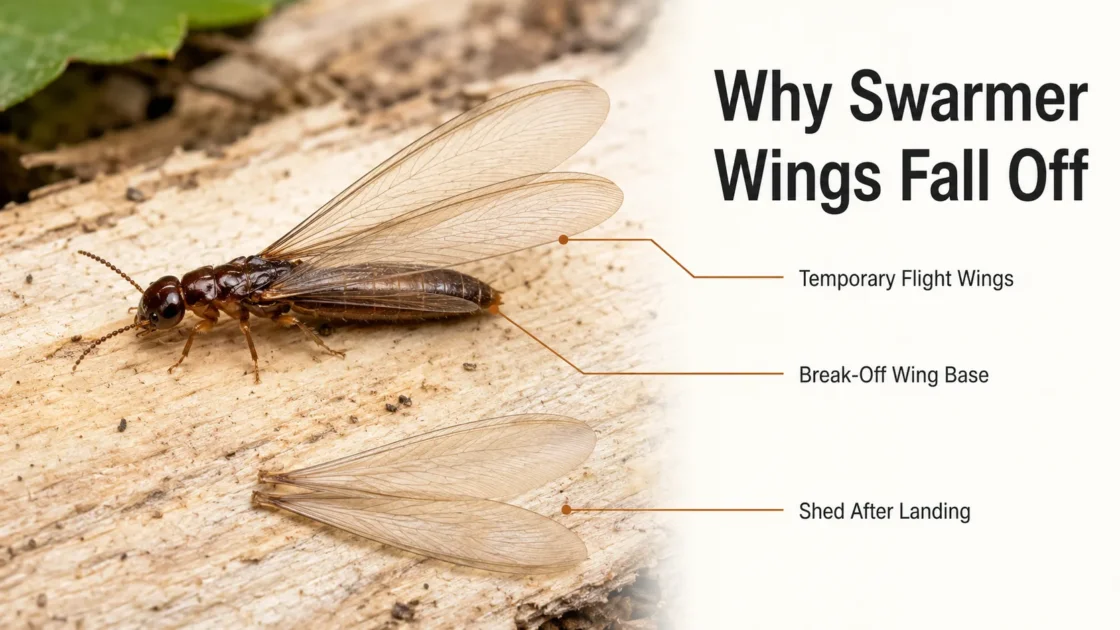
The Wing Base Is Built for Controlled Separation
A termite alate normally begins its dispersal flight with four functional wings—a forewing and hind wing on each side of the thorax. The two pairs are generally similar in length and overall appearance, one of the visible traits that helps distinguish an intact termite swarmer from a winged ant.
Near the base of a termite wing is a defined separation region known as the basal suture. When dealation occurs, pressure is concentrated at this region and the large flight portion of the wing separates. Small basal remnants, often described as wing stubs or wing scales, can remain attached to a dealate termite. University of Hawaiʻi’s Termite Project uses these wing stubs as one of the visible characters of termite alates and dealates.[b]
How a Termite Removes Wings Without Losing Them in Flight
The clearest experimental description comes from Reticulitermes speratus. Researchers studying its dealation found that alates hold their wings in a three-dimensional configuration during the nuptial flight. This posture helps prevent the basal sutures from breaking while the insect is airborne.
After the flight, the mechanics change. The alate holds the wings in a flatter configuration, partly spreads and lowers them, then bends the abdomen backward toward the wings. That movement places high pressure on the basal sutures, allowing the wings to separate from the body.[a]
| Stage | Wing position | Effect at the wing base |
|---|---|---|
| Flight | Held in a three-dimensional flight configuration | Helps prevent premature separation at the basal sutures |
| After landing | Wings become flatter, partly spread and lowered | Changes how force is applied to the wing base |
| Dealation | Abdomen bends back toward the lowered wings | Pressure at the basal sutures separates the wings |
This mechanism explains an otherwise puzzling feature of termite biology: a wing can survive the aerodynamic forces of dispersal yet detach soon after the insect lands. The separation depends on how the wing and body are positioned, not simply on the wing becoming too fragile to remain attached.
Mating Is Not a Universal Trigger for Wing Loss
Termite colony-founding sequences are often compressed into a simple story: swarm, mate, land, drop the wings. That sequence can describe the broad reproductive transition, but it should not be treated as proof that mating directly causes dealation.
In the R. speratus experiments, pairing had no detectable effect on dealation timing. Instead, isolation from other alates promoted wing shedding. The authors identified social context—particularly whether an alate remained among other alates—as a factor affecting when dealation occurred in that species.[c]
A termite without wings is therefore not proof of a successful mating. Shed wings show that the insect has entered or begun the post-flight dealate condition. They do not, by themselves, reveal whether mating occurred, whether a pair found a suitable founding site, or whether a new colony survived.
The experimental result should also stay within its taxonomic limits. R. speratus provides unusually detailed evidence for the mechanics and timing of termite dealation, but termites include many lineages with different swarming schedules, nesting biology and colony-founding behavior. Its isolation response should not automatically be assigned to every termite species.
What Happens After the Wings Come Off?
Dealation does not end dispersal. In the Formosan subterranean termite, Coptotermes formosanus, wingless reproductives continue moving on foot while searching for a mate and, after pairing, for a suitable colony-founding site. A 2026 Journal of Pest Science study reanalyzed experimental movement recordings with posture tracking and modeled how those dealates could move beyond the limits of the laboratory arena.[j]
The observed termites accumulated an average walking distance of 23 m in 15 minutes. That figure is total path length during the experimental observation, not a statement that a termite normally ends up 23 m from the point where its wings were shed. When the constrained trajectories were mathematically converted to approximate movement in open space, estimated displacement reached as much as 18.74 m. The authors explicitly treated this conversion as an approximation rather than a direct field measurement.
Movement also changed after pairing. Single dealates searching for a mate followed less stable paths, while male–female tandems searching for a nest site moved in a more directional and steadier pattern. Simulations based on the observed behavior further indicated that attraction of flying alates to urban lights could concentrate potential partners and raise encounter rates even when termite density was low. These results describe C. formosanus under the conditions and modeling used in that study; they should not be converted into a universal walking distance or post-flight rule for termites as a whole.
Why Discard Functional Wings After One Flight?
The reproductive flight has a narrow purpose: it moves an alate away from its parent colony and creates opportunities to reach a mate and a new founding site. Once that aerial phase has ended, large wings become poorly suited to what follows. A dealate reproductive must move along the ground, enter cracks or other sheltered spaces, and eventually remain within a founding site if colony establishment succeeds.
There is also experimental evidence for an immediate survival benefit. In the same R. speratus study, researchers exposed winged alates and dealates to the termite-hunting ant Brachyponera chinensis. Wing shedding reduced predation risk while the termites were running on the ground during the interval between flight and colony foundation.[d]
The biological value of dealation is therefore more specific than saying that termites “no longer need wings.” The insect is switching from an aerial dispersal form to a ground-based reproductive form, and retaining large detachable wings can become a disadvantage once flight is over.
Temporary Termite Wings Are Still Highly Specialized Flight Surfaces
A wing that will later be discarded can still be highly specialized for the short period in which it is needed. A 2026 study examined the micro- and nanoscale wing surfaces of 54 termite species from 16 families or subfamilies. The researchers used differential interference contrast and scanning electron microscopy to compare structures associated with how termite wings interact with water.[e]
Among the studied higher termites, many wings carried arrays of microscopic setae together with star-shaped structures called micrasters. These structures reduce contact between water droplets and the wing surface and were interpreted as adaptations associated with flight in rainy conditions. Many of the lower termites examined had smoother wing surfaces and lacked the same setae-and-micraster arrangement.
This research concerns flight-surface function, not the basal mechanism that causes dealation. Its relevance to wing shedding is narrower: termite wings should not be pictured as disposable because they are crude or poorly constructed. They can contain specialized surface architecture for a brief dispersal phase while also possessing a basal system that permits the entire flight blade to be discarded afterward.
What Shed Termite Wings Look Like
An intact termite alate carries two pairs of membranous wings, with the forewings and hind wings roughly similar in size and appearance. UC Integrated Pest Management describes mature termite reproductives as alates with two pairs of equal-sized wings that are shed after the swarming flight.[f]
Detached wings are commonly pale, translucent or silvery-looking, but color and surface appearance vary among termite groups. Wing venation can also differ. The University of Hawaiʻi Termite Project, for example, uses venation and surface characteristics to help distinguish subterranean and drywood termite alates. That level of identification requires a reasonably intact wing and appropriate regional context; a torn fragment on a floor is not enough for confident species identification.
| Observation | What it can support | What it cannot establish alone |
|---|---|---|
| Several similarly sized membranous wings together | Consistent with a recent reproductive shedding event | Termite species or colony location |
| Four similar wings with an intact termite body | Much stronger termite-alate identification evidence | Whether a structure contains an active damaging colony |
| Wingless termite with small basal wing stubs | Consistent with a dealate reproductive | Whether mating or successful colony founding occurred |
| One torn or incomplete wing | Very limited identification evidence | Whether the wing came from a termite at all |
Termite wings and ant wings are not interchangeable clues
Winged ants can also lose their wings, so the presence of loose wings alone should not be converted automatically into a termite identification. When an intact insect is available, termites generally show similar-sized forewings and hind wings, beadlike or non-elbowed antennae, and a broad body without the pinched waist of an ant. Winged ants typically have larger forewings than hind wings. The broader anatomical distinction is covered separately in flying ants versus termites.
Why a Pile of Wings May Remain After the Termites Are Gone
A windowsill covered with wings but no obvious termites is compatible with normal dealation. The wing blades remain where they were shed while the dealates can continue moving. Indoors, other alates may die after becoming trapped in unsuitable conditions. University of Maryland Extension notes that most alates that fly inside die from dehydration.[g]
Detached wings are also extremely light. Air movement, opening doors, cleaning and ordinary movement through a room can separate wings from the bodies that produced them. Spider webs may retain membranous wings after an insect body has fallen away or disappeared. A concentration of wings therefore records that winged insects were present, but it does not preserve a perfect map of where every swarmer landed.
What Indoor Shed Wings Actually Tell You
Location changes the meaning of the observation. Termite alates outdoors may emerge from colonies associated with soil, dead wood, stumps, trees or other suitable habitat around a property. Finding wings outside near such material does not establish that a building contains termites.
Multiple termite-like wings or swarmers indoors deserve closer investigation. University of Maryland Extension lists flights of termite alates and piles of shed wings among the signs homeowners may first notice and advises investigation when alates occur indoors. The observation indicates reproductive termite activity in or near the setting, but the wings do not reveal the exact source, colony size, termite group or amount of structural damage.[h]
Repeated indoor emergence, many intact swarmers, a visible emergence point, shelter tubes, damaged wood or other termite evidence provides more context than a single isolated wing. Conversely, one damaged wing with no body and no other evidence should not be assigned the same weight as a fresh indoor swarm.
Preserve Fresh Wings Before Cleaning Them Away
Fresh wing piles are more useful when their original context is preserved. A photograph should show both the wings and the place where they accumulated. If intact insects are present, keeping several specimens provides more identification characters than saving loose wings alone.
- Photograph the original location, including the windowsill, doorway, floor edge, wall opening or other surface where the wings were found.
- Keep several intact wings and any insect bodies in a small rigid container if identification may be needed.
- Do not identify from color alone. Wing proportions, antennae, body shape, wing venation and regional termite fauna can carry more diagnostic value.
- Look for separate structural evidence such as shelter tubes, damaged wood, repeated indoor swarming or a visible emergence opening instead of treating the wing pile itself as proof of damage.
- Consider a qualified inspection when numerous or repeated termite swarmers occur indoors, especially when other termite evidence is present.
Surface spraying of the visible swarm does not determine where a termite colony is located or whether termites are active elsewhere in a structure. The U.S. Environmental Protection Agency recommends proper identification and inspection when evaluating termite problems and notes that termite control may require specialized professional treatment.[i]
Sources and Verification
- Matsuura & Nishida, Insectes Sociaux — Mechanism, induction factors, and adaptive significance of dealation in Reticulitermes speratus — experimental description of flight posture, post-flight wing posture, abdominal bending and pressure at the basal sutures. [a]
- University of Hawaiʻi at Mānoa Termite Project — Alate Identification Guide — four-wing condition, termite wing stubs, wing venation and identification characters. [b]
- Matsuura & Nishida, Insectes Sociaux — Dealation induction factors — isolation promoted dealation while pairing had no effect on dealation timing in the studied R. speratus. [c]
- Matsuura & Nishida, Insectes Sociaux — Predation experiment — reduced ant-predation risk after dealation during the ground-running period. [d]
- Shen et al., Insects — Microstructural Analysis of Termite Wings: Implications for Hydrophobic Adaptations in Rainy Flight — 2026 analysis of wing microstructure across 54 termite species and water-interacting setae and micraster structures. [e]
- UC Statewide Integrated Pest Management Program — Subterranean and Other Termites — alates, similar-sized wing pairs and post-swarm wing shedding. [f]
- University of Maryland Extension — Termites — indoor alates, dehydration and household termite evidence. [g]
- University of Maryland Extension — Termite Detection and Damage — shed-wing piles, indoor alates and inspection context. [h]
- U.S. Environmental Protection Agency — Termites: How to Identify and Control Them — identification, inspection and termite-management guidance. [i]
- Mizumoto, Journal of Pest Science — Evaluating mate encounter and walking dispersal dynamics of termites using posture tracking and behavioral simulation — 2026 experimental and simulation study of post-dealation walking in Coptotermes formosanus, including travel distance, estimated displacement, tandem movement and the modeled effect of urban light attraction on mate encounters. [j]