Dampwood Termite Swarmers: What You Need to Know
Dampwood termite swarmers are winged reproductive termites, also called alates, that leave a mature colony to pair, disperse, and start new colonies. A sighting usually points to damp, decayed, or water-damaged wood nearby. It does not automatically prove that a structure is actively infested, but indoor swarmers, repeated indoor wings, or swarmers emerging from wood should be treated as inspection-level evidence.
Quick Identification Summary
A dampwood termite swarmer is the winged reproductive stage of a dampwood termite colony. In the Pacific Northwest, Oregon State University describes winged Pacific dampwood termites as about 1 inch long, with swarms leaving established nests in late summer or fall [a]. The Pacific Northwest Pest Management Handbook also notes that Pacific dampwood termite reproductives may exceed 1 inch including the wings and that dampwood termites need wet or damp wood to infest and establish a colony [b].
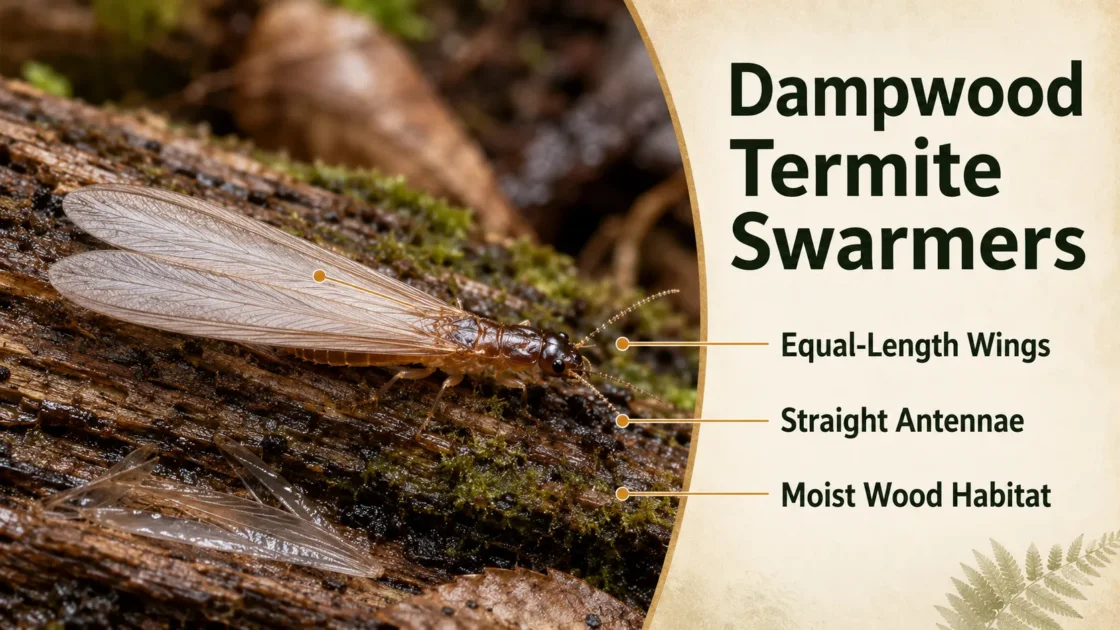
| Feature | What to Look For | Identification Value | Caution |
|---|---|---|---|
| Wings | Four wings of similar length and shape | Strong termite marker | Shed wings alone may not identify the termite group to species. |
| Antennae | Straight or beaded, not elbowed | Useful for termite vs flying ant separation | Needs a clear specimen or close photo. |
| Body shape | Broad, tube-like body without a narrow pinched waist | Useful for termite vs ant separation | Crushed or dried specimens can be misleading. |
| Size | Pacific dampwood termite swarmers may be about 1 inch long including wings | Helps separate them from many smaller subterranean swarmers | Size varies by species, caste, and specimen condition. |
| Habitat clue | Wet wood, leaks, soil contact, decayed lumber, damp crawl spaces | Strong ecological clue for dampwood termite risk | Moisture does not replace specimen identification. |
What Dampwood Termite Swarmers Are
Termite colonies produce winged reproductives when part of the colony becomes capable of dispersal. UC IPM describes alates as winged reproductives that leave the nest in swarms to mate, disperse, and establish new colonies; timing varies by species and geography [c]. NC State Extension explains that swarmers are reproductive adults and that killing the swarmers does not solve any hidden colony problem because structural damage is caused by worker termites, not the winged adults [d].
For dampwood termites, the most important context is moisture. UC IPM states that dampwood termites infest decayed wood that remains moist through soil contact or water leaks, and their presence can indicate a moisture problem or wood decay in structures [e]. This makes a dampwood termite swarmer less of a “single insect problem” and more of a building-condition signal.
Dampwood vs Other Termite Swarmers
| Group | Typical Habitat Association | Swarmer Clue | Primary Risk Signal | Management Emphasis |
|---|---|---|---|---|
| Dampwood termites | Very moist, wet, decayed, or water-damaged wood | Often large; Pacific dampwood winged forms are about 1 inch in OSU guidance | Moisture defect, decayed wood, or wood-soil contact | Fix moisture, remove or replace damaged wood, improve ventilation, inspect structure |
| Subterranean termites | Soil nests with access to wood, often via shelter tubes | Western subterranean swarmers are described by OSU as about 3/8 inch including wings | Mud tubes, soil contact, foundation access, hidden foraging | Professional inspection and treatment plan |
| Drywood termites | Dry, sound wood above ground | Swarmers may be the first visible sign in some infestations | Pellets or frass below kick-out holes | Species-specific professional identification and treatment |
Charts and Interpretation
Chart 1: Extension-Reported Size Comparison
Approximate lengths reported in extension sources for Pacific dampwood and western subterranean termite forms.
Source: Oregon State University Solve Pest Problems and Pacific Northwest Pest Management Handbook. Values are approximate field-guide measurements, not population data.
Chart 2: Inspection Priority by Evidence Type
A practical interpretation scale for deciding when a dampwood termite swarmer sighting should trigger closer inspection.
Values are editorial interpretation scores for this guide, not species counts, occurrence counts, or measured infestation probabilities.
What to Do After a Sighting
The right response depends on where the swarmers are found. A few winged termites outdoors near a rotting log, stump, or wet wood pile can be part of normal termite ecology. Swarmers inside a house, shed wings on a window sill, or winged termites emerging from trim, framing, crawl-space wood, or damp structural lumber need a more careful inspection.
| Where You Find Them | Likely Meaning | Immediate Step | Next Step |
|---|---|---|---|
| Outdoors near wet logs, stumps, or wood debris | Possible nearby natural colony | Photograph and note the location | Move wood debris away from structures and reduce wood-soil contact. |
| Near exterior doors or lights after dusk | May be attracted to light from an outdoor swarm | Collect a specimen if possible | Inspect nearby wet wood, leaky trim, porch supports, and crawl-space ventilation. |
| Inside near windows or sills | Could be accidental entry or a sign of nearby activity | Save bodies or wings in a small container | Request identification from extension or a licensed pest professional. |
| Emerging from wood indoors | High inspection priority | Do not seal or spray the emergence point before documentation | Arrange a structural inspection and moisture investigation. |
| Repeated shed wings in the same room | Possible recurring emergence or hidden entry route | Map the exact locations and dates | Check leaks, crawl spaces, wood decay, exterior grade, and wood-soil contact. |
Moisture Clues Matter More Than Spraying Swarmers
Dampwood termite management is strongly tied to moisture correction. The Pacific Northwest Pest Management Handbook states that management often depends on removing materials prone to infestation, replacing unsound wood, improving ventilation, and eliminating moisture problems; it also notes that chemical applications alone will not eradicate this pest if the water issue remains [f].
- Check for leaking plumbing, roof leaks, gutter overflow, and wet porch or patio grades.
- Inspect crawl spaces for condensation, poor airflow, wet wood, and wood scraps.
- Move firewood and lumber away from buildings.
- Replace structurally unsound or decayed wood where needed.
- Save specimens or wings for identification before cleaning everything away.
- Use a licensed pest professional when swarmers are indoors, recurring, or emerging from structural wood.
Taxonomy and Record-Based Evidence
The best-documented dampwood termite example for many western North American readers is the Pacific dampwood termite, Zootermopsis angusticollis. GBIF places this species in Animalia, Arthropoda, Insecta, Blattodea, Archotermopsidae, Zootermopsis [g]. BugGuide lists it as the Pacific Dampwood Termite and gives a broad range from southwestern British Columbia to Baja and Mexico [h].
Occurrence records and guide-page ranges are useful evidence layers, but they are not a complete distribution map. Available occurrence records may reflect sampling effort, observer access, identification confidence, and reporting bias as much as true abundance. Identification should be verified against physical specimens where possible.
Data Limits and Verification
| Evidence Type | Used For | Strength | Limitation |
|---|---|---|---|
| University extension guidance | Identification, prevention, inspection, and management context | High practical reliability | Often region-specific and not a global species treatment. |
| PNW Pest Management Handbook | Pacific Northwest dampwood termite biology and moisture management | High regional relevance | Best applied to western Washington, Oregon, Idaho, and nearby regional contexts. |
| GBIF taxonomy | Scientific name and taxonomic placement | Useful backbone taxonomy | Taxonomy pages do not confirm a local structure infestation. |
| BugGuide | North American guide classification and range context | Useful identification reference | Image-based records need careful confirmation for difficult specimens. |
| Editorial inspection score | Prioritizing user action | Useful decision aid | Not a measured risk model or pest-control diagnosis. |
Sources and Verification
This page uses source-based pest identification guidance and conservative interpretation. It does not claim that every dampwood termite sighting confirms an active structural infestation. Local verification is important because swarming season, species composition, and building risk vary by climate, region, and moisture conditions.
- Oregon State University Solve Pest Problems: Termites [a]
- Pacific Northwest Pest Management Handbook: Wood-infesting pests, Termite [b] [f]
- UC IPM: Subterranean and Other Termites [c] [e]
- NC State Extension: Termite Swarmers [d]
- GBIF Backbone Taxonomy: Zootermopsis angusticollis [g]
- BugGuide: Pacific Dampwood Termite [h]