Drywood termite swarmers are winged reproductive termites that leave established colonies and attempt to form new ones. An intact swarmer typically has four wings of similar size and shape, straight beadlike antennae, and a broad body without the narrow waist of a winged ant. Those features can establish that an insect is consistent with a termite, but they do not by themselves prove that it is a drywood termite. The identification becomes much stronger when the swarmers occur with small six-sided fecal pellets, tiny kick-out holes, shed wings, or emergence directly from dry structural wood or furniture.
That distinction matters because subterranean and dampwood termites also produce winged reproductives. A swarmer should therefore be read together with the evidence around the wood rather than identified from color, season, or one loose wing alone.
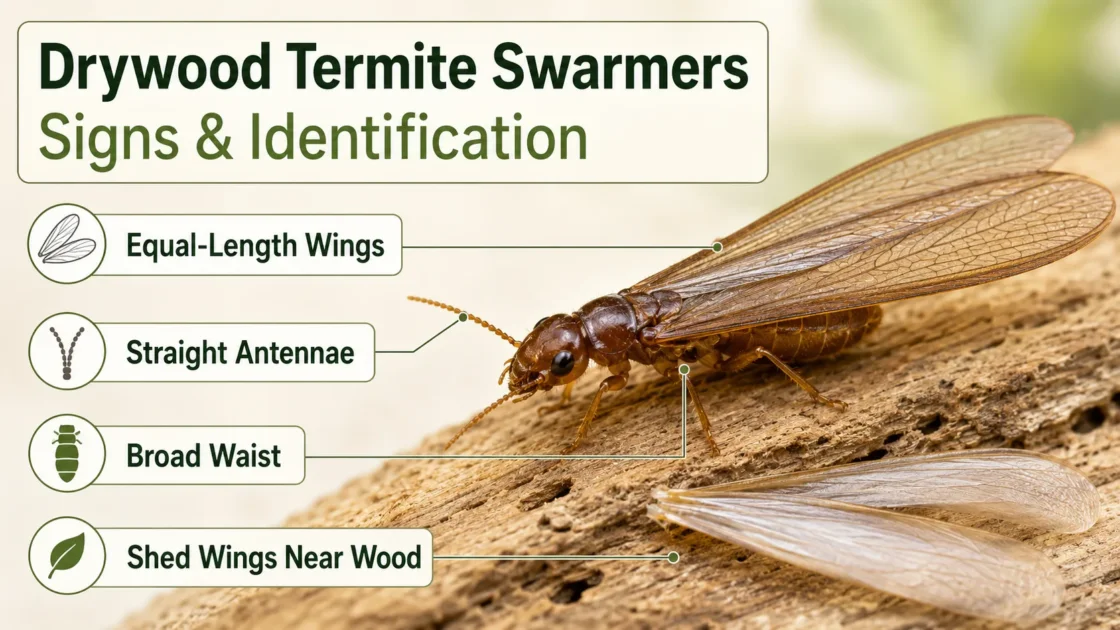
What a Drywood Termite Swarmer Looks Like
The most useful visible characters first establish termite versus ant. NC State Extension describes termite swarmers as having wings of the same general length and shape, a tube-like body without a pinched waist, and straight, beaded antennae. Winged ants usually show larger forewings than hind wings, elbowed antennae, and a visibly narrowed waist.[a]
Wing pairs
Four similar wings
Antennae
Straight and beadlike
Waist
Broad, not pinched
After flight
Wings may be shed
Color is supporting evidence, not a drywood diagnosis. Drywood termite alates are not all the same shade. The western drywood termite, Incisitermes minor, has an orange-brown head and pronotum, a dark brown abdomen, and wings with a smoky tint. UF/IFAS reports a length of about 11–12.5 mm including the wings for this species.[b] Other drywood termite species can be paler, darker, smaller, or differently patterned.
Equal wings identify the termite pattern; they do not identify the termite as drywood. The surrounding evidence is what separates a drywood case from other termite groups.
The Evidence Combination That Points to Drywood Termites
A drywood termite colony lives inside the wood it occupies and does not need a soil connection. Because most of the colony remains concealed, identification often depends on a small number of external traces. UC Statewide IPM lists feeding damage, shed wings, fecal pellets, and kick-out holes among the features inspected in suspected drywood termite infestations.[c]
Evidence pattern
A termite-shaped swarmer emerging directly from wood, with six-sided pellets collecting below a small opening in that same wood, is far more informative than a single winged insect found elsewhere in a room.
The observations do not all carry the same meaning. Direct emergence from a wooden member identifies a much more precise source than insects merely resting on a window. A fresh pellet pile beneath the same piece of wood adds another drywood-specific clue. A visible kick-out opening above those pellets strengthens the connection further.
By contrast, one dead swarmer near an open window, body color by itself, or a swarm occurring during a locally typical month cannot establish an infestation or a species. Outdoor alates may simply be dispersing from colonies elsewhere.
Drywood Termite Pellets Are Not Ordinary Sawdust
One of the most useful drywood termite signs may remain after the swarmers have disappeared. Drywood termites conserve water by removing moisture from their waste before it is expelled. The resulting fecal material consists of small, hard, dry pellets with a characteristic six-sided form and longitudinal ridges. UC IPM describes these pellets as diagnostic for drywood termites when properly identified.[d]
At ordinary viewing distance, a pile can resemble coarse sand, seeds, pepper-like grains, or sawdust. Magnification is much more useful than color. Drywood termite pellets tend to be relatively uniform in shape, while wood shavings and carpenter-ant debris contain irregular fibers and fragments.
| Material | Typical appearance | What separates it from drywood pellets |
|---|---|---|
| Drywood termite pellets | Small, dry, hard grains; fairly uniform; six-sided or longitudinally ridged under magnification | The repeated pellet form is more regular than ordinary wood debris |
| Carpenter-ant debris | Fibrous wood fragments, coarse shavings and other nest debris | Carpenter ants excavate wood rather than producing uniform six-sided fecal pellets |
| Wood-boring beetle frass | May be powdery, gritty or packed in galleries depending on the beetle | Texture varies by beetle group and should not be assumed to be drywood termite frass |
| Ordinary sawdust | Irregular chips, fibers or powder generated by cutting, abrasion or damaged wood | Lacks the repeated hard pellet form produced by drywood termites |
Pellet color is unreliable as a freshness test. UF/IFAS documents cream, red and dark pellets in the West Indian drywood termite, Cryptotermes brevis, and notes that color does not provide a simple indication of pellet age.[e] A dark pile should therefore not be classified as old, nor a pale pile as newly produced, from color alone.
Look Above the Pellet Pile for a Kick-Out Hole
Drywood termites dispose of pellets through tiny openings in the wood surface commonly called kick-out holes. UC IPM describes these holes as less than about 2 mm in diameter. In Cryptotermes brevis, UF/IFAS reports openings commonly around 1–2 mm. They can be difficult to see because termites may close them when they are not being used.
When pellets are found on a floor, windowsill, countertop or piece of furniture, the useful search area is often directly above the accumulation. Door frames, window trim, baseboards, ceiling timbers, exposed beams, cabinets, furniture joints and decorative wood can all conceal an opening. Western drywood termite guidance from UF/IFAS specifically notes that kick-out holes can sometimes be located by carefully inspecting the wood above a pellet accumulation.
The pile does not always form a neat cone directly beneath the opening. Pellets falling from height can bounce and scatter, and air movement or cleaning can spread them away from the source. The relationship between the debris and the wood is therefore more useful than the shape of the pile on the surface below.
A Pellet Pile Does Not Automatically Prove Current Activity
Drywood termite pellets confirm that the characteristic waste material has been produced, but pellets alone cannot show whether termites are still active inside the wood or how far the infestation extends. Old pellets can remain in galleries and later be dislodged by vibration or movement.
Testing for renewed pellet production
After the exact location has been photographed, pellets around a suspected kick-out area can be cleaned away and the location checked again after several days. New pellets appearing in the same place support continuing activity, although building movement can occasionally dislodge older material. UC IPM recommends this approach as one clue rather than as a stand-alone test.
The same caution applies to shed wings. Wings show that alates were present, but they do not measure colony size, the amount of damaged wood, or the number of colonies in a building.
Drywood vs Subterranean Termite Swarmers
Drywood and subterranean alates share the basic termite body plan, so equal wings and straight antennae cannot separate them reliably. The more useful distinction comes from how the colony occupies the structure and what evidence surrounds the swarm. The dedicated subterranean termite swarmer identification guide covers that group in greater detail.
| Evidence | Drywood termite pattern | Subterranean termite pattern |
|---|---|---|
| Colony relationship to soil | Colony can live entirely inside wood without ground contact | Structural colonies are normally associated with a soil-connected system |
| Fecal pellets | Hard six-sided pellets expelled from the wood are a characteristic clue | Dry six-sided pellet piles are not the normal structural sign |
| Kick-out holes | Small pellet-expulsion openings may occur in the infested wood | Not a typical diagnostic feature of subterranean termite activity |
| Mud shelter tubes | Not characteristic of drywood termite colonies | A common structural clue where termites travel between soil and wood |
| Furniture or isolated dry timber | Can support a colony without soil contact | Less consistent with the normal biology of subterranean termites |
The absence of a mud tube does not prove that a termite is drywood. Tubes may be hidden, damaged, inaccessible or simply not present at the observation point. Positive drywood evidence such as characteristic pellets and an emergence source in dry wood is more useful than reasoning from a missing subterranean sign.
Drywood vs Dampwood: Examine the Wood Condition
Dampwood termites can also produce alates and fecal material, creating another identification problem. The condition of the wood adds useful context. Structural drywood pest species can occupy sound, comparatively dry wood, while dampwood termites are associated much more strongly with moist or decaying wood.
Pellet form also differs. UC IPM notes that dampwood termite pellets tend to be elongated and rounded at the ends and lack the clear longitudinal ridges seen in drywood termite pellets. Moisture context and pellet structure together are more informative than swarmer size alone. The separate dampwood termite swarmer page covers the alate side of that comparison.
Drywood Termite Swarmer vs Flying Ant
Ant confusion is common because both groups produce winged reproductive forms. The fastest separation is anatomical.
| Feature | Termite swarmer | Winged ant |
|---|---|---|
| Antennae | Straight or gently curved, beadlike | Clearly elbowed |
| Waist | Broad, without a narrow constriction | Narrow and visibly pinched |
| Forewings and hind wings | Roughly similar in size and shape | Forewings usually larger than hind wings |
| Drywood pellet evidence | May occur when a drywood colony occupies the wood | Does not produce six-sided drywood termite pellets |
This comparison answers “termite or ant?” It does not answer “drywood or subterranean termite?” Once the insect fits the termite pattern, the wood, pellets, holes and emergence location become the more useful evidence.
Where the Swarmers Appear Changes What the Sighting Means
Location can transform the interpretation of the same insect. An alate crawling on an exterior wall provides much less information about a building than multiple alates visibly emerging from a wooden door frame.
| Observation | How to interpret it |
|---|---|
| Swarmers emerging through a crack or hole in structural wood | Direct emergence connects the alates to that wooden member and warrants closer drywood evidence inspection. |
| Swarmers emerging from furniture | Drywood termites can colonize wooden articles without ground contact, making the item itself a plausible colony source. |
| Shed wings below trim with pellets nearby | The combination is more informative than either observation alone; inspect the wood immediately above and around the debris. |
| Several alates on a closed-room windowsill | They may have been attracted to light after emerging elsewhere inside, so the windowsill is not necessarily the colony location. |
| One alate outdoors | Shows that a reproductive termite is present in the area but does not establish a building infestation. |
The broader interpretation of winged termites found inside buildings is covered separately in Termite Swarmers Indoors. For drywood identification, the more specific question is whether the insect can be tied to dry wood and drywood-type waste.
Furniture Can Be the Infested Wood
Drywood termites do not need a continuous route to soil, so a colony can remain confined to a piece of furniture, stored lumber, architectural woodwork or another wooden article. Cryptotermes brevis, the West Indian drywood termite, is well documented from moisture-protected structural wood and furniture, and its association with transported wooden articles has helped it spread outside its native range.
Incisitermes minor is likewise documented from structural lumber, furniture and other wooden objects. UF/IFAS records Florida infestations associated with furniture traced to the Pacific Coast, illustrating why the source of the wood can matter when drywood termites appear outside a species’ better-known regional range.
Pellets collecting beneath a cabinet joint, chair frame, antique, wooden picture frame, door, stored board or other isolated item should therefore not automatically be traced to the wall or floor behind it. The object itself may need to be examined.
Shed Wings and Dealates After a Swarm
An active swarm can be short-lived, leaving wings behind after the insects are gone. Once an alate lands, it may break off its wings and become a dealate. The small basal scales where the wings were attached remain on the body.
Western drywood termite alates have been observed breaking their wings at the base after landing and then crawling in search of a mate. Cryptotermes cavifrons shows the same general transition from alate to dealate before a pair attempts to enter a suitable crack, knot or crevice in wood.[f]
As a result, a drywood termite event may leave several different forms of evidence: intact winged reproductives, dead alates, detached wings, or wingless dealates. An identification should not depend on finding a live flying specimen.
There Is No Universal Drywood Termite Swarming Month
Swarming time can support identification when the species and region are already plausible, but it should not be turned into a universal calendar. Different drywood termite species fly in different seasons and at different times of day, and indoor temperatures can shift the timing further.
| Taxon | Documented flight pattern | Source context |
|---|---|---|
| Incisitermes minor | Late September through November is typical in southern California; daytime flights. Earlier events occur in hotter desert or warm indoor settings. | UF/IFAS western drywood termite profile |
| Cryptotermes brevis | UF/IFAS reports multiple mating flights mainly from April through June, while flights can occur outside that window. | UF/IFAS West Indian drywood termite profile |
| Cryptotermes cavifrons | Evening swarms can occur through the year in its Florida context, with a March–May peak. | UF/IFAS Florida drywood termite profile |
For Incisitermes minor, UF/IFAS documents southern California flights mainly from late September through November but also records much earlier activity in hot desert areas and warm indoor locations. For Cryptotermes cavifrons, the same institution reports evening flights throughout the year with a spring peak in Florida. These patterns are incompatible with a single rule such as “drywood termites swarm only in summer.”
Species-Level Identification From a Swarmer Has Limits
An intact alate can contain useful species characters, including body size, head and pronotum color, wing tint, venation, antennal structure and wing-scale proportions. These features can narrow an identification when they are combined with geography and suitable taxonomic references.
For example, the orange-brown head and smoky wings of Incisitermes minor help separate its alates from some Cryptotermes. UF/IFAS describes Cryptotermes cavifrons alates as approximately 8.5–9.7 mm including the wings, with a dull pale-brown head and body and identifiable venation features in the wings. Those measurements and colors apply to those species, not to drywood termites as a whole.
Close examination becomes more important as the requested identification becomes narrower. Some termite keys rely on alates or soldiers because pale worker-like individuals may not provide enough species-level characters. A phone image showing a brown winged insect can therefore support a broader termite identification without supporting a reliable species name.
Identification limit
Do not assign a drywood termite species from body color alone. Lighting, specimen condition, overlapping coloration and regional species diversity can all make that shortcut unreliable.
Preserve the Evidence Before Cleaning
Useful identification evidence is easily lost when a swarm is vacuumed up or a pellet pile is immediately discarded. Before disturbing the area, record the relationship between the insects and the wood.
- Photograph the swarmers close enough to show the antennae, waist and both wing pairs when possible.
- Photograph the pellet pile before moving it, including the wooden surface above it.
- Keep one or more intact swarmers rather than saving only fragmented wings.
- Retain a small sample of suspicious pellets if identification is uncertain.
- Record the exact emergence point if insects were visibly leaving a crack, hole, joint or wooden member.
- Check for a small kick-out opening above a recurring pellet accumulation without enlarging or damaging the hole.
This evidence is particularly useful because an inspector may arrive after the swarm has ended. Mississippi State University Extension also treats swarmers emerging directly from a structure, indoor accumulations of winged termites or wings, and six-sided drywood pellets as meaningful infestation clues.[g]
When the Evidence Warrants a Structural Inspection
The presence of swarmers does not reveal how much wood has been damaged. Drywood colonies can remain concealed inside timber, and visible evidence may represent only a small portion of the occupied area. UC IPM notes that determining the extent of a drywood termite infestation requires experience because colonies can be difficult to locate within inaccessible wood.
Inspection becomes particularly well supported when swarmers emerge directly from structural wood, new pellets repeatedly return after cleanup, pellets occur with kick-out holes, or several wooden locations show related evidence. Visible galleries, blistered surface wood or other structural deterioration add further reason to determine how far the activity extends.
A professional inspection is an identification and extent-assessment step; it should not be treated as proof that whole-structure treatment is automatically necessary. Treatment decisions depend on where colonies are located, whether activity is localized or widespread, access to the infested wood and the termite species involved.
The most persuasive drywood pattern is not a brown flying insect by itself. It is a termite-form swarmer connected to dry wood, together with characteristic pellets, kick-out openings, shed wings or repeated emergence from that wood.
Sources and Verification
- NC State Extension — Termite Swarmers: What Do They Mean for You? — termite-versus-ant wing, antenna and body-shape characters. [a]
- UF/IFAS — Western Drywood Termite, Incisitermes minor — alate size, coloration, swarming behavior, pellets, kick-out holes and wood associations. [b]
- University of California Statewide IPM Program — Drywood Termites — inspection evidence including shed wings, feeding damage, pellets and kick-out holes. [c]
- University of California Statewide IPM Program — Drywood Termites — six-sided pellet structure, activity limits and comparison with dampwood fecal pellets. [d]
- UF/IFAS — West Indian Drywood Termite, Cryptotermes brevis — drywood biology, furniture association, pellet form and color, kick-out holes, alates and dealates. [e]
- UF/IFAS — Drywood Termite, Cryptotermes cavifrons — alate morphology, dealation, flight timing, pellets and drywood colony biology. [f]
- Mississippi State University Extension — Signs of Termite Infestation — structural emergence, shed-wing evidence and six-sided drywood termite pellets. [g]