A subterranean termite swarmer is the winged reproductive form of a subterranean termite colony. An intact swarmer usually has four wings of roughly equal length, non-elbowed bead-like antennae, and no narrow ant-like waist. Those traits are good evidence for a termite, but they do not by themselves prove that the termite is subterranean. The stronger identification comes from combining the insect with its wing characters, emergence site, soil association, shelter tubes, and other evidence around the structure.
This distinction matters because drywood and dampwood termite alates also have the basic termite body plan. A useful identification therefore moves through three levels: first termite versus winged ant, then subterranean versus another termite group, and only then—when the specimen and locality allow it—toward genus or species. University extension identification guidance likewise relies on several characters rather than color alone. [a]
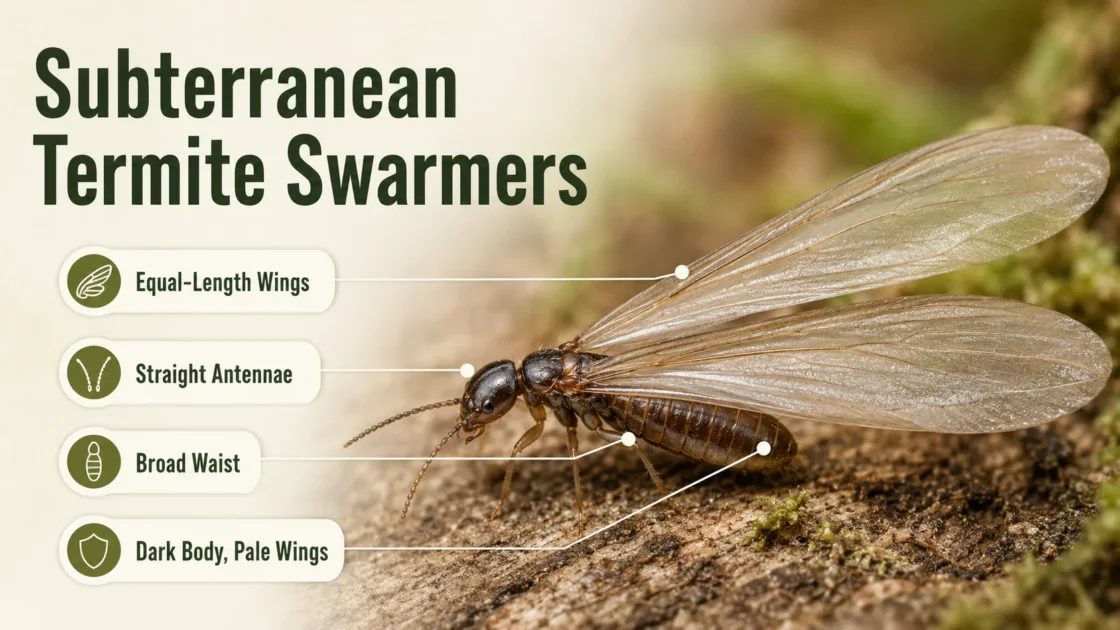
The Body Features That Establish a Termite Swarmer
The easiest features to inspect are the wings, antennae, and transition between the thorax and abdomen. They are most useful on an intact insect resting on a flat surface rather than one in flight.
Four long wings with similar forewing and hind-wing proportions
Termite alates carry two pairs of wings. The front and rear pairs are similar in length and general shape, and the wings normally extend well beyond the abdomen. Because the pairs overlap closely when the insect is resting, a photograph can make four wings look like only two.
Equal-looking wing pairs are useful for separating termites from many winged ants, whose forewings are normally larger than their hind wings. They are not a subterranean-termite-only feature. Drywood and dampwood termite reproductives also have the termite wing plan.
Bead-like antennae without the ant’s distinct elbow
The familiar description of termite antennae as “straight” can be taken too literally. A termite’s antenna can curve naturally. The useful feature is the absence of the sharply elbowed, geniculate antenna typical of ants. Under magnification, a termite antenna also has a bead-like segmented appearance.
A broad body connection rather than a pinched waist
A winged ant normally has a conspicuous narrow connection between the thorax and abdomen, formed around the petiole. A termite does not. The termite body continues backward with a much broader profile. “No narrow waist” is more accurate than imagining that every termite must look thick-bodied.
| Feature | Termite swarmer | Winged ant | Use in identification |
|---|---|---|---|
| Antennae | Bead-like, without a pronounced elbow | Usually distinctly elbowed | Useful when the head is visible |
| Waist | Broad connection between body sections | Narrow, visibly constricted | Useful even after wings are lost |
| Wing pairs | Forewings and hind wings roughly similar in size | Forewings usually larger than hind wings | Useful only when both pairs can be examined |
| Color | Dark brown, blackish, amber, yellow-brown, or other shades depending on taxon | Also highly variable | Poor as a stand-alone character |
A more extensive ant-versus-termite comparison belongs on the dedicated flying ants vs termites identification page. Once all three body features point toward termite, the harder question is whether the specimen is actually from a subterranean group.
How to Tell Whether the Swarmer Is Subterranean
There is no single household-visible feature equivalent to the ant-versus-termite waist test that identifies every subterranean termite. Instead, the specimen and the material around it must agree.
| Evidence | Subterranean termite | Drywood termite | Dampwood termite |
|---|---|---|---|
| Soil association | Often central to colony access and foraging | Not required | Not the defining feature |
| Mud or shelter tubes | Strong supporting evidence | Not characteristic | Not the usual household clue |
| Dry, hard fecal pellets | Not characteristic evidence | Strong supporting evidence when associated with kick-out holes | Not the usual diagnostic debris |
| Wet or decaying wood | Moisture can favor activity, but saturated wood is not required for every structural encounter | Colonies can occupy comparatively dry wood | Strong ecological context |
| Emergence beside slab, foundation, crawlspace, or soil-connected crack | Supports subterranean origin | Less characteristic | Less characteristic |
| Swarmer body alone | May support genus-level identification with suitable characters | May be difficult to separate without close examination | May be difficult to separate without close examination |
UC Integrated Pest Management describes shelter tubes as the most commonly noticed evidence of subterranean termite infestation. Workers construct these tubes from soil and other material, creating protected pathways between soil, structural surfaces, and wood. UC IPM recognizes working tubes, exploratory or migratory tubes, drop tubes, and tubes used during swarming. [b]
Subterranean vs Drywood Termite Swarmers
Once an insect has been identified as a termite, subterranean versus drywood is often a more useful comparison than termite versus ant. Both groups produce winged reproductive adults with similar-sized wing pairs and a broad waist.
The surroundings may resolve an identification that the swarmer alone cannot. Subterranean termites commonly leave soil-based shelter tubes or soil-like material in feeding areas. Drywood termites live within wood without the same requirement for a soil pathway and can leave small, hard fecal pellets pushed through kick-out openings. Mississippi State University Extension treats piles of uniform six-sided pellets as evidence of drywood termite activity, while mud shelter tubes are among the characteristic subterranean signs. [c]
- Termite swarmer + mud tube + soil-connected emergence: strongly supports a subterranean termite interpretation.
- Termite swarmer + repeated dry pellet piles + kick-out holes: points toward a drywood termite investigation.
- Termite swarmer + persistently wet or decayed wood: makes dampwood termites locally relevant where those taxa occur.
- Termite swarmer with none of these clues: the termite group can remain unresolved from household evidence alone.
The separate drywood termite swarmer identification and dampwood termite swarmer pages cover those groups in greater depth.
Subterranean Swarmers Are Not All Black
Color is useful only after stronger characters have narrowed the possibilities. The pale workers hidden inside a subterranean termite colony are a poor visual reference for the reproductive caste. Alates are pigmented adults with developed eyes and a much darker or more strongly colored body than workers.
Even closely related subterranean termites can differ noticeably. UF/IFAS describes Florida Reticulitermes flavipes and R. virginicus alates as dark brown and nearly black to the unaided eye, while R. hageni is yellowish brown. The same source emphasizes that alates and soldiers are the castes commonly used for species identification and gives wing, pronotum, eye, and ocellus characters for separating Florida Reticulitermes. [d]
A black winged insect can be a subterranean termite, and an amber or yellow-brown swarmer can also be a subterranean termite. Color should narrow an already plausible identification, not create one.
Reticulitermes, Coptotermes, and Heterotermes: What Changes at Genus Level?
For much of the United States, the most familiar structural subterranean termites include species of Reticulitermes and, in parts of the South and other established areas, invasive Coptotermes. Heterotermes occurs in warmer regions. These genera cannot be separated reliably with a rule such as “black equals Reticulitermes” or “brown equals Coptotermes.” Wing surface, venation, hairs, head characters, size, locality, and flight behavior can all contribute.
| Group | Useful alate clues in cited U.S. references | Limit |
|---|---|---|
| Reticulitermes | UF/IFAS describes Florida species with a reticulated wing texture and genus-level wing characters; body color varies among species. | Species separation can require pronotum, eye/ocellus, measurements, or other close characters. |
| Coptotermes formosanus | UF/IFAS describes alates as orange to light amber-brown, about 12–15 mm long including wings, with small hairs on the body and wing membranes. | Color and size overlap with other termites and should be combined with locality and morphology. |
| Coptotermes gestroi | UF/IFAS describes darker brown alates than C. formosanus, with contrasting pale antennal spots and somewhat shorter wing hairs. | Reliable separation from related taxa requires a suitable specimen and close examination. |
| Heterotermes | UF/IFAS describes Florida material with pale yellow-brown to orange-brown alates and smooth wing membranes with tiny marginal hairs. | Regional references should not be converted into a universal color rule for the genus. |
The Formosan subterranean termite, Coptotermes formosanus, provides a useful example of why wing texture matters. UF/IFAS describes its alates as having two darkened veins along the leading wing margin and small hairs over the wing membrane, in addition to the amber-brown body color. [e] Its close relative C. gestroi can be separated with finer characters, including coloration, antennal spots, measurements, and wing hairs. [f]
Wing Venation Becomes Useful Under Magnification
The familiar “four equal wings” test operates at a coarse level. Once termite identity is established, the wing itself contains finer taxonomic information. Features used in specialist or extension identification material include:
- the number and position of sclerotized veins along the leading edge;
- presence and arrangement of median and cubital venation;
- whether the membrane appears smooth, reticulated, clear, or opaque;
- hairs on the wing margin, veins, or membrane;
- wing proportions relative to the body;
- the basal portion left behind when a reproductive sheds its wings.
UF/IFAS, for example, describes Florida Reticulitermes alates as having two sclerotized veins toward the front of the wing, median and cubitus veins in the front-central region, and a nonpigmented reticulated texture. These details are far more useful in a preserved specimen or sharp macro photograph than in an image of an insect flying around a light.
Wing venation should not be guessed from a blurred phone photograph. If the veins or hairs are not resolved, the image does not contain that evidence.
Swarm Timing Can Support an Identification, but It Cannot Create One
Subterranean termite flights vary with species, region, colony maturity, weather, moisture, temperature, and time of day. A month on the calendar should therefore be treated as supporting context, not a diagnostic character.
NC State Extension reports that eastern subterranean termites in North Carolina commonly swarm during warmer conditions, often after rain, and generally fly during the day. [h] In contrast, UF/IFAS describes Florida Coptotermes formosanus dispersal flights as occurring shortly after sunset during its local flight season, while C. gestroi also flies at dusk or at night. Those observations can help test whether a suspected identification fits the locality, but they should never override a contradictory specimen.
A broader calendar belongs on the termite swarm season reference because a single nationwide spring date would hide the differences among species and climates.
Where the Swarmers Appeared Changes What the Evidence Means
The same insect has a different evidentiary value depending on where it was found. The emergence point is usually more informative than the place where dead swarmers finally accumulate. Winged termites can move toward light after emergence, so a windowsill may be a collection point rather than the colony opening.
| Observation | What it supports | What it does not establish by itself |
|---|---|---|
| Swarmers emerging through a wall, floor, trim gap, slab crack, or other part of the structure | A nearby structural termite source becomes much more likely | Exact colony size, damage extent, or species |
| Dead swarmers concentrated at an interior window | Termites were present inside or entered the room | That the window itself is the emergence point |
| Termite swarm beside a foundation with shelter tubes | Subterranean termite activity associated with the structure is strongly supported | How far feeding extends inside the building |
| Outdoor swarm from a stump, log, buried wood, or landscape timber away from the structure | A nearby landscape colony | That the building is infested |
| A pile of detached wings indoors | A recent alate event is plausible | Species, colony location, or damage severity |
Mississippi State University Extension lists swarmers emerging directly from a building, mud shelter tubes on the foundation, and termite damage among the major clues of structural termite activity. It also notes an important exception for light-attracted Formosan termite alates: in heavily infested areas, some individuals can enter a building from an outdoor source at night. [i]
For this reason, “indoors” and “emerging indoors” are not identical observations. Repeated insects visibly coming through a structural opening provide stronger source evidence than several alates discovered beside an open, illuminated window during a local nighttime flight.
Structural damage interpretation is covered separately in identifying termite damage after a swarm, while indoor sighting context is treated in more detail on the termite swarmers indoors page.
What Shed Wings Can Identify
After the dispersal flight, termite reproductives shed their wings. A formerly winged individual is then a dealate. Detached wings can therefore remain after the termites themselves have crawled away, dried out, paired, or been removed.
A group of long, similarly sized wings can support a termite interpretation, especially when intact bodies nearby show termite antennae and body shape. A loose wing may also preserve venation or surface characters useful under magnification. However, a pile of wings does not automatically identify a subterranean species. It also cannot reveal the number of termites remaining in a colony or the amount of wood damage present.
Once the wings are gone, wing-pair proportions can no longer be checked on the body. Identification then depends more heavily on the antennae, body profile, head and pronotum characters, locality, nearby wings, and environmental evidence. The biology of the shedding process is covered separately on the termite swarmer wing-loss page.
A Practical Identification Sequence
- Confirm that four wings are present if the insect is still alate. Separate overlapping wings gently enough to compare both pairs.
- Compare forewings with hind wings. Similar proportions support termite; distinctly smaller hind wings support an ant.
- Inspect the antennae and waist. Non-elbowed bead-like antennae plus a broad body connection provide additional termite evidence.
- Do not stop at “termite.” Look for soil association, shelter tubes, emergence from a slab or foundation area, dry fecal pellets, or strongly moisture-damaged wood.
- Use color, size, flight time, and locality only after the broader group is plausible. These can narrow candidates but are easy to misuse.
- Move to wing venation and other fine characters when genus or species matters. A whole preserved alate is substantially more informative than a blurred image or one detached wing.
How Far a Photograph Can Take the Identification
A clear photograph can often answer “termite or ant?” when the antennae, waist, and both wing pairs are visible. It may also support a subterranean-termite interpretation when the photograph includes associated shelter tubes or when diagnostic wing characters are resolved.
Species-level identification is less predictable. Closely related species may require measurements or characters around the pronotum, compound eyes, ocelli, wing venation, wing hairs, or other structures that disappear in an ordinary photograph. Geographic information can exclude impossible candidates, but locality should not be used to force a species identification when the necessary morphology is missing.
The most useful specimen photographs
- a dorsal view showing the full body and attached wings;
- a side view showing the body profile;
- a close view of the head and antennae;
- a flattened view of at least one intact wing showing venation and surface texture;
- a photograph beside a millimeter scale when size may matter.
Recording the location, date, approximate time, indoor or outdoor setting, and exact point where the insects appeared gives the specimen far more identification value. Several intact insects should be preserved when available because one may have damaged wings, antennae, or body structures.
The South Florida Coptotermes Exception
Southeastern Florida presents an unusual species-level problem because the ranges and flight periods of the invasive Formosan subterranean termite, Coptotermes formosanus, and Asian subterranean termite, Coptotermes gestroi, overlap in part of the region. The two species can hybridize.
UF/IFAS reports naturally occurring hybrid alates and field colonies from Broward County. Its research summary states that 2025 dispersal-flight records found hybrids representing only about 0.1% of sampled alates in parts of Broward County. The hybrids may appear intermediate between the parental species when suitable specimens are examined, but naturally collected hybrids reported in the scientific literature were confirmed with molecular diagnostics. A visual inspection cannot positively establish hybrid status. [j]
An unusually colored Coptotermes swarmer in South Florida therefore should not be labeled a hybrid from appearance alone. UF/IFAS also reports that available evidence does not show hybrid colonies consuming wood at a greater rate than the parental species, so the presence of a suspected hybrid does not justify a separate “super termite” damage category.
What Each Observation Actually Establishes
| Observation | Reasonable interpretation | Do not infer |
|---|---|---|
| Four similar wings, bead-like antennae, broad waist | Termite swarmer strongly supported | Exact termite group or species |
| Termite specimen plus soil-connected shelter tubes | Subterranean termite interpretation strongly supported | Colony size or damage depth |
| Termite specimen plus hard dry pellets and kick-out openings | Drywood termite evidence should be investigated | That the insect itself is drywood without confirming characters |
| Termite swarm emerging directly through part of a building | A structural termite source is strongly indicated | Which species or how much damage exists |
| Outdoor swarm from a stump or buried wood | Nearby landscape termite activity | Building infestation |
| Equal-looking detached wings only | Termite alate activity may be plausible | Subterranean status, species, colony position, or active damage |
| Dark brown or black swarmer | Compatible with several subterranean termites | Reticulitermes identification from color alone |
| Amber or yellow-brown swarmer | Compatible with several termite taxa, including some subterranean species | Coptotermes formosanus identification from color alone |
| Intermediate-looking Coptotermes in southeastern Florida | May justify expert examination | Hybrid status without appropriate confirmation |
The most defensible household identification is often not a species name. It may be “termite swarmer consistent with a subterranean termite, supported by shelter tubes and the emergence site.” That conclusion uses the evidence actually visible instead of assigning certainty that the specimen cannot support.
Sources and Identification References
- [a] NC State Extension — Biology and Behavior of Eastern Subterranean Termites — termite-versus-ant antenna, wing, and waist characters; swarming context.
- [b] UC Statewide IPM Program — Subterranean and Other Termites — shelter tubes, subterranean evidence, termite groups, and structural context.
- [c] Mississippi State University Extension — Signs of Termite Infestation — indoor swarmers, mud shelter tubes, drywood pellets, and interpretation of structural evidence.
- [d] UF/IFAS — Native Subterranean Termites: Reticulitermes — Florida Reticulitermes alate coloration, wing characters, measurements, and species-level identification features.
- [e] UF/IFAS — Formosan Subterranean Termite, Coptotermes formosanus — alate size, coloration, wing hairs, venation, and Florida dispersal-flight behavior.
- [f] UF/IFAS — Asian Subterranean Termite, Coptotermes gestroi — alate comparison with C. formosanus, antennal spots, measurements, wing hairs, and night flights.
- [g] Hellemans et al., Nature Communications — Genomic data provide insights into the classification of extant termites — genomic-scale termite classification and elevation of Heterotermitidae to family rank.
- [h] NC State Extension — Eastern Subterranean Termite Swarming — regional daytime flight behavior, rainfall association, and seasonal variation.
- [i] Mississippi State University Extension — Structural and Indoor Termite Evidence — emergence-site interpretation and the light-attracted Formosan swarmer exception.
- [j] UF/IFAS — Hybrid Coptotermes Termites: Separating Fact from Fiction — southeastern Florida hybrid occurrence, prevalence in sampled alates, visual-identification limits, and molecular confirmation.