Finding termite swarmers indoors deserves investigation, but the sighting does not by itself reveal how much termite damage exists. The most useful question is where the swarmers came from. Termites seen emerging from a wall, floor, baseboard, ceiling, or another part of the building are much stronger evidence of an infestation than a few winged termites that may have flown through an open door or window.
The flying termites themselves are reproductive adults, also called alates. They are not the worker caste responsible for most wood feeding. Their value as household evidence comes from the colony that produced them. Mississippi State University Extension lists swarmers emerging directly from a structure, indoor accumulations of swarmers or wings, mud shelter tubes, and termite damage among the main signs used when assessing a possible infestation.[a]
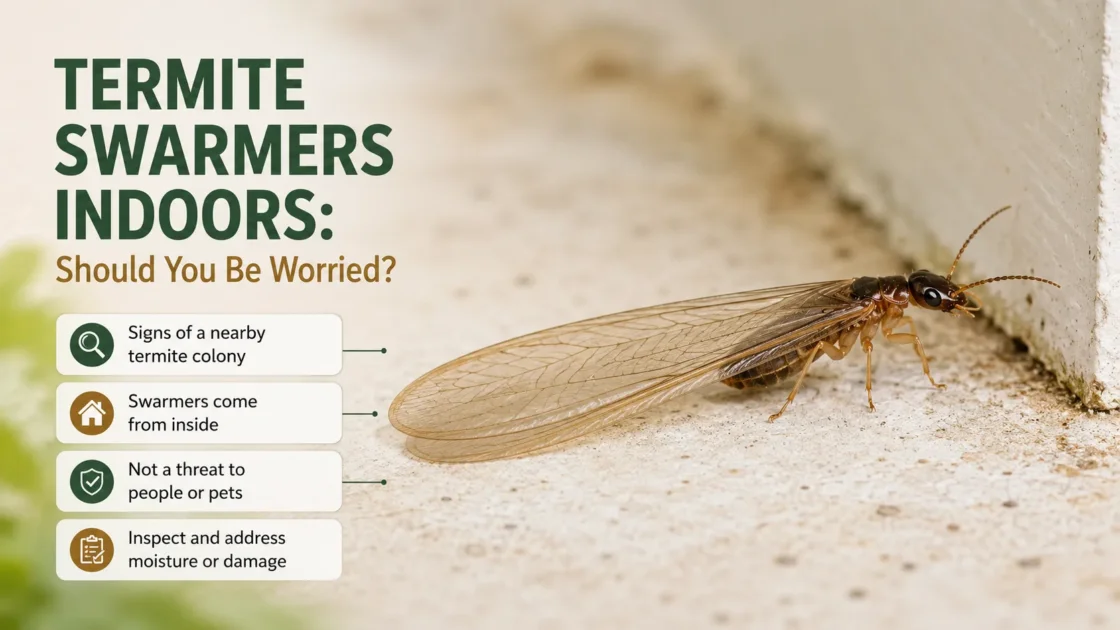
What an indoor swarm can tell you
A confirmed indoor termite swarm can justify a structural inspection. It cannot tell you the amount of hidden damage from the number of swarmers alone, and finding insects on a windowsill does not prove that the colony is inside the window frame.
Did the Swarmers Emerge Indoors or Fly In?
This distinction changes the interpretation of almost every indoor sighting. NC State Extension notes that swarmers found within a home are likely to be associated with an infestation in or under the structure, while outdoor swarmers can originate from soil, stumps, landscape timbers, wood-to-soil contact, or other colonies elsewhere in the surrounding area.[b]
Actually seeing termites emerge from the building is the clearest household clue. Examples include insects pouring from a crack beside a baseboard, appearing through a flooring joint, leaving a hole in trim, emerging from a wall or ceiling opening, or coming from an accessible foundation or crawlspace area. The exact opening may only be a route into the room, but observed emergence ties the swarm much more closely to the structure than finding dead insects after the event.
| What was observed | What the observation supports | What it does not prove |
|---|---|---|
| Swarmers visibly emerging from a wall, floor, ceiling, trim, or structural opening | Strong evidence that termites are active in or closely connected to the building | The amount or exact extent of damage |
| Numerous live or dead termite alates inside with shed wings | A nearby source that warrants inspection | The precise colony location |
| A few swarmers near an open window or door during an outdoor swarm | Possible accidental entry from outdoors | An indoor infestation |
| Swarmers concentrated at a closed window | Termites reached a lighted or bright surface | That the colony is inside the window frame |
| The same indoor emergence point used again | A localized source deserves close inspection | How large the colony is |
There is an important regional exception to a simple “indoors equals infestation” rule. In areas with heavy Formosan subterranean termite activity, nighttime swarmers are strongly attracted to lights. Mississippi State Extension reports that small numbers can enter even properly treated buildings from outside colonies during the swarm season. That exception is context-specific; it should not be generalized to every termite sighting or every region.
Why Termite Swarmers Often End Up at Windows
Windows are often where an indoor termite event becomes visible, not necessarily where it began. Swarmers may move toward light after emerging and then become trapped against glass. NC State Extension describes indoor swarmers as readily collecting and dying on windowsills or other open, lighted areas when they cannot escape.[c]
A windowsill is an accumulation point, not automatically an emergence point.
A swarm could have entered the room from a wall opening several feet away and then moved toward the window. Conversely, termites from an outdoor flight can enter through an open window, door, damaged screen, utility gap, or another exterior opening and end up in exactly the same place. This is why the room should be examined beyond the pile of insects itself.
Look for where the first insects appeared, whether windows or doors were open, whether the insects were already present when a room was entered, and whether a trail of bodies or shed wings leads back toward trim, flooring, wall joints, plumbing penetrations, or another opening. The path into the room can be more informative than the place where the swarmers finally died.
First Confirm That the Insects Are Termite Swarmers
Winged ants commonly appear during their own reproductive flights and can be mistaken for termites. Color is a poor shortcut because both groups include dark, brown, tan, and other forms. A better field screen uses several visible body characters together.
- Wings: termite front and hind wings are roughly similar in size and length; winged ants usually have larger forewings and smaller hind wings.
- Antennae: termite antennae appear relatively straight or beadlike rather than distinctly elbowed.
- Waist: termites have a broad connection between body regions; ants show a conspicuously narrowed waist.
An intact specimen is more useful than a distant photograph or a crushed insect. The full anatomical comparison is covered separately in Flying Ants vs Termites; the indoor question should only be interpreted as a termite problem after the insect identification is reasonably secure.
Shed Wings Can Outlast the Swarm
A termite swarm may be over before anyone sees a live insect. Mature colonies produce winged reproductives that disperse, land, pair, and shed their wings. Indoors, the remaining evidence may therefore be a scattering or pile of pale, membranous wings on a sill, floor, countertop, beneath a light, or caught in a spider web. University of Maryland Extension includes accumulations of shed insect wings among household termite detection signs and notes that alates themselves often die after flying indoors because of dehydration.[d]
The presence of wings is useful, but their final location has the same limitation as the swarmers themselves: it may show where the termites gathered rather than where they emerged. Loose wings can also be moved by airflow, cleaning, foot traffic, or other disturbance.
When bodies are available, keep several intact insects along with some loose wings. When only wings remain, their similar size can support termite identification, but a body specimen provides antenna and waist characters that wings cannot. The biology of post-flight wing loss is covered in more detail on why termite swarmer wings fall off.
What Else Is Near the Swarm?
Indoor swarmers become more informative when another termite-specific clue occurs nearby. The useful evidence differs between subterranean and wood-nesting termites, so there is no single household sign that accompanies every infestation.
Mud or shelter tubes
Subterranean termites typically maintain protected access between soil, moisture, and food sources. UC Statewide IPM describes shelter tubes as one of the most commonly visible signs of subterranean termite infestation. Tubes can run over foundation surfaces or other materials that termites cannot tunnel through directly, and specialized swarm tubes may also be built for emerging reproductives.[e]
A tube near the location of an indoor swarm gives the event a different context from a few isolated insects beside an open window. Destroying a visible tube, however, is not termite control; termites can remain in the structure or soil and use other concealed routes.
Drywood termite pellets and kick-out holes
Drywood termites do not require soil contact. They can live entirely inside wood, so a house can show no subterranean-style mud tubes. UC Statewide IPM notes that drywood inspections look for swarmers, shed wings, feeding damage, fecal pellets, and small kick-out holes through which pellets are pushed from galleries.[f]
Drywood termite pellets have a characteristic six-sided form when examined closely. A pellet pile beneath wood can therefore add useful evidence, but pellets alone do not reveal how far an infestation extends or necessarily prove that the colony is currently active. Old pellets can remain in wood and later be dislodged. Newly accumulating pellets after an area has been cleaned are more informative.
Where drywood termites occur, the combination of swarmers, wings, kick-out holes, and characteristic pellets deserves a different inspection approach from a soil-associated subterranean termite problem. More detailed drywood identification belongs on the dedicated drywood termite swarmer page.
Wood changes and moisture
Subterranean termite feeding can remain hidden beneath an outer wood surface. Thin, darkened, blistered, or easily punctured areas can occur with termite damage, although similar surface changes can also result from moisture or other wood problems. A hollow sound from tapping wood is therefore not a stand-alone termite diagnosis.
Moisture also changes the inspection context. Plumbing leaks, persistent wet wood, poor drainage, damp crawlspaces, roof leaks, and wood-to-soil contact can create favorable conditions for some termite groups. Dampwood termites, in particular, are associated with high-moisture wood, while subterranean termites ordinarily depend on moist environments and often maintain a soil connection. Drywood termites are the major exception to the assumption that structural termites must remain connected to moist soil.
Where the Swarm Appeared Changes What Should Be Inspected
| Indoor location | Useful areas to examine | Interpretive caution |
|---|---|---|
| Window or glass door | Frame, sill, nearby trim, wall joints, exterior openings, screens | Light attraction can make a window the destination rather than the source |
| Baseboard or wall edge | Cracks, trim joints, wall penetrations, sill area, adjoining flooring | The visible gap may be only an exit route from a concealed space |
| Floor or flooring perimeter | Subfloor, slab joints, crawlspace below, wood-to-soil connections | Surface location alone does not identify the termite group |
| Basement or crawlspace | Foundation, support piers, sill plates, plumbing penetrations, shelter tubes | Moisture and soil access are especially relevant to subterranean termites |
| Wooden door, frame, trim, furniture, or exposed timber | Small openings, pellets, galleries, damaged surface wood | Drywood termites are regionally restricted and species confirmation may be needed |
| Vent or air register | Wall or floor void around the register and adjacent structural material | Finding swarmers at a vent does not prove that termites are nesting in the HVAC system |
| Area with a leak or persistent dampness | Wet wood, plumbing, drainage, roof or flashing problems, adjacent structural members | Moisture supports the inspection context but does not identify termites by itself |
Does the Number of Swarmers Tell You How Bad the Damage Is?
No reliable damage estimate can be made by counting the swarmers visible in a room. A large indoor emergence can be persuasive evidence that a mature colony is associated with the structure, but the observed count is influenced by where termites emerged, how many reached the room, whether they moved toward a light source, how long the event went unnoticed, and how many bodies or wings were removed before anyone inspected the area.
The reverse is also true: a small visible sample does not establish that only a small termite problem exists. Termites are concealed insects, and much of the worker activity can remain inside wood, soil, shelter tubes, wall voids, subfloor areas, or other inaccessible spaces.
The swarm therefore answers a narrower question: a reproductive flight occurred somewhere close enough for the insects to appear indoors. It does not reveal how many structural members are affected, how much wood has been consumed, how long feeding has continued, or whether repairs are necessary. Those are inspection questions.
One Swarmer Is Different From Watching a Swarm Emerge
An isolated winged insect beside an open window provides relatively little information until its identity and route of entry are established. A room containing confirmed termite alates and piles of shed wings provides more evidence. Watching confirmed termite swarmers actively emerge from part of the building provides much stronger source evidence.
There is no defensible universal household rule such as “fewer than five is safe” or “more than twenty means severe damage.” Termite species, outdoor swarm density, light attraction, building openings, colony location, and regional biology can all change the number that becomes visible. Artificial count thresholds can create false reassurance in one house and unnecessary alarm in another.
Repeated emergence from the same room or structural opening adds useful evidence because it makes accidental outdoor entry less persuasive as the sole explanation. Even so, the absence of another visible swarm does not establish that termites are gone. A reproductive flight can be brief while concealed worker activity continues.
Can Termite Swarmers Start a New Colony Inside the House?
The answer depends on the termite group. It is unsafe to apply one rule to all termites.
Subterranean termite swarmers
Many subterranean termite alates trapped in a normal dry interior die because they cannot obtain the moisture conditions needed for successful colony establishment. This is why piles of dead swarmers often remain on windowsills. Their death, however, does not resolve an infestation if the insects were produced by a colony already connected to the building.
Some subterranean termites can also establish above-ground colonies where persistent moisture is available, so moisture conditions and local termite biology still matter. The broader identification and soil-association clues are covered on the subterranean termite swarmer page.
Drywood termite swarmers
Drywood termites require a different interpretation because they can establish colonies inside wood without soil contact. UF/IFAS describes post-flight drywood termite pairs searching for a suitable crack, hole, or knot in wood, then excavating a nuptial chamber in which colony founding begins.[g]
For that reason, the statement that “flying termites indoors will simply die and cannot infest wood” is too broad. It can describe the usual fate of many trapped subterranean termite swarmers, but it should not be applied to drywood termites capable of founding colonies in suitable wooden material.
What to Preserve Before Cleaning Up
Cleaning away the insects is reasonable after the evidence has been recorded. A small amount of documentation can preserve information that disappears once the room has been vacuumed or wiped down.
- Photograph the insects before moving them. Include a close view and a wider image showing exactly where they accumulated.
- Photograph any visible emergence point. A wall crack, flooring joint, trim gap, kick-out hole, shelter tube, or other opening can matter more than a pile on the windowsill.
- Save several intact insects if possible. A small sealed container or bag protects antennae, waist shape, and wings for identification.
- Keep some loose wings. They can still be useful when intact bodies are unavailable.
- Record the room and location. Note whether the insects were at a window, baseboard, floor edge, crawlspace opening, wooden frame, or another specific feature.
- Check whether exterior entry was plausible. Open doors, open windows, damaged screens, exterior lighting, and a visible outdoor swarm change the interpretation.
- Look nearby for termite-associated evidence. Shelter tubes, pellets, kick-out holes, damaged wood, unusual moisture, or a repeated emergence point should be documented rather than immediately destroyed.
After specimens and photographs have been saved, visible swarmers can be vacuumed. Their removal is sanitation; it is not a test showing that the underlying termite activity has ended.
Why Spraying the Visible Swarmers Does Not Solve the Source
The insects flying around a room are only the reproductive caste. NC State Extension notes that workers are responsible for structural feeding and that killing the visible swarmers does not protect a building from termite activity already occurring out of sight.
A contact spray may kill exposed alates while leaving termites in soil, wood, wall spaces, shelter tubes, or other concealed areas untouched. It can also remove insects that would otherwise be useful for identification. If a termite infestation is confirmed, the appropriate management method depends on termite type, construction, infestation location, soil access, and other site conditions.
The U.S. Environmental Protection Agency lists soil-applied termiticides, termite baits, treated building materials, and wood treatments among registered termite-management approaches, and notes that termiticide application in most cases is properly performed by trained pest-management professionals.[h] A product that kills flying insects on contact should therefore not be assumed to provide structural termite control.
What a Termite Inspection Is Trying to Establish
The useful outcome of an inspection is not simply confirmation that winged insects were present. The inspection should connect the swarm to the building and determine what other evidence exists.
- Were the collected insects actually termite alates rather than flying ants or another winged insect?
- Is the likely termite group subterranean, drywood, dampwood, or another locally occurring type?
- Is there evidence that the swarmers emerged from the structure?
- Are subterranean termite shelter tubes, soil connections, or concealed access routes present?
- Are drywood termite pellets, kick-out holes, shed wings, or localized wood galleries present?
- Is damaged wood visible or detectable in accessible structural areas?
- Are leaks, damp wood, drainage problems, or other moisture sources contributing to the site conditions?
- Does the property have a previous termite treatment or active termite service contract?
- Does the evidence point to localized activity, a broader structural problem, or an uncertain sighting that requires monitoring?
The treatment decision should follow those findings. Subterranean and drywood termites differ in where colonies live and how structures are treated, so a swarm alone is not enough information to select a control method.
How Worried Should an Indoor Sighting Make You?
Indoor termite swarmers are best treated as an inspection signal rather than a damage meter. A confirmed swarm emerging from a structural opening deserves prompt investigation. Swarmers accompanied by shelter tubes, drywood pellets, kick-out holes, or visible wood damage add independent evidence that termites may be associated with the building.
| Situation | Reasonable interpretation | Next step |
|---|---|---|
| One uncertain winged insect near an open window | Source and identity are unresolved | Identify the insect and check whether outdoor entry was likely |
| Confirmed termite swarmers or shed termite wings indoors | A nearby termite source should be investigated | Preserve evidence and inspect the structure |
| Confirmed swarmers visibly emerging from the building | Strong evidence of termite activity associated with the structure | Arrange a qualified termite inspection |
| Indoor swarmers with mud shelter tubes | Multiple clues consistent with subterranean termite activity | Have the building evaluated for active infestation and concealed access |
| Swarmers with characteristic drywood pellets or kick-out holes | Evidence consistent with a drywood termite source where these termites occur | Inspect the affected wood and surrounding structure |
| A few possible Formosan swarmers entering during a heavy nighttime outdoor flight | Outdoor light attraction may explain the indoor insects in regions where Formosan termites are established | Confirm identification, entry route, local presence, and the building’s termite protection status |
The sighting is usually not a reason to assume that a house is about to fail structurally. It is also not something that should be dismissed simply because the insects disappeared the next morning. The source matters more than the duration of the swarm. Preserve enough evidence to identify the insects, determine whether they emerged from the building, and examine the structure for the termite signs that can answer the question the swarm itself cannot.
Sources
- [a] Mississippi State University Extension — Signs of Termite Infestation — indoor emergence, shed wings, shelter tubes, structural evidence, and the Formosan light-attraction exception.
- [b] NC State Extension — Termite Swarmers: What Do They Mean for You? — indoor versus outdoor swarm interpretation and source context.
- [c] NC State Extension — Termite Swarmers: What Do They Mean for You? — attraction to light, windowsill accumulation, specimen collection, and the distinction between swarmers and feeding workers.
- [d] University of Maryland Extension — Termites — alate flights, shed-wing evidence, indoor dehydration, shelter tubes, and concealed termite damage.
- [e] UC Statewide IPM Program — Subterranean and Other Termites — shelter tubes, subterranean termite moisture requirements, wood evidence, and swarming structures.
- [f] UC Statewide IPM Program — Drywood Termites — drywood detection, six-sided fecal pellets, kick-out holes, shed wings, and limits of pellet evidence.
- [g] University of Florida IFAS — West Indian Drywood Termite, Cryptotermes brevis — wood-only colonies, post-flight dealation, tandem behavior, and colony founding in cracks, holes, and knots in wood.
- [h] U.S. Environmental Protection Agency — Termites: How to Identify and Control Them — registered termite treatment categories and professional termiticide application context.