Termite swarm season varies by termite type, geography, weather, and time of day. Many subterranean termites swarm in spring when warmer weather and rainfall create suitable conditions, but there is no universal termite month. Georgia subterranean termite swarmers are most commonly seen from February through April, eastern subterranean termite flights in Mississippi can range from late January near the coast to April through June farther north, and some subterranean species also fly in fall. Western drywood and dampwood termites in California commonly swarm during summer and fall, while Formosan subterranean termites can fly around dusk from late spring into early summer.
Last reviewed: August 2026
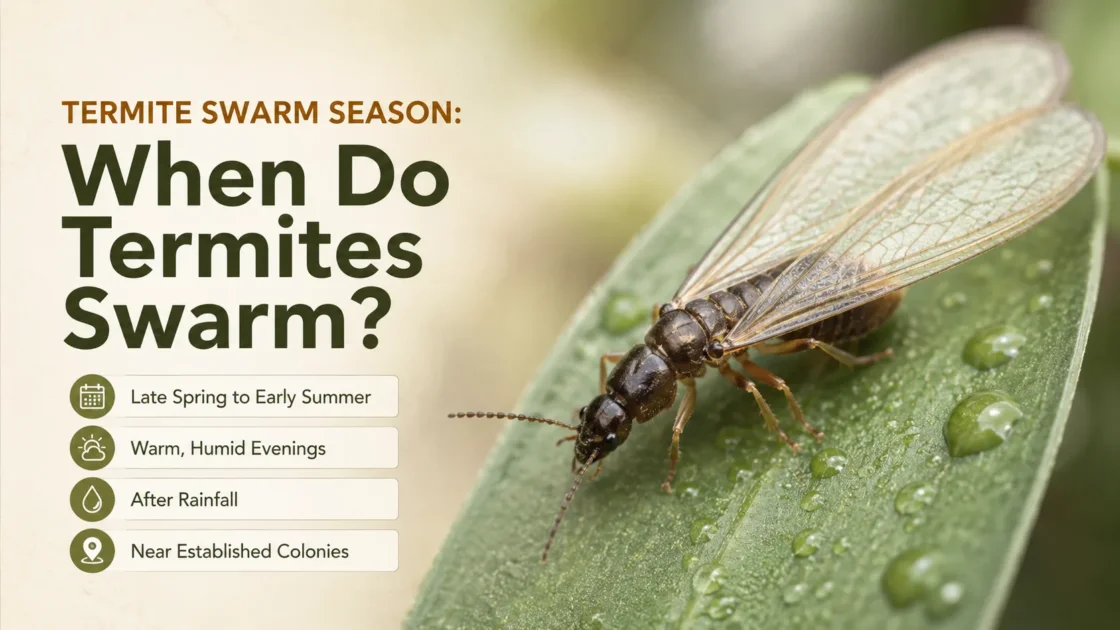
When Termites Swarm by Region and Termite Type
Calendar timing is most useful when it is tied to a location and termite group. Extension records from different parts of the United States show why a single “termite season” date does not work across regions.
| Region and Termite | Reported Swarm Period | Time of Day | Seasonal Context |
|---|---|---|---|
| Subterranean termites — Georgia | Most commonly February through April [a] | Not given as one statewide hour | Spring is the main regional flight period. |
| Eastern subterranean termites — coastal Mississippi | As early as late January; peak activity from late February into early April [b] | Usually morning | Flights begin earlier near the Gulf Coast. |
| Eastern subterranean termites — northern Mississippi | Usually April through June | Usually morning | Season shifts later within the same state. |
| Reticulitermes — California | Spring or fall [c] | Afternoon | Flights are reported on clear days after soaking rain. |
| Heterotermes aureus — southeastern California | July through September | Late afternoon or early evening | Desert-region timing differs from the usual spring pattern of many subterranean termites. |
| Formosan subterranean termites — Mississippi | Late April through mid-May in southern areas; delayed into June in central Mississippi | Night, usually at or shortly after dusk | Swarmers are strongly attracted to lights. |
| Western drywood termites — California | Summer and fall [d] | Daytime | Flying adults may be among the most visible signs of colonies hidden in wood. |
| Dampwood termites — California | Summer and fall | Can be seen around lights after dark | The seasonal window can overlap with western drywood termites. |
A month is regional evidence, not a species test
A spring, summer, fall, or winter sighting should not identify a termite by itself. Geography, recent weather, time of day, and an intact specimen provide better context when used together.
What a Termite Swarmer Is
Termite swarmers, also called alates, are winged reproductive termites released by mature colonies. They disperse, pair after flight, shed their wings, and may attempt to establish new colonies. Anatomy, caste role, wings, antennae, waist shape, and flying-ant identification are covered on What Are Termite Swarmers (Alates)?.
For seasonal interpretation, the useful question is when those reproductives leave the colony. The answer depends on local temperature, rainfall or moisture, termite type, geography, and the daily light cycle.
Why Warm Weather and Rain Often Precede Swarms
Warm weather and rainfall are repeatedly associated with subterranean termite flights. University of Kentucky Entomology describes spring emergence as being triggered by warmer temperatures and rainfall. [e] NC State Extension likewise reports that swarming frequently occurs during spring daytime hours and often follows rain. [f]
Temperature Opens the Seasonal Flight Window
Subterranean colonies can remain active outside the brief period when alates are visible. Seasonal warming helps create conditions in which mature reproductives can leave together. This produces the familiar spring swarm pattern in many temperate regions without making spring a universal rule for all termite species.
The regional differences are easy to see in extension records. Georgia reports its common subterranean termite swarmers mainly from February through April, while northern Mississippi often records eastern subterranean termite flights from April through June. [a] [b]
Rainfall and Soil Moisture Can Change Flight Timing
Subterranean termites depend heavily on moisture, so rain can coincide with conditions favorable for reproductive flights. UC IPM gives a specific California example: Reticulitermes species swarm during the afternoon in spring or fall on clear days after a soaking rain. [c]
Rain should not be treated as an automatic swarm switch. Colony maturity, species, soil conditions, temperature, and local climate still matter. A storm can pass without a visible flight, and termite flights can occur under other combinations of suitable conditions.
Moisture and Humidity Are Part of the Local Context
Moisture is especially relevant to subterranean termites, which normally maintain access to soil or another moisture source. NC State Extension notes the high moisture requirement of subterranean termites in its discussion of swarmer origins. [f] Humid or recently wet conditions can therefore accompany flights, but extension guidance does not support one humidity percentage as a universal swarming threshold.
Termite Swarms Can Happen in the Morning, Afternoon, or at Night
Time of day varies enough among termites to be useful seasonal context. Eastern subterranean termites in Mississippi usually swarm in the morning. California Reticulitermes are reported flying in the afternoon, while Heterotermes aureus flies in the late afternoon or early evening. [b] [c]
Formosan subterranean termites follow a different daily schedule. Mississippi State University Extension reports nighttime swarming, usually at or shortly after dusk, with strong attraction to lights. UC IPM likewise reports late-evening Formosan flights in California. [b] [c]
Western drywood termites in California are commonly observed flying during daytime hours in summer and fall. Dampwood termites can swarm in the same broad seasons, but UC IPM notes their attraction to lights at dark. [d]
Subterranean Termite Swarm Season
Spring is the most familiar swarm period for many subterranean termites in the eastern United States. NC State Extension reports frequent daytime spring swarming, often after rain, and Kentucky Extension associates spring emergence with rising temperatures and rainfall. [f] [e]
The start and end of that season change with latitude and local climate. Mississippi State University Extension reports eastern subterranean termite swarms as early as late January in coastal counties, with peak coastal activity from late February into early April. In the northernmost counties, swarming usually occurs from April through June. Occasional fall flights are also reported. [b]
California records add further variation. UC IPM reports Reticulitermes flights in either spring or fall and Heterotermes aureus flights in July, August, and September. [c]
Formosan Subterranean Termites Usually Follow a Later Schedule
Where Formosan and native subterranean termites occur in the same region, their swarm periods may be separated by both date and time of day. In southern Mississippi, Formosan termites usually swarm from late April through mid-May. Activity is delayed into June in the central part of the state. [b]
These flights occur at night, usually around or shortly after dusk. In heavily affected locations, lights can collect large numbers of swarmers during the short seasonal flight period. A late-spring nighttime swarm therefore fits a different pattern from the morning spring flights reported for eastern subterranean termites in the same state.
Drywood Termite Swarm Season
Drywood termite flights do not have to follow the spring subterranean pattern. UC IPM reports that western drywood termite flying adults in California are commonly seen during daytime hours in summer and fall. [d]
Drywood termites live deep inside wood and may remain difficult to see outside a swarming period. That makes the timing of flying adults especially noticeable, but the summer-and-fall pattern cited here is regional rather than a universal drywood calendar.
Dampwood Termite Swarm Season
UC IPM reports summer and fall swarming for dampwood termites in California, overlapping the broad seasonal window of western drywood termites. [d] The daily pattern can differ, with dampwood swarmers associated with attraction to lights after dark.
This overlap illustrates why season alone should not be used for identification. A summer or fall flight may fit more than one termite group in the same region.
Why Termite Season Shifts From One Region to Another
The same termite group can swarm weeks or months apart across its geographic range. Latitude, seasonal temperature, rainfall patterns, local moisture, and species composition all contribute to the observed timing.
Mississippi provides a clear within-state example. Eastern subterranean termite flights can begin in late January near the coast but usually occur from April through June in the northernmost counties. Formosan flights are also earlier in southern areas and later farther north. [b]
Georgia has another regional schedule, with subterranean swarmers reported most commonly from February through April. [a] California records include spring and fall Reticulitermes flights, midsummer desert-subterranean activity, and summer-to-fall drywood and dampwood flights. These records describe local patterns rather than a national progression that every state follows.
Can Termites Swarm in Winter?
Winter is outside the normal outdoor flight period for many temperate subterranean termites, but winter swarms can occur under some conditions. UC IPM reports that termites may occasionally fly indoors during winter in buildings with heated basements. [c]
Indoor temperature can therefore separate a swarming event from the outdoor calendar. A winter date should not automatically exclude termites when the insects have emerged from a heated structure.
Use Swarm Timing as Context, Not Identification
Date and time can narrow the context of a termite flight, especially when compared with local extension records. They cannot replace examination of the insect. Several termite groups may overlap in the same season, and regional weather can shift the expected flight window.
- Record the exact date of the swarm.
- Record the approximate time of day.
- Note recent rain and whether the ground or surrounding area was still wet.
- Record the city or region rather than relying only on a statewide or national calendar.
- Note whether the swarm concentrated around exterior lights.
- Save intact insects when termite type or species needs confirmation.
When identification is the main question rather than timing, use the physical characters described in What Are Termite Swarmers (Alates)?.
Termite Swarm Season Questions
What months are termite swarm season?
There is no single range for all termites. Many subterranean termites swarm in spring, but regional records can extend from late winter into early summer, with some fall flights. Western drywood and dampwood termites in California commonly swarm during summer and fall.
Why do termites swarm after rain?
Rain can create moist conditions associated with subterranean termite reproductive flights. Extension sources from North Carolina, Kentucky, and California all connect some subterranean swarms with rainfall or post-rain conditions. Rain is one part of the timing pattern rather than a universal trigger by itself.
Do termites swarm during the day or at night?
Both occur. Eastern subterranean termites may swarm in the morning, California Reticulitermes in the afternoon, western drywood termites during daytime hours, and Formosan subterranean termites around dusk or at night.
How long does a termite swarm season last?
A regional swarm window may cover several months even though an individual colony releases alates during much shorter events. Mississippi State University Extension notes that the Formosan swarm season in heavily affected areas lasts only a few weeks, while eastern subterranean termite activity across the state spans a much broader part of the year.
Sources
- [a] University of Georgia CAES — Preventing Termites in Georgia Homes — February through April timing for common subterranean termite swarmers in Georgia.
- [b] Mississippi State University Extension — Species of Termites in Mississippi — geographic variation in eastern subterranean termite timing, fall flights, Formosan swarm months, and time-of-day patterns.
- [c] UC IPM — Subterranean and Other Termites — California Reticulitermes, Heterotermes aureus, and Formosan flight timing, post-rain conditions, time of day, and occasional winter indoor flights.
- [d] UC IPM — Drywood Termites — summer and fall swarming of western drywood and dampwood termites and their differing daily flight patterns.
- [e] University of Kentucky Entomology — Termite Control: Answers for Homeowners — warmer temperatures and rainfall as spring swarming conditions.
- [f] NC State Extension — Termite Swarmers: What Do They Mean for You? — spring daytime swarming, rain association, subterranean termite moisture requirements, and seasonal context.