Termite swarm season in the United States is not one fixed calendar date. Most states watch for subterranean termite alates in spring, while Gulf Coast, Florida, Hawaii, California, and desert Southwest areas may also see later flights tied to invasive, drywood, dampwood, or rainfall-driven termite activity. This page gives state-level watch windows, not exact flight forecasts. A swarm should be read with location, species, weather, and whether the insects emerged indoors or outdoors.
A termite swarm is a reproductive flight by winged adults, also called alates. Extension sources describe these flights as seasonal events from mature colonies, often after warm weather and rain. Indoor alates, especially with shed wings near windows or doors, need closer inspection than a brief outdoor swarm from a stump, mulch bed, or wooded edge. [a] [b]
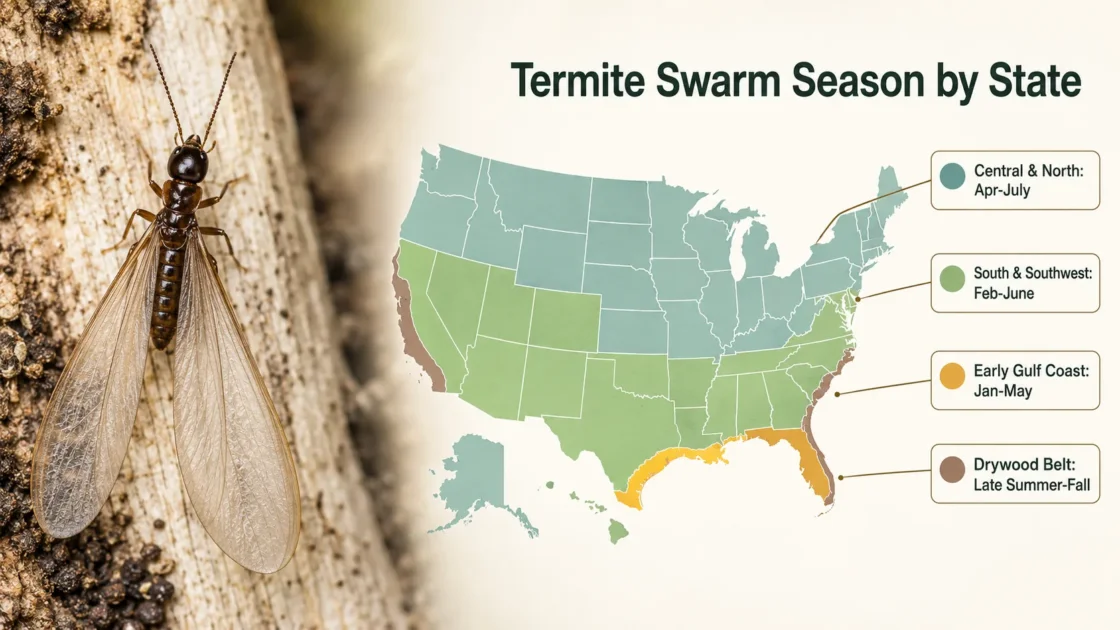
Last reviewed: August 2026. Season ranges are source-based watch windows, not live occurrence records.
Key Data Points
Subject
Termite swarm season by US state
Main alate group
Subterranean termites
Peak national pattern
March to May
Earliest watch areas
Gulf Coast and warm southern zones
Later watch areas
California, Hawaii, desert Southwest
Alaska status
No routine swarm calendar
Best inspection clue
Indoor alates or shed wings
Data confidence
Moderate
How to Read the State Calendar
The table uses “watch window” language because termite flights are triggered by local temperature, rainfall, colony maturity, and termite group. A state window means alates are most worth watching during that span; it does not mean every county, house, or colony will swarm in those months.
How to Read This Data
State rows combine state extension pages where available with regional extension guidance. The result is a practical calendar layer, not an occurrence database. Records may reflect sampling effort as much as true abundance.
Termite Swarm Season by US State
| State | Typical watch window | Main seasonal context | Data confidence |
|---|---|---|---|
| Alabama | February to May; coastal areas may watch later | Native subterranean spring flights; Gulf Coast Formosan risk can extend into late spring. | Medium |
| Alaska | Data not available as a routine season | No routine structural termite swarm calendar is used here. | High |
| Arizona | March to May; July to September after wet periods | Subterranean termites are a major urban pest; wet periods can raise activity in desert settings. | Medium |
| Arkansas | March to May | Spring subterranean termite watch window after warm rain. | Medium |
| California | February to April; August to October for some drywood and dampwood activity | Subterranean, drywood, and dampwood termite groups create more than one watch period. | High |
| Colorado | April to June | Eastern subterranean termite is listed as the common termite species in Colorado. | Medium |
| Connecticut | April to June | Northeastern spring watch window; local confirmation matters. | Medium |
| Delaware | March to May | Mid-Atlantic spring subterranean termite window. | Medium |
| Florida | February to July | South Florida Asian subterranean flights can begin earlier; Formosan activity often begins late April into June. | High |
Florida — 2026 Distribution Note UF research published in 2026 found that both invasive Coptotermes species have spread farther in Florida than earlier records suggested. Formosan subterranean termites are now established across most coastal counties and in most large urban centers statewide, with current trends indicating a high likelihood of detection throughout Florida before 2050. Asian subterranean termites have also expanded northward, with established records as far north as Brevard County on the Atlantic coast and Hillsborough County on the Gulf Coast. Hybrid C. formosanus × C. gestroi termites remain a localized exception: UF/IFAS reports confirmed hybrids only in Broward County, and 2025 dispersal-flight records from parts of the county found hybrids in about 0.1% of alates. [s] [t] | |||
| Georgia | February to May | Eastern and southeastern subterranean termite flights are mostly spring, with later invasive termite concern in some areas. | High |
| Hawaii | May to June peak; some species may fly outside that span | Formosan subterranean peak and drywood termite activity make local species ID essential. | High |
| Idaho | April to June | Low to moderate watch window; verify insects before treatment decisions. | Low |
| Illinois | March to May | Central spring subterranean termite window. | Medium |
| Indiana | March to May | Spring alate flights after warming soil and rain. | Medium |
| Iowa | April to June | Upper Midwest spring to early summer watch window. | Medium |
| Kansas | March to May | Plains spring subterranean termite activity. | Medium |
| Kentucky | March to May | Spring subterranean termite alate window. | Medium |
| Louisiana | January to July | Native termites may begin early; Formosan subterranean termites commonly swarm April to June or July. | High |
| Maine | April to June | Limited northern watch window; identification should be verified. | Low |
| Maryland | March to May | Mid-Atlantic spring subterranean termite watch period. | Medium |
| Massachusetts | April to June | Northeastern spring watch window. | Medium |
| Michigan | April to June | Cool-climate spring to early summer watch window. | Medium |
| Minnesota | April to June | Termites are uncommon to rare and mainly noted in the southern third; swarmers are spring records when present. | High |
| Mississippi | January to June | Coastal areas may start early; northern areas can continue into June. | High |
Mississippi — 2026 Observed Event Exceptionally heavy Formosan subterranean termite swarms were reported in southern Mississippi in May 2026. On May 13, a large swarm in Hattiesburg postponed a high school softball championship game. Mississippi State University Extension reported that the timing itself was normal: Formosan swarmers in the state typically appear from late April through June. The unusual feature was the size of the swarm, not an extension of the known seasonal window. [u] | |||
| Missouri | March to May | Eastern subterranean termite flights occur during spring months on warm sunny days after rain. | High |
| Montana | May to June | Low-density northern watch window; records should be interpreted cautiously. | Low |
| Nebraska | April to May | Central Plains spring watch period. | Medium |
| Nevada | March to May; summer after wet periods in desert areas | Desert and urban moisture conditions can shift visible activity. | Low |
| New Hampshire | April to June | Northern spring watch window; termite records are more localized. | Low |
| New Jersey | March to May | Mid-Atlantic spring subterranean termite window. | Medium |
| New Mexico | March to May; summer after monsoon rain | Desert Southwest seasonality is tied to warmth and moisture pulses. | Low |
| New York | April to June | Spring to early summer watch window; indoor alates need inspection. | Medium |
| North Carolina | March to May | Subterranean termite alates are commonly discussed as spring swarmers. | High |
| North Dakota | May to June | Short northern watch window; confirm with local extension or specimen ID. | Low |
| Ohio | March to May | Spring subterranean termite watch period. | Medium |
| Oklahoma | March to May | Oklahoma State extension identifies March, April, and May as normal flight months. | High |
| Oregon | April to June | Pacific Northwest records require local species confirmation. | Medium |
| Pennsylvania | Late winter to early spring | Eastern subterranean termite swarms may be noticed indoors during late winter or early spring. | High |
| Rhode Island | April to June | Northeastern spring watch window. | Low |
| South Carolina | February to July | Native termites usually swarm early spring; Formosan termites often swarm mid-May to July. | High |
| South Dakota | May to June | Short northern watch window; local confirmation is needed. | Low |
| Tennessee | March to May | Spring subterranean termite watch window. | Medium |
| Texas | January to June; drywood activity may differ | Texas A&M notes spring and early summer flights, with South Texas beginning in January. | High |
| Utah | April to June | Utah State extension notes winged swarmers in spring. | High |
| Vermont | April to June | Northern spring watch window; activity is localized. | Low |
| Virginia | March to May | Mid-Atlantic spring subterranean termite window. | Medium |
| Washington | April to June; later local activity may occur with dampwood termites | Pacific Northwest termite activity depends strongly on termite group and moisture. | Medium |
| West Virginia | March to May | Appalachian spring subterranean termite watch window. | Medium |
| Wisconsin | April to June | Upper Midwest spring to early summer watch window. | Medium |
| Wyoming | May to June | Short northern and high-plains watch window; records are localized. | Low |
What a Swarm Means Indoors vs Outdoors
Swarm location changes the meaning. A short outdoor flight from soil, a log, a stump, or landscape wood may only show a colony nearby. Alates emerging indoors, crawling from trim, or leaving many shed wings near windows suggest the building should be inspected by a qualified local professional. EPA guidance also treats correct identification and safe pesticide use as separate steps. [c]
| Swarm evidence | Likely interpretation | Reasonable action |
|---|---|---|
| Outdoor swarm from soil or a stump | Nearby colony evidence, not automatic indoor infestation. | Document date, location, photos, and check foundation areas. |
| Alates emerging indoors | Higher concern for a hidden colony or entry path. | Collect specimens and schedule inspection. |
| Shed wings on windowsills | Alates have flown, dropped wings, and moved toward light. | Keep wings/specimens for identification. |
| Night swarm near exterior lights | Can fit Formosan, drywood, or other light-attracted termite groups in warmer regions. | Reduce exterior light attraction and verify species. |
| Single winged insect | Not enough evidence by itself. | Compare antennae, waist, wing length, and collection context. |
Termite Alates vs Flying Ants
Many spring “flying termite” reports are actually flying ants. The safest field method is to compare several body markers together rather than relying on color alone.
| Marker | Termite alate | Flying ant | Usefulness |
|---|---|---|---|
| Antennae | Straight or bead-like | Elbowed | High |
| Waist | Broad, not pinched | Narrow, pinched | High |
| Wings | Front and hind wings about equal length | Front wings longer than hind wings | High |
| Shed wings | Often found after indoor termite swarms | Less diagnostic alone | Medium |
| Color | Varies by termite group | Varies by ant species | Low |
Action Timing During Swarm Season
| Timing | What to check | Reason |
|---|---|---|
| One month before state watch window | Wood-to-soil contact, mulch depth, leaks, crawlspace moisture | Moisture and wood access support subterranean termite foraging. |
| During first warm rainy period | Windowsills, door tracks, slab edges, porch lights | Alates often move toward light after flight. |
| After indoor alates appear | Collect specimens, save wings, photograph emergence point | Identification should be verified against physical specimens where possible. |
| After outdoor swarms | Inspect nearby stumps, fence posts, landscape timbers, foundation gaps | Outdoor swarms show local colony presence, not always structural infestation. |
| Outside the expected season | Check heated slabs, moisture sources, and species group | Indoor heating and local termite biology can shift timing. |
Interactive Swarm Season Visuals
US State Watch-Window Coverage by Month
Number of states whose listed watch window includes each month.
Source: Derived from the state table using university extension and agency sources cited below; values are state-window counts, not occurrence counts.
Swarm Evidence Interpretation Score
Relative weight of common field clues when judging a termite swarm report.
Values are editorial interpretation scores for this page, not species counts.
Data Interpretation Note
Seasonal timing varies by geography and climate conditions. A state-level watch window should be used as a screening tool, not as a diagnosis. Pest risk should be assessed based on local inspection data, not occurrence records or calendar timing alone.
Data Quality and Limitations
Where the Data Has Limits
Termite season data is uneven across states. Southern and high-risk states often have better extension coverage than low-record northern or high-plains states. Sampling bias, amateur reports, climate variation, and taxonomic uncertainty all affect how swarm reports should be read.
- Occurrence records are not the same as true range.
- Warm indoor spaces can produce off-season alate sightings.
- Drywood, dampwood, Formosan, Asian subterranean, and native Reticulitermes termites may fly at different times.
- County-level timing can differ from the state-level window.
- Identification should be verified against physical specimens where possible.
- Records may reflect sampling effort as much as true abundance.
How This Calendar Was Built
The state table was built from extension statements on termite swarming months, regional termite biology, and state-specific pages where available. When a state lacked a precise extension swarm calendar, the row was assigned a cautious regional watch window and lower confidence.
FAQ
What month do termites swarm in most US states?
March, April, and May are the main watch months for many eastern, central, and southern states. Warm coastal states can begin earlier, while western drywood or dampwood activity can run later.
Does a termite swarm mean my house is infested?
Not always. Outdoor swarms may come from nearby soil, wood, stumps, or landscape areas. Indoor alates, shed wings indoors, or repeated emergence from trim or slab edges deserve inspection.
Why do termites swarm after rain?
Warm, moist conditions help alates leave the colony without drying out quickly. Many extension sources link spring flights with warm days after rain.
Are Formosan termite swarms later than native termite swarms?
Often, yes in Gulf Coast and southeastern references. Native subterranean termites are often early spring swarmers, while Formosan subterranean termites are often reported from late spring into early summer.
Can termites swarm in winter?
They can be seen earlier in warm southern zones and sometimes indoors near heated structures. In colder states, winter sightings need specimen confirmation because flying ants and other insects are often confused with termites.
What should I save if I find swarmers?
Save several intact insects or shed wings in a small container, photograph the emergence point, and record date, time, weather, and whether the swarm was indoors or outdoors.
Sources and Verification
- [a] NC State Extension: Termite Swarmers — alate meaning and North Carolina subterranean termite context.
- [b] University of Georgia Extension: Biology of Subterranean Termites in the Eastern United States — eastern US subterranean termite biology and seasonal context.
- [c] EPA: Termites, How to Identify and Control Them — termite identification and control decision context.
- USDA Forest Service: Subterranean Termites, Prevention and Control in Buildings — national termite occurrence context and prevention notes.
- UF/IFAS: Termite Season Questions and Misconceptions — Florida termite season and Formosan timing notes.
- Texas A&M AgriLife Extension: Subterranean Termites — Texas swarming season and South Texas early-season note.
- UC IPM: Subterranean and Other Termites — California termite groups and flight behavior.
- Penn State Extension: Eastern Subterranean Termites — late winter and early spring indoor swarmer context.
- University of Missouri Extension: Subterranean Termites — Missouri spring swarming flights after warm rain.
- Oklahoma State University Extension: Termites, Spring Swarming Season in Oklahoma — March, April, and May flight months.
- University of Minnesota Extension: Subterranean Termites — Minnesota rarity and spring swarmer note.
- Mississippi State Extension: Eastern Subterranean Termites — Mississippi coastal early season and northern June continuation.
- LSU AgCenter: Preparing for the Termite Swarms — Louisiana Formosan termite April to June swarm season note.
- Clemson Extension: Formosan Termites Increase Distribution in South Carolina — native and Formosan swarm timing in South Carolina.
- University of Hawaii CTAHR: Wood Destroying Organisms — Hawaii drywood termite swarming context.
- University of Arizona Extension: Termite Control for Homeowners — Arizona termite group and urban pest context.
- Utah State University Extension: Subterranean Termites — spring swarmer note for Utah.
- Colorado State University: Termites — Colorado termite species context.
- [s] University of Florida — New study shows invasive termites threatening homes in Florida are spreading farther than predicted — 2026 distribution update for Formosan and Asian subterranean termites in Florida.
- [t] UF/IFAS — Hybrid Coptotermes Termites: Separating Fact from Fiction — Broward County hybrid distribution and 2025 dispersal-flight prevalence.
- [u] Mississippi State University Extension — Protect property from heavy termite swarms — May 2026 southern Mississippi Formosan swarms and the May 13 Hattiesburg event.