Wasps can form conspicuous aerial groups, but a “wasp swarm” is not one single biological event. In annual social wasps such as many paper wasps and yellowjackets, late-season activity may involve newly produced males and reproductive females leaving mature colonies to mate. Some paper wasp males gather at mating landmarks. Foundresses can also assemble before nest founding, and certain tropical social wasps move queens and workers together as a true colony swarm. A sudden cloud of workers around a disturbed nest, meanwhile, is defense rather than reproductive swarming.
The useful question is therefore not simply whether many wasps are flying. Who is present, where they are gathering, whether a nest is involved, how the insects move and what stage the colony has reached are much better clues to what the activity means.
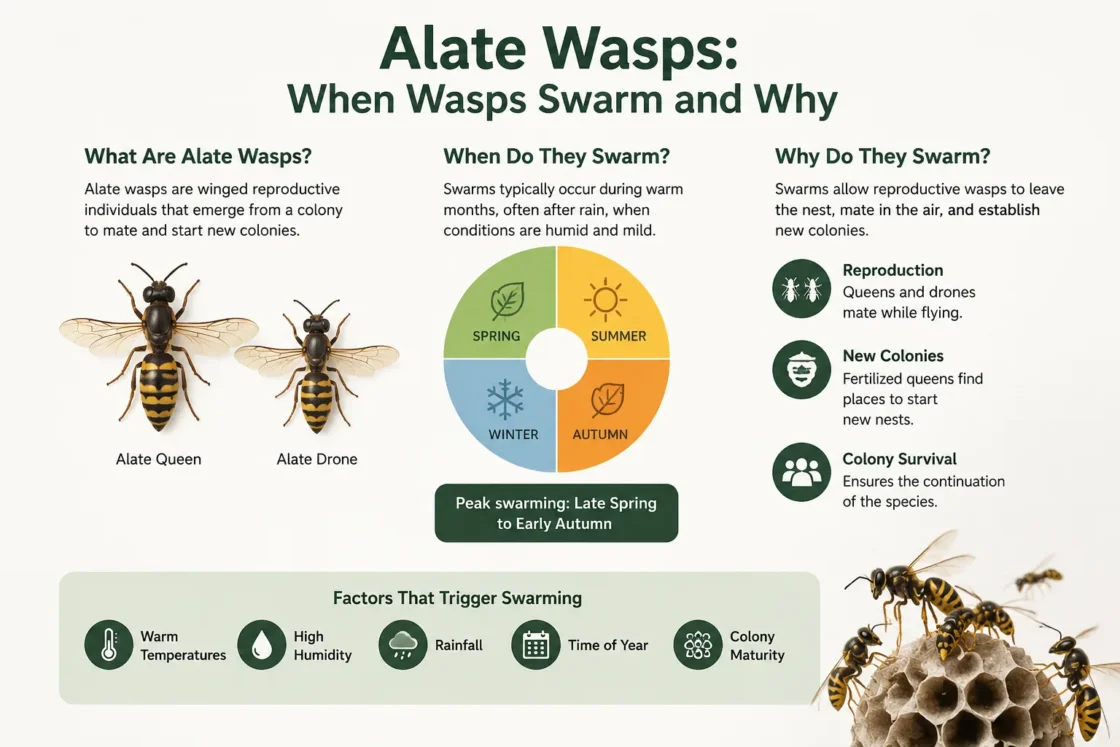
Why “Alate Wasp” Needs a Different Interpretation
Alate literally describes a winged form. The term is especially informative in ants and termites because ordinary workers are wingless while the reproductive individuals that leave for mating and dispersal are winged. In those insects, seeing wings can immediately point toward a reproductive caste.
Social wasps are different. Adult workers are normally winged females already, while males and reproductive females are winged as well. Wings alone therefore do not identify a wasp as a reproductive individual. In a wasp colony, terms such as male, drone, gyne, future queen or foundress can be more informative than treating every flying wasp as an alate.
This distinction changes how swarms should be interpreted. A group of winged ants emerging from a colony is strongly associated with reproduction. A group of winged wasps could instead be workers responding to a threat, males assembling to find mates, reproductive females searching for shelter, or an entire swarm-founding colony moving to another site.
Several Different Behaviors Can Look Like a Wasp Swarm
| What is observed | Likely biological context | Typical purpose | Does it imply a nest at that exact spot? |
|---|---|---|---|
| Repeated aerial activity around a prominent tree, ridge, roofline or other landmark | Male mating aggregation or lek in species that use landmark-based mating | Encountering reproductive females | Not necessarily |
| Males and new reproductive females leaving a mature nest | Reproductive departure and dispersal | Mating and movement away from the natal colony | A source nest is involved, although individuals may travel away from it |
| Females repeatedly gathering at a site without a nest or food resource | Foundress social aggregation in species where this behavior occurs | Assessment of potential nest-founding partners | No |
| A stationary group in a protected crevice, attic, siding gap or similar shelter | Seasonal or overwintering aggregation, especially in some paper wasps | Survival through an unfavorable season | Not necessarily; the location may be shelter rather than a colony nest |
| A sudden cloud emerging after a nest, wall void or ground opening is disturbed | Defensive response | Colony defense | Usually yes |
| A coordinated population of workers and reproductive females moving to a new site | Swarm founding | Establishing or relocating a colony | The group is moving between colony sites |
| Many wasps repeatedly visiting fallen fruit, flowers, garbage or another food source | Foraging concentration | Feeding | No |
Number alone is a poor diagnostic feature
Dozens of wasps in one place can represent mating, foraging, sheltering, nest defense or colony movement. The pattern of movement and its relationship to a nest or landmark usually carries more information than the size of the group.
When Reproductive Wasp Activity Becomes Most Visible
There is no universal “wasp swarm month.” Timing varies with species, latitude, climate and colony cycle. A useful pattern can still be seen in many annual temperate paper wasps and yellowjackets.
In the annual cycle described for yellowjackets and paper wasps in the Upper Midwest, an overwintered queen begins a colony in spring. Early broods produce workers, and those workers take over much of the foraging, nest maintenance and brood care while colony size grows. Later in the season, colony investment shifts toward reproduction. New queens and males are produced by late summer, after which mating and dispersal occur and the old annual colony declines. Mated reproductive females are the individuals that survive to continue the cycle the following year.[a]
That seasonal sequence should not be turned into a fixed global calendar. A late-summer pattern from Minnesota cannot be assigned unchanged to Southern Hemisphere populations, tropical species or social wasps with different colony cycles. Season describes a local biological window, not a universal date.
Weather changes when reproductive flight is visible
Weather can concentrate flight activity once reproductive individuals are ready to leave, but weather does not create males or new queens overnight. Colony development produces the reproductives; suitable flight conditions influence when they are active outside.
A 2025 field study of Vespula germanica and Vespula vulgaris drones in northern Patagonia illustrates how local conditions can shape what an observer sees. During the reproductive flight period there, researchers found more flying drones during earlier sampling hours, on warmer days and under lower cloud cover. Drone presence was also associated with vegetation characteristics, including plant height.[b]
Those results come from a specific population, place and reproductive period and should not be converted into a universal temperature rule for wasps. They do show why the same colony population can produce an obvious aerial gathering on one suitable day and far less visible activity under different conditions.
Mating Aggregations Can Form Away From the Nest
One of the clearest reasons for a wasp “swarm” is mate finding. Reproductive individuals that have left separate colonies need places or behaviors that increase the chance of encountering one another. The result can be a temporary concentration of wasps in an area that contains no nest.
Several Polistes paper wasps use landmark-based mating systems. Depending on species, males may occupy territories, patrol conspicuous locations or return repeatedly to particular landmarks. Male competition can include chasing other males from perches or aerial space. The gathering place functions as a mating site rather than a colony center.[c]
From the ground, this may look like wasps repeatedly circling the upper part of a tree, fence, roof, ridge or another visually prominent feature. The absence of steady traffic into a nest opening separates this pattern from ordinary worker movement. Repeated return to the same aerial space can also be more informative than simply seeing several wasps pass through an area.
Yellowjackets can form reproductive rendezvous areas as well. The Patagonia field study recorded locally dense areas of flying Vespula drones during their reproductive period and found both V. germanica and V. vulgaris males using the same general areas.[b] A conspicuous male aggregation therefore does not require a visible nest immediately below it.
A Wasp Aggregation Can Be Social Without Being a Mating Swarm
An especially useful distinction comes from recent work on the northern paper wasp, Polistes fuscatus. A study published online in July 2025 and appearing in the April 2026 issue of Current Zoology documented nest-founding females repeatedly assembling at particular locations before stable nests were established.
The aggregation sites contained neither nests nor obvious resources that could explain the concentration. Foundresses interacted, observed other individuals and changed their aggressive behavior as the partner-sampling period progressed. The researchers described the pattern as consistent with a “social lek”: a place where females can sample potential co-foundresses before settling into nesting associations.[d]
This differs from a conventional mating lek. In a mating lek, the central interaction concerns reproductive partners. In the P. fuscatus social lek described by the study, the females are evaluating potential social partners for nest founding. A visible group of paper wasps can therefore be associated with reproduction and colony formation without the insects actually mating at that location.
Some Wasps Really Do Move as a Colony Swarm
The familiar temperate pattern of a queen founding a nest alone or with a few other foundresses is not the only way social wasp colonies begin. Among swarm-founding Polistinae, colony establishment can involve a coordinated group containing reproductive females and numerous workers.
Phylogenetic and behavioral work on Polistinae distinguishes independent-founding groups from swarm-founding groups. In the latter, workers accompany reproductive females when a new colony site is established; the colony does not pass through the worker-free solitary founding phase typical of independently founding paper wasps. Swarm founding occurs in the tribe Epiponini and also in some other polistine lineages.[e]
This is a true colony-level movement. It should be separated from a mating aggregation in which independent reproductive individuals meet temporarily and then disperse. The unit that is moving is different: in one case it is mating individuals; in the other it is an organized social group capable of establishing another nest.
| Feature | Mating aggregation | Swarm-founding colony |
|---|---|---|
| Main participants | Reproductive males and/or females | Workers together with reproductive females |
| Main function | Mate encounter | Establishing or relocating a colony |
| Relationship to a new nest | Mating site may have no nest | Movement is tied to a new colony site |
| Social organization during movement | Individuals gather temporarily | Members move as part of the same colony |
| Typical of all social wasps? | No; mating systems vary | No; restricted to swarm-founding lineages |
Three Common “Swarms” That Are Not Reproductive Flights
A defensive burst from a nest
A dense cloud of wasps appearing immediately after a nest is struck, vibrated, opened or otherwise disturbed is best interpreted as nest defense. Workers may exit rapidly and concentrate around the disturbance. This activity can look dramatic, but its biological purpose has little in common with a reproductive flight.
The location provides the strongest clue. Repeated entry and exit through the same hole in soil, a wall void, roof space or nest envelope supports nest-associated activity. If numbers rise abruptly after physical disturbance, defense becomes a much more plausible explanation than mating.
A seasonal cluster in shelter
Paper wasp reproductive females can also gather in protected places. University of Minnesota Extension notes that overwintering paper wasp queens may live in groups, while yellowjacket queens in the regional species it discusses overwinter individually.[a]
That makes a sheltered cluster biologically different from an occupied summer nest. Several inactive or slow-moving paper wasps found together beneath siding, in an attic space or another protected cavity can represent an overwintering aggregation rather than an active colony producing workers.
Many independent foragers at one resource
Fallen fruit, exposed sugary foods, nectar, prey and waste can draw numerous wasps into a small area. The insects may arrive and leave continuously and appear swarm-like, yet the concentration can simply reflect a resource being attractive to many foragers. Shared destination does not automatically mean shared reproductive behavior.
How the Flight Pattern Helps Identify What Is Happening
| Field observation | Interpretation it supports | What it does not establish by itself |
|---|---|---|
| Wasps repeatedly enter and leave one structural opening | Active nest traffic is plausible | Whether the individuals are currently reproductive |
| Many wasps erupt immediately after an area is struck or disturbed | Defensive response is plausible | A reproductive swarm |
| Wasps circle or patrol a high landmark with no visible nest traffic | Mating-site activity may be plausible in species using landmark systems | Species identity or the presence of a nest beneath the landmark |
| A stationary cluster occupies a protected cavity during a cold-season transition | Overwintering aggregation may be plausible | An active colony at that location |
| Numerous insects repeatedly land on the same fruit, flowers or waste | Foraging concentration is plausible | Mating or colony relocation |
| Workers and reproductive females move together and establish another nest | True swarm founding | That the same behavior occurs in ordinary local yellowjackets or paper wasps |
A swarm that disappears after a short period also does not necessarily indicate that a nearby nest has vanished. A mating rendezvous can be temporary, suitable flight conditions can end, reproductive individuals can disperse, and a foraging concentration can disappear when the resource is gone. Conversely, repeated traffic through the same fixed opening over many days points more strongly toward a persistent nest source.
Can Swarming Wasps Sting?
Male wasps cannot sting. The hymenopteran stinger is derived from female reproductive anatomy, and males lack the ovipositor from which the sting apparatus develops. Female workers and reproductive females can possess functional stingers.[f]
That does not make every aerial gathering equally likely to produce stings. A male mating aggregation and a worker defense response involve different insects and different motivations. Nest-defense activity deserves particular caution because social wasps use stinging as a colony-defense behavior. A mating aggregation should not automatically be described as an attacking swarm, but a mixed group cannot safely be assumed to contain males only unless sex has actually been established.
Behavior matters more than the word “swarm”
A cloud centered on a disturbed nest should not be approached as though it were a harmless male mating aggregation. The same everyday word can describe biologically different situations with different sting contexts.
Why Wasp Swarming Is Not the Same as Honey Bee Swarming
Honey bee swarming has a relatively specific colony-level meaning: an established colony divides, and an existing queen leaves with a large body of workers to establish another colony. The cluster that forms while scouts search for a nest site is part of that colony-fission process.[a]
Many familiar temperate social wasps follow another pattern. A paper wasp or yellowjacket colony can produce new males and reproductive females late in its annual cycle, after which the reproductive individuals leave and mate while the old worker colony eventually dies. The departure of sexual reproductives is not equivalent to the old queen leaving with thousands of workers as a honey bee colony does.
Yet saying that “wasps do not swarm like bees” without qualification also misses part of wasp biology. Swarm-founding polistine wasps really can establish colonies with groups of workers and reproductive females moving together. The broader wasp lineage therefore contains both individual reproductive dispersal and colony-level swarming, depending on the species and social system.
What a Wasp Swarm Actually Reveals
Seeing many wasps in flight establishes one fact with confidence: wasp activity is concentrated in that place and time. The reason still has to be inferred from context.
Repeated circling around a landmark can fit a mating aggregation. Late-season departure from a mature annual colony can involve males and future queens. A protected stationary cluster can consist of overwintering paper wasp females. A sudden cloud from a disturbed nest is defensive activity. In other social wasp lineages, a coordinated movement of queens and workers can be the colony itself relocating or founding another nest.
For wasps, wings are not enough to identify an “alate,” and numbers are not enough to identify a swarm. The strongest interpretation comes from combining caste, behavior, season, location and the relationship of the insects to a nest.
Sources
- University of Minnesota Extension — Wasps and bees — Supports the annual paper wasp and yellowjacket colony cycle, late-season production of males and new queens, overwintering behavior, paper wasp queen aggregations and the comparison with honey bee swarming. [a]
- Scientific Reports — Environmental influence and species occurrence of yellowjacket drones in an invaded area — Field evidence on reproductive-flight rendezvous areas and associations between Vespula drone activity, vegetation, temperature, cloud cover and time of day in northern Patagonia. [b]
- Landmark-Based Mating Systems in Four Polistes Species (Hymenoptera: Vespidae) — Supports the use of conspicuous landmarks and territorial or patrol behavior in paper wasp mating systems. [c]
- Current Zoology — Nest-founding paper wasps aggregate in “social leks” and decrease aggression during partner selection — Documents spring partner-sampling aggregations of Polistes fuscatus foundresses at sites without nests or resources. [d]
- BMC Evolutionary Biology — The phylogeny of the social wasp subfamily Polistinae — Supports the distinction between independent-founding and swarm-founding Polistinae and the participation of workers with reproductive females in swarm-founded colonies. [e]
- Purdue University Extension — Stinging Insects — Supports the female origin of the hymenopteran sting apparatus, the inability of male wasps to sting and the defensive role of stinging in social Hymenoptera. [f]