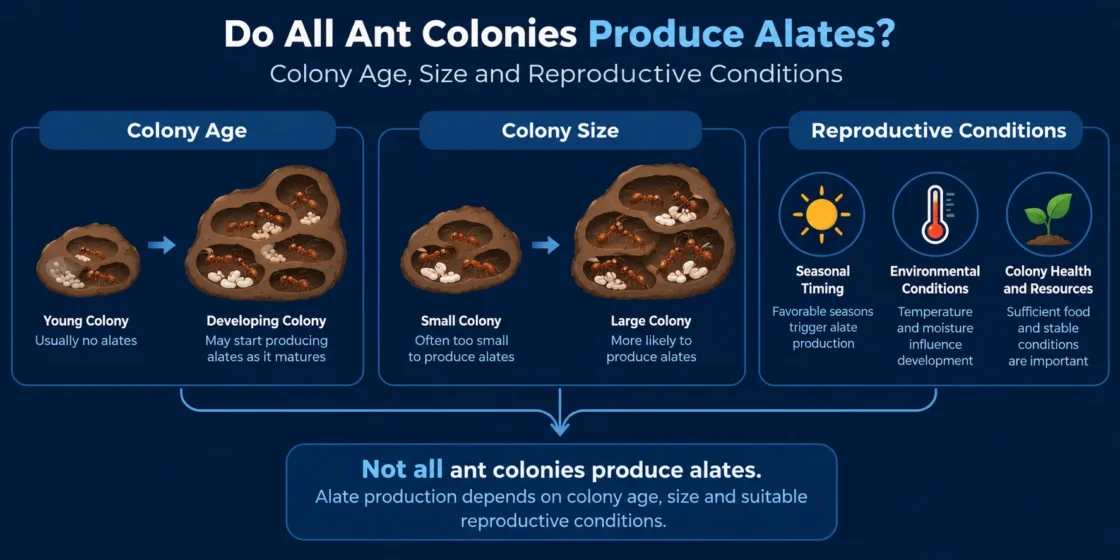
No. Not every ant colony produces alates, and a colony that is capable of producing them may produce none during a particular season or year. In ant species that use winged reproductives, alate production usually begins only after the colony reaches a species-specific stage of reproductive maturity. Colony age can matter, but age alone is not a reproductive switch. Worker population, resource condition, season, social organization, sex allocation and the species’ method of colony reproduction can all change what is produced.
The distinction also depends on what is meant by an alate. A colony may produce winged males, winged reproductive females called gynes, both sexes, or neither at a given time. Some ants use permanently wingless reproductive females or reproduce partly through colony division, so the familiar pattern of a winged queen leaving on a mating flight is not universal.
Production and flight are different events
Rain, warm temperatures, humidity or calm air can coincide with the departure of reproductives that have already developed. Those conditions do not cause a young colony to manufacture adult alates overnight. Colony development comes first; emergence and mating flight come later.
A Colony Usually Builds Its Workforce Before Investing Heavily in Sexuals
A newly founded colony faces a different biological problem from an established colony. Its first workers must forage, care for brood, maintain the nest and support the queen. Producing sexual offspring too early would divert resources into individuals that normally leave rather than contribute to the colony’s labor force.
For many ants, the early trajectory is therefore dominated by worker production and colony growth. As the worker population expands, the colony gains more capacity to collect food and rear brood. Only later does sexual production become a regular part of the colony’s life cycle. Colorado State University Extension describes winged males and potential queens as forms produced as colonies mature.[a]
A queen laying eggs does not mean the colony has reached reproductive maturity. A queen can produce worker-destined brood long before the colony begins producing winged sexuals.
There Is No Universal Age for the First Alates
Ant species differ too much in colony growth, lifespan and social organization for a rule such as “all colonies produce alates after two years” to be useful. Even within a species, colonies of similar age can have different reproductive output.
A long-term study of the red harvester ant Pogonomyrmex barbatus illustrates the problem. Colonies begin producing winged sexuals at about five years of age, but the study examined 172 colonies from 4 to 17 years old and found that 36% produced no alates during the study period. Among colonies that did reproduce, older colonies produced more alates than younger reproductive colonies. Failure to reproduce, however, was not explained simply by colony age.[b]
Other ants operate on very different schedules. UC Statewide IPM describes carpenter-ant colony growth as slow at first, with new winged reproductives appearing only after the colony has matured over several years.[d] Its red imported fire ant material, by contrast, notes that colonies can begin producing winged reproductive forms after about one year.[e]
| Ant example | Reported reproductive threshold or timing | What the example shows |
|---|---|---|
| Pogonomyrmex barbatus | Alate production begins at about 5 years | Age can mark maturity, but mature-age colonies do not all reproduce in a given period. |
| Pogonomyrmex badius | Reproductive maturity at roughly 700 workers in the studied population | Worker population can be a more useful threshold than calendar age. |
| Carpenter ants | Winged reproductives generally appear after several years of colony growth | Slow-growing colonies may remain worker-focused for years. |
| Red imported fire ant | Winged reproductive production can begin after about 1 year | Some species reach reproductive maturity much faster than others. |
These values should not be combined into a universal ant timetable. They come from different species and biological systems. A threshold reported for one species should not be used to estimate the age of an unidentified colony.
Colony Size Can Be a Reproductive Threshold
Age and size are related, but they are not interchangeable. A colony can grow slowly or quickly depending on species and conditions. From the colony’s perspective, a sufficiently large worker force may matter because workers acquire food, feed larvae, maintain the nest and support the brood that will become future reproductives.
The Florida harvester ant Pogonomyrmex badius provides a well-studied example. Researchers found that colonies became reproductively mature at approximately 700 workers. Seventeen of 19 colonies reproduced during the study, and every reproductive colony contained more than 700 workers. The production of males and gynes occurred as a seasonal pulse, followed by worker production.[c]
That does not make 700 workers an ant-wide threshold. It is a result for P. badius. Another species may reproduce with a much smaller colony, while a different one may require thousands of workers or a different developmental state.
Larger colonies can produce more sexual offspring without being more productive per worker
A controlled experiment with the acorn ant Temnothorax crassispinus adds another layer. Colonies were kept for three months in artificial nest cavities of different volumes. More populous colonies invested more in producing males and gynes, but the researchers found no statistical difference in sexual production attributable to cavity volume. They also found no correlation between colony size and productivity per capita within the cavity groups.[f]
The useful distinction is between total reproductive capacity and efficiency per worker. A larger workforce can be associated with greater total sexual output without each additional worker making the colony proportionally more productive.
Reaching Maturity Does Not Guarantee Alates Every Year
Reproductive maturity means that sexual production has become biologically possible for the colony. It does not mean the colony must produce alates continuously or on every reproductive cycle.
Three different colony states can all produce “no visible alates”
- Pre-reproductive colony: the colony has not yet reached its species-specific maturity threshold.
- Mature but non-reproducing colony: the colony is capable of sexual production but produces none during the observed period.
- Reproducing colony before emergence: sexual larvae, pupae or adult reproductives may still be concealed within the nest.
The P. barbatus result is especially useful here: more than one-third of colonies produced no alates even though the sample included colonies well beyond the approximate age at which the species begins reproduction. The same study found that the relationship between neighborhood density and reproductive output differed from an earlier study at the same site. The authors suggested that annual variation in factors such as rainfall and food supply could contribute to those changing patterns.
This means that the absence of alates on one date, or even during one season, is weak evidence for estimating colony age. It may describe the colony’s current reproductive output without revealing its full reproductive capacity.
Resource Condition Matters, but Extra Food Is Not an Automatic Alate Switch
Sexual offspring require colony resources. Winged reproductive females in particular can represent a large energetic investment because their bodies support dispersal and, in independently founding species, reserves used during early colony establishment. It is therefore reasonable to expect colony condition to affect reproduction. The relationship, however, is not a simple equation in which more food always produces more alates.
An experiment on the desert harvester ant Pogonomyrmex desertorum manipulated artificial predation, seed addition and insect-food addition. Increased artificial predation reduced alate production. Adding seeds or insect material by itself did not produce a measurable increase in alate output in that experiment.[g]
Why “feed more to get alates” is unreliable
Food abundance is only one part of colony biology. Colony size, existing brood, worker losses, season, queen condition, species-specific life history and how resources are allocated can all alter the reproductive response. A feeding effect demonstrated in one ant cannot automatically be transferred to another species.
Producing Males and Producing Future Queens Are Separate Outcomes
A colony does not necessarily divide its reproductive investment evenly between winged males and gynes. In many ants, colonies can show strongly biased sex allocation, and populations may contain colonies that specialize heavily in one reproductive sex.
This pattern is known as a split sex ratio when different colonies within a population specialize toward male or female reproductives. Research across ants shows that several mechanisms can contribute, including queen number, queen mating history, relatedness structure and whether queens or workers exert greater control over sex allocation.[h]
In the Alpine silver ant Formica selysi, most colonies in one study specialized in producing a single sex. Queens in female-specialist colonies laid a high proportion of diploid eggs, while queens in male-specialist colonies laid almost entirely haploid eggs, giving the queen a strong influence over the colony’s eventual sex allocation.[i]
A colony producing male alates but no gynes is still investing in sexual reproduction. The absence of winged future queens does not by itself show reproductive failure.
Some Ants Do Not Depend on Winged Queens at All
The familiar ant life cycle—winged queen leaves the nest, mates, sheds her wings and independently founds a colony—is widespread, but it is only one reproductive strategy.
In some ants, colonies reproduce through fission or budding. A reproductive female moves with workers rather than attempting solitary colony foundation. Some lineages with obligate colony fission have permanently wingless queens known as ergatoid queens. In other ants the conventional queen caste can be absent and reproduction can be performed by mated reproductive workers called gamergates.[j]
UC IPM also describes budding in ants such as Argentine and pharaoh ants, where queens can move to new nest sites with workers instead of relying on the usual solitary post-flight founding sequence.[k]
These systems make the question “does the colony produce alates?” more precise. A species may have wingless female reproductives while still producing winged males. Another may retain winged forms but use them differently from an ant with long-distance independent queen dispersal. Absence of winged queens is therefore not the same as absence of reproduction.
A broad comparative study published in Evolution in 2026, using data from 546 ant species, also found wide variation in worker reproductive capacity across ants. The study estimated that complete worker sterility occurs in only 42% of the species in its dataset, reinforcing how much ant reproductive division of labor varies among lineages.[l]
Alate Production Happens Before the Visible Swarm
A mating flight is the visible end of a developmental process that began inside the colony. Reproductive individuals must first be produced as brood, complete development and reach the adult winged stage. Adult alates may then remain associated with the colony until departure conditions and the species’ seasonal reproductive schedule align.
Colony reproduction and swarm timing operate on different stages
- Colony growth: workers accumulate and the colony approaches reproductive maturity.
- Sexual brood production: larvae develop toward male or reproductive-female forms according to the species’ biology.
- Pupal and adult development: winged reproductives complete development inside the nest.
- Pre-flight period: mature alates may remain in or near the nest before departure.
- Emergence and dispersal: suitable seasonal and local conditions coincide with release from the colony.
This separation explains why flying ants can appear suddenly even though their development was not sudden. Weather may help determine when existing alates leave. It cannot turn ordinary adult workers into winged reproductives, nor does a rainfall event by itself show that a colony has only just become mature.
What the Presence—or Absence—of Alates Actually Reveals
| Observation | Reasonable interpretation | What it does not establish |
|---|---|---|
| Winged males and/or gynes are being produced | The source colony has reached a reproductive state capable of producing those sexual forms. | The colony’s exact age, worker number, queen number or future reproductive output. |
| No alates are visible | The colony may be immature, between reproductive periods, producing concealed sexual brood, or producing no sexuals at that time. | That the colony is young or permanently incapable of reproduction. |
| Only male alates are present | The colony may be allocating reproduction strongly toward males. | That female reproductives must have died or that the colony is abnormal. |
| Alates appear immediately after favorable weather | Weather may have coincided with emergence or flight. | That the weather created or developmentally triggered adult alates that day. |
| A species has no winged queens | It may use ergatoid queens, gamergates, budding or another reproductive system. | That the species lacks sexual reproduction or cannot establish new colonies. |
The most reliable interpretation therefore comes from separating reproductive maturity, current sexual production and visible alate release. A colony can be mature without producing alates in the observed period, can be producing sexuals that remain hidden inside the nest, or can reproduce through a system in which winged female reproductives are reduced or absent.
Sources and Verification
- [a] Colorado State University Extension — Ants in the Home — Used for mature-colony production of winged reproductive castes and general ant colony biology.
- [b] Wiernasz & Cole — Colony age, neighborhood density and reproductive potential in harvester ants — Used for the approximate five-year reproductive onset in Pogonomyrmex barbatus, the 172-colony dataset, the 36% non-reproductive result and age-related reproductive output.
- [c] Smith & Tschinkel — The sociometry and sociogenesis of reproduction in the Florida harvester ant, Pogonomyrmex badius — Used for the approximately 700-worker maturity threshold and seasonal production schedule.
- [d] UC Statewide IPM Program — Carpenter Ants — Used for slow early colony growth and reproductive maturity after several years.
- [e] UC Statewide IPM Program — Red Imported Fire Ant: Colony Propagation — Used for the reported onset of winged reproductive production after about one year.
- [f] Smitrus — Sexual Offspring Production by Acorn Ant Temnothorax crassispinus Colonies Is Associated with the Colony Size but Not with the Volume of the Nest Cavity — Used for experimental evidence relating colony size, sexual investment and nest-cavity volume.
- [g] Munger — Reproductive potential of colonies of desert harvester ants: effects of predation and food — Used for experimental effects of artificial predation and food supplementation on alate production.
- [h] Meunier et al. — Patterns of split sex ratio in ants have multiple evolutionary causes based on different within-colony conflicts — Used for mechanisms producing colony-level male or female specialization.
- [i] Rosset & Chapuisat — Sex Allocation Conflict in Ants: When the Queen Rules — Used for sex specialization and queen influence over egg sex ratio in Formica selysi.
- [j] Peeters & Ito — Colony dispersal and the evolution of queen morphology in social Hymenoptera — Used for colony fission, permanently wingless ergatoid queens and gamergates.
- [k] UC Statewide IPM Program — Ant Biology and Life Cycle: Colony Establishment — Used for independent colony foundation and budding as alternative colony-propagation routes.
- [l] Turner et al. — Larger colony sizes favour greater division of labour between queens and workers in ants — Used for the 2026 comparative analysis of reproductive division of labor across 546 ant species.