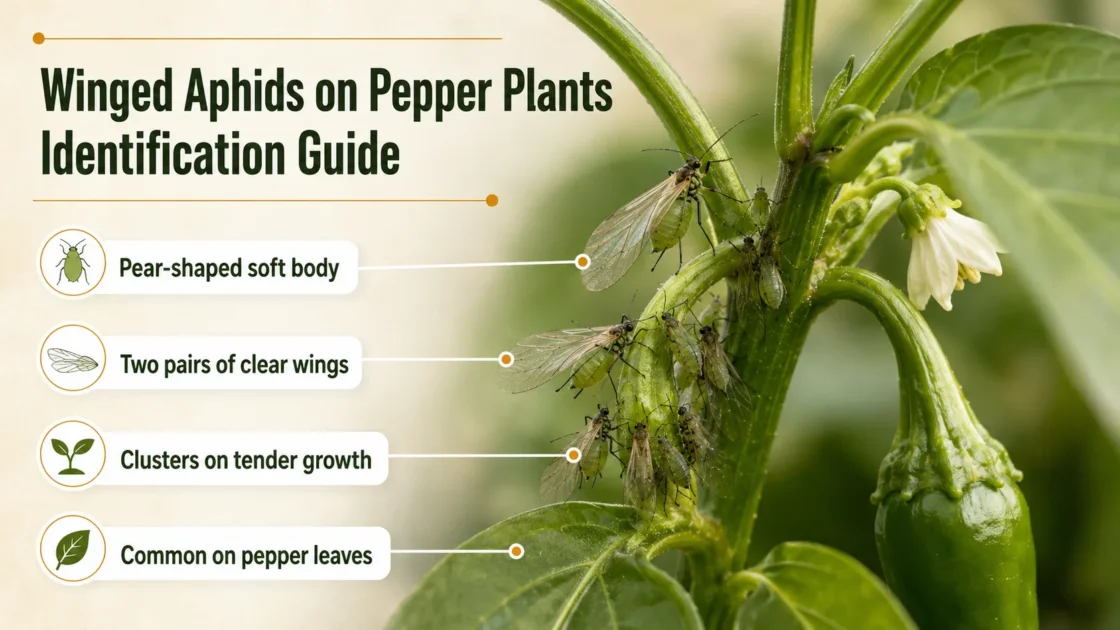
A small winged insect on a pepper plant is consistent with an aphid when it has a soft, pear-shaped body, long antennae and two short tubes called cornicles near the rear of its abdomen. Aphids are commonly about 2–4 mm long, and mature individuals may be winged or wingless. Color is a weak identification feature because green, yellow, pink and dark forms can occur. On peppers, the green peach aphid is a common candidate; its winged form often has a dark abdominal patch and swollen, clublike cornicles. [a] [b]
Pepper plants can also host potato aphids, melon aphids and other locally occurring species. A clear photograph can often support identification as a winged aphid, but color and plant association alone should not be used to assign a species name.
Start With the Two Cornicles
The most useful aphid feature is found at the rear of the abdomen. Cornicles are a paired set of tube-like projections. They may be long, short, dark, pale, cylindrical or swollen, depending on the species. A hand lens, macro lens or sharply enlarged side photograph may be needed to see them.
- Find the rear of the abdomen. Look for two matching projections, one on each side.
- Check the body outline. Aphids are usually soft-bodied and pear-shaped or teardrop-shaped, with a broad abdomen behind a narrower thorax.
- Look at the antennae. Aphid antennae are slender and readily visible when the photograph is sharp enough.
- Examine the wings. A winged adult has clear wings extending over or beyond the abdomen. The darker thorax can make the insect look less like the nearby wingless aphids.
- Inspect the surrounding leaf. Wingless aphids, smaller nymphs, white cast skins or sticky honeydew strengthen the identification.
THE REAR-BODY CHECK
If paired cornicles are clearly visible, aphid is the leading identification. If the rear of the abdomen is hidden, do not rely on green or black coloration alone.
Small white flecks near a colony may be shed aphid skins rather than eggs. Aphid nymphs resemble smaller, wingless adults, so a mixture of winged adults, wingless adults and nymphs can occur on the same plant.
Aphid, Whitefly, or Thrips?
Several small flying insects may gather beneath pepper leaves. Their body shape and resting posture are more useful than their apparent color.
| Feature | Winged aphid | Whitefly | Thrips |
|---|---|---|---|
| Body shape | Soft, pear-shaped or teardrop-shaped abdomen | Tiny yellowish body mostly hidden beneath white wings | Narrow, tapered and similar in outline to a grain of rice |
| Best structural clue | Two cornicles near the rear of the abdomen | White wings held flat or rooflike over the body | Very narrow wings with fringed edges |
| Movement when disturbed | May walk or fly; nearby wingless forms may remain on the leaf | Adults often lift from the underside of the leaf together when disturbed [d] | May walk quickly, jump or fly; the narrow wings can be difficult to see [e] |
| Nearby evidence | Wingless nymphs, cast skins, honeydew and curled tender growth | Flattened immature stages attached beneath leaves and sticky honeydew | Silvery or pale feeding scars, dark fecal spots and damage around flowers or tender leaves |
White wings suggest whitefly only when the insect itself has the compact whitefly form. A dark body with transparent wings is not automatically an aphid; the cornicles still need to be checked.
Which Aphid Is Most Likely on Pepper?
Green peach aphid, potato aphid and melon aphid have all been documented on pepper crops in extension guidance. The list is not universal: the aphids present on a plant can vary with region, growing system, season and nearby hosts. [c]
Green peach aphid
Myzus persicae is a common pepper aphid. Wingless individuals may be pale green, yellowish or pinkish. The winged form usually has a dark head and thorax with a distinct dark patch toward the rear of the abdomen. Its cornicles are relatively short and become swollen or clublike near their ends.
Potato aphid
Macrosiphum euphorbiae is generally longer-bodied than green peach aphid and may be green, pink or mottled. Long, slender cornicles are a more useful clue than body color. The antennae can appear especially long in a clear photograph.
Melon aphid
Aphis gossypii can range from yellowish to dark green. Dark cornicles may contrast with a paler abdomen. Small dark individuals can be confused with other aphids when the cornicles and antennae are not visible.
COLOR COMES LAST
Green does not confirm green peach aphid, and a black winged aphid is not automatically melon aphid. Compare cornicle length and shape, body proportions, host plant and location before considering a species name.
Why Some Aphids Develop Wings
Many aphid colonies contain mostly wingless forms while conditions remain suitable. Crowding, declining host quality and other environmental cues can lead to the production of winged adults that disperse to other plants. These winged forms are alates, meaning insects with developed wings in the relevant life stage.
One alate resting on a pepper leaf may be a recent arrival and does not by itself show that a colony is established. A stronger colony signal is the presence of wingless adults, several sizes of nymphs, repeated new arrivals, cast skins or continuing honeydew on the same growth point.
What the Pepper Plant Adds to the Identification
Inspect the undersides of leaves, tender shoots, flower stems and folded new growth. The insect and the plant evidence should be recorded separately: the insect helps identify the group, while the plant shows whether feeding has been repeated.
- Several body sizes together: consistent with adults and developing nymphs in a colony.
- White hollow skins: aphids leave cast exoskeletons as they grow.
- Clear or sticky droplets: may be honeydew produced during sap feeding.
- Downward curling or distorted tender leaves: compatible with sustained aphid feeding, though other pests and plant disorders can produce similar symptoms.
- One isolated winged adult with no other evidence: compatible with a dispersing visitor that has not yet established a colony.
MOSAIC LEAVES DO NOT IDENTIFY THE INSECT
Several aphid species can transmit pepper potyviruses while moving between plants and briefly probing tissues. Mosaic coloring, curling or distorted fruit cannot identify the aphid species and does not prove that the photographed insect carried a virus. [f]
Take Photos That Preserve the Useful Features
A sharp photograph of the right body area is more useful than a close image that shows only the wings. Avoid crushing the insect before the rear and side views have been recorded.
- Photograph the insect on the pepper leaf before moving it. Include the leaf surface and any nearby nymphs or cast skins.
- Take a top view that shows the body outline, antennae and wing pattern.
- Take a side or rear-oblique view aimed at the two cornicles.
- Use a hand lens, phone macro attachment or magnifying app without applying digital sharpening that invents false edges.
- Place a millimeter ruler beside a second specimen or photograph it beside a known scale.
- Record the date, whether the plant is indoors or outdoors, and the exact leaf or shoot where the insect was found.
- When species-level confirmation matters, save one or more intact specimens in a small sealed container and seek a local extension or entomology identification service.
What a Photograph Can Confirm
A photograph can provide strong support for “winged aphid” when the cornicles, soft pear-shaped abdomen and antennae are visible. It may also support a likely green peach aphid when the abdominal patch and swollen cornicles are clear. Species-level aphid identification remains difficult when the image is blurred, shows only one angle or relies mainly on color; closely related species and different aphid forms can look similar. [g]
Use the narrowest identification supported by the evidence: “winged aphid” is more accurate than an unsupported species name, and “small winged insect” is more accurate when the cornicles cannot be seen.
Sources
- [a] University of Minnesota Extension — Aphids in Home Yards and Gardens — verified aphid size, body form, cornicles, winged and wingless adults, cast skins and the production of dispersing forms.
- [b] UC Statewide IPM Program — Green Peach Aphid on Peppers — verified pepper association, the dark abdominal patch of winged adults, clublike cornicles and feeding evidence.
- [c] University of Maryland Extension — Insect Pest Management in Pepper — verified green peach, potato and melon aphids as pepper-associated candidates and their comparative cornicle and body features.
- [d] UC Statewide IPM Program — Whiteflies on Peppers — verified adult whitefly appearance, wing posture, underside-of-leaf location and movement when disturbed.
- [e] University of Maryland Extension — Thrips in Home Gardens — verified the slender body, narrow fringed wings, size and movement used in the lookalike comparison.
- [f] UC Statewide IPM Program — Potyvirus Mosaic Diseases of Peppers — verified aphid-mediated transmission during movement and probing and the limits of interpreting pepper disease symptoms.
- [g] University of Minnesota Extension — Green Peach Aphid — verified that aphid species identification can be difficult because different species may share similar colors and general appearance.