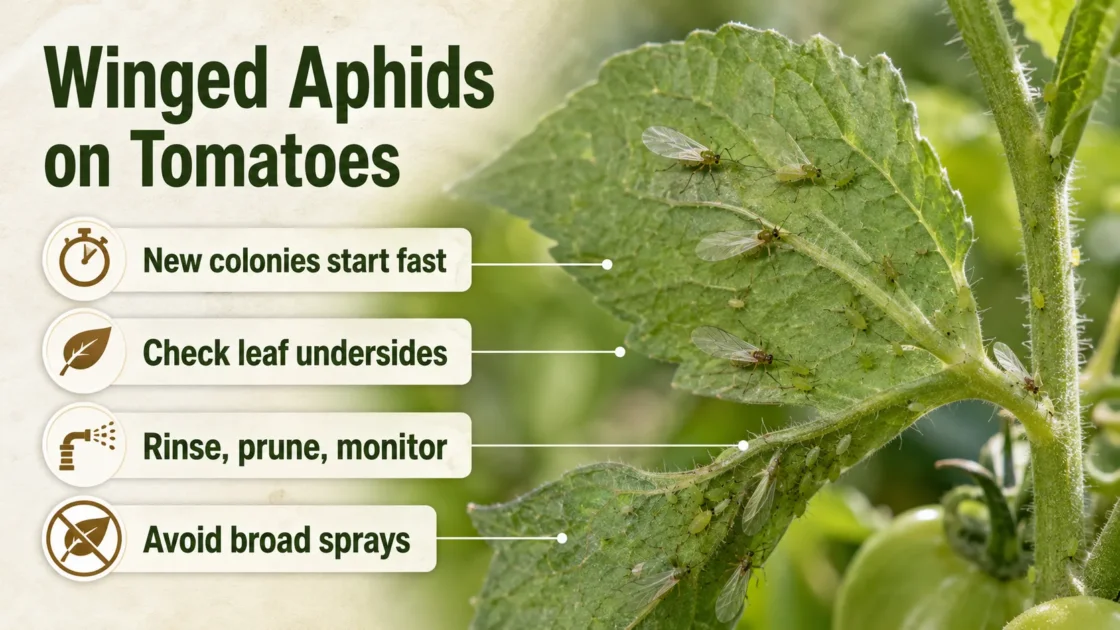
Winged aphids on tomatoes usually mean aphid colonies are moving between plants or searching for new feeding sites. Control starts with confirmation: check the undersides of tender leaves, new shoots, flower clusters, and nearby weeds before spraying. If colonies are light, a firm water spray, removal of curled leaves, and protection of predators often work better than broad insecticides. If aphids are dense, repeat contact treatments such as insecticidal soap or horticultural oil may be useful, but only where spray coverage can reach the insects.
Last reviewed: June 2026
Key Data Points
Common field name
Winged aphids on tomatoes
Taxonomic group
Aphididae
Tomato-linked species
Green peach aphid; potato aphid
Main warning sign
Winged adults plus colonies
Plant risk
Low to high
Best first action
Scout leaf undersides
Control priority
Nonchemical first
Data confidence
Moderate
What Winged Aphids Mean on Tomato Plants
Aphids may appear in wingless and winged adult forms. UC IPM notes that winged individuals are common when populations are high or when host quality changes, giving aphids a way to move to new plants [a]. On tomatoes, this matters because the first insects noticed by a gardener may be dispersing adults, while the main colony may already be feeding on leaf undersides.
Tomato aphids are not managed only by killing visible winged adults. The control target is the active colony: nymphs, wingless adults, honeydew-producing clusters, and aphids hidden inside curled leaves. University of Minnesota Extension recommends water spray, natural enemy protection, and low-risk contact products such as insecticidal soap or horticultural oil when treatment is needed [b].
How to Read This Data
A winged aphid on a tomato leaf is evidence of movement, not proof of a damaging outbreak. The decision point comes from scouting: colony size, leaf curling, plant age, virus symptoms, ants, and the presence of predators or aphid mummies.
Identification Checklist
| Marker | What to Look For | Meaning on Tomatoes |
|---|---|---|
| Body shape | Small, soft, pear-shaped body with long antennae. | Consistent with aphids, but species ID may need magnification. |
| Cornicles | Two small tube-like structures near the rear of the body. | Strong aphid marker; UC IPM treats cornicles as a core aphid feature [c]. |
| Wings | Clear wings held roof-like or above the body. | Suggests dispersal from a nearby colony or crowded plant. |
| Colony location | Undersides of leaves, tender shoots, and flower clusters. | Control should reach hidden colonies, not only flying adults. |
| Honeydew | Sticky residue, sometimes with ants or dark sooty mold. | Shows active sap feeding and repeated visits by aphids. |
| Leaf response | Curling, yellowing, distorted new growth, or stunting. | Damage risk rises when young tomato plants are affected. |
Look-Alike Insects on Tomato Leaves
| Insect | How It Differs | Common Confusion Point |
|---|---|---|
| Whiteflies | Very small white insects that flutter when leaves are disturbed. | Winged aphids may also move, but aphids are usually pear-shaped and have cornicles. |
| Fungus gnats | Slender dark flies usually around damp soil or potting mix. | They fly near plants but do not form sap-feeding colonies on tomato shoots. |
| Thrips | Narrow, tiny insects; damage often appears as silvery scarring. | Thrips are slimmer than aphids and lack the aphid cornicles. |
| Leafhopper nymphs | More wedge-shaped and fast moving. | They may jump sideways when disturbed; aphids usually cluster and move slowly. |
When to Act
A few winged aphids do not always justify spraying. Act faster when tomato plants are young, colonies are forming on several plants, leaves are curling, ants are guarding colonies, or virus-like symptoms appear. Utah State University Extension notes that aphid colonies can build quickly and recommends scouting young, fast-growing plants at least twice weekly, with attention to the undersides of leaves and ant activity [d].
| Tomato Stage | Aphid Signal | Action Level |
|---|---|---|
| Seedling or transplant | Winged aphids landing, scattered colonies, nearby weeds. | Scout twice weekly; use row covers or reflective mulch where practical. |
| Vegetative growth | Colonies on new shoots and leaf undersides. | Use water spray, prune curled leaves, and protect natural enemies. |
| Bloom to early fruit set | Potato aphids present on many sampled leaves. | UC IPM lists treatment consideration around 50 to 60 percent infested sampled leaves for potato aphid in tomato fields [e]. |
| Late fruit set | Persistent infestation during the period before harvest. | UC IPM notes a 50 percent sampled-leaf threshold for potato aphid in a late fruit set decision context [f]. |
| Any stage with virus symptoms | Mottling, curling, yellowing, stunting, distorted fruit. | Remove confirmed infected plants and reduce virus sources; insecticides may not stop fast non-persistent virus spread. |
Control Method Comparison
| Method | Best Use | Limit | Natural Enemy Impact |
|---|---|---|---|
| Strong water spray | Early colonies on sturdy tomato plants. | Needs leaf underside coverage and may need repeating. | Low when used carefully. |
| Prune curled leaves | Aphids hidden inside curled or distorted foliage. | Do not over-prune stressed plants. | Low. |
| Weed and debris removal | Reducing nearby aphid and virus sources. | Works best before colonies are dense. | Low. |
| Reflective mulch or row cover | Young plants and early-season winged aphid pressure. | Mulch effect declines as foliage covers the surface; row covers need crop management. | Low. |
| Insecticidal soap or horticultural oil | Active colonies that can be directly contacted. | Does not work well on aphids hidden in curled leaves; avoid stressed plants and hot conditions. | Lower than many broad insecticides when used by label. |
| Broad residual insecticides | Only when local guidance and label directions support use. | Can disrupt aphid predators and may worsen later outbreaks. | Higher risk to beneficial insects. |
Pesticide Safety Note
Use the product label as the legal authority. Confirm that tomatoes are listed, follow pre-harvest intervals where applicable, and avoid spraying during heat, drought stress, or pollinator activity unless the label and local extension guidance support that use.
Interactive Data Notes
Tomato Aphid Treatment Decision Values
UC IPM potato aphid guidance uses sampled-leaf infestation percentages for tomato treatment decisions.
Source: UC IPM potato aphid tomato guidance. Values are treatment decision percentages, not occurrence records.
Home Garden Control Priority Score
This score ranks actions by fit for tomato aphids in a small garden setting.
Values are editorial interpretation scores for this guide, not species counts.
Virus Risk and Winged Aphids
Winged aphids are relevant to virus risk because they move between plants. University of Minnesota Extension lists cucumber mosaic virus among aphid-carried viruses that can infect tomato, and Utah State University Extension notes that migrating aphids can spread some non-persistent viruses rapidly [g] [h]. This is why virus management is built around prevention, sanitation, resistant cultivars where available, and reducing plant sources of infection.
If tomato leaves show mosaic mottling, strong distortion, severe stunting, or ring-like fruit symptoms, treat the issue as a possible disease problem as well as an aphid problem. Aphid sprays do not cure infected plants.
Data Quality and Limitations
Where the Data Has Limits
Aphid records and garden observations can reflect sampling effort as much as true abundance. Winged forms may arrive from nearby weeds, other vegetables, peach or nectarine hosts, or greenhouse transplants. Species-level identification can be uncertain without magnification, and seasonal timing varies with region, temperature, crop stage, and local management. Professional crop thresholds may not transfer perfectly to a home garden, but they help show when dense colonies become a treatment decision rather than a casual sighting.
FAQ
Are winged aphids a different species from regular aphids?
Usually no. Many aphid species can produce winged and wingless adults. The winged form helps the population move to new plants.
Should I spray tomatoes as soon as I see winged aphids?
Not automatically. First check for colonies, leaf curling, honeydew, ants, and natural enemies. A few winged aphids may not mean the plant needs treatment.
Does insecticidal soap work on winged aphids?
It can work when it directly contacts aphids. Coverage matters because soaps and oils do not control insects hidden inside curled leaves or missed on leaf undersides.
Why are ants on my tomato plant with aphids?
Ants may be attracted to honeydew and can interfere with aphid predators. Ant activity is a useful scouting clue when checking aphid colonies.
Can aphids kill tomato plants?
Established plants often tolerate light feeding, but heavy infestations can reduce growth, curl leaves, stress young plants, and add virus risk.
What is the safest first control step?
For sturdy plants, spray colonies off with water early in the day, then rescout. Remove heavily curled leaves and avoid broad insecticides that disrupt predators.
Sources and Verification
- [a] UC IPM: Aphids — identification markers, winged forms, natural enemies, and management guidance.
- [b] University of Minnesota Extension: Aphids in Home Yards and Gardens — water spray, natural enemies, low-risk products, and virus notes.
- [d] Utah State University Extension: Aphids on Tomato, Pepper, and Eggplant — tomato aphid damage and cultural, biological, and chemical management notes.
- [e] UC IPM: Potato Aphid on Tomato — tomato scouting method, treatment decision thresholds, and natural enemy notes.
- [h] Utah State University Extension: Aphid Pests on Vegetables — vegetable aphid monitoring, virus spread, reflective mulch, and sanitation guidance.
- [f] UC IPM: Green Peach Aphid and Other Early-Season Aphids on Tomato — early-season tomato aphid guidance, reflective mulch context, and organically acceptable methods.