Argentine ant alates belong to the reproductive castes of Linepithema humile, but their dispersal biology differs from the familiar model of winged queens flying away to establish isolated colonies. Winged males are the main aerial dispersers, while female reproductives usually mate within their natal colony and local colony expansion occurs through budding—the movement of queens and workers into nearby nest sites. Long-distance spread is largely associated with human transport rather than queen flights.
Linepithema humile is the accepted scientific name for the Argentine ant; older literature may use Iridomyrmex humilis, a former combination that appears in many classic studies of its reproductive biology. [a] Recognizing that older name is useful because some of the experiments that established what is known about mating and dispersal were published before the current genus placement became standard.
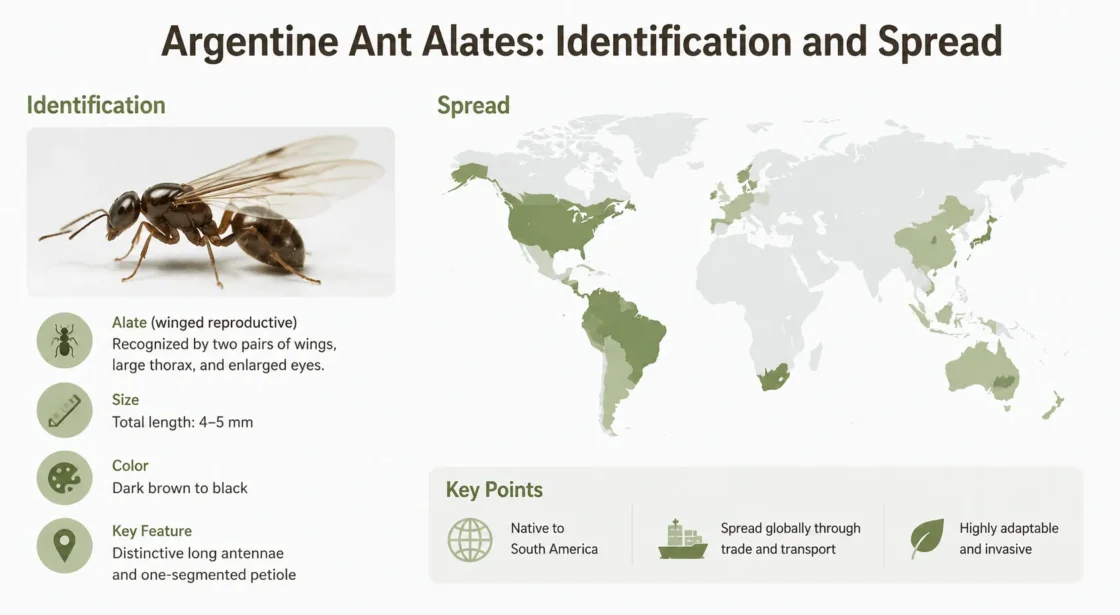
Recognizing an Argentine Ant Alate
An Argentine ant alate is a winged reproductive ant, either a male or an unmated reproductive female. It should not be identified from brown coloration or wings alone. Small brown alates occur in many ant groups, and reproductive castes can look quite different from the workers people usually notice in Argentine ant trails.
Useful Argentine ant characters include elbowed antennae with 12 segments, a narrow ant waist with a single petiole node, and a generally brown to reddish-brown body. Argentine ant workers are small and fairly uniform in size, while queens are substantially larger. University of Florida identification material gives workers at about 2.2–2.6 mm long and describes the queen as larger, winged while unmated, and bearing three ocelli on the top of the head. [b]
USDA-supported IDTools material gives another useful caste comparison: males are about 2.5 mm long and queens about 4–6 mm. Both reproductive sexes can have four whitish to yellowish wings with darker veins; male wings are described as having a stigma, a small pigmented area toward the wing tip. [c]
| Form | Wings | Approximate size | Most useful field impression | Role relevant to spread |
|---|---|---|---|---|
| Worker | Absent | About 2–3 mm | Small, brown, narrow-waisted ant commonly seen in trails | Foraging, nest movement and budding |
| Male alate | Present | About 2.5 mm | Small winged reproductive; much smaller than a queen | Aerial dispersal and mating |
| Female alate | Present before dealation | About 4–6 mm | Noticeably larger body and enlarged wing-bearing mesosoma | Reproduction; usually remains associated with the colony rather than founding alone after a long flight |
| Dealate queen | Wings shed | About 4–6 mm | Large reproductive female with wing scars on the mesosoma | Egg laying and movement with colony fragments during budding |
Body length is supporting evidence, not a species diagnosis. Published measurements vary somewhat among identification resources and specimens. Shape, antennae, petiole structure, accompanying workers and geographic context should be considered together.
Female alates are much easier to separate from workers than males are
A female reproductive has to accommodate flight musculature before wing loss and the anatomy associated with queen reproduction. The middle body region—the mesosoma—therefore appears much more developed than it does in a worker. The overall body is also markedly larger. After mating, Argentine ant queens remove their wings, leaving scars where the wings were attached.
Males create a different identification problem. They are small enough that overall size can overlap the visual impression of a worker, especially in a photograph without a scale. Wings immediately separate an intact male alate from a worker, but sex and species should not be assigned merely because a small brown winged ant occurs near Argentine ant habitat.
Identification clue
When possible, examine wingless workers from the same trail or nest area as well as the alate. Argentine ant worker characters are better documented for routine identification than the appearance of an isolated winged individual.
The Female Has Wings, but the Usual Ant Nuptial-Flight Model Does Not Fit
In many familiar ant life cycles, a virgin queen flies from her natal nest, mates during or around a nuptial flight, lands elsewhere, sheds her wings and attempts to establish a new colony. Applying that sequence automatically to an Argentine ant female alate gives the wrong picture.
Argentine ant queens generally do not undertake the dispersal-oriented mating flights typical of independently founding ant queens. Mating usually occurs within the natal nest or colony system. Males, by contrast, can leave and enter other nests, making male flight the more relevant aerial component of the mating system. [d]
Experiments by Luc Passera and Laurent Keller showed a strongly sex-biased pattern: female sexuals remained in their mother nests, while males dispersed. Males that entered foreign colonies could mate with resident female sexuals. The tendency of a male to leave was also affected by mating opportunities in its original colony.
This distinction changes how a winged Argentine ant should be interpreted. A male in flight can be dispersing between colonies without establishing a colony himself. A winged female does not automatically represent a queen travelling to a distant location to start a nest independently.
Wing loss does not prove that a queen completed a long flight
A dealate Argentine ant queen has passed from the winged reproductive form into a wingless reproductive condition, but the missing wings do not reveal how far she travelled. Because mating normally occurs within the colony system, dealation should not be treated as evidence of a conventional long-distance nuptial flight.
The same caution applies in reverse. A female that still has wings is a reproductive alate, but the wings alone do not show that she is about to leave for independent colony founding. Alate describes the winged form; it does not specify the dispersal strategy used by that species.
Local Spread Happens Mainly Through Budding
Once Argentine ants are established, nearby expansion is closely tied to budding. A mated queen does not need to leave alone, dig an isolated founding chamber and rear the first workers without help. Queens can move with existing workers into additional nest sites, allowing part of an established colony network to occupy new space while retaining the social advantages of a functioning workforce.
A long-term analysis of Argentine ant invasion documented two distinct spatial processes: local diffusion associated with colony budding and much longer jump dispersal associated with human activity. In that study system, the distance gained through budding was far smaller than the jumps responsible for sudden appearances well beyond an existing invasion front. [e]
Three movements that should not be confused
Winged male → flies between colony locations and can contribute to mating and gene flow.
Queen + workers → move on the ground during budding or nest relocation, extending the local nest network.
Colony material transported by people → can create a distant introduction beyond the distance ants would normally cover through local colony movement.
A new nest site may still belong to the same colony network
Argentine ant social organization makes the word nest especially easy to misread. A physical nest is not necessarily an independent colony. Linepithema humile commonly forms polydomous systems in which members of one colony occupy multiple nest sites connected by trails. Workers can move between them, and queens and brood may be distributed unevenly.
This means that ants appearing beneath a second stone, planter, board or patch of soil a short distance away do not automatically represent a newly founded colony produced by a flying queen. They may represent another occupied point within an existing network.
A laboratory study published in 2026 examined this process by starting Argentine ant colonies in a central location and giving them access to multiple peripheral nest sites. The colonies reached a relatively stable spatial distribution within 5–10 days. Queens and brood moved into some peripheral sites, but most expansion sites contained workers only. [f]
What the 5–10 day result means
It describes experimental nest-network expansion, not the speed at which Argentine ants invade landscapes. It should not be converted into a field spread rate or used to predict how quickly a natural infestation will cross a property.
Male Flight, Queen Movement and Colony Spread Operate at Different Scales
The reproductive roles of the two alate sexes are easiest to understand when gene movement and colony movement are separated.
- Male flight can move reproductive genes between nests because dispersing males can mate with resident female reproductives.
- Queen-and-worker budding moves functioning colony units into nearby habitat.
- Human-assisted transport can move viable colony material far beyond the edge of an established population.
A cloud of winged males therefore represents reproductive dispersal, but it should not be mapped directly onto the future edge of the colony. Conversely, a colony front can continue moving through budding even when no queen flight is visible. The species can expand locally with queens travelling on foot alongside workers.
Human Transport Explains the Biggest Geographic Jumps
Linepithema humile originated in South America and is now established far beyond its native range. University of Florida material places the native range in the Paraná River drainage basin of northern Argentina, Paraguay, Uruguay and Brazil and notes that global dispersal has been associated with human trade. The species was already recorded outside its native range during the nineteenth century.
The biology of budding helps explain an apparent contradiction: a species whose queens are poor candidates for long-distance independent aerial founding has nevertheless spread across the globe. Transport can move more than an isolated insect. Soil, nursery stock, potted plants and other materials capable of carrying workers, queens or brood can relocate part of a viable colony system. The exact pathway differs among introductions, so a particular shipment or material should not be blamed without evidence.
This produces a characteristic invasion pattern. Expansion around an established population can be gradual, while a transported colony fragment can create a new focus far away. The distant focus can then begin its own local expansion through budding.
When Argentine Ant Reproductives Appear
Reproductive production is seasonal, but a single universal Argentine ant “alate month” would be misleading. Colony phenology depends on region and climate, and much of the historical work on this species came from introduced populations. New native-range data provide a useful comparison without turning one locality into a worldwide calendar.
A 2026 study followed nests in Ciervo de los Pantanos National Park in Argentina and reported that workers dominated throughout the year, while males appeared earlier in the reproductive season than new queens. Male pupae and adult males first appeared during austral spring. Winged queens were found in late October, and queen pupae were recorded later in spring. The researchers concluded that new queens in this native-range population were produced once during the annual cycle. [g]
Those dates belong to a South American study site. Simply shifting them by six months does not create a dependable flight calendar for California, southern Europe, Australia or another invaded region. The biologically transferable observation is the seasonal sequence: males appeared before newly produced queens, and reproductive production occupied a limited part of the annual cycle.
The same study also found differences between native-range and invasive queens in seasonal reproductive physiology. Native queens retained ovarian activity and some egg laying during winter, while queens from the invaded populations examined entered a winter reproductive pause and showed stronger reproductive activity in spring. That result reinforces why seasonal observations from one population should not automatically be applied to every population of the species.
What an Alate Sighting Actually Shows
Finding a winged Argentine ant can reveal reproductive activity, but the interpretation depends on sex, number of individuals and surrounding colony evidence. The sighting itself does not measure how far the colony has spread.
| Observation | What it can support | What it does not establish |
|---|---|---|
| One small winged male | Reproductive Argentine ant activity may be nearby if the species identification is sound | That a new colony has been founded at the place where the male was found |
| Several winged males around established worker trails | Seasonal reproductive production in a nearby colony system | That queens are leaving on matching long-distance mating flights |
| Winged females within a nest or colony aggregation | Production of female reproductives | That each female will fly away and establish an independent colony |
| Large dealate queen with workers | A reproductive queen associated with a functioning colony fragment | That she arrived there after a long aerial flight |
| Queens, workers and brood moving together | Budding or nest relocation becomes a strong interpretation | That movement originated from an alate swarm |
| Worker trails appearing progressively beyond an established area | Local network expansion is plausible | That flying queens produced every newly occupied nest site |
| A remote new population separated from known colonies | A discontinuous introduction should be considered | The exact transport pathway without supporting evidence |
Indoor observations need the same restraint. A single winged individual at a window may have entered from outdoors. Repeated reproductives accompanied by established worker trails provide stronger evidence of a nearby colony system, but the location of the source nest still requires additional evidence.
Why a Small Brown Flying Ant Is Not Enough for Species-Level Identification
Argentine ant alates overlap visually with other small brown ants. IDTools lists other Linepithema species, members of the Iridomyrmex anceps group and the odorous house ant Tapinoma sessile among relevant lookalikes. Species identification becomes especially uncertain when the only evidence is a distant photograph of a winged insect.
Several traits are more informative when they occur together:
- Elbowed, 12-segmented antennae consistent with Argentine ant morphology.
- A single erect petiole node between the mesosoma and gaster.
- A generally brown to reddish-brown body, used only as supporting evidence.
- The absence of conspicuous spines at the rear of the mesosoma.
- A female reproductive in the approximate 4–6 mm range or a much smaller male reproductive.
- Nearby small, similarly colored workers forming characteristic trails.
- Worker morphology that agrees with diagnostic Linepithema humile characters under closer examination.
Color is among the weaker characters on that list. Lighting, specimen age and photography can alter the apparent shade, while unrelated ant species may occupy the same broad brown color range. The associated workers often provide better species evidence than the alate by itself.
Do not use the alate’s presence as a shortcut for mapping an invasion
A confirmed Argentine ant alate documents a reproductive individual at a place and time. It does not reveal population density, colony boundaries, nest number or the route by which the species arrived. Even confirmed occurrence records have to be interpreted as records of presence rather than direct measurements of abundance.
The Spread Pattern Makes Sense Once the Castes Are Separated
The apparent puzzle of Argentine ant alates disappears when the reproductive castes are assigned their actual roles. Females can be winged without acting as long-distance independent founders. They usually mate within the colony system and, after mating and dealation, queens can take part in colony growth through budding. Males provide the clearer aerial dispersal component, moving between nests and mating with female reproductives.
At the colony level, nearby territory is occupied through a flexible network of workers, queens, brood and multiple nest sites. At much larger geographic scales, accidental human transport can bypass the limits of that local movement and place viable Argentine ant colony material far from an existing population. The result is a species whose global invasion history cannot be understood by watching winged queens alone.
Sources and Verification
- [a] GBIF — Linepithema humile (Mayr, 1868) — accepted scientific name, authority and documented earlier combinations including Iridomyrmex humilis.
- [b] University of Florida IFAS Extension — Argentine Ant Linepithema humile — worker morphology, queen characters, wing loss, mating biology, native range and human-associated global dispersal.
- [c] IDTools — Argentine ant — caste measurements, antennae, petiole, coloration, reproductive wings and male wing stigma.
- [d] Passera & Keller — Mate availability and male dispersal in the Argentine ant — sex-biased dispersal, female sexuals remaining in natal nests and dispersing males mating in foreign colonies.
- [e] Suarez, Holway & Case — Patterns of spread in biological invasions dominated by long-distance jump dispersal — local budding and longer-distance jump dispersal in Argentine ant invasion dynamics.
- [f] Nonacs — Building a polydomous colony: nest network expansion by Linepithema humile — experimental expansion of multi-nest networks and the distribution of workers, queens and brood among new sites.
- [g] Abril et al. — Seasonal life cycle and reproductive physiology of the Argentine ant in its native range — native-range reproductive phenology and seasonal physiological comparisons between native and invasive queens.