Bullet ant alates are the winged reproductive adults of Paraponera clavata: reproductive females capable of becoming colony-founding queens and males whose role centers on mating. They are not winged workers, and they are not a separate kind of bullet ant. The winged condition is temporary for a female that proceeds into post-flight colony founding.
That distinction matters because most familiar images of bullet ants show large, wingless workers. An alate belongs to a different colony caste and carries the flight anatomy needed for reproductive dispersal. After a reproductive female leaves the natal colony, mates, lands and sheds her wings, she can enter the dealate phase associated with founding a new colony. The male follows a different path: he participates in reproduction but does not become a worker or founding queen.
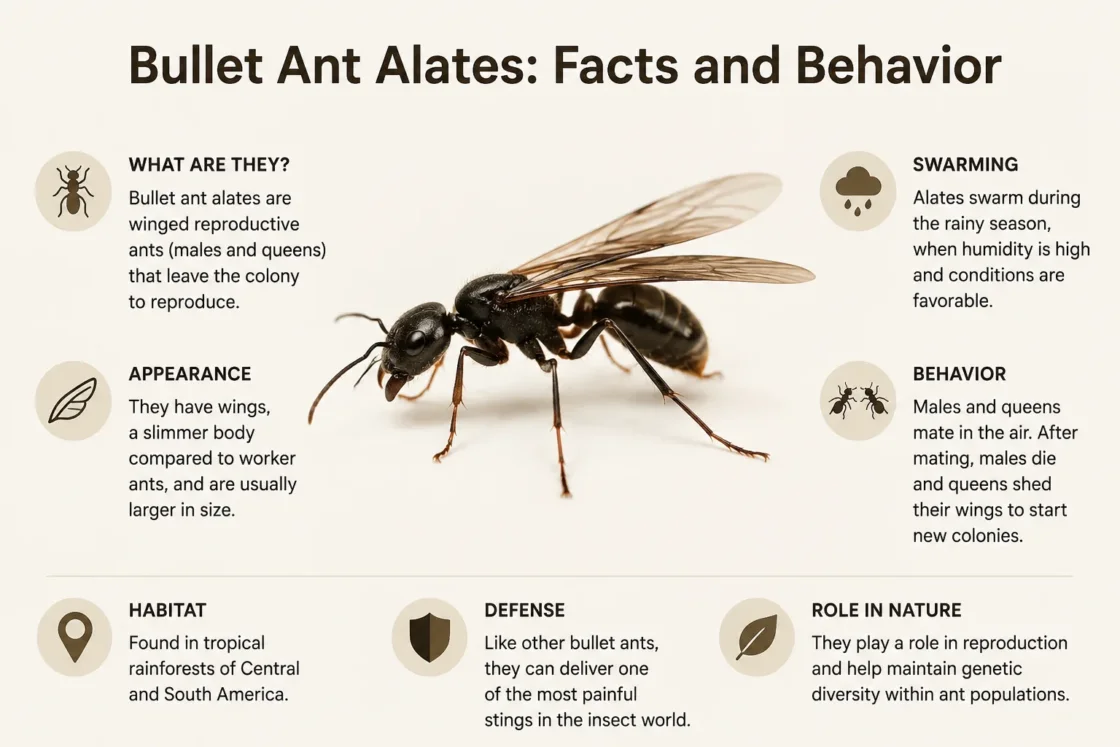
Paraponera clavata is the accepted scientific name for the living species commonly called the bullet ant.[a] Its reproductive biology is especially interesting because direct observations of colony foundation show a slow first-worker phase, food acquisition outside the founding nest and worker-produced trophic eggs fed to larvae.[b]
A Bullet Ant Alate Is a Reproductive Caste, Not a Flying Worker
The term alate describes a winged form. In an ant colony, the familiar winged reproductives and the wingless worker force arise through different developmental pathways. An adult bullet ant worker does not later grow wings and transform into an alate.
For a female, the terminology also changes with reproductive status. A female alate, often called a gyne or virgin queen in ant biology, has the potential to become a colony queen but has not necessarily founded a colony. After the dispersal and mating phase, a female that sheds her wings is dealate. If she then successfully establishes and maintains a colony, she becomes its reproductive queen.
A winged male is also an alate, but the word queen does not apply to him. Wings alone therefore identify a reproductive form more readily than they identify sex.
Female Alate, Male, Worker and Dealate Queen
The four forms represent different points in the colony’s reproductive and working system. Body size alone is a weak shortcut, especially when trying to distinguish a post-flight queen from one of the famously large workers.
| Form | Wings | Sex | Main biological role | What happens next |
|---|---|---|---|---|
| Female alate / gyne | Present | Female | Reproductive dispersal and mating | May become a dealate founding queen |
| Male alate | Present | Male | Mating | Does not found a colony or become a worker |
| Worker | Absent | Female | Foraging, nest work, brood care and defense | Remains part of the worker caste |
| Dealate queen | Shed after previously being winged | Female | Colony foundation and reproduction | Raises brood if colony foundation succeeds |
Why a Bullet Ant Queen Is Not Identified by Size Alone
Ant queens that fly need a mesosoma—the middle body region—capable of housing the musculature associated with wings. Across ants, queen and worker thoracic architecture reflects a trade-off between structures needed for flight and those associated with a permanently wingless terrestrial worker body.[c]
P. clavata shows this distinction in a useful way. Peeters’ comparison of a dealate queen and worker documented differences in thoracic segmentation: in the queen, the pronotum is relatively small compared with the mesonotum, consistent with greater anatomical investment in the flight-bearing part of the thorax before dealation.[b]
While wings are present, they provide the clearest external clue that an adult belongs to the reproductive flight form. After wing loss, thoracic structure and evidence of previous wing attachment become more informative than a simple “large ant equals queen” rule. A large wingless bullet ant seen foraging can still be a worker.
What Happens When Bullet Ant Alates Leave the Colony?
The alate phase exists for reproductive dispersal. As in the familiar ant nuptial-flight pattern, mature colonies can produce winged males and reproductive females that leave the natal colony and create opportunities for mating away from the worker force. Female reproductives can subsequently land, lose their wings and attempt colony foundation. Winged ant males and virgin queens performing this reproductive dispersal are well established in ant biology.[g]
The bullet ant requires more caution when the discussion turns from that general reproductive sequence to exact flight timing. Published species-level work does not support a single universal month, temperature threshold, flight duration or rainfall countdown for P. clavata across its broad Neotropical range.
A distribution study based on georeferenced collection localities found P. clavata broadly associated with wet Neotropical environments and identified rainfall as the strongest variable in its predictive range models.[d] That tells us a great deal about the ecological setting in which bullet ant colonies occur. It does not establish that alates always fly immediately after rain.
| Claim about bullet ant alates | How the evidence should be read |
|---|---|
| Winged reproductives participate in dispersal and reproduction | Well supported by ant reproductive biology and the documented winged/dealate queen morphology of P. clavata. |
| A female can proceed from a winged phase to colony foundation | Supported; a dealate P. clavata foundress has been studied directly during independent colony foundation. |
| Bullet ants have one fixed flight month throughout their range | Not established. A continent-scale calendar would require field data across localities and years. |
| A specific rainfall total triggers every flight | Not established for this species. Rainfall association with habitat should not be treated as a flight threshold. |
| Flight distance and swarm size can be predicted from general ant data | Not defensible. Figures from other ant species should not be transferred to P. clavata. |
After Flight, the Female Faces the Hardest Part: Founding a Colony
For a reproductive female, flight is only the dispersal phase. The biologically demanding transition begins after she has left the natal colony and becomes a foundress. Her wings are no longer needed for the same purpose, and dealation leaves a large reproductive female committed to life on or around the ground rather than continued reproductive flight.
Bullet ant colony founding is unusually useful here because it has been observed directly rather than reconstructed only from mature nests. In a 2017 laboratory study, a dealate queen collected in Peru was followed for 18 months while founding a colony independently.[b]
- The dealate queen reared 10 adult first-generation workers over 18 months.
- The first two workers emerged after approximately five and six months.
- Those first workers were smaller than average and were described as nanitic workers.
- Eight cocoons and several larvae failed during the observation period.
- Food was obtained outside the nest and supplied to larvae.
- Workers were observed laying trophic eggs and giving them directly to larvae.
These values describe one laboratory-observed founding colony. They should not be treated as a fixed timetable or survival rate for every wild bullet ant queen.
The founding queen does not simply live on stored reserves
One revealing feature of the observation was the use of food from outside the nest. The study reports that food was obtained externally and given to larvae, and it notes anecdotal field observations of queen foraging. That makes it unsafe to impose the fully sealed, reserve-dependent founding strategy familiar from some other ants onto bullet ants.
The alate’s flight muscles and large reproductive body do not automatically mean that the post-flight queen can remain sealed underground until workers emerge. In the documented bullet ant case, external food acquisition formed part of the founding process.
The first workers are smaller
The first two workers in the observed colony were nanitics—smaller than average workers. Small first workers are biologically sensible in a young colony operating under the constraints of a single foundress and a tiny workforce, but the published observation should still be read for what it is: a documented case, not a universal body-size formula for every first brood.
The First Workers Feed Larvae With Trophic Eggs
A particularly informative behavior appeared after workers joined the young colony. Peeters observed workers laying trophic eggs and giving them directly to medium and mature larvae on three occasions. Five of six workers dissected immediately after the queen died also contained yolky oocytes in their ovaries.[b]
This behavior changes the picture of the alate-to-colony transition. The founding female begins alone, but once the first workers appear, even a tiny workforce can contribute nutritionally to brood development. The first workers therefore do more than add labor outside the brood chamber; their ovarian activity can also be redirected into food for larvae.
Male Bullet Ant Alates Have a Different Biological Endpoint
A male bullet ant alate is built for reproduction, not colony foundation. He does not land after mating and turn into a worker, and he cannot become a queen. This is why finding a winged bullet ant does not automatically mean that a future colony founder has been found; the insect may be male.
Male anatomy in P. clavata has received detailed modern study. A 2024 Journal of Morphology paper used the species to produce a multimodal anatomical treatment of male genitalia, including three-dimensional approaches intended to improve comparative understanding of insect reproductive anatomy.[f] Detailed male anatomy is therefore much better documented than some field questions about when and how far bullet ant reproductives fly.
Can a Winged Bullet Ant Sting?
Sex matters. In stinging Hymenoptera, the sting is derived from the female ovipositor. Male ants lack an ovipositor and therefore cannot deliver a true venomous sting. Purdue University Extension states this explicitly for male ants, bees and wasps.[e]
A female bullet ant alate belongs to the stinging sex and should not be assumed harmless simply because she has wings. At the same time, the famous defensive behavior associated with bullet ants is most often encountered through workers around an established colony. The existence of a potent worker sting does not justify inventing a separate pain score, attack rate or sting frequency for female alates without direct evidence.
A Plausible Bullet Ant Alate Sighting Needs the Right Geographic Context
Paraponera clavata is a Neotropical ant associated mainly with wet and moist tropical forests. The 2007 distribution study worked from museum collection localities and described records extending from Nicaragua in the north to Bolivia and Brazil toward the southern part of the documented range.[d]
The same research notes that nests typically occur in soil at the base of rainforest trees, although other nesting situations have been reported. That setting gives useful context to a genuine reproductive emergence: a large winged ant appearing around tropical forest vegetation or a known bullet ant nesting area is biologically more plausible than identifying an isolated winged insect far outside the species’ known Neotropical context solely from its size or dark coloration.
Geography still cannot identify an alate by itself. A location inside the known range only makes P. clavata possible; it does not separate bullet ants from every other large ant occurring in the same region. Clear views of the body, antennae, waist, thorax and wings provide stronger identification evidence than color alone.
Why Bullet Ant Alates Are Encountered Less Often Than Workers
The worker caste is a persistent part of an established colony. Workers repeatedly forage, maintain the nest, tend brood and defend colony space. A winged reproductive occupies a much narrower biological window. It develops for reproduction and dispersal, then leaves the natal colony when the reproductive phase proceeds.
The female’s visible alate condition can end when she sheds her wings. After that transition, a surviving reproductive is no longer recognizable simply as a “flying bullet ant.” The male likewise does not join the long-term workforce. This temporary reproductive window explains why the species can be familiar from worker observations while intact winged reproductives remain comparatively unfamiliar.
The Bullet Ant Alate Sequence
Mature colony
↓
Winged reproductive males and females
↓
Reproductive dispersal and mating opportunity
↓
Female lands and enters the post-flight phase
↓
Wing loss / dealation
↓
Independent colony foundation
↓
Eggs and larvae
↓
First small workers emerge
↓
Workers expand brood care and can provide trophic eggs
↓
Growing worker force and continued queen reproduction
The sequence is useful because it separates two events that are easy to collapse into one. Becoming an alate happens before dispersal; becoming a successful queen requires surviving what comes afterward. Wings create the opportunity to leave the natal colony. They do not guarantee mating, successful nest establishment, brood survival or the emergence of a viable worker force.
What Remains Poorly Documented
Direct study of bullet ant colony foundation has filled in part of the post-flight story, but several details often presented casually in discussions of flying ants remain poorly resolved for P. clavata. There is no well-supported species-wide calendar giving one dependable nuptial-flight month across its range. Exact flight distance, flight height, swarm size, mating duration and universal weather thresholds should likewise not be supplied from other ant species as if they were bullet ant measurements.
The distinction between known reproductive biology and missing field measurements is especially useful for this species. The dealate founding queen has been observed obtaining food, slowly producing her first workers and receiving help from workers that feed trophic eggs to larvae. Those are species-level observations. A precise rainfall countdown or continent-wide flight date is not.
Sources and Verification
- GBIF — Paraponera clavata (Fabricius, 1775) — Current accepted taxon record and synonymy sourced from Catalogue of Life. [a]
- Peeters (2017), Sociobiology — Independent colony foundation in Paraponera clavata — Dealate foundress, first-worker timing, nanitic workers, external food acquisition, trophic eggs and queen–worker functional morphology. [b]
- Keller, Peeters & Beldade (2014), eLife — Evolution of thorax architecture in ant castes — Queen and worker thoracic specialization associated with flight versus ground-based function. [c]
- Murphy & Breed (2007), Journal of Insect Science — A predictive distribution map for the giant tropical ant, Paraponera clavata — Museum-locality range evidence, wet-forest association, nesting context and climatic variables in distribution modeling. [d]
- Purdue University Extension — Stinging Insects — Ovipositor-derived sting in female social Hymenoptera and the absence of an ovipositor-based sting in male ants, bees and wasps. [e]
- Boudinot et al. (2024), Journal of Morphology — Male genitalia and anatomy of the bullet ant — Modern multimodal anatomical study of male P. clavata. [f]
- Natural History Museum — Winged ants and nuptial flight — General ant context for winged males, reproductive females, mating dispersal and post-flight female wing loss. [g]