Female ant alates are often larger and more heavily built than ordinary workers of the same species, but alates are not universally the larger caste. The comparison depends on whether the alate is female or male, which worker is being used for comparison, and how size is measured. In some ants, reproductive females and workers are close in size. In others, the difference is extreme.
Wings can also make an alate look much larger than it really is. A winged ant occupies more visual space, yet wingspan is not body size. For a useful comparison, the body itself has to be examined.
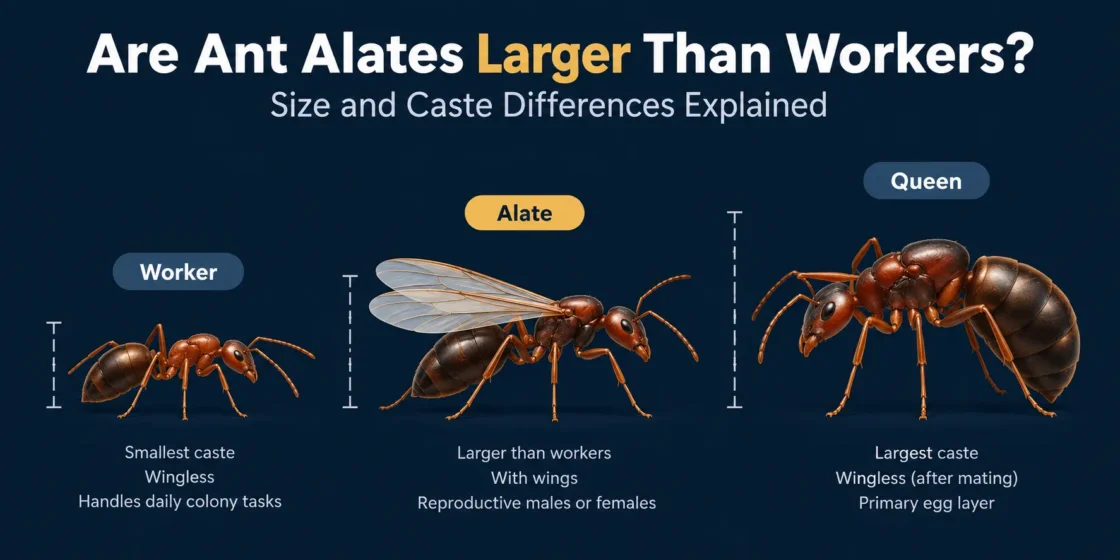
“Alate” Does Not Mean “Large Ant”
In ants, an alate is a winged reproductive form. That includes reproductive females and males. The word describes a winged caste or life stage, not a particular size class.
This distinction changes the answer to the size question. A reproductive female—often called a gyne before colony founding—may have a much bulkier body than nearby workers. A male from the same colony can have very different proportions, often with a more slender abdomen and a head that appears small relative to the eyes and mesosoma. Male size, however, varies too, so “male alates are always smaller than workers” would be another unreliable rule.
| Caste or form | Wings | Primary role | What size usually tells you |
|---|---|---|---|
| Female alate | Present before dealation | Dispersal, mating and potential colony founding | Often bulkier than ordinary workers, but the difference is species-dependent |
| Male alate | Present | Dispersal and mating | Highly variable; should not be grouped with females for a simple size rule |
| Worker | Absent | Foraging, brood care, nest work and defense | May occur in one size range or several worker size classes |
Why Female Alates Often Have a Larger Mesosoma
One of the clearest caste differences is found in the mesosoma, the central body region that carries the legs and, in alates, the wings. A winged reproductive female needs a flight apparatus. Workers do not.
Micro-CT comparisons of winged queens and workers show how deeply this changes ant anatomy. In the studied species, queens possess large indirect flight muscles occupying much of the thoracic cavity. Workers lack that flight musculature, and their thoracic architecture is reorganized around terrestrial work, including structures and muscles involved in moving the head, legs and abdomen.[c]
A worker therefore should not be pictured as a small queen with the wings removed. The two castes are built differently. The enlarged flight-bearing region of many female reproductives is one reason they can look taller, deeper-bodied or more massive through the middle of the body than workers from the same colony.
A useful visual clue
When comparing a suspected reproductive female with a worker, mesosoma shape can be more informative than total apparent size. A large worker may have an enormous head, while a reproductive female may stand out more through the flight-adapted middle of the body.
The Size Difference Can Range From Almost None to Extreme
There is no reliable statement such as “an ant alate is twice the size of a worker.” Ant lineages differ too much for a universal ratio.
A large comparative study published in Evolution examined reproductive specialization across 546 ant species. For the size analysis, the researchers obtained overlapping queen and worker head measurements for 76 species and calculated reproductive size dimorphism as mean queen head width divided by minimum worker head width.[a]
How wide was the measured range?
The queen-to-worker head-width ratio ranged from 0.84 in Veromessor pergandei to 7.03 in Dorylus nigricans. A ratio of 1 would represent equal head widths under this measurement method.
The authors estimated that a width ratio at the upper end could correspond to roughly 350 times the overall volume if body size scales with width cubed. That does not mean the queen was 350 times longer, nor was 350× a directly measured body-mass difference.
The 0.84 value is especially useful because it demonstrates why “queens are always larger than workers” is too absolute. Even among reproductive females, the relationship depends on the species and on the body dimension being measured.
The same research found that larger colony sizes were associated evolutionarily with greater queen–worker size dimorphism. That pattern describes diversification across ant species; it should not be turned into a field rule for estimating the population of an individual nest from the size of one alate.
A Worker Is Not Always a Single Standard Size
The question becomes harder in species with worker polymorphism. Some ants have workers clustered around one general body form and size range. Others produce workers that differ sharply in size and morphology.
Depending on the species, terms such as minor, media, major or soldier may be used for different parts of that worker variation. A major worker can have a much broader head and heavier-looking body than a minor from the same colony. Comparing an alate only with the smallest workers can therefore make reproductive dimorphism look much greater than comparing it with the largest workers.
A 2024 analysis assembled social-trait data from 794 ant species and found that larger colony sizes favoured the evolution of more physical worker castes and greater worker-size variation. Among the species for which worker-caste number was available, 76% had a single physical worker caste, while the remainder illustrate why “the worker size” is not always one fixed value.[b]
This also explains why a very large wingless ant should not automatically be labelled a queen. In a polymorphic species, it may simply be a major worker.
Wings Can Exaggerate Apparent Size
A winged reproductive resting beside a worker may appear several times larger at first glance because its wings extend well beyond the body. That visual footprint is useful for noticing the insect, but it is a poor measurement of caste size.
Exclude the wings when comparing body size. For a casual comparison, examine the body from the head through the end of the gaster and pay attention to head width and mesosoma dimensions. Scientific studies may use more repeatable measurements such as head width rather than relying on a visual estimate of total length.
Different measurements can also change the impression. A major worker may dominate a head-width comparison because of enlarged head morphology, while a reproductive female may be deeper-bodied through the mesosoma or larger in overall volume. “Larger” should therefore be tied to a measurement whenever precision matters.
Female and Male Alates Should Be Compared Separately
A mating flight can contain both sexes, so two winged ants emerging from the same colony need not be similar in size or shape. The female reproductive and male reproductive follow different developmental programs and reproductive roles.
| Trait | Female alate | Male alate |
|---|---|---|
| Reproductive role | May mate and later attempt colony founding | Mates with reproductive females |
| General build | Often comparatively heavy-bodied, especially through the mesosoma and gaster | Often more slender, with proportions that can make the head appear smaller |
| Relationship to worker size | Frequently larger than ordinary workers, with many exceptions across species | Variable; no universal male-to-worker ratio |
| Can size identify the sex? | No. Body proportions and sex-specific morphology are more useful than size alone. | |
This matters when interpreting research as well. A queen–worker dimorphism study is a comparison of female reproductives and workers; it does not establish a size ratio for every winged male produced by those species.
Caste Size Is Established During Development
An adult worker does not become a reproductive alate by growing wings later. Physical caste differences are established during development, producing adults with different morphology and functional anatomy. The comparative study of worker castes describes these physical castes as developmentally determined and fixed for adult life.[b]
That developmental separation helps explain why caste differences involve more than body length. Flight apparatus, head proportions, reproductive anatomy and the allocation of space within the mesosoma can all differ between reproductives and workers.
After Wing Loss, a Female Reproductive Does Not Become Worker-Sized
A female alate may shed or remove her wings after a mating flight. Once wingless, she can be described as dealate. Losing the wings changes her wing condition; it does not transform her into a worker.
The body that supported flight remains morphologically different from a worker body. Wing scars may remain visible on the mesosoma, and the reproductive female can retain the broader or more developed mesosoma associated with her former flight apparatus.
This creates a common identification problem: a large wingless ant is not automatically a worker, and it is not automatically a queen either. It could be a dealate reproductive, a major worker, or simply a member of a larger-bodied ant species. Structure and context are needed to separate those possibilities.
How to Make a Meaningful Alate–Worker Size Comparison
- First establish that the ants are plausibly the same species. A large alate beside a small worker from another species says nothing about caste dimorphism.
- Separate female and male alates where possible. Combining both sexes can hide very different body proportions.
- Ignore the wings when judging body size. Compare the insect body itself rather than the space occupied by the wings.
- Look at the mesosoma. Female reproductives often show the body architecture associated with a flight apparatus, while workers have a flightless worker form.
- Check whether worker polymorphism is possible. A tiny minor and a large major from one colony should not be treated as interchangeable reference specimens.
- For a wingless suspected reproductive, look for wing scars. Their presence supports prior winged status and can help distinguish a dealate female from a worker.
- Use size as supporting evidence. Size can strengthen a caste interpretation, but it rarely settles caste or species identity by itself.
Does a Larger Alate Mean a Larger Ant Species?
No. Relative caste dimorphism and the overall body size of a species are different traits.
A relatively small ant species can have a pronounced difference between reproductive females and its smallest workers. Another species may be larger overall while showing much less difference between those castes. Cross-species comparisons therefore need actual measurements rather than statements such as “the species with the biggest queen must have the biggest workers.”
Can Alate Size Reveal the Size or Age of the Colony?
Not reliably. Production of winged reproductives is associated with a colony reaching the reproductive phase of its life cycle, but the body size of one alate does not provide a dependable count of workers or an exact colony age.
Across species, evolutionary research has found relationships between colony size and caste differentiation. That is different from estimating one individual nest. Species biology, worker caste structure, environmental conditions and reproductive strategy all interfere with a simple “bigger alate equals bigger colony” interpretation.
What Size Can Actually Tell You
Size is most useful when it is treated as one piece of caste evidence. A bulky winged female standing among much smaller workers can strongly support a reproductive-caste interpretation. The evidence becomes weaker when sex is unknown, the insects may belong to different species, or the colony has several worker size classes.
The safest general statement is therefore narrow: female ant alates are often larger than ordinary workers of their species, sometimes dramatically so, but there is no universal alate-to-worker size ratio. Male alates add another layer of variation, and worker polymorphism can make even a same-species comparison depend on which worker is standing beside the reproductive.
Scientific Sources
- Turner, J. F. R. et al. — Larger colony sizes favour greater division of labour between queens and workers in ants, Evolution. Queen–worker head-size measurements, reproductive dimorphism range and the relationship between colony size and caste differentiation. Oxford Academic [a]
- Bell-Roberts, L. et al. — Larger colony sizes favoured the evolution of more worker castes in ants, Nature Ecology & Evolution. Comparative data on 794 ant species, physical worker castes, worker-size variation and developmental fixation of physical castes. Nature Ecology & Evolution [b]
- Peeters, C. et al. — The loss of flight in ant workers enabled an evolutionary redesign of the thorax for ground labour. Micro-CT evidence comparing the flight-bearing thorax of winged queens with the reorganized thoracic anatomy of workers. PubMed Central [c]