A termite swarm can reveal a hidden problem, but the swarm itself is not termite damage. Swarmers are reproductive termites; the worker caste is responsible for feeding on wood. After a swarm, the useful evidence is found in where the insects emerged, what the wood looks like beneath the surface, whether mud or pellets are present, and whether there are signs of current termite activity. A swarm seen today also does not mean the damage began today. [a]
Swarm date is not damage date
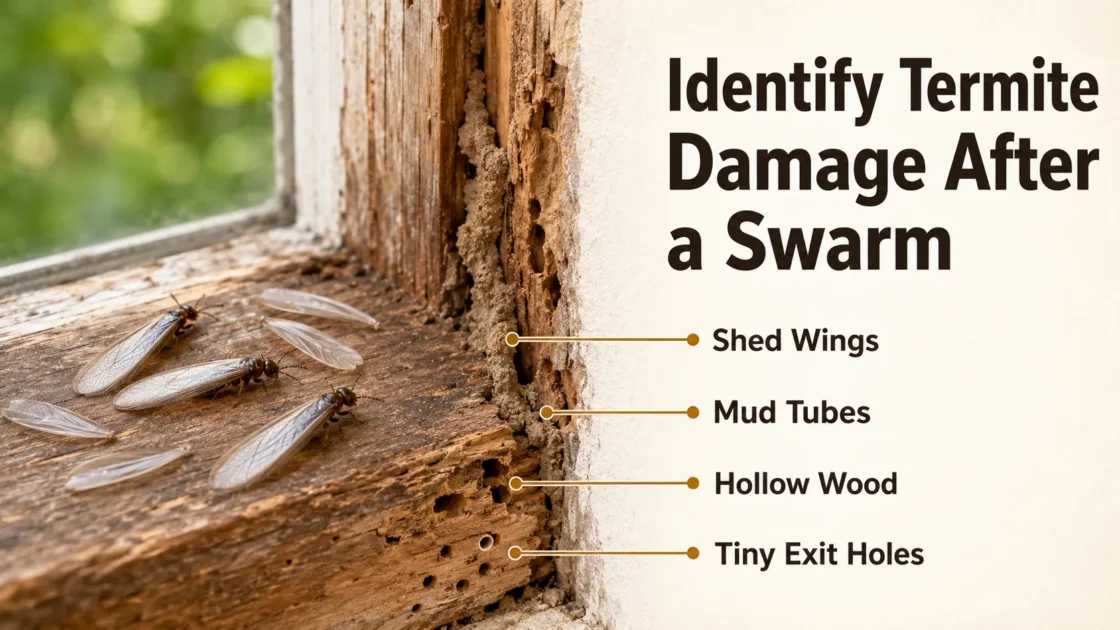
A swarm can tell when reproductive termites became visible. It cannot establish when workers first reached the wood, how long feeding has continued, how far galleries extend, or whether every damaged area is still active. NC State Extension notes that there is no accurate method for assigning an age to newly discovered termite damage without an earlier reference point showing that the wood was undamaged. [b]
Start Where the Swarm Actually Came From
The first inspection area should be the probable emergence point, not automatically the place where the dead swarmers or shed wings accumulated. This distinction is especially useful indoors because termite alates may move toward light after emerging. NC State Extension notes that indoor swarmers often die on windowsills and other open, lighted areas. A windowsill full of wings may therefore be an accumulation point rather than the opening through which the termites entered the room. [c]
If termites were seen coming directly from a baseboard, wall joint, floor edge, door or window trim, ceiling opening, plumbing penetration, expansion joint, or crack, inspect that location and the construction immediately around it. The route may continue downward toward a slab or foundation, sideways through framing, or into a specific wooden member.
Shed wings can still help narrow the search, but their distribution matters. A dense concentration in one room, around one section of trim, or along one wall deserves more attention than a few wings beside an open window during an outdoor flight. If identification of the insects themselves is uncertain, the separate termite swarmer identification evidence should be resolved before interpreting damaged wood as termite damage.
An outdoor swarm changes the interpretation
Termites swarming from a stump, buried wood, landscape timber, fence post, dead tree, firewood, or soil near a building show that a reproductive flight occurred nearby. They do not by themselves demonstrate that structural wood has been reached. For subterranean termites, outdoor alates can originate from colonies elsewhere in the surrounding landscape; indoor emergence is much more closely tied to investigation of the building itself. [d]
What Termite-Damaged Wood Actually Looks Like
Termite damage can remain concealed behind a surface that initially looks intact. Workers feed within protected areas of wood and other cellulose-containing materials, so the visible face of a board, sill, trim piece, wall covering, or framing member may reveal less damage than the interior contains. A normal-looking surface does not establish that the material behind it is sound.
A thin surface over hollowed wood
Subterranean termite feeding can leave wood that sounds hollow when gently tapped or feels unusually soft where the interior has been consumed. NC State Extension lists hollow-sounding wood, wood that is easily penetrated, and a gritty gray-brown surface film among signs associated with subterranean termite damage. [e] The U.S. Environmental Protection Agency likewise recommends examining accessible exposed wood for hollow areas when termite activity is suspected. [f]
A hollow sound is supporting evidence, not a termite diagnosis. Voids, construction details, decay, previous repairs, and other wood-destroying organisms can alter how wood sounds or feels. The stronger interpretation comes when hollow or weakened wood occurs together with termite galleries, mud-like material, shelter tubes, live termites, drywood pellets, or a documented emergence point.
Sunken lines beneath paint or wall coverings
Damage is not always exposed as bare wood. Narrow winding depressions or sunken areas beneath paint, wallpaper, or other thin surfaces can result when termite galleries lie immediately underneath. Mississippi State University Extension documents termites feeding on the paper covering of gypsum wallboard while leaving the gypsum itself untouched, allowing a thin painted surface to remain over the feeding area. [g]
Bubbling paint, warped trim, cracked finishes, or a sticking door should not be labeled termite damage from appearance alone. Moisture movement, fungal decay, construction defects, and ordinary material failure can produce overlapping symptoms. The condition becomes more informative when a termite-specific trace is found beneath or beside it.
The Material Inside the Galleries Can Narrow the Termite Type
One of the most useful post-swarm distinctions is whether damaged wood is associated with soil or mud-like material or with dry fecal pellets and kick-out holes. Subterranean and drywood termites occupy structures differently, so their surrounding evidence is not interchangeable.
| Evidence around the wood | More consistent with subterranean termites | More consistent with drywood termites | What it does not prove |
|---|---|---|---|
| Mud or shelter tubes | Yes | Not typical | The full extent of hidden wood damage |
| Soil-like or muddy material within galleries | Yes | Not the usual drywood pattern | The exact age of the damage |
| Hard, repeatedly shaped fecal pellets | Not the normal clue | Yes | Whether every nearby wooden member is infested |
| Small pellet kick-out holes | Not the normal clue | Yes | The boundaries of the hidden colony |
| Hollow or weakened wood | Possible | Possible | Termite type by itself |
| Shed swarmer wings | Possible | Possible | Damage amount or colony location by themselves |
Mud in or around the wood points toward subterranean termite evidence
Subterranean termites maintain protected connections between soil, shelter tubes, and feeding sites. Damage may contain dried soil, dirt-like material, or mud lining the galleries. That feature can help separate termite feeding from ordinary rot and from the cleaner excavations produced by carpenter ants. Mississippi State Extension notes that galleries containing dried mud establish termite damage, although damage without termites still present may be left from an infestation that was controlled earlier. [h]
Search for associated shelter tubes along foundation walls, piers, crawlspace supports, slab edges, plumbing penetrations, siding transitions, and other protected routes between soil and structural material. UC IPM describes subterranean termites as soil-nesting termites that commonly reach wood through earthen shelter tubes. [i]
A tube that contains live workers or is rebuilt after disruption supports current activity at that route. An empty or broken tube is less conclusive. NC State Extension notes that tubes can be abandoned and that finding no termites inside one broken tube does not establish that termites are absent elsewhere in the structure. [j]
Dry pellets below wood point in a different direction
Drywood termites live within wood without requiring a soil connection. Their colonies can therefore leave no foundation mud tube at all. A more characteristic trace is a pile of small, hard fecal pellets expelled from openings in the wood. Under magnification, properly identified drywood termite pellets show a repeated six-sided form with longitudinal surfaces. UC IPM lists feeding damage, shed wings, fecal pellets, and small kick-out holes among the features used to detect drywood termites. [k]
When pellets are found below a beam, trim board, window frame, cabinet, furniture item, or other wooden object, inspect the wood above the pile for the source opening. The pile can fall some distance from the actual gallery, so the debris on the floor is not itself the colony boundary.
Pellets are also not a reliable clock. UC IPM states that pellets alone cannot establish whether a drywood infestation is currently active or how far it extends through a wooden member or structure. After the area is documented, removing the pellets and watching for a newly accumulating pile can provide more useful activity evidence, although vibration can dislodge older pellets from previously infested wood. [l]
More detailed identification of pellets, kick-out holes, and drywood alates belongs to drywood termite swarmer evidence; after a swarm, the practical task is to connect those traces to the wood from which they originated.
Can the Damage Be Separated Into Active and Old Evidence?
Existing wood loss does not disappear when termite activity stops. Old galleries, dried mud, previous shelter tubes, pellet material, surface scars, and weakened wood can remain long after the colony has left or treatment has occurred. For that reason, the appearance of damaged wood cannot reliably answer whether termites are feeding there now. [m]
| Finding | What it supports | Current activity interpretation |
|---|---|---|
| Live workers or soldiers inside damaged wood | Termites are occupying that location | Direct evidence of current activity at the inspected point |
| Live termites in a shelter tube | A protected subterranean route is in use | Supports current activity at that route |
| A disrupted tube that is rebuilt | Termites are maintaining the route | Supports current activity |
| New drywood pellets accumulating after documented cleanup | Pellets are continuing to leave the wood | Stronger activity evidence than an undated pellet pile |
| Dried mud in empty galleries | Termite damage occurred | Cannot establish that termites remain there |
| Old hollowed or weakened wood | Material has been lost or altered | Cannot date the damage by appearance |
| Shed wings after a swarm | A reproductive flight occurred | Does not show which damaged wood is still active |
The distinction also explains why killing visible swarmers does not resolve hidden feeding. NC State Extension states that swarmers do not cause structural damage; worker termites do. Removing the flying reproductives therefore removes the visible insects without reaching workers already concealed in wood, soil, or shelter routes. [n]
Trace the Evidence Through the Building in a Logical Order
Randomly tapping walls throughout a house is less useful than following the physical relationship between the swarm and the structure. Begin with the observed event and move outward from it.
- Examine the emergence area. Check the crack, joint, trim, floor edge, ceiling opening, or other location from which termites were actually seen appearing. Photograph the location before cleaning or sealing it.
- Inspect the same wall or structural line. Follow baseboards, door and window framing, flooring edges, sill areas, and accessible wood connected to the emergence point.
- Check the opposite side. An interior emergence point may correspond with an exterior foundation edge, siding transition, porch connection, plumbing route, crawlspace, or other concealed access area.
- Move toward the foundation for subterranean evidence. Examine accessible slab edges, foundation walls, crawlspace piers, sill plates, joists, plumbing penetrations, and soil-to-structure interfaces for tubes or mud.
- Move upward when the swarm emerged high in the building. Upper-wall trim, attic framing, eaves, roof leaks, and moisture-affected areas may deserve inspection when the evidence begins above ground level.
- Follow pellet piles upward for drywood evidence. A pile below furniture, trim, exposed framing, a cabinet, or a beam should lead to inspection of the wooden material directly above and around it.
Moisture deserves attention during this route because leaks and persistently damp construction can change which wood-destroying organisms are plausible and can create conditions favorable to some termite situations. Moisture damage itself, however, should not be converted into a termite diagnosis without termite-specific evidence.
Termite Damage Has Several Common Look-Alikes
Discovering weak or hollow wood immediately after seeing winged insects creates an easy opportunity for misidentification. The timing of two observations does not establish that they have the same cause. Several other conditions can alter wood or produce debris around it.
Carpenter ant galleries are excavated, not eaten
Carpenter ants remove wood while creating nest galleries rather than consuming it as food. University of Minnesota Extension describes carpenter-ant galleries as clean and smooth, with a sanded appearance. Termite tunneling, by comparison, may contain dirt-like material rather than the clean interior associated with carpenter-ant excavation. Coarse wood fragments around an ant gallery also differ from the repeated hard pellet form associated with drywood termites. [o]
Wood-boring beetles often leave exit holes and a different frass pattern
Several groups of wood-boring beetles damage structural or decorative wood. Adults commonly leave round emergence holes, while larval feeding can produce powdery or gritty frass whose texture varies among beetle groups. A round hole and loose powder therefore warrant a different identification path from subterranean mud galleries or properly identified drywood termite pellets. [p]
Rot can weaken wood without producing termite galleries
Fungal decay and chronic moisture can make wood soft, discolored, cracked, crumbly, or structurally weak. Those changes may occur in the same areas where termites are found, so rot and termite damage are not mutually exclusive. The termite interpretation should come from evidence such as insects, characteristic galleries, mud, shelter tubes, drywood pellets, kick-out holes, or emergence from the affected material—not softness alone.
What the Swarm Cannot Reveal About the Damage
A swarm is highly visible, but it answers fewer structural questions than the damaged material itself. Even a confirmed termite swarm cannot be used as a direct measure of:
- when feeding began;
- how much wood has been removed;
- how many structural members are affected;
- whether every visible damaged area is still active;
- whether the window where wings accumulated is the colony location;
- whether an outdoor colony has entered the building; or
- whether a weakened member still has adequate structural capacity.
This is why swarm evidence, termite activity evidence, physical wood damage, and structural damage extent should be treated as separate questions. They can overlap in the same building without being interchangeable.
Visible Damage May Be Only the Accessible Part
Termites spend much of their time concealed in wood, soil, galleries, wall cavities, and protected travel routes. Mississippi State Extension notes that infestations can remain difficult to detect until populations produce visible damage, shelter tubes, or swarmers. A previous inspection with no visible evidence therefore does not establish that concealed termites could not have been present. [q]
The opposite error is also possible. One damaged trim board does not demonstrate that an entire house has extensive structural damage. Drywood termite colonies can be hidden within individual wooden components, while subterranean feeding can occur along concealed routes that are not obvious from a single exposed location. UC IPM notes that determining the extent of drywood termite infestation can require experience because colonies are concealed inside the wood and wall coverings can obscure their boundaries. [r]
Termite inspection and structural assessment answer different questions
An insect or pest inspection can establish termite identity, evidence of activity, likely access routes, and areas needing closer examination. Determining whether a damaged joist, beam, sill, post, header, roof member, or other load-bearing component remains structurally adequate is a separate construction or engineering question.
When Termite Damage Becomes a Structural Issue
Damage deserves structural evaluation when wood loss is associated with a visible change in how the building is supported or aligned. Examples include a sagging floor or roof, a heavily hollowed sill or joist, a damaged post or beam, a failing door frame, or a member that has lost an obvious portion of its cross-section. Mississippi State Extension specifically lists sagging floors or roofs and damaged structural timbers among situations where termite galleries may be uncovered and professional inspection is warranted. [s]
Do not create damage simply to look for damage
Accessible trim or exposed wood can sometimes be examined gently, but cutting, drilling, prying apart, or removing a suspected load-bearing beam, joist, sill plate, header, post, roof member, or concealed structural connection solely to search for termites can damage the building and erase useful evidence. Hidden areas that require destructive access are better evaluated as part of a planned inspection or repair.
Preserve the Evidence Before Cleaning the Swarm Area
Vacuuming dead swarmers immediately can remove the evidence that helps establish what happened and where it began. A small amount of documentation is more useful than an elaborate monitoring system.
- Photograph the exact place where termites were first seen emerging, if it was observed.
- Keep several reasonably intact swarmers or shed wings for identification rather than discarding every specimen.
- Photograph wing concentrations before moving them, including enough surrounding area to show whether they were beside a window, trim joint, wall opening, or light fixture.
- Photograph mud tubes, exposed galleries, damaged wood, pellet piles, and kick-out holes before disturbing them.
- If a drywood pellet pile is documented and cleaned, note the location so any later accumulation can be distinguished from the original debris.
- Do not paint over, caulk, replace, or dismantle the suspected emergence point before its relationship to the surrounding evidence has been recorded.
The U.S. EPA describes swarms and exposed wood damage as two common ways termite problems first become apparent. After the swarm, the useful next step is therefore not to estimate damage from the number of flying termites, but to connect the reproductive event to physical evidence in the structure. [t]
Sources
- NC State Extension — Termite Swarmers: What Do They Mean for You? — reproductive caste, worker-caused structural damage, indoor versus outdoor swarm interpretation, and specimen preservation. [a] [d] [n]
- NC State Extension — Monitoring and Management of Eastern Subterranean Termites — limits on dating termite damage and visible characteristics of damaged wood. [b] [e]
- NC State Extension — Termite Swarmers: What Do They Mean for You? — attraction to light and accumulation of indoor swarmers at windowsills and other open areas. [c]
- U.S. Environmental Protection Agency — Termites: How to Identify and Control Them — swarms, exposed wood inspection, hollow spots, and termite identification context. [f] [t]
- Mississippi State University Extension — Signs of Termite Infestation — concealed galleries beneath wall coverings, mud in galleries, old versus active damage, structural symptoms, drywood pellets, and limits of visual inspection. [g] [h] [q] [s]
- UC Statewide IPM Program — Subterranean and Other Termites — subterranean soil association, shelter tubes, termite groups, and differences from drywood termites. [i]
- NC State Extension — Biology and Behavior of Eastern Subterranean Termites — mud tubes, hollow wood, mud within damaged wood, and interpretation of abandoned tubes. [j]
- UC Statewide IPM Program — Drywood Termites — drywood feeding damage, shed wings, six-sided fecal pellets, kick-out holes, detection limits, and pellet monitoring. [k] [l] [r]
- NC State Extension — Monitoring and Management of Eastern Subterranean Termites — inability to reliably determine damage age from appearance alone. [m]
- University of Minnesota Extension — Carpenter Ants — carpenter ants excavate rather than eat wood and produce clean, smooth galleries. [o]
- UC Statewide IPM Program — Wood-Boring Beetles in Homes — wood-boring beetle damage, adult emergence holes, and differential identification. [p]