A sudden cloud of winged leafcutter ants above a nest is a reproductive flight, not a mass departure of the worker force. Mature colonies have already produced winged males and unmated reproductive females, or gynes, before the event begins. When suitable environmental conditions coincide across several colonies, large numbers can leave within a narrow time window and turn an otherwise hidden reproductive investment into a conspicuous swarm.
The scale can be remarkable. In a field study of Atta vollenweideri in northern Argentina, researchers estimated that a mature colony produced roughly 30,000–40,000 males and 4,000–5,000 gynes per year. Those figures describe estimated annual production in the studied colonies, not the number leaving in one instant. The same population used multiple flight days in some years, while neighboring colonies could synchronize their departures. [a]
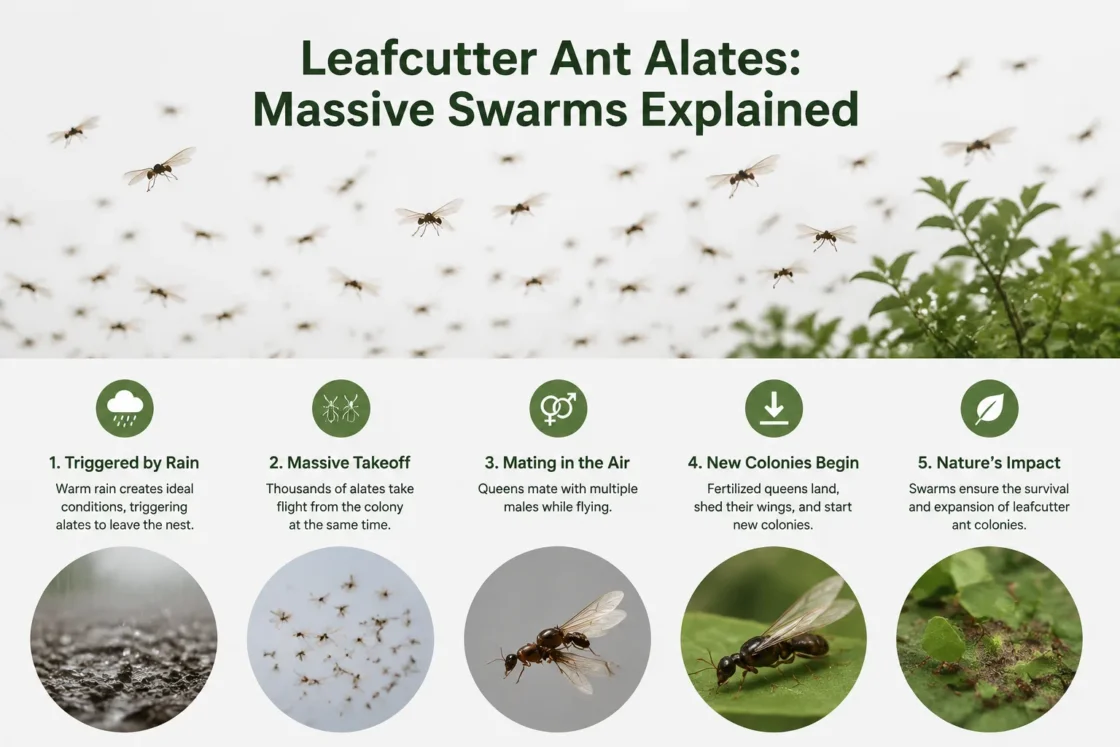
A Massive Swarm Is the Visible Part of a Much Larger Colony
Atta colonies can contain enormous worker populations, but workers are not the individuals leaving to mate. The swarm consists of a temporary reproductive caste produced by colonies that have reached the stage at which they can invest resources in males and future queens.
The alates have also not appeared because of a rainstorm the previous night. In the studied A. vollenweideri colonies, reproductive individuals were produced well before the first visible signs of swarming. Suitable weather helps determine when prepared alates are released; it does not transform workers into winged ants or create thousands of reproductives overnight.
Synchronization multiplies the visible effect. A single mature nest can release large numbers, but several colonies responding to the same rainfall, temperature and seasonal conditions can produce what appears to be one immense aerial event. The biological unit seen overhead may therefore be larger than any single colony’s flight.
The Swarm Begins Before the First Alate Leaves the Ground
Detailed observations of A. vollenweideri separated swarming behavior into three consecutive stages: initiation, aggregation and mating flight. This sequence shows why a leafcutter swarm should not be understood as ants simply deciding to fly at once.
Workers prepare the nest surface
After sufficient rain in the Argentine study population, workers enlarged major entrances and opened additional peripheral entrances. Alates could be seen near the central tunnels during nights preceding a flight. On the flight day, large workers and soldiers became unusually active over the mound and nearby vegetation.
Males can cover the mound before take-off
The aggregation stage began when males emerged onto the nest surface. In the focal colonies they eventually appeared from most nest openings and became so dense that parts of the mound could be covered by multiple layers of males. This surface accumulation can itself look like a swarm even though the main aerial departure has not yet started.
Future queens follow the male departure
In these observations, males began taking off first. Gynes appeared around the major entrances shortly afterward and spent far less time exposed on the mound before becoming airborne. Male departures rose rapidly into a concentrated mass flight, with female departures overlapping the male peak.
Rain Sets the Stage, but There Is No Universal Leafcutter Swarm Formula
Rain is strongly associated with reproductive flights in several well-studied Atta populations, yet the useful variable is not simply “did it rain?” The amount accumulated over preceding weeks, soil properties, temperature after rain, wind and local seasonal timing can all change whether prepared colonies actually release their alates.
| Studied population | Observed flight pattern | What the weather evidence shows |
|---|---|---|
| Atta vollenweideri Northern Argentina | Late-afternoon flights before dusk during austral spring | The first annual flight followed at least 64.2 mm of cumulative precipitation during the preceding 30 days in the 2004–2010 dataset. Flights followed major rain when temperatures subsequently rose above 26°C; activity was associated with temperatures around 32°C. |
| Atta mexicana Organ Pipe Cactus National Monument, Arizona | Predawn flights associated with the summer monsoon | Flights were associated with storms delivering more than 1 cm of rain, but not every 1 cm event produced a swarm. Breezes, rainfall during the predawn period and rapid drying of the soil could prevent a flight. |
| Atta sexdens rubropilosa Botucatu, Brazil | A documented November flight followed heavy rainfall | The 2024 event used in a colony-foundation study occurred on a sunny day after heavy rain. It documents the local event but does not establish a universal rainfall threshold for the species. |
The Argentine thresholds come from one A. vollenweideri population, while the Arizona observations concern A. mexicana. They should not be converted into a weather rule for every leafcutter ant. [b]
Wet soil matters after the flight as well
The connection with rain continues after mating. A newly mated queen must reach the ground, shed her wings and excavate a founding chamber. Dry, hard soil can make excavation more difficult, while exposed ground can increase heat and water stress. In the A. vollenweideri study, the authors proposed that local soil characteristics and preferred founding depth help explain why different Atta species or populations may require different accumulated rainfall before flights occur.
Field work on Atta sexdens also found better early colony development in shaded conditions, where founding chambers experienced a more stable thermal environment than chambers in exposed sunny plots. Soil moisture, temperature and irradiation therefore matter beyond the few minutes when an alate is airborne. [g]
Leafcutter Swarm Season Changes Across the Americas
A single calendar for “leafcutter ant season” would erase much of the real biology. The Argentine A. vollenweideri population described above flew during austral spring. At the northern edge of the range in Arizona, A. mexicana reproduction is tied to summer monsoon storms. Other Atta populations occupy different rainfall regimes.
A 2026 preprint examining Atta mating-flight phenology across the Americas combines 2,335 iNaturalist records of reproductive ants with 806 records assembled from the literature and 836 mating-flight observations contributed by researchers. The analysis supports a close relationship between local climate seasonality and flight timing, while also showing that nearby regions can differ in when flights are concentrated. Because the study is currently a preprint, its continent-wide conclusions should be treated as provisional rather than as settled taxonomic rules. [d]
Day Flyers, Dusk Flyers and Predawn Swarms
Time of day varies almost as clearly as season. A. vollenweideri is documented leaving during the late afternoon before dusk. A. mexicana at Organ Pipe conducts its reproductive flights in predawn darkness after suitable monsoon storms. Published work also describes differences among other Atta species, so “leafcutter ants swarm at night” and “leafcutter ants swarm during the day” are both too broad.
The Arizona observations add another useful detail: rainfall does not override flight weather. A storm may prepare moist ground, yet wind or poorly timed rainfall can still suppress that night’s departure. After heavier rain, some colonies may retain enough ready alates to fly on more than one consecutive night rather than releasing the entire reproductive population at once.
Males and Gynes Enter the Swarm With Different Futures
Both sexes carry wings into the mating event, but their trajectories diverge rapidly. Males are there to mate. They do not excavate founding chambers or establish fungus gardens. The gyne, by contrast, can become the reproductive queen of a new colony if she mates successfully and survives the sequence that follows landing.
This difference helps explain the male-heavy appearance of some Atta swarms. The A. vollenweideri colony estimates of 30,000–40,000 males versus 4,000–5,000 gynes corresponded to roughly eight to ten males for every gyne produced in those focal colonies. The numbers should not be generalized to every leafcutter species, but they show how a mound can become dominated visually by winged males before future queens depart.
A Future Queen Leaves With Two Resources for a Colony That Does Not Yet Exist
A successful leafcutter queen carries more away from the mating event than fertilized eggs could provide. She needs a long-term supply of sperm and a starter culture for the fungal agriculture on which the future colony will depend.
Sperm from the mating flight is stored for future reproduction
Leafcutter queens can mate with multiple males. Work on Acromyrmex shows that queens store sperm obtained during a single mating flight and do not need to return to the air for repeated mating later in life. Stored sperm can therefore support reproduction long after the wings and males associated with the original swarm have disappeared. [f]
She also transports the starter for her fungus garden
Before dispersal, a fungus-growing ant gyne can take material from the garden of her natal colony and retain it as a pellet in the infrabuccal pocket, an oral filtering cavity in the head. After mating and nest excavation, this material supplies inoculum for the incipient fungus garden. Research on fungus-growing ant queens has directly examined these pellets in Atta and Acromyrmex, confirming that the queen serves as a route by which the cultivated fungus and associated microbes move from the parent colony to the new one. [e]
Landing Turns the Swarm Into a Survival Bottleneck
The enormous number of insects in the air can give the impression that thousands of new colonies are about to appear. Colony founding is much less forgiving. A mated queen still has to survive landing, reach suitable ground, avoid predators and lethal exposure, excavate a chamber, establish her fungal cultivar and rear the first workers.
- Land after mating. The queen must reach terrain where excavation is physically possible.
- Lose the wings. A successfully dispersing queen becomes dealate as she shifts from flight to nest founding.
- Excavate. She digs into the soil while exposed to predators, heat and water loss.
- Start the fungus garden. The carried inoculum must establish inside the founding chamber.
- Rear the first brood. The founding colony remains vulnerable until workers emerge and begin taking over colony tasks.
Predation begins even before this sequence. Birds were recorded taking alates during A. vollenweideri flights, while observations at Organ Pipe documented bats and toads feeding during predawn A. mexicana swarms. The swarm therefore supplies predators with a short-lived pulse of abundant food at exactly the stage when reproductive ants are most exposed.
A 2026 Field Study Shows How Few Foundations May Remain Active
A field study of Atta sexdens rubropilosa in Botucatu, São Paulo, recorded 906 queens initiating nests after a November 2024 nuptial flight across two 700 m² study areas. Researchers then marked 300 new foundations in an open, sun-exposed site and another 300 in a shaded site near riparian vegetation. Four months later, 30 of the marked nests remained active in the open site and 135 in the shaded site. [c]
The study also illustrates an ecological mismatch that can occur between where many queens begin digging and where early colonies persist. More founding queens were initially recorded in the exposed area, yet far fewer of the marked nests there were active four months later. A crowded post-swarm landscape is therefore evidence of a large reproductive event, not a count of future mature colonies.
Why Release Tens of Thousands When So Many Will Fail?
High reproductive output makes biological sense when each individual founding attempt has a low chance of surviving the full transition from alate to established colony. Producing many males also increases the pool of potential mates during a short reproductive window, while synchronized release brings reproductive individuals from different colonies into the same flight period.
Researchers studying A. vollenweideri proposed two pressures that can favor broad synchronization: outbreeding among colonies and intense predation during flight and colony establishment. When an enormous number of insects becomes available simultaneously, predators can consume many individuals without necessarily capturing them all. NPS observations of A. mexicana similarly discuss temporary predator satiation as one possible effect of dense local swarms.
The swarm’s abundance and the queen’s low founding odds are therefore connected. Mass release creates many reproductive attempts; environmental filtering removes most of them.
What the Nest and Ground Can Look Like Around a Flight
A leafcutter reproductive event can produce several distinct scenes within a few hours. Before take-off, a normally organized nest surface may become crowded with workers, soldiers and winged males. During the main departure, alates rise above the nest and disperse. Afterward, the evidence shifts from the mound to the surrounding ground.
| Observation | Likely biological stage |
|---|---|
| Large numbers of workers and soldiers moving rapidly over the mound | Can accompany pre-swarming activity in studied Atta; these are not the flying reproductive caste. |
| Dense concentrations of winged males at nest entrances | Aggregation before the main mating flight. |
| Winged males followed by larger reproductive females taking off | Active reproductive flight. |
| Large wingless females walking or digging in wet soil | Dealate queens attempting colony foundation after mating. |
| Loose wings, dead males and predator activity | Normal post-flight evidence around a large reproductive event. |
Seeing many dealate queens after a flight should not be interpreted as proof that each one has an established nest. A shallow excavation started that evening is only the first step in a much longer founding process.
The Best-Studied Atta Flights Are Examples, Not a Rule for Every Leafcutter Ant
Much of the detailed quantitative evidence for enormous leafcutter mating flights comes from Atta. That makes these studies especially useful for explaining how mass emergence works, but it also sets a boundary on interpretation. A rainfall threshold measured in A. vollenweideri, a predawn schedule documented for A. mexicana, or survival measured in A. sexdens rubropilosa should remain attached to the population and conditions from which it came.
Even within Atta, one population may fly in late afternoon while another uses predawn darkness. One may respond to accumulated spring rainfall, while another is organized around summer monsoon storms. “After rain” describes a recurring ecological relationship; it is not a continent-wide prediction formula.
The Flight Is Brief; Colony Founding Is the Filter
Leafcutter ant alate swarms become enormous because mature colonies can invest heavily in reproductives and many colonies can release them within the same favorable weather window. The visible event may peak within minutes or hours even though the ants involved were produced long beforehand and the environmental preparation of the soil developed over days or weeks.
Once the swarm ends, the biology changes completely. Males disappear from the reproductive cycle, while mated queens move underground carrying stored sperm, body reserves and the fungal starter needed to attempt a new colony. The thousands of alates overhead are therefore the opening stage of a much narrower sequence: mating, landing, dealation, excavation, fungus establishment, first brood and survival. Only a fraction of those attempts can progress far enough to become the mature colonies that produce a future swarm.
Sources
- Staab & Kleineidam — Initiation of swarming behavior and synchronization of mating flights in Atta vollenweideri, Myrmecological News — field observations of swarm phases, reproductive output, synchronization, rainfall, temperature and flight timing. [a]
- U.S. National Park Service — Changes over 30 years in populations of the leafcutter ant Atta mexicana at Organ Pipe Cactus National Monument — predawn swarming, monsoon rainfall, wind, repeated flight nights, predators and post-flight excavation. [b]
- Camargo et al. — Foundation and early survival of Atta sexdens rubropilosa colonies in contrasting environments, Scientific Reports — 906 founding queens and four-month monitoring of marked nests in open and shaded sites. [c]
- Mueller et al. — Atta Leafcutter Ants are Fine-Scale Bioindicators of Geographic and Seasonal Climate Changes Across the Americas, bioRxiv preprint — continent-scale mating-flight phenology assembled from community records, literature and expert observations; not yet peer reviewed. [d]
- Sadowski et al. — Bacterial communities of fungus-growing ant queens are species-specific and suggest vertical transmission, PLOS ONE — garden pellets stored by nest-founding queens and their role as inoculum for new fungus gardens. [e]
- Liberti et al. — Queen reproductive tract secretions enhance sperm motility in leaf-cutting ants, Biology Letters — sperm from multiple males stored by Acromyrmex queens following their mating flight. [f]
- Sousa et al. — The ideal habitat for leaf-cutting ant queens to build their nests, Scientific Reports — field comparison of sunny and shaded founding environments in Atta sexdens. [g]