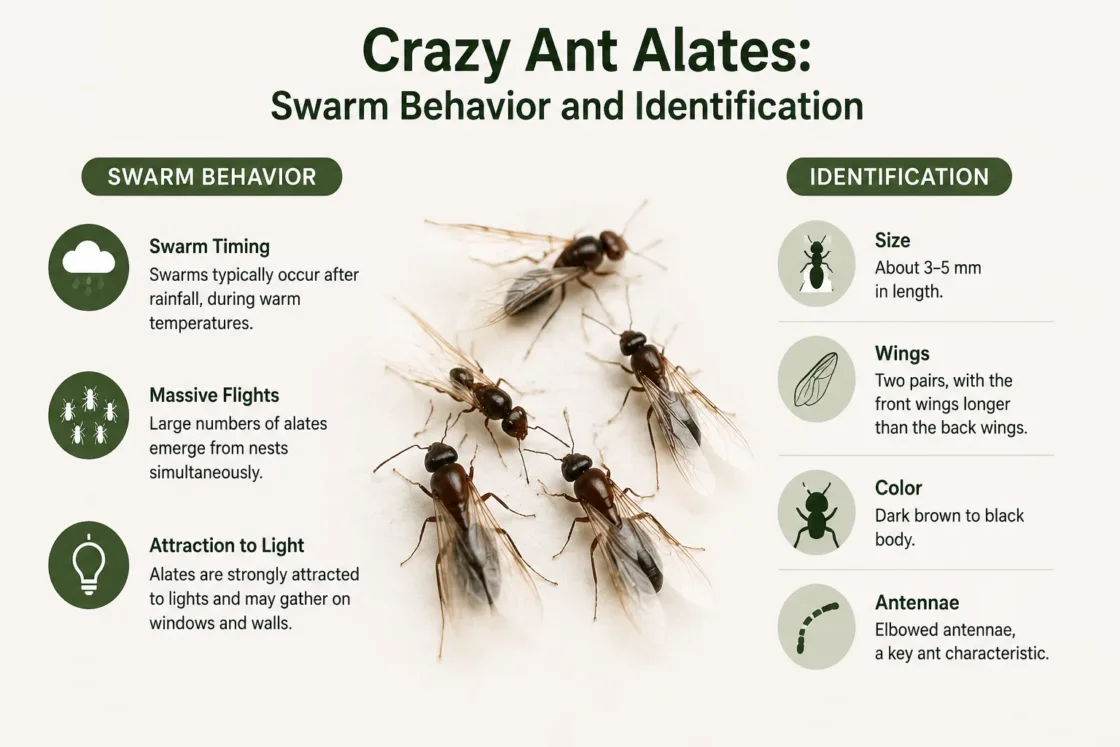
Crazy ant alates are reproductive ants, but seeing wings does not automatically mean a colony is beginning the familiar mass nuptial flight seen in many other ants. Tawny crazy ants, Nylanderia fulva, produce winged males and females, yet their reproductive activity does not fit a simple “both sexes take off, mate in the air, and found isolated colonies” pattern. Longhorn crazy ants, Paratrechina longicornis, can show an even more conspicuous ground-level event in which males gather and mill around nest entrances while workers remain active nearby.
Identification therefore depends on two separate questions: what kind of crazy ant is present, and what are the reproductives actually doing? A cluster of winged or recently dealated ants around a nest can be reproductive activity even when there is no dense cloud of ants overhead.
What “swarm” can mean here
With crazy ants, swarm may describe alates gathering around a nest, males moving over the ground, reproductive activity mixed with dense worker traffic, or actual flight. Those observations should not be treated as biologically identical.
“Crazy Ant” Is a Common Name, Not a Single Identification
The name crazy ant is applied to more than one ant. Two species are especially relevant when interpreting alates and household or landscape activity: the tawny crazy ant, Nylanderia fulva, and the longhorn crazy ant, Paratrechina longicornis. Other ants, including the yellow crazy ant Anoplolepis gracilipes, also carry “crazy ant” in their common name. A photograph labeled only “crazy ant” therefore does not establish a species.
The two focal species differ noticeably when workers are available. Tawny crazy ant workers are reddish brown, relatively compact, hairy, and fast moving. Longhorn crazy ant workers have a more slender outline with exceptionally long legs and antennal scapes. Their reproductive behavior also differs enough that the appearance of an “alate swarm” should be interpreted in species context.
| Clue | Tawny crazy ant Nylanderia fulva | Longhorn crazy ant Paratrechina longicornis |
|---|---|---|
| Worker appearance | Reddish brown, hairy, relatively compact | Dark brown to blackish, very slender |
| Legs and antennae | Long, but less extreme | Exceptionally long |
| Characteristic movement | Rapid, erratic foraging; very dense populations can occur | Rapid, erratic running with long-distance foraging |
| Reproductive activity | Winged males and females are produced; male flight is documented, while female flight remains poorly established | Males can mass around nest entrances and mill on the ground; queens may already be dealate |
| Colony spread | Budding and movement of colony fragments are major pathways | Budding and colony movement can occur; conventional mating flights have not been clearly documented |
Tawny Crazy Ant Alates Do Not Fit a Simple Mass-Flight Pattern
Nylanderia fulva colonies periodically produce both male and female reproductives. Texas A&M describes these colonies as polygyne—containing many queens—and reports periodic production of winged sexual forms. The same extension account states that mating flights have not been observed in the field and identifies budding as a major mechanism of colony propagation, with breeding potentially occurring near colony margins.[a]
Later work adds an important distinction. A 2016 review of the tawny crazy ant literature reports that male alates had been confirmed actively flying, with the highest abundance during summer in the populations discussed. Female alates were reported as being produced in late summer, but female flight activity had not been confirmed. The authors proposed that flying males may locate queens through pheromonal cues near colonies.[b]
Male flight is not the same evidence as a conventional nuptial flight involving dispersing males and females. The available observations support flying males and reproductive activity, while the familiar model of large numbers of female alates launching, mating aloft, landing far away, and independently founding new colonies remains a poor description of known tawny crazy ant spread.
This distinction matters when interpreting a property covered with crazy ants. Tawny crazy ant infestations can reach very high worker densities. Fast-moving workers crossing walls, pavement, vegetation, mulch, utility boxes, and landscape objects can look like a swarm even when the visible activity is predominantly foraging and colony movement rather than an airborne reproductive event.
Budding can spread the colony without a dramatic flight
Budding occurs when queens and workers establish another nest in association with the existing colony network rather than relying entirely on a newly mated queen flying away and starting alone. Tawny crazy ants can nest in soil, rotting wood, mulch, beneath objects, inside potted plants, in vehicles, and within structural voids. Colony fragments can also be moved in infested materials.
As a result, absence of an obvious aerial swarm does not mean absence of reproduction or local spread. Equally, finding one flying male does not prove that numerous future queens are dispersing through the air at the same time.
Longhorn Crazy Ant Reproductive Activity Can Stay Close to the Nest
The longhorn crazy ant provides an unusually clear example of why “swarm” should not automatically be translated as “mass aerial mating flight.” UF/IFAS reports that on warm, humid evenings, large numbers of Paratrechina longicornis males may gather outside nest entrances and mill about excitedly on the ground. Workers patrol nearby vegetation and structures, and dealate queens can emerge from the colony.[c]
The observations summarized by UF/IFAS did not document mating itself. Mating was proposed to occur within these nest-edge gatherings. Males in those observations were not seen using their wings for flight, although males have also been found at lights. Queens may have their wings removed while they are still callow, meaning that an active reproductive event does not necessarily supply an obvious group of large winged females outside the nest.
A ground swarm can be reproductive
Numerous males moving around a longhorn crazy ant nest entrance on a warm, humid evening can represent reproductive activity even if the insects never form a conspicuous cloud above the nest.
Female, Male, or Worker? Identifying Tawny Crazy Ant Castes
Tawny crazy ants are useful for caste comparison because museum material documents workers, queens, and males separately. Mississippi State University’s Mississippi Entomological Museum describes workers at approximately 2.0–2.5 mm, queens at approximately 4.0 mm, and males at approximately 2.4–2.7 mm in the measured specimens. These measurements come from small museum samples and should be treated as identification references rather than rigid size limits.[d]
| Character | Female reproductive | Male reproductive | Worker |
|---|---|---|---|
| Approximate body length in cited N. fulva specimens | ~4.0 mm | ~2.4–2.7 mm | ~2.0–2.5 mm |
| Wings | Four wings before dealation, or visible wing scars afterward | Winged | Absent |
| Mesosoma | Broad and enlarged for flight musculature | Developed for wings but less bulky than queen | Smaller worker form |
| Ocelli | Three | Three, conspicuous | Absent in typical N. fulva workers |
| Compound eyes | Large | Very large relative to head size | Smaller proportionally |
| Antenna segments | 12 | 13 | 12 |
| Overall build | Larger, fuller gaster and enlarged mesosoma | Small, relatively slender, large-eyed | Small, reddish-brown forager |
A female alate should look structurally different from a worker
A reproductive female is not simply a worker with wings attached. Her mesosoma is much larger because it accommodates the structures associated with flight. Intact females carry two pairs of wings. After wing loss, scars remain where the wings were attached. Three ocelli—small simple eyes on the top of the head—are also present.
A dealate female can therefore still be recognized as a reproductive even after the most obvious alate feature has disappeared. A relatively large reddish-brown ant with an expanded mesosoma, large compound eyes, ocelli, and wing scars is much more informative than color alone.
A male may be mistaken for a small winged worker
Male tawny crazy ants are close to worker size in the cited museum specimens, so size alone can be deceptive. The head provides better clues. Males have very large compound eyes, three large ocelli, and 13-segmented antennae. Their genital structures also carry taxonomic information that is unavailable from an ordinary overhead photograph.
When several small winged ants occur among ordinary workers, they should not be dismissed because they appear too small to be queens. They may be males participating in the reproductive phase of the colony.
The Worker Population Often Identifies the Swarm Better Than the Wings
A reproductive ant can be harder to identify than the workers surrounding it because the reproductive caste changes body proportions. When a suspected crazy ant event occurs around an established nest or trail, nearby workers provide valuable context.
Clues favoring tawny crazy ant
- Workers are small and fairly uniform in size.
- The body is usually reddish brown to orangish brown rather than nearly black.
- Long, coarse hairs are visible under good magnification.
- Legs and antennae are long but do not have the extremely stretched proportions of P. longicornis.
- Workers run rapidly and irregularly, sometimes at very high densities.
- Numerous interconnected nesting sites may occur beneath landscape objects, mulch, debris, wood, soil cover, or potted plants.
Clues favoring longhorn crazy ant
- The worker is dark brown to blackish and distinctly slender.
- Legs are exceptionally long for such a small ant.
- The antennal scape extends far beyond the back of the head.
- Workers have conspicuous erect hairs when examined closely.
- Movement is fast, erratic, and visually distinctive.
- Reproductive males may gather around the nest entrance rather than disappearing immediately into an aerial swarm.
Behavior supports morphology; it should not replace it. Many ants run quickly when disturbed, and poor lighting can make reddish-brown ants look black. A useful identification combines body structure, workers, reproductives, locality, and the pattern of activity.
Reproductive Swarm, Worker Surge, or Colony Movement?
Crazy ants can become visible in numbers for several different biological reasons. Separating those events prevents dense worker activity from being mistaken for a mating flight.
| Observation | What it may indicate | What it does not prove |
|---|---|---|
| Many winged males concentrated around a nest | Reproductive activity is strongly supported | That females are simultaneously making a long-distance aerial flight |
| Winged males flying above or away from tawny crazy ant activity | Male dispersal or mate-searching flight | A conventional mass flight by both sexes |
| Large numbers of wingless workers running over the ground | Heavy foraging, colony movement, disturbance, or dense local population | That a nuptial flight is underway |
| Large female with wing scars near crazy ant workers | A dealate reproductive female is plausible | Where she mated or how far she traveled |
| Winged insect alone at a porch light | An alate may have been attracted to light | Species, colony location, or an indoor nest |
| Repeated reproductives emerging from the same nest opening | A nearby colony producing sexual forms | Colony size or the exact mode of mating |
The distinction is especially useful with tawny crazy ants because enormous worker populations can create continuous moving masses. The visual impression of “swarming” may be real in the everyday sense while describing something different from an entomological nuptial flight.
2026 Mississippi range update
Mississippi State University Extension reported on October 6, 2026, that tawny crazy ants had been confirmed in seven Mississippi counties. Hancock, Harrison, Jackson, and Pearl River were the previously established counties; Wilkinson, Marion, and Perry were newly confirmed in 2026. The wider known range changes where the species may be encountered, but it does not change the evidence needed to call an event reproductive: dense masses of fast-moving workers can occur without an alate flight. Wings, reproductive body structure, repeated reproductive emergence, or other caste evidence are needed to separate worker surges from true alate activity.[g]
There Is No Single Crazy Ant Alate Season
Seasonal information should remain tied to the species and region from which it was recorded. A month reported in Florida or the U.S. Gulf Coast should not be converted into a worldwide crazy-ant flight calendar.
For tawny crazy ants in the southern United States, worker activity rises in spring and can become extremely dense through summer and fall. The 2016 review reports active male flight throughout the year in the populations discussed, with a summer peak, while female alates were reported in late summer and female flight had not been confirmed. These observations describe different components of reproductive biology; they do not identify one universal “crazy ant flying day.”
For longhorn crazy ants, UF/IFAS reports that colonies may produce sexual forms at any time of year in warmer regions. In the seasonal climate of north Florida, alate production was reported mainly during the warm, rainy period from May through September. The geographic qualifier matters: those months are not a global limit for a species capable of living across tropical, subtropical, and heated indoor environments.
Seasonal evidence
Warmth, moisture, season, colony condition, and local climate can all coincide with reproductive activity, but a weather pattern cannot identify the ant. Morphology and colony context remain stronger evidence.
Crazy Ant Alate or Termite Swarmer?
A crazy ant alate is still an ant. The same broad characters that separate other flying ants from termites remain useful: ant-like elbowed antennae, a narrow waist, and unequal front and rear wing pairs. Termite swarmers lack the pronounced ant-style waist and usually carry two pairs of wings that are much more similar in size.
| Feature | Crazy ant alate | Termite swarmer |
|---|---|---|
| Antennae | Ant-type, distinctly elbowed; often long | Bead-like, without the pronounced ant elbow |
| Waist | Narrow, with a constricted ant profile | Broad connection between body regions |
| Wing pairs | Forewings larger than hind wings | Forewings and hind wings roughly similar in size |
| Leg proportions | Can be very long, especially in longhorn crazy ants | Do not show the same long-legged ant silhouette |
| After wing loss | Queen retains an ant-like narrow waist; wing scars may be visible | Termite dealate retains the broad-waisted termite body plan |
Loose wings are weaker evidence. Without a body, the antennae and waist cannot be examined, and overlapping or damaged wings may hide the proportions needed for comparison. An intact specimen provides much more information than a pile of detached wings.
What Crazy Ant Alates Indoors Actually Indicate
An alate found indoors proves that a reproductive ant entered the room; it does not by itself reveal where the colony is. Crazy ants can nest in or around structures, but reproductives and males may also be attracted to lights or enter through openings from outdoor populations.
The emergence point carries more evidentiary value than the place where an insect eventually stops. One male beside an open illuminated window is different from repeated reproductives visibly coming from a wall void, plumbing opening, baseboard gap, planter, or another protected nesting area.
| Indoor finding | Reasonable interpretation |
|---|---|
| One winged ant at a window or light | Could have entered from outdoors; source remains unresolved |
| Several males repeatedly appearing at the same light | A nearby reproductive population becomes more plausible, but the light may be attracting them from elsewhere |
| Reproductives emerging directly from a structural gap | Supports a nest or connected colony space in or immediately beside the structure |
| Alates occurring with dense crazy ant worker traffic | Stronger evidence that the reproductive ants belong to the nearby worker population |
| Ants associated with an indoor potted plant | The planter, root zone, drainage area, or material beneath it may provide a colony site |
| A few detached wings with no bodies | Shows that winged insects were present but does not establish crazy ant species or colony location |
Tawny crazy ants frequently nest beneath moisture-retaining objects and can occupy potted plants, debris, wood, vehicles, and structural spaces. Longhorn crazy ants are also highly flexible nesters and may occupy both dry and moist sites. Repeated emergence therefore deserves more attention than an isolated light-attracted insect, but alate numbers cannot be converted into a hidden colony-size estimate.
Longhorn Crazy Ant Genetics Add Another Twist to Reproduction
The reproductive biology of Paratrechina longicornis is unusual even by ant standards. Genetic work found a double-clonal reproductive system: reproductive daughters can carry the maternal queen lineage clonally, reproductive males can carry the paternal lineage clonally, while workers are produced sexually from the combination of queen and male genomes.[e]
This arrangement allows closely associated reproductive lineages to mate without producing the ordinary genetic outcome expected from repeated sibling mating. It does not, by itself, tell where mating occurs or whether a particular male will fly. It does show why the reproductive biology of this species should not be forced into a generic description written for ants that depend on synchronized, long-distance mating flights and independent queen founding.
Why a Photograph May Stop at “Crazy-Ant-Like”
The broad distinction between tawny and longhorn crazy ants can be visible in a good specimen: P. longicornis has the more extreme long-legged, long-antennaed form, while N. fulva is reddish brown and more compact. Species-level identification within Nylanderia can be much harder.
Tawny crazy ant workers are particularly difficult to separate from some close relatives. A 2024 study of Neotropical Nylanderia found that worker morphology can be cryptic and showed the value of male genital morphology together with molecular and other taxonomic evidence. The study supported N. fulva and N. pubens as distinct while also showing why simple worker appearance can fail to resolve difficult specimens.[f]
Species-level identification limit
A reddish-brown alate beside erratically moving Nylanderia-like workers can support a tawny-crazy-ant interpretation, but color and movement alone cannot reliably resolve every close Nylanderia species. A blurred photograph should not be given certainty that the visible characters do not support.
What a useful specimen or photograph should preserve
- Head and antennae: enough detail to see the ant-like elbow, antennal length, eyes, and—when resolution allows—ocelli.
- Top or side view of the body: enough detail to see the narrow waist and relative enlargement of the reproductive mesosoma.
- Both wing pairs: useful for confirming ant rather than termite proportions when the wings remain attached.
- Nearby workers: often more informative for separating tawny from longhorn crazy ants than an isolated reproductive.
- Scale: a ruler or known object beside a still specimen is more useful than estimating size from memory.
- Location of emergence: nest opening, landscape material, wall gap, planter, window, or light source changes how the observation should be interpreted.
The strongest field interpretation may therefore be a calibrated one: a crazy-ant-like reproductive associated with tawny-crazy-ant-type workers, or a longhorn-crazy-ant-type reproductive event around a nest entrance. A species name becomes appropriate when the characters actually visible—and, where necessary, microscopic or molecular evidence—support it.
Sources and Verification
- Texas A&M University Urban and Structural Entomology — Tawny (Rasberry) Crazy Ant, Nylanderia fulva — colony structure, alate production, nesting, seasonal worker abundance, budding, and field interpretation of mating flights. [a]
- Wang et al., Insects — A Review of the Tawny Crazy Ant, Nylanderia fulva — male alate flight, female alate production, limits of confirmed female flight, and reproductive behavior. [b]
- University of Florida IFAS — Crazy Ant, Paratrechina longicornis — worker identification, regional alate seasonality, nest-entrance male aggregations, queen dealation, and observed flight behavior. [c]
- Mississippi Entomological Museum, Mississippi State University — Nylanderia fulva — worker, queen, and male measurements; eyes, ocelli, antennae, wing characters, setae, and comparison with P. longicornis and related Nylanderia. [d]
- Pearcy, Goodisman & Keller, Proceedings of the Royal Society B — Sib mating without inbreeding in the longhorn crazy ant — genetic evidence for the unusual reproductive system of Paratrechina longicornis. [e]
- Williams et al., Insect Systematics and Diversity — male genital morphology and Neotropical Nylanderia species delimitation — identification limits in cryptic Nylanderia, including evidence separating N. fulva and N. pubens. [f]
- Mississippi State University Extension Service — Tawny crazy ants spread to 7 Mississippi counties — October 6, 2026 range update documenting established records in Hancock, Harrison, Jackson, and Pearl River counties and new 2026 confirmations in Wilkinson, Marion, and Perry counties. [g]