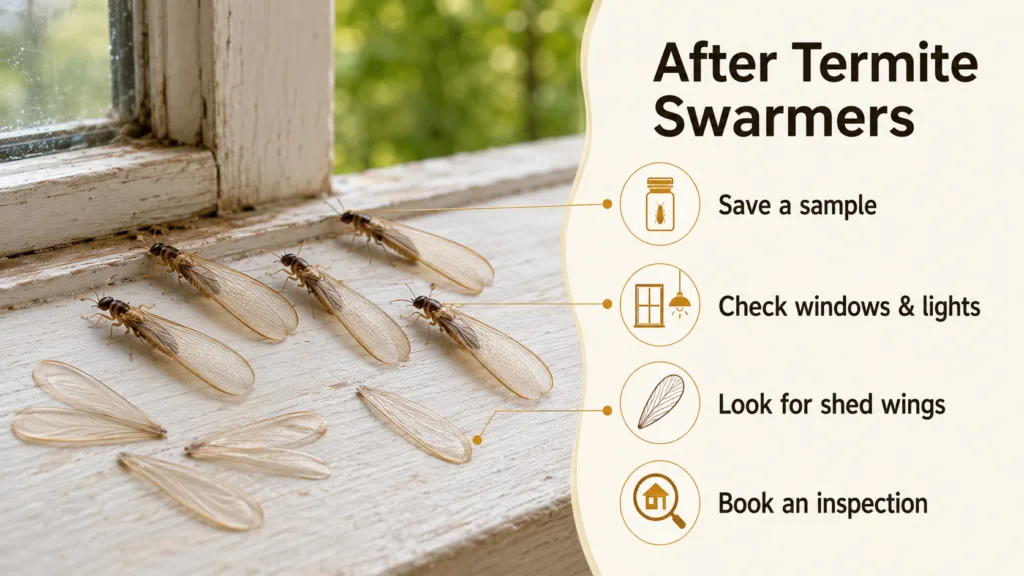
If termite swarmers appear indoors, collect a few insects or shed wings, photograph where they emerged, vacuum the dead swarmers, and arrange a licensed termite inspection. Do not spray over the emergence point or destroy mud tubes before evidence is documented. Indoor swarmers usually point to a colony in or under the structure, while outdoor swarmers near stumps, landscape timbers, or wood piles call for a careful exterior check rather than automatic treatment. Termite swarmers themselves do not eat wood; the hidden workers and colony access routes are the real inspection target.
Key Data Points
Common sighting
Winged termites or shed wings
Often seen near windows, doors, lights, or emergence cracks indoors.
Biological role
Reproductive alates
Swarmers leave mature colonies to pair, shed wings, and attempt colony founding.
Immediate indoor risk
Inspection needed
Indoor swarmers are strong evidence of activity in or below the structure.
Outdoor risk
Context dependent
Outdoor swarms may come from soil, stumps, wood piles, or nearby colonies.
Main ID markers
Equal wings, straight antennae, broad waist
These markers separate termite swarmers from many winged ants.
Best next step
Document, save specimens, inspect
Treatment decisions should follow identification and structural evidence.
DIY pesticide value
Low for structural termites
Structural termite control usually requires professional tools and placement.
Data confidence
High for response steps
Guidance is based on university extension and EPA consumer resources.
What to Do in the First Hour
A termite swarm indoors is not a reason to make a rushed chemical decision. The first job is evidence preservation: keep several bodies or wings, record the exact place where they were found, and note the time, weather, and room conditions. Many swarms happen after warm, wet weather, but local timing varies by termite group, region, and building moisture conditions.[a]
Dead swarmers can be removed with a broom or vacuum after samples are saved. Killing the visible swarmers does not remove the colony. The inspection should focus on mud tubes, damaged wood, moisture sources, wood-to-soil contact, crawlspace conditions, foundation cracks, and indoor emergence points.[b]
| Step | Action | Why it matters | Risk if skipped |
|---|---|---|---|
| 1. Save specimens | Place several insects or wings in a small container or sealed bag. | Identification can be checked by a pest professional or extension office. | Flying ants and termite swarmers are often confused. |
| 2. Photograph the site | Photograph windowsills, door frames, baseboards, cracks, vents, or floor gaps. | The emergence point may guide inspection. | Vacuuming alone may erase useful location evidence. |
| 3. Avoid surface spraying | Do not cover emergence points, wings, tubes, or damaged wood with aerosol sprays. | Sprays may scatter insects and obscure evidence without reaching the colony. | Inspection can become harder and the colony may remain active. |
| 4. Check visible evidence | Look for mud tubes, hollow-sounding wood, shed wings, moisture, and soil-to-wood contact. | Termite workers and tubes indicate colony access routes. | A swarm may be treated as a one-day nuisance instead of a structural warning. |
| 5. Arrange inspection | Use a licensed termite or structural pest professional when swarmers appear indoors. | Structural termite control depends on species group, building design, and access routes. | Wrong treatment can waste time and miss the colony. |
Confirm That the Insects Are Termite Swarmers
Termite swarmers and flying ants can appear at similar times. The fastest field check uses three markers: termite swarmers have four wings of roughly equal size, straight or beadlike antennae, and a broad waist. Winged ants usually have elbowed antennae, a narrow waist, and front wings that are larger than the hind wings.[c]
| Marker | Termite swarmer | Flying ant | Inspection value |
|---|---|---|---|
| Wings | Four wings about the same size and shape. | Front wings longer than hind wings. | High value when wings remain attached or shed wings are intact. |
| Antennae | Straight or beadlike. | Elbowed. | High value under a hand lens or clear photo. |
| Waist | Broad, without a pinched middle. | Narrow, pinched waist. | Useful when the body is not crushed. |
| Shed wings | Often found in piles on windowsills or near light sources indoors. | Can occur, but wing proportions differ. | Save samples rather than relying on memory. |
| Damage clues nearby | Mud tubes, mud-lined galleries, damaged wood along the grain. | Carpenter ant galleries may contain fibrous sawdust-like debris. | Damage pattern helps separate wood consumption from excavation. |
Data Interpretation Note
Identification should be verified against physical specimens where possible. Crushed insects, incomplete wings, poor lighting, and mixed insect debris can lead to wrong field identification.
Indoor vs Outdoor Swarmers
The location of the swarm changes the response. Indoor swarmers, shed wings on interior windowsills, or swarmers emerging from baseboards are stronger evidence of a structural issue than a swarm seen around a stump or woodpile outdoors. Outdoor swarmers still deserve attention when they appear near the foundation, porch, slab edge, crawlspace vents, attached deck, or wood stored close to the building.[d]
| Where swarmers are seen | Likely evidence meaning | Recommended response | Risk level |
|---|---|---|---|
| Inside living areas | Possible colony activity in or below the structure. | Save specimens, document emergence point, schedule inspection. | High |
| Interior windowsills or near lights | Swarmers may be attracted to light after emerging indoors. | Collect bodies and wings before cleaning. | High |
| Garage, crawlspace, or basement | Possible access through slab cracks, utility gaps, mud tubes, or wood contact. | Inspect foundation, sills, joists, moisture, and stored wood. | High |
| Foundation edge or attached porch | Nearby colony may have access to structural wood. | Check tubes, cracks, wood-to-soil contact, and moisture conditions. | Moderate to high |
| Yard stump or woodpile | Termites may be using buried or exposed cellulose outdoors. | Move wood away from the structure and inspect nearby foundation areas. | Context dependent |
Evidence to Preserve Before Inspection
A termite inspection works best when the evidence layer is still visible. Mud tubes, shed wings, damaged wood, moisture marks, and the position of stored lumber can all matter. If a mud tube must be opened, photograph it first and note whether live termites are present. An empty tube does not prove that activity has ended because termites may abandon one tube and forage elsewhere.[e]
| Evidence type | What to record | What it may indicate | Handling note |
|---|---|---|---|
| Shed wings | Room, surface, window or light source, date, and number seen. | Recent indoor swarming or entry from an emergence point. | Save some wings in a dry container. |
| Dead swarmers | Body color, wing length, antenna shape, and exact location. | Possible reproductive termite emergence indoors. | Save intact insects for ID. |
| Mud tubes | Tube location, width, height, and whether it crosses foundation or masonry. | Subterranean termite shelter route between soil and wood. | Photograph before breaking any section. |
| Damaged wood | Hollow sound, soft grain loss, mud in galleries, nearby moisture. | Current or past termite feeding. | Do not remove structural wood before inspection unless safety requires it. |
| Moisture source | Leaks, condensate, poor drainage, crawlspace dampness, gutter overflow. | Condition that may support termite access or wood decay. | Repair moisture issues after documentation. |
Interactive Data Visuals
Source-Based Time References After Termite Evidence
Published guidance gives several useful time ranges for inspection habits, service guarantees, and colony maturity.
Source: UC IPM inspection interval guidance, EPA pest service guarantee guidance, and Texas A&M termite maturity notes.
Evidence Priority Score After Seeing Swarmers
This scoring ranks which observations should carry the most weight when deciding whether to request inspection.
Values are editorial interpretation scores for this guide, not species counts, occurrence totals, or population data.
When Professional Inspection Is Needed
A licensed inspection is warranted when swarmers are found indoors, when shed wings collect repeatedly inside, when mud tubes are visible, or when wood shows mud-lined galleries. Professional inspection is also prudent when outdoor swarmers occur next to a foundation, attached porch, crawlspace, deck ledger, garage slab, or stored wood in contact with soil.[f]
Treatment should match the termite group and building conditions. Subterranean termites are usually managed with soil-applied termiticides, bait stations, direct treatment to nests or tubes, or related professional methods. Drywood termite control may involve different inspection and treatment methods, so a swarmer sighting should not be treated as a one-method problem.[g]
| Question for the inspector | Reason to ask | Good documentation to request |
|---|---|---|
| Which evidence confirms activity? | Swarmers alone need to be tied to structural signs where possible. | Written notes on wings, tubes, damaged wood, moisture, and access points. |
| Which termite group is suspected? | Subterranean, drywood, and dampwood termites are not managed the same way. | Specimen ID, photos, or explanation of diagnostic features. |
| What treatment method is proposed? | EPA lists liquid soil treatments, baits, treated materials, and wood treatments as termite options. | Product label, application plan, target zones, and safety notes. |
| Is the applicator licensed? | Termiticide placement is often a trained professional task. | License details and proof of certification where required. |
| What does the guarantee cover? | EPA notes that termite guarantees often vary by term and coverage. | Written guarantee, renewal terms, inspection fees, and exclusions. |
How to Read This Data
A termite swarmer sighting is a detection signal, not a full map of colony size, damage depth, or treatment need. Pest risk should be assessed from local inspection evidence, building design, moisture conditions, and verified termite identity.
Data Quality and Limitations
Where the Data Has Limits
Seasonal timing varies by geography, climate, rainfall, colony maturity, and termite group. Outdoor occurrence evidence can reflect sampling effort as much as true abundance. Amateur photos may not show antennae, waist, or wing proportions clearly enough for confident identification. Structural risk cannot be measured from swarmers alone, and occurrence records do not define a complete range or the exact location of a colony.
Available occurrence records and homeowner observations should be treated as evidence layers, not as a finished diagnosis. A swarm seen outside near natural wood may come from a colony that never enters the structure. A swarm seen inside may point to concealed activity that needs professional tracing. The same visible event can therefore lead to different decisions depending on room location, foundation design, moisture, prior treatment history, and local termite species.
FAQ
Do termite swarmers mean my house is infested?
Indoor termite swarmers usually justify a professional inspection because they may indicate activity in or below the structure. Outdoor swarmers are more context dependent, especially when they are coming from stumps, wood piles, or soil away from the building.
Should I spray termite swarmers?
Surface spraying visible swarmers is not a reliable structural control step. Save specimens, document the site, clean up dead insects, and focus on inspection evidence that leads to the colony access route.
How long do termite swarmers live indoors?
University extension guidance notes that indoor swarmers often die quickly when they cannot escape or find moisture. Their short survival does not rule out a hidden colony.
What should I save for identification?
Save several intact insects and shed wings in a small container or sealed bag. Clear photos of antennae, wings, waist shape, and the discovery location are also useful.
Are termite swarmers dangerous to people?
Termite swarmers are not the wood-damaging caste and are not a medical hazard in ordinary household sightings. The concern is the colony that produced them and the worker termites that may be feeding unseen.
Can I wait a few days before choosing a termite company?
A few days to compare qualified companies is usually reasonable when there is no structural emergency. EPA recommends checking competence, licensing, labels, references, and written terms instead of choosing only by price or pressure.
Sources and Verification
- [a] NC State Extension — Termite Swarmers: What Do They Mean for You? — swarming behavior, indoor vs outdoor context, specimen collection, and shed-wing interpretation.
- [b] University of Kentucky Entomology — Termite Control: Answers for Homeowners — indoor swarmers, short swarmer survival, vacuum cleanup, mud tubes, and damage recognition.
- [c] Purdue Extension Entomology — Termite Control — termite swarmer and winged ant comparison markers, damage notes, and inspection timing.
- [d] UC IPM — Subterranean and Other Termites — prevention, moisture, wood-to-soil contact, swarming context, and professional inspection guidance.
- [e] Texas A&M Urban Entomology — Native Subterranean Termites — Reticulitermes swarmer size, signs of infestation, mud tubes, moisture, and damage evidence.
- [f] U.S. EPA — Tips for Selecting a Pest Control Service — licensing, estimates, references, guarantees, and consumer questions before contracting.
- [g] U.S. EPA — Termites: How to Identify and Control Them — termite treatment categories, professional application cautions, and prevention notes.