Winged aphids, also called alate aphids, are wing-bearing forms produced by many aphid species for dispersal. They are not a separate species. A colony can contain or produce both wingless and winged forms, with the alates able to leave an established host, search for another plant, and in some species move between seasonal hosts.
The word alate describes the winged morphology. In aphids, it does not automatically mean a reproductive caste in the social-insect sense used for ants and termites. Many alates encountered during the growing season are dispersing females, although aphid life cycles vary and winged males also occur in some species and seasonal phases.
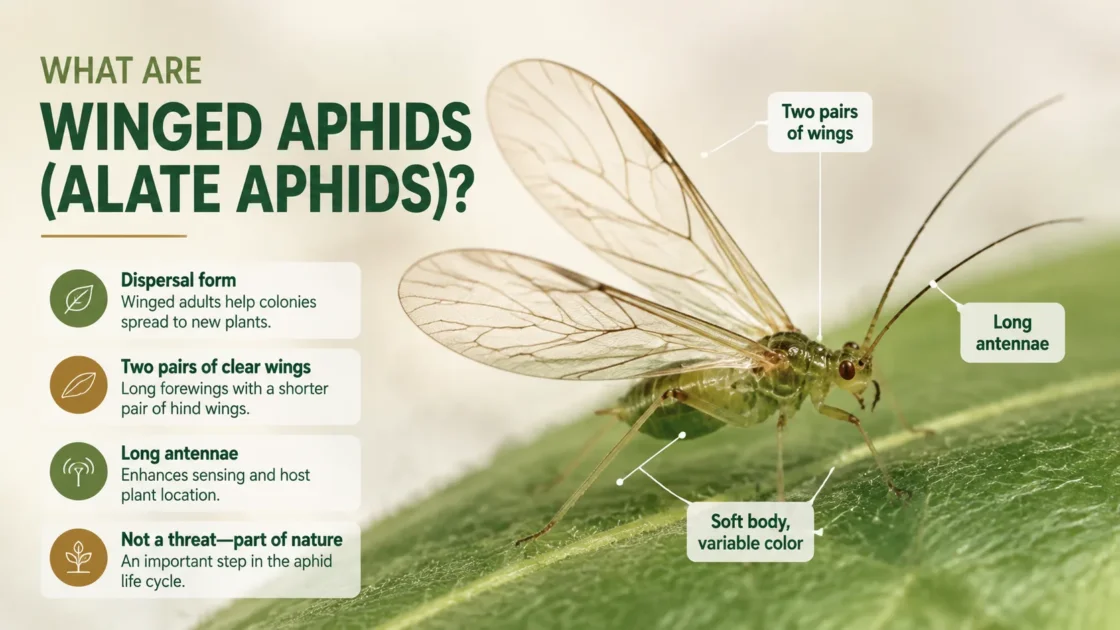
What one winged aphid tells you
A single alate on a leaf is evidence that a mobile aphid reached that plant. It does not by itself show that a large colony is established there. Wingless aphids, nymphs, cast skins, honeydew, distorted growth, or repeated alate activity provide stronger evidence of an active local colony.
What “Alate Aphid” Actually Describes
Aphids belong to the sap-feeding hemipteran group Aphidoidea. Within many aphid species, adults can occur in alternative body forms. The winged form is alate; a wingless form is apterous. These words describe morphology rather than separate species names.
The distinction is biologically useful because the two forms often emphasize different tasks. An apterous aphid can remain on a suitable plant and invest heavily in local reproduction. An alate has the flight structures needed to leave that plant and colonize another location. The difference therefore involves dispersal strategy, not simply whether two otherwise unrelated insects happen to have different wings.
The more detailed developmental comparison belongs to alate versus apterous aphids. For identification, the practical point is simpler: a winged individual can belong to the same aphid species as the wingless aphids clustered nearby.
How to Recognize a Winged Aphid
Wing presence alone is not enough for identification. Aphids have a recognizable combination of a small, soft body, long slender antennae, piercing-sucking mouthparts, and paired cornicles near the rear of the abdomen. University of Maryland Extension describes adult aphids as roughly pear- or teardrop-shaped and notes that winged adults normally have clear or mostly clear wings. Color varies widely, so green, black, reddish, yellow, gray, or brown coloration should not be treated as a species diagnosis.[a]
Cornicles are the most useful body clue
Cornicles, also called siphunculi, are a paired set of structures projecting from the rear part of the abdomen. They may look like short tubes, narrow pipes, or small raised projections. Their size and shape vary among aphids, and reduced cornicles can disappear in a poor photograph or beneath waxy material.
A hand lens can make them much easier to see. When a tiny winged insect has a soft aphid-like body, long antennae, clear wings, and visible cornicles, the combination strongly supports aphid identification. Cornicle form can also help with finer identification, but species-level work often requires additional characters and host-plant information.
The wings are transparent, not powdery
An alate aphid has two pairs of membranous wings. UNH Extension describes the wings as transparent, with visible venation and a thickened area known as a stigma toward the outer part of the wing.[b] This is useful when separating alates from insects such as whiteflies, whose wings usually have an opaque, powdery white appearance.
Wing venation can contain taxonomic information, but it is usually a poor first test for a casual sighting. The insect may be only a few millimeters long, wings can overlap when at rest, and photographs frequently lack the resolution needed to inspect fine veins accurately.
| Visible feature | What supports an aphid identification | Where caution is needed |
|---|---|---|
| Cornicles | Paired tube-like or raised structures toward the rear of the abdomen | They may be very short, obscured, or invisible in a small photo |
| Wings | Two transparent membranous pairs with visible venation | Clear wings occur in many other insect groups |
| Antennae | Usually conspicuous and relatively long | Antenna length alone does not identify an aphid |
| Body | Soft, compact, commonly pear- or teardrop-shaped | Body shape changes among species and morphs |
| Color | May be green, yellow, dark, reddish, gray, brown, or wax-covered | Color is too variable to use as the main diagnostic character |
| Plant association | Presence on leaves, stems, buds, shoots, or near an aphid colony | Host association helps identification but does not prove species by itself |
Species identification can be much harder
Recognizing a winged insect as an aphid is often possible from a good macro view. Assigning the aphid to a species may require the host plant, cornicle form, antennal proportions, cauda, wing characters, geographic records, and sometimes a properly prepared specimen under magnification. A photograph that supports “winged aphid” may still be insufficient for a defensible species name.
Aphids Do Not Simply Add Wings as Adults
Seeing alates appear in a previously wingless colony can make it look as though the resident adults suddenly grew wings. That is not the usual developmental process. The winged and wingless forms follow different developmental pathways. In well-studied viviparous systems such as the pea aphid, environmental conditions experienced by the mother can influence whether developing daughters become winged or wingless.
A 2025 study of pea aphid wing plasticity found that natural genetic lines differed greatly in how strongly they produced winged offspring after crowding. Some lines responded strongly, while others produced far fewer alates under comparable conditions. The work supports a multigenic basis for variation in the wing-production response, which is one reason a simple rule such as “crowding always makes aphids winged” is too broad.[c]
The developmental term often used here is wing polyphenism: one genetic background can produce distinct winged and wingless phenotypes according to developmental and environmental signals. Aphid biology is diverse, so the precise timing and control of this switch should not be assumed to be identical across Aphidoidea.
Why a Colony Starts Producing Dispersers
Wing production becomes useful when remaining on the current host is less favorable than moving. Crowding and declining host quality are two well-established cues, but they are not universal switches. Seasonal conditions, interactions with predators, host identity, temperature, genetics, and other biological influences can alter the response.
Experiments with aphids on tansy illustrate why species-level differences matter. Crowding and predator presence raised the proportion of winged offspring in Macrosiphoniella tanacetaria in that study, while Metopeurum fuscoviride did not show the same response to those treatments. Wing induction therefore cannot be reduced to a single stress formula applied to every aphid.[d]
A 2026 laboratory study of the hedgehog grain aphid, Sipha maydis, provides another example. Researchers tested wheat, barley, and sorghum under several temperatures and found that the proportion of winged morphs depended on the interaction between host plant and temperature. The highest population densities did not consistently produce the highest alate proportions. On sorghum at 25°C, for example, relatively low total numbers occurred alongside a high proportion of winged individuals. The result is specific to the tested aphid population and experimental conditions, but it shows why density alone cannot explain every alate event.[e]
The broader biology of these induction cues is covered separately in why aphids produce winged forms. For identifying an alate, the useful interpretation is that wings provide a route away from the current host; they do not reveal which single cue caused that individual to develop.
The Alate Form Changes More Than the Wings
An alate should not be pictured as an apterous aphid with a pair of wings attached. Flight requires changes to the thorax and flight musculature, and the dispersal form can differ in body proportions, behavior, reproductive allocation, and sensory anatomy.
A 2026 scanning-electron-microscopy study compared alate and apterous forms of Semiaphis heraclei. The alates had longer antennae, larger primary rhinaria, and secondary rhinaria that were absent from the apterous morph examined in the study. Rhinaria are sensory structures on aphid antennae associated with chemical perception. The researchers interpreted these differences as sensory specialization that may assist host detection during dispersal.[f]
A species-specific finding, not a universal ID rule
The antennal differences documented in Semiaphis heraclei should not be turned into a diagnostic rule for every aphid. Their value is biological: they demonstrate that an alate phenotype can include sensory differences associated with finding a new host, not only visible flight structures.
What Happens After an Alate Leaves Its Host
Once airborne, alates can combine their own flight behavior with movement of the surrounding air. Their destination is not necessarily the nearest plant, and the plant on which an aphid lands is not automatically a suitable host.
Host finding is a sequence rather than a single landing event. A dispersing aphid can orient toward vegetation and plant-derived cues, land, examine the surface, and use its stylets to probe plant tissue. An unsuitable plant may be rejected, allowing the aphid to depart and continue searching. A suitable host can provide the setting for feeding and, for the appropriate female morph, reproduction and establishment of a new local population.
Some aphids spend their life cycle on one host species or a related group of hosts. Others are host-alternating and move between different primary and secondary hosts during the year. University of Maryland Extension documents several such systems, including aphids that shift between woody plants and different secondary hosts.[a] An alate seen in seasonal migration may therefore be carrying out a normal life-cycle movement rather than simply escaping an overcrowded colony.
Aphid flight is not the same event as an ant or termite swarm
The shared word alate can hide a major biological difference. Ant and termite alates are commonly discussed as colony reproductives participating in mating and colony-founding flights. Aphid alates are often dispersal morphs produced within a very different reproductive system.
Many growing-season aphid populations reproduce parthenogenetically, with females producing daughters without mating. Winged females can move to another host and continue the population there. Some aphid life cycles later produce sexual forms, including males, but the presence of wings by itself does not identify sex or prove that a mating flight is occurring.
What a Winged Aphid on a Plant Actually Means
Alates are mobile, so the location where one is found may be a destination rather than its place of origin. This makes the surrounding evidence more informative than the presence of wings alone.
| Observation | What it can reasonably indicate | What it does not prove |
|---|---|---|
| One winged aphid on otherwise clean growth | A recent arrival, exploratory landing, or early colonization attempt | An established or damaging colony |
| Several alates with many wingless aphids and nymphs | An established aphid population with active dispersal or incoming migrants | The exact reason wings were induced |
| Honeydew and pale cast skins around aphids | Repeated feeding and development on the plant | The aphid species without additional identification |
| Curled or distorted new growth with an aphid colony | Feeding injury consistent with some aphid infestations | That every observed symptom was caused by aphids |
| A winged aphid on a sticky card | Aphid flight activity within the trap’s capture environment | Which plant produced the aphid |
| Repeated alates around an indoor plant | A reason to inspect the plant closely for aphids and nymphs | A structural infestation of the building |
UC IPM notes that winged forms commonly occur when aphid populations are high or when food quality deteriorates, while low to moderate aphid numbers on established garden plants may cause little injury.[g] The presence of alates is therefore best interpreted as evidence of movement. Plant condition and colony evidence determine whether that movement also represents a pest problem.
Why Alates Matter for Plant-to-Plant Spread
The ecological advantage of an alate is mobility. A wingless colony is concentrated on its existing host; a winged individual can connect that colony with plants elsewhere. This allows aphids to colonize new growth, move between seasonal hosts, and escape deteriorating local conditions.
Mobility also matters because some aphid species transmit plant viruses. A winged aphid that has contacted an infected plant may move to another plant and probe it. Wings themselves do not make an aphid infectious, and finding an alate cannot show whether it carries a virus. Transmission depends on the aphid, the virus, the host, and the acquisition and inoculation biology involved. That subject is treated separately in winged aphids and plant-virus spread.
Winged does not mean virus-carrying
An alate’s wings show that it can disperse. They reveal nothing about whether that individual previously contacted an infected plant or can transmit the particular virus affecting a crop.
Winged Aphids Indoors Usually Point Back to Plants
A winged aphid can enter a building from outdoor vegetation or emerge from aphids living on a houseplant, greenhouse plant, or recently introduced plant material. An individual may then appear near a window or another bright area after leaving the plant.
Aphids are plant feeders, not structural wood pests. Their presence indoors does not carry the same meaning as termite swarmers emerging from structural material. When alates repeatedly appear near houseplants, the useful inspection targets are tender shoots, buds, stems, leaf undersides, and curled new growth. Honeydew, white shed skins, clusters of wingless aphids, or ants visiting a plant strengthen the case for an established colony.
If a colony is confirmed and management is needed, the practical response belongs to aphid colony management rather than attempts to catch individual flying aphids.
The Small Flying Insects Most Easily Confused With Alates
Size and the fact that an insect is sitting on a plant are weak identification tests. Several unrelated insects occupy the same visual scale. The best separation comes from combining wing appearance, antennae, body form, behavior, and the presence or absence of cornicles.
| Possible look-alike | Useful separation from a winged aphid |
|---|---|
| Whitefly | Adult whiteflies usually have powdery white wings and shorter-looking antennae. Aphid wings are normally transparent or mostly transparent, and aphids have cornicles.[a] |
| Fungus gnat | More fly-like and long-legged, with no cornicles. Indoors, fungus gnats are strongly associated with moist potting media rather than aphid colonies on shoots and leaves. |
| Barklouse | Barklice have chewing mouthparts, lack cornicles, and are often found grazing on bark surfaces rather than extracting phloem from tender plant tissue.[a] |
| Leafhopper | Usually more wedge-shaped and much more inclined to jump rapidly when disturbed. Leafhoppers lack the paired aphid cornicles.[g] |
Alate Does Not Tell You the Aphid’s Sex
It is easy to import the ant or termite meaning of “winged reproductive” into aphids, but aphid life cycles use wings differently. Alate describes the winged form; it is not a sex label.
Many alates encountered during periods of active colony growth are females capable of establishing or extending populations after dispersal. In species with a sexual phase, winged males can also occur, and the exact combination of morph, sex, reproductive mode, and host movement differs among species. A winged aphid therefore cannot be labeled male, female, sexual, or asexual from the word alate alone.
Do Winged Aphids Shed Their Wings After Landing?
Winged aphids do not follow the familiar ant-queen pattern in which a reproductive completes a mating flight and then deliberately sheds its wings before founding a colony. An aphid alate can land on vegetation, probe or feed, and remain a winged adult. Post-flight dealation is not what defines the aphid dispersal cycle.
This distinction also prevents a common terminology error. An apterous aphid is a wingless morph; it should not automatically be interpreted as an alate that landed and lost its wings. The wingless and winged aphids seen together on a plant usually represent different developmental forms.
Are Winged Aphids More Damaging Than Wingless Aphids?
Not simply because they have wings. Direct plant injury depends on the aphid species, feeding site, plant susceptibility, and the size and persistence of the feeding population. Wingless forms can make up much of a dense colony and account for extensive local feeding.
The special importance of the alate is mobility. It can reach another plant, introduce an aphid population to a new host, participate in host migration, and—in compatible aphid-virus systems—provide a path for disease movement. That makes an alate biologically informative without making every isolated winged aphid a reason for treatment.
Sources and Verification
- University of Maryland Extension — Aphids in Home Gardens — Aphid morphology, cornicles, wing characteristics, look-alikes, feeding biology, reproduction, and host alternation. [a]
- UNH Extension — Aphids Fact Sheet — Paired cornicles, piercing-sucking mouthparts, and the transparent wing pairs, venation, and stigma of winged forms. [b]
- Journal of Heredity — Pea aphid wing plasticity variation has a multigenic basis — 2025 evidence that pea aphid genetic lines vary in their production of winged offspring in response to crowding. [c]
- PLOS ONE — Multiple Cues for Winged Morph Production in an Aphid Metacommunity — Experimental evidence that crowding, predators, season, and species identity can produce different wing-induction responses. [d]
- Journal of Economic Entomology — Temperature and host plant influence alate formation in the hedgehog grain aphid, Sipha maydis — 2026 controlled experiments showing host-dependent temperature effects on alate proportions. [e]
- Journal of Insect Science — Antennal morphological differences between alate and apterous morphs of Semiaphis heraclei — 2026 comparison of antennal length and sensory structures in winged and wingless morphs. [f]
- UC Statewide IPM Program — Aphids — Aphid identification, cornicles, production of winged forms, dispersal, plant injury, and evidence-based garden interpretation. [g]