Flying ants appearing indoors during winter deserve a different interpretation from ants noticed during a normal outdoor mating flight. In a cold-winter climate, many winged ants emerging from the same indoor opening can point to a colony associated with the building. The pattern is not exclusive to carpenter ants: pavement ants beneath heated slabs and some soil-nesting yellow ants can also produce winter indoor swarms. The most useful evidence comes from combining the insect’s anatomy with its number, exact emergence point, nearby workers, moisture conditions and nesting debris.
Why Winter Changes the Meaning of an Indoor Swarm
Ant flight seasons are not fixed worldwide. Species, geography, colony development and local weather all affect when reproductive ants fly. A winter sighting therefore cannot be interpreted from the calendar alone. Climate and the conditions inside the building matter.
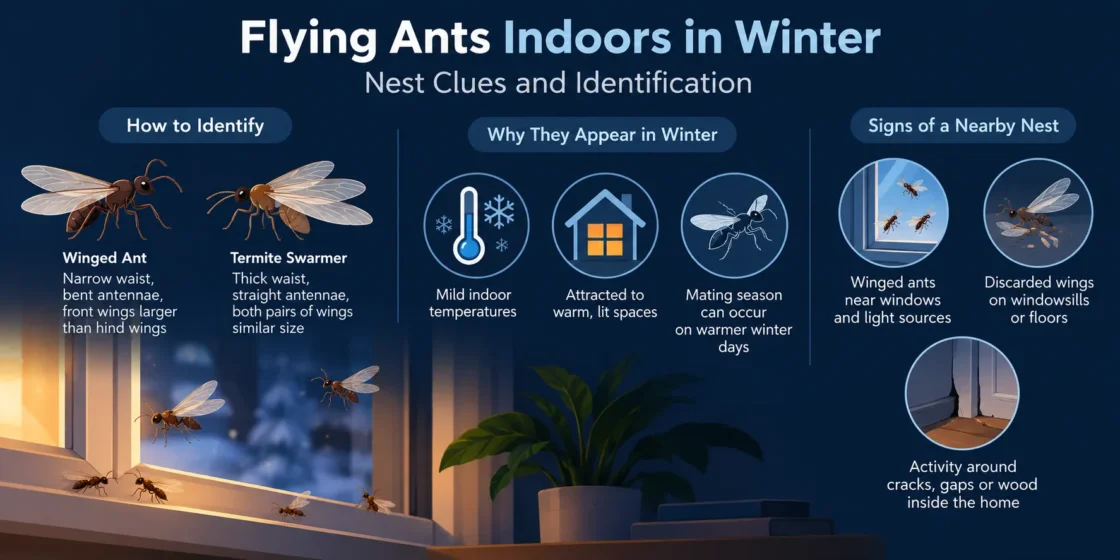
In regions with cold winters, outdoor colonies are normally much less active than they are during warm months. A colony or part of a colony inside a heated structure can experience very different conditions. Penn State Extension notes that carpenter ants that would otherwise be inactive in winter can remain active when their nest occupies a heated portion of a building.[a] University of Minnesota Extension likewise describes winter carpenter-ant activity inside heated homes and notes that sunlight, mild conditions or indoor heat can warm a nest enough for activity.[b]
That makes a concentrated January or February emergence in a northern climate more informative than a single winged ant that appears during a summer flight. It still does not prove which ant is present or how much of a structure is affected.
Climate changes the interpretation
A winter date is much more unusual for outdoor ant activity in Minnesota or Pennsylvania than in a warm coastal or subtropical climate. Winter timing should support an identification, not replace one.
First Make Sure the Insects Are Ants
Winged ants and termite swarmers can both appear suddenly indoors and both may collect around windows. Before interpreting a possible nest, examine an intact specimen. A typical flying ant has a constricted waist and front wings that are larger than the hind wings. Antennae are commonly distinctly elbowed. A termite swarmer has a broader body connection, wing pairs that are much more similar in size and antennae without the pronounced ant-like elbow.
No single character should be forced when it cannot be seen clearly. Overlapping wings can hide the smaller hind pair, and antenna shape can be difficult to judge on a crushed specimen or distant photograph. The full anatomical comparison is covered in Flying Ants vs Termites.
Loose wings are not enough
Both ant and termite reproductives can lose their wings. A pile of wings can document a reproductive event, but an intact body provides much better evidence for deciding which insect produced them.
Where the Ants Came From Matters More Than Where They Ended Up
A windowsill covered with winged ants can look as though the insects emerged from the window. That conclusion is not always justified. Ants that originate elsewhere in a room may move toward daylight and accumulate against glass. The window can be a collection point rather than the source.
The strongest location evidence is direct emergence: seeing ants come through a trim joint, wall crack, floor gap, plumbing penetration, ceiling opening or another defined part of the structure.
| Winter observation | What it can support | What it does not prove |
|---|---|---|
| One winged ant beside a window | Ant reproductive present indoors; outside entry may still be possible | An indoor nest |
| Several alates collected at one closed window | A nearby indoor source becomes worth checking | That the nest is inside the window frame |
| Many alates visibly emerging through one wall or trim gap | Strong evidence of a colony or nest space associated with that part of the structure | The full extent or exact boundaries of the nest |
| Repeated emergence from the same opening on separate winter days | A persistent concealed source becomes more plausible | Species identity or damage level |
| Small ants emerging through a slab crack or floor joint | A soil or sub-slab nest should be considered | Carpenter-ant activity in wood |
| Large ants plus coarse debris and moisture-affected wood | A carpenter-ant nest deserves closer investigation | How much structural wood has been excavated |
Indoor Heat Can Create a Winter Microclimate
A building does not have one uniform winter temperature. Wall cavities beside heated rooms, plumbing chases, warm foundation areas and sun-exposed walls can stay much warmer than outdoor soil or exterior wood. This helps explain why ants may become active in one part of a house while colonies outdoors remain quiet.
For carpenter ants, University of Minnesota Extension specifically describes winter workers becoming active when nests receive enough warmth from indoor heating, sunlight or mild outdoor temperatures. Workers may then appear near sinks, cabinets, dishwashers, bathrooms and other moisture sources.[c]
A colony can also remain unnoticed through winter if its cavity stays cold. A nest in a poorly heated exterior wall may remain inactive until seasonal warming. The absence of winter activity therefore does not rule out a nest.
Large Winged Ants Raise the Carpenter-Ant Question
Large dark alates appearing indoors in winter often lead to suspicion of carpenter ants in the genus Camponotus. That possibility deserves attention, but large and black is not a species diagnosis. Carpenter ants vary in color, and other ant groups can resemble them.
The case becomes much stronger when the winged ants occur with other carpenter-ant evidence:
- many alates originating inside the building rather than a lone insect near an entry point;
- large wingless workers repeatedly using the same void or route;
- activity around previously wet, softened or decayed wood;
- coarse fibrous wood debris repeatedly accumulating below a crack or opening;
- smooth excavated galleries if damaged wood is already exposed;
- persistent activity near plumbing, window frames, roof leaks or other moisture-prone areas.
University of Minnesota Extension states that large numbers of winged carpenter ants indoors are evidence of an inside nest in its cold-climate context, while one or a few winged queens do not carry the same meaning. Penn State describes reproductive carpenter ants developing in established colonies, remaining in the nest through winter and becoming active when a nest is heated.
The identification details and structural evidence specific to Camponotus are treated separately in Flying Carpenter Ants: Identification and Risks. Winter timing is most useful here as an extra piece of evidence about where the colony may be active.
Carpenter-ant debris is more informative than ordinary household dust
Carpenter ants excavate nesting galleries; they do not eat wood as termites do. Material removed from galleries can accumulate as coarse sawdust-like or fibrous debris. Penn State notes that carpenter ants remove wood as they create galleries and that piles of this material can occur near occupied areas.[d]
A random pile of wood particles is not enough to identify carpenter ants. Debris becomes more useful when it repeatedly appears beneath the same opening and agrees with ant specimens, worker traffic, moisture-affected wood or visible galleries.
Small Brown Ants From a Floor Crack Point Toward a Different Scenario
Winter alates do not have to come from wood. Pavement ants can nest in soil beneath concrete slabs, and the thermal environment beneath a heated building can allow reproductive activity at a time when outdoor colonies would not normally be swarming.
University of Minnesota Extension identifies the pavement ant as Tetramorium immigrans and notes that colonies commonly occur beneath concrete slab construction. Its usual mating swarms occur in warmer months, but nests beneath heated slab foundations can also swarm indoors during winter.[e]
For a small winter ant, the floor can be a better clue than color. Repeated emergence through a concrete crack, expansion joint or slab edge supports a sub-slab source even when the ants later gather at a distant window.
This has a different structural meaning from carpenter ants occupying wood. Pavement ants are primarily soil nesters and household nuisance ants. Finding their reproductives does not by itself indicate wood excavation.
Yellow or Amber Winged Ants Can Also Appear in Winter
A yellowish or amber alate should not be forced into a carpenter-ant identification. University of Minnesota’s household insect material describes the larger yellow ant as a soil-nesting ant that can occupy sites beneath objects and concrete slab construction. It may be found in homes throughout the year, including winter, and winged forms can be encountered indoors.[f]
Color remains supporting evidence only. Yellow, brown, reddish and black forms occur across many ant groups, and species-level identification may require structures that an ordinary household photograph does not show.
The Winter Patterns That Separate the Main Possibilities
| Evidence pattern | Carpenter-ant pattern | Pavement-ant pattern | Larger yellow-ant pattern |
|---|---|---|---|
| Typical nesting context relevant indoors | Wood cavities, wall voids and other structural spaces; often associated with moisture history | Soil beneath slabs, pavement and foundations; sometimes wall voids | Soil, including sites beneath concrete slab construction |
| Winter indoor activity possible | Yes, especially when a structural nest is warmed | Yes, including swarms from heated slab situations | Yes |
| Coarse wood debris | Supports the diagnosis when it aligns with other evidence | Not expected as characteristic nesting evidence | Not expected as characteristic nesting evidence |
| Direct emergence through floor or slab crack | Possible but not especially diagnostic by itself | Strongly compatible with a sub-slab colony | Compatible with a soil or slab-associated source |
| Moisture-damaged wood | Useful nest-location evidence | Not a primary identifying clue | Not a primary identifying clue |
| Color | Variable; often dark but not reliably diagnostic | Often brown to dark brown | Yellowish to amber/brown |
Identification limit: These are evidence patterns, not a species-identification key. Regional ant fauna varies, and specimens that lack visible diagnostic characters may only support identification to a broader group.
One Flying Ant and a Repeated Indoor Swarm Are Different Evidence
The number of insects changes how a winter observation should be interpreted, but there is no universal numerical threshold at which a sighting becomes an infestation.
One alate
Many alates in one room
Direct emergence
Repeated winter emergence
Wingless Workers Can Reveal What the Alates Cannot
Alates may appear for a short period and then disappear. Workers can provide a longer trail of evidence. Watch where wingless ants travel rather than assuming the place containing the most dead alates is the nest.
- Workers repeatedly entering one gap can identify a travel route into a concealed space.
- Nighttime activity can be useful with carpenter ants, which often forage after dark.
- Workers near sinks, tubs or plumbing can connect ant activity with a moisture source.
- Different worker sizes may support identification of some polymorphic ant groups, but size variation alone does not establish carpenter ants.
- Workers crossing a floor toward a foundation or exterior wall may indicate that the main colony is outside or beneath the structure rather than in the room where alates collected.
Colorado State University Extension notes that most household ants encountered indoors are outdoor nesters entering in search of food or water, while some pavement ants and carpenter ants can establish nests associated with buildings.[g] The presence of workers therefore needs the same source-location analysis as the alates.
Moisture Can Narrow the Search for Carpenter Ants
When large winter ants appear compatible with carpenter ants, moisture history becomes especially useful. Carpenter ants often occupy wood that has already been softened or affected by decay. They can also use structural cavities and satellite sites, so damp wood is not required at every point where workers are seen.
Areas worth comparing with the emergence point include:
- window and door framing with a history of leakage;
- roof edges, flashing and rafters below previous roof leaks;
- sink and dishwasher plumbing;
- tub and shower walls;
- pipe and vent penetrations;
- basement sill areas;
- crawlspaces with condensation or persistent dampness;
- wood that was repaired or dried after an older leak.
An active leak is not required. A past moisture problem may have created suitable nesting material before the leak was repaired. Conversely, ants beside wet wood do not prove that the ants caused the moisture damage.
Room Location Can Help Narrow the Nest Clues
| Where winter alates appear | Evidence worth checking nearby |
|---|---|
| Bathroom | Plumbing penetrations, tub or shower wall, damp trim, vanity voids and moisture history |
| Kitchen | Sink plumbing, dishwasher cavity, exterior-wall voids and warm appliance spaces |
| Basement | Sill areas, foundation interfaces, utility penetrations, slab cracks and floor joints |
| Living room or bedroom | Window frames, baseboards, sun-warmed exterior walls, radiator or heating routes |
| Upper floor or ceiling | Roof-leak history, attic moisture, ceiling voids, recessed fixtures and upper-wall cavities |
The purpose of matching rooms with building features is to locate a plausible origin. It cannot establish the nest merely because a bathroom contains water or a basement contains concrete.
Firewood Can Explain Some Winter Ant Sightings, but Not Every Swarm
Firewood brought from outdoors can carry carpenter-ant workers or other insects into a heated building. University of Minnesota Extension notes that carpenter-ant workers transported indoors with firewood cannot start a new nest by themselves.
A few ants appearing immediately after firewood is moved indoors therefore have a plausible non-structural explanation. That explanation becomes weaker when large numbers of alates repeatedly emerge from a fixed wall, ceiling, trim or floor opening away from the stored wood.
Preserve the Evidence Before the Swarm Disappears
Winter alate events can be brief. Once the insects and debris have been vacuumed away, the strongest identification and source clues may be lost.
- Save at least one intact specimen. Avoid crushing the waist, antennae and wing bases.
- Photograph it from above and from the side. Include a scale such as a ruler if size may aid later identification.
- Record the first observed emergence point. Do not record only the window or light where the insects eventually accumulated.
- Photograph debris before cleaning it. Its position relative to an opening can be useful.
- Note whether wingless workers are present. Their route may remain visible after the alates stop flying.
- Keep loose wings with intact bodies when possible. Wings alone carry less diagnostic information.
What a Winter Swarm Cannot Establish by Itself
Even an unusual winter emergence has limits as evidence. The presence of flying ants alone cannot determine:
- the ant species from season or color alone;
- the exact position of every nest or satellite nest;
- the size or age of the colony;
- the amount of structural damage;
- whether a windowsill containing dead alates is the place they emerged;
- whether moisture damage was caused by the ants;
- whether loose wings belong to ants when no identifying body remains.
These limits are especially relevant to carpenter ants. Alates can indicate a mature colony source, while the condition of the structure must be established separately.
When the Pattern Supports a Closer Inspection
A single confirmed flying ant without recurrence belongs in a different evidence category from a winter swarm repeatedly originating inside a structure. Closer inspection becomes more justified when several observations agree:
- many alates emerge directly from an interior wall, ceiling, floor or trim opening;
- the event repeats from the same area during winter;
- large carpenter-ant-like specimens occur with coarse wood debris or persistent worker trails;
- activity corresponds with wet, decayed or historically moisture-damaged wood;
- a concealed source cannot be followed without opening structural material;
- the insects have a broad waist and similarly sized wing pairs consistent with termite swarmers rather than ants.
If the insects are confirmed as ants and the immediate question is removal or colony control rather than interpretation of the winter evidence, those methods belong to How to Get Rid of Flying Ants Indoors. The winter sighting itself is most useful for identifying where the ants may have originated and which nest scenario fits the evidence.
A flying ant found indoors is an observation. Repeated winter emergence from the same heated structural area is evidence about a source. The strongest interpretation comes when that source agrees with the ant’s anatomy, worker activity, slab or wood association, moisture conditions and any debris left around the opening.
Sources and Verification
- Penn State Extension — Carpenter Ants — Used for carpenter-ant overwintering, reproductive development and activity in heated building areas. [a]
- University of Minnesota Extension — Carpenter Ants — Used for winter indoor nest interpretation, winged-ant evidence, worker activity, heat, moisture and firewood context. [b]
- University of Minnesota Extension — Carpenter Ants: Winter Activity — Used for warm structural areas and winter worker activity around indoor moisture sources. [c]
- Penn State Extension — Carpenter Ants in Trees — Used for wood excavation, sawdust-like debris and the association between carpenter ants and softened or moisture-affected wood. [d]
- University of Minnesota Extension — Ants — Used for pavement-ant identification, sub-slab nesting and winter swarms beneath heated slab foundations. [e]
- University of Minnesota Extension — Larger Yellow Ant — Used for year-round indoor occurrence, winter sightings, winged forms and soil or slab-associated nesting. [f]
- Colorado State University Extension — Ants in the Home — Used for household ant nesting context, reproductive swarms, pavement ants, carpenter ants and the distinction between outdoor foragers and indoor nesting situations. [g]